Coronavirus, Ray Dalio and forecasting in an age of uncertainty
Predictive models only get you so far. We also need to maintain our peripheral vision
It is never easy to admit that you are wrong; especially when you have previously earned fame (and billions of dollars) by calling the future right.
However, Ray Dalio, founder of the world’s largest hedge fund, Bridgewater Associates, has done just that. After it emerged that his flagship fund was down about 20 per cent since the start of the year, Dalio admitted that he had been caught flat-footed by the recent coronavirus-driven market swings — in sharp contrast to the 2008 financial crisis, when he and his team predicted events with such prescience that they profited handsomely.
“We’re disappointed because we should have made money rather than lost money in this move, the way we did in 2008,” he told the FT. It seems that the systems that Bridgewater developed to analyse the flows of finance and economic activities — which have traditionally driven its bets on the direction of stocks, bonds and other securities — did not offer any guidance when looking at a rare event such as the current pandemic.
“We did not know how to navigate the virus and chose not to because we didn’t think we had an edge in trading it,” Dalio went on to explain. “So, we stayed in our positions and, in retrospect, we should have cut all risk.”
Now, many readers may feel baffled by this, given that the whole point of investing with a hedge fund is that they are supposed to beat the markets at times of stress (Dalio himself has published extensive advice on how to handle turbulence).
However, I think that scorn is the wrong response here. Never mind the fact that Bridgewater is far from the only fund to suffer big losses and that Dalio has admitted to his mistakes (which is a more honest approach than most of his rivals).
What is interesting to ponder is what this episode reveals about the nature of forecasting — and our modern attitudes towards time.
As anthropologists often point out, the way we think about time is a defining feature of the post-enlightenment world. During much of human history, the future was viewed as a vague and terrifyingly unknowable blur marked by constant bargaining with deities (to ward off disaster) or cyclical seasonal rhythms (of the sort that underscore Buddhist cognitive maps).
In modern, post-enlightenment western cultures, however, a linear vision of time emerged that presumes the past can be extrapolated into the future, with a sense of progression, not just cyclicality.
In the 20th century, this gave birth to the risk management and finance professions, as Peter Bernstein wrote two decades ago in his brilliant book Against the Gods: the Remarkable Story of Risk.
By the turn of the century, innovations such as computing and the internet were turbocharging the forecasting business to an extraordinary degree, as Margaret Heffernan notes in her excellent (and very timely) new book Uncharted. “Human discomfort with uncertainty . . . has fuelled an industry that enriches itself by terrorising us with uncertainty and taunting us with certainty,” she writes.
However, as Heffernan stresses, while the forecasting business has made its “experts” very rich, it is also based on a fallacy: the idea that the future can be neatly extrapolated from the past. Moreover, the apparent success of some pundits in predicting events (such as the 2008 crash) makes them so overconfident that they get locked into particularly rigid models. “The harder economists try to identify sure-fire methods of predicting markets, the more such insight eludes them,” she writes.
Is there a solution? Heffernan’s answer is to embrace uncertainty, build resilience, use “narrative” (or qualitative) analyses instead of rigid models and to respect the wisdom of diverse views to avoid tunnel vision. Strikingly, in the wake of the 2008 crisis, some economists agree.
Indeed, Mervyn King, former governor of the Bank of England, has just joined forces with his fellow economist and former FT columnist John Kay to pen a thoughtful tome, Radical Uncertainty, which echoes Heffernan’s points.
“Over 40 years the authors have watched the bright optimism of a new, rigorous approach to economics — which they shared — dissolve into the failures of prediction,” they write, arguing that the modern community of economists and policymakers needs to accept radical uncertainty and rethink its models.
This is sensible. But to my mind there is another way to frame this debate: to treat models (whether they emerge from computer science or economics) like a compass in a dark wood at night. Navigation tools can give you a sense of direction and orientation; it would be ridiculous to toss them out entirely.
However, if you rely exclusively on them, accidents occur. If you walk through a wood just looking down at the dial of a compass, you will bang into a tree or worse. The trick, then, is to use navigation aids but also to maintain your peripheral vision.
I would argue that using the insights of cultural anthropology is one way to do this, since it provides a social context for looking at our favoured tools (and thus a way to see their shortcomings). Others might argue that peripheral vision simply stems from common sense.
Either way, now more than ever, we need this broader perspective — and humility — when we try to assess what might happen next, not just with the markets but with the coronavirus outbreak too.
5.7 Magnitude
A magnitude 5.7 earthquake shook Utah's Salt Lake City area Wednesday morning, knocking out power to many in the region and prompting the FAA to ground all flights at Salt Lake City International Airport


#FAA statement below regarding the evacuation of the air traffic control tower at @SLCairport following an earthquake this morning. pic.twitter.com/GYgdhSHHBL— The FAA (@FAANews) March 18, 2020
The United States Geological Survey's (USGS) quake report indicates the epicenter was three miles north-northeast of Magna, Utah, and it occurred at a depth of 6.3 miles.

Utah Emergency Management said this was the largest earthquake since 1992.

We are receiving earthquake reports from Logan to Riverton. The strongest shaking seems to have been felt around Salt Lake County.— Utah Emergency Mgmt (@UtahEmergency) March 18, 2020
The power has been knocked out in some areas. #utquake

The @UtahDepOfHealth state lab is assessing damage and currently down. The poison control center has been evacuated and the @UtahCoronavirus hotline is down.— Gov. Gary Herbert (@GovHerbert) March 18, 2020
Reports are starting to come in of damaged structures in the Salt Lake area.


EARTHQUAKE DAMAGE: this is next to the Rescue Mission or Salt Lake at 500 S 400 W @fox13 pic.twitter.com/HMEErQC1sv— Sydney Glenn (@SydneyGlennTV) March 18, 2020


— SkyBug (@Cindeerella16) March 18, 2020


#BREAKING: 5.7-magnitude earthquake strikes 10 miles east of Salt Lake City, Utah, USGS reports.— Terrence Daniels (Captain Planet) (@Terrence_STR) March 18, 2020
This is some seriously good parenting. Great work in an Emergency situation. pic.twitter.com/Bx01Y2NpUC


DELI DAMAGED: Getting our first look at #earthquake aftermath in Magna. #Utah pic.twitter.com/MAPzaVJYge— Michael Locklear (@MichaelLocklear) March 18, 2020
PowerOutage.us reports that 73k customers have no power.
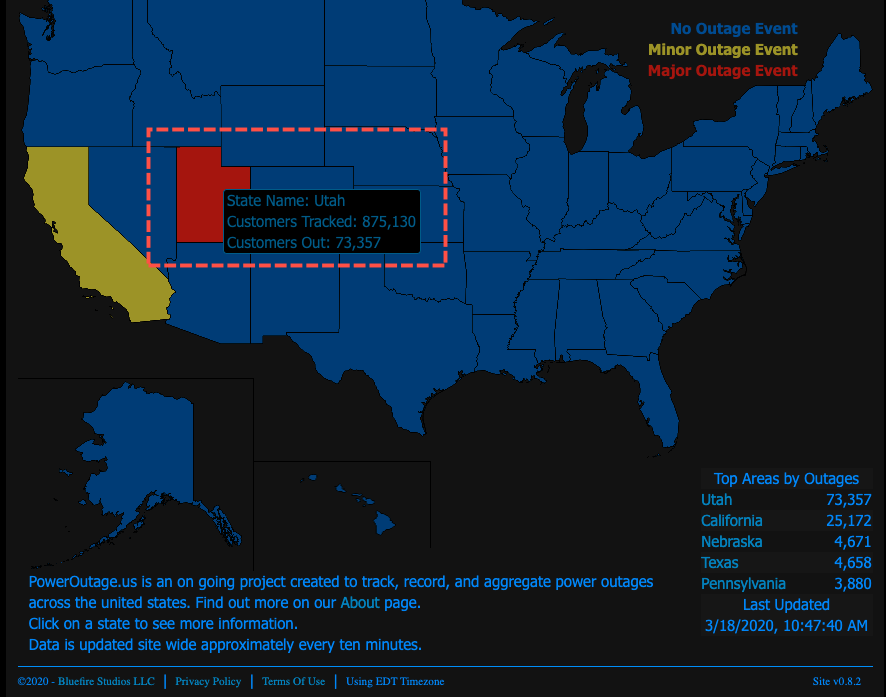
The quake comes as Utah residents are adjusting to Covid-19 shutdowns, including school cancelations, shorter business hours, and social gathering limits.
Bank of England offers unlimited QE for large company financing
New governor Andrew Bailey seeks to limit impact of coronavirus on economy
The new Bank of England governor, Andrew Bailey, said on Wednesday that the UK central bank was willing to pump unlimited quantities of money into the economy via its new commercial paper facility to help fight the effects of the coronavirus — and would go further if requested to by the government.
Speaking to journalists on a conference call from Threadneedle Street, Mr Bailey, who took over from Mark Carney at midnight on Monday, said the bank’s ambition was to ensure the virus had a “disruptive”, rather than “destructive”, impact on the economy.
He warned that the situation was serious but added that it was not yet time to shut financial markets because they had not lost their integrity and their ability to price. “I don’t think we’re there at all,” Mr Bailey said.
Sterling’s rapid descent to below $1.19 on Wednesday — a level it has not consistently traded at since the 1980s — was not something he could not explain easily, he admitted, but he said the Monetary Policy Committee would take it into account at its meeting next week.
The BoE governor was keen to clarify the details of the commercial paper facility, announced by Rishi Sunak, the chancellor, on Tuesday. He said that over the weekend it had become clear that large companies, as well as small ones, were running short of cash and needed facilities to borrow quickly and cheaply.
He said the commercial paper facility, in which the BoE would print money and use it to lend directly to large companies that issued new short-term bonds, would be up and running by the start of next week.
The BoE would be indemnified by the government for the risk of these loans and Mr Bailey said the facility was potentially unlimited in size. “We didn’t put a limit on it . . . we didn’t announce it was ‘X’ because the reason for that is we don’t know.”
By making it clear that companies can issue new commercial paper directly to the BoE and have it financed by newly issued sterling, the facility is in effect an unlimited form of quantitative easing.
This will potentially greatly increase the amount of excess reserves in the financial system and take pressure off banks to lend. The BoE was open to the idea of extending the facility to commercial paper backed by assets as well as companies, Mr Bailey added.
Saying the aim of the government and the BoE moves was to limit the damage to the economy, Mr Bailey said the central bank was not yet working from any reliable economic forecasts although its regional agents were seeing signs of financial stress across the country.
“Please don’t think we’re sitting on an economic forecast that tells you what is going to happen,” he said. “We’ve got all sorts of charts with ‘Vs’ on them” representing the economy, he added.
But he wanted to reassure people that the BoE would do whatever it took to keep markets operating effectively and would support the government when it undertook expensive measures to support the economy, businesses and households during the coronavirus outbreak.
He did not rule out creating money to finance government projects, something that is possible because the BoE is the government’s banker, but said the situation did not yet warrant such a move. “I don’t think at the moment we’re facing an inability of the government to fund itself,” he said.
Helicopter money, in which the central bank financed government spending directly, especially if it wanted to send cheques to every household, was a matter for the chancellor, he said.
With the BoE having used up most of its fuel it normally uses to fight an economic downturn, Mr Bailey said it was now looking to create more tools and the commercial paper facility was an example of that to increase the capacity of the central bank to act. “We have to look at the size of the tank,” he said.
Gapping down
In reaction to disappointing earnings/guidance:
- NIO -20.7%, MDB -14.4%, WH -10.1%, PGNY -10% (suspends guidance), BILI -7%, NUS -4.4%, FDX -3.8%, FUTU -3.2%, GIS -2.8%, GVA -2.5%, BZUN -1.1%
Select ETFs showing early weakness:
- XLY -6.6%, DIA -5.9%, XLE -5.9%, SPY -5.8%, XLF -5.8%, XLV -5.8%, QQQ -5.3%, XLK -5.3%, IWM -5.1%, XLI -5.1%, XLP -5.1%, XLU -4.7%, XLB -4.1%, IGV -3.1%
Other news:
- BA -15.7% (issues statement on support for aerospace manufacturers; supports a minimum of $60 bln in access to public and private liquidity, including loan guarantees, for the aerospace manufacturing industry)
- PLNT -15.2% (halting share repurchases for the time being)
- CRON -14.6% (to restate certain 2019 unaudited interim financial statements)
- MFGP -14.5% (suspends annual dividend)
- KTB -9.2% (to temporarily close retail locations across North America and Europe in response to COVID-19)
- ARWR -9% (announces precautionary measures to mitigate COVID-19 spread; to evaluate whether accommodations are necessary for trials)
- KSS -8.2% (discloses that it temporarily closed some retail locations, reduced store operating hours, and have seen a reduction in consumer traffic, all resulting in a negative impact to sales)
- SABR -7.9% (to suspend the payment of quarterly cash dividends and repurchase program)
- CPRI -7.4% (to temporarily close North American and European Versace, Jimmy Choo, and Michael Kors stores)
- EXK -6.9% (implements plans to minimize COVID-19 risks; initiates internal review of Terronera prefeasibility study)
- CNK -6.3% (to temporarily close its 345 U.S. theatres), GM -5.8% (UAW has asked the Big Three Detroit automakers to shut down production for two weeks)
- SDC -5.6% (comments on AADB Telehealth Directive)
- EVRI -5.4% (completed the full draw down of its $35.0 mln available capacity under its Credit Facility as precautionary measure to increase cash position, improve liquidity and preserve financial flexibility in light of current uncertainty) D -4.9% (files for $500 mln share common stock offering)
- F -4.6% (UAW has asked the Big Three Detroit automakers to shut down production for two weeks)
- SAFE -3.7% (announces offering of 900,000 shares)
- FORM -3.7% (withdraws Q1 guidance)
- ABBV -3% (co and AGN sign consent decree with FTC regarding pending acquisition)
- TGT -2.9% (to reduce store hours)
Analyst comments
- AMC -12.5% (downgraded to Sell from Buy at Citigroup; tgt lowered to $1)
- LEN -8.5% (downgraded to Neutral from Overweight at JP Morgan)
- AIMT -6.6% (downgraded to Mkt Perform from Mkt Outperform at JMP Securities)
- PHM -5.3% (downgraded to Neutral from Overweight at JP Morgan)
Gapping up
In reaction to strong earnings/guidance:
- XP +7.2%
Other news:
- IMV +79.3% (advances clinical development of a DPX-based vaccine candidate against COVID-19)
- VXRT +46.1% (entered into agreement with Emergent BioSolutions (EBS) for the development and manufacturing of oral coronavirus vaccine candidate)
- CANF +15.7% (confirming it is looking to partner on co-development of piclidenoson for coronavirus treatment ; will participate in the digital Bio-Europe Spring partnering conference from March 23 to 27, 2020)
- TGNA +12.7% (gets offer to be acquired and go private for $20/sh in cash)
- VXX +12.1% (trading higher with futures limit down)
- SAGE +7.6% (announces development plan for Zuranolone following FDA Breakthrough Therapy Guidance Meeting)
- VKTX +5.6% (authorizes $50 mln stock repurchase program)
- HOLX +4.9% (CEO says coronavirus test kits are being shipped out, with more to come)
- IDYA +4% (Pfizer and IDEAYA (IDYA) enter clinical trial collaboration and supply agreement to evaluate clinical combination of IDE196 and binimetinib in solid tumors harboring GNAQ or GNA11 hotspot mutations)
- NAT +1.9% ( to establish a share buy-back program)
- SPTN +1.1% (says it's seeing unprecedented sales volume since the onset of coronavirus)
Analyst comments:
- WUBA +1.1% (upgraded to Outperform from Neutral at Credit Suisse)
Early premarket gappers
- Gapping up:
- VXX +14%, ABR +12.9%, TGNA +10.1%, XP +7.2%, VKTX +2.8%, QGEN +0.6%, SPTN +0.6%
- Gapping down:
- BA -16.9%, CRON -13.9%, MDB -12.7%, BILI -8.7%, BVN -8.4%, XLK -7.1%, DIA -7%, FDX -7%, SPY -6.8%, IWM -6.8%, SDC -6.6%, XLF -6.6%, XLY -6.4%, QQQ -6.3%, XLE -5.9%, XLV -5.7%, XLU -5.2%, TGT -4.4%, XLI -4%, CNK -3.9%, FORM -3.7%, BZUN -3.7%, XLP -3.2%, IGV -3.1%, ABBV -2.9%, VECO -2.7%, GVA -2.5%, SAFE -2%, KEY -1.9%, XLB -1.8%
Former Uzbekistan leader’s daughter found guilty of graft
Gulnara Karimova sentenced to move than 13 years in prison for embezzlement and extortion
Gulnara Karimova, the convicted daughter of Uzbekistan’s former president, has been found guilty on new charges of embezzlement and extortion and sentenced to more than 13 years in prison.
Karimova, a powerful socialite and business tycoon during her father Islam Karimov’s 27-year-long dictatorship, fell from grace in the later years of his regime and was found guilty in 2015 of stealing as much as $1.6bn through tax evasion, embezzlement, and illegally appropriating state assets.
Last year, the US indicted Karimova for receiving more than $850m in bribes from three telecom companies seeking access to the country’s market and then laundering the money through the US financial system.
On Wednesday Uzbekistan’s supreme court said in a statement that the 47-year-old had been found guilty of fresh charges of “extortion, racketeering . . . . criminal activities and embezzlement”.
After a closed trial, Karimova was given a sentence of 13 years and four months. The prison term will be calculated from August 2015, when she was first found guilty. Five other people were also found guilty of acting in concert with her.
Karimova was described in a US diplomatic cable published by WikiLeaks as a “robber baron” and “greedy, power-hungry individual” whose corrupt appetites had made her “the most hated person in the country”.
A fashion designer and pop star who also served as Uzbekistan’s representative to the UN and ambassador to Spain, Karimova built a business empire that spanned many of the resource-rich country’s industries before she fell out of favour with her ageing father.
She became a lightning rod for popular anger in Uzbekistan, Central Asia’s most populous nation, over rampant corruption under Mr Karimov’s rule, which began before the collapse of the Soviet Union and ended upon his death.
Islam Karimov’s successor, Shavkat Mirziyoyev, has sought to use his presidency to open up Uzbekistan to the west and enact widespread reforms, including a crackdown on the use of child labour in the country’s vast cotton industry.
Karimova, who denied the charges, had requested Mr Mirziyoyev permit her release on ill-health grounds in exchange for her dropping attempts to contest the country’s efforts to recoup $686m worth of her assets frozen by Swiss authorities.