Data Shows Surge in February Online Orders
Anxious shoppers are purchasing quickly to ensure timely deliveries.
New research from Quantum Metric shows online orders have surged by 108 percent year-over-year in February.
As many consumers prepare to stay inside for an unknown period of time, stockpiling goods and panic-buying has led consumers to place more orders. Revenue growth rate peaked the week of Feb. 17 with order growth rate peaking the following week and a year-over-year conversion increase of 8.8 percent.
The report gives three reasons why consumers prefer online shopping at this time. The first being consumer sourcing when local stores are out of stock on items given delayed shipments from China. The second is a rise in consumer stockpiling and retailer options that allow “ship to you” to save shoppers from driving to different stores. Finally, the report notes many consumers may prefer online shopping as they make the decision to avoid busy public places.
However, while more orders are being placed, they are accompanied by smaller cart sizes, averaging an order value decrease of 31 percent.
And while the boxes might be lighter, there will be more deliveries to make for logistics companies. According to Quantum Metric, this behavior will put a strain on shipping and logistic companies, with UPS and FedEx feeling added pressure to deliver under uneasy conditions. The company notes that “shoppers are purchasing quickly to be sure that their items are in stock and can be delivered before further shutdowns prevent receiving their orders.”
While purchase rates did experience an increase, the company says this does not guarantee retailers a great quarter, though it could result in positive first quarter revenue impacts for select categories.
Quantum Metric’s data is based on the analysis of 5.5 billion anonymous and aggregated retailers online and mobile visits in the U.S. during the time between Jan. 1, 2019, and March 9, 2020.
Stunning Visualization Reveals Where Spring Break Covidiots Traveled After Flooding Florida Beaches
On Monday we reported how thousands of young Americans laughed off warnings to self-isolate and partied on Florida beaches anyway for spring break - with several now testing positive for COVID-19.
The poster child for these selfish 'covidiots' - who will statistically survive coronavirus - was a spring breaker from Ohio, Bradley Sluder - told CBS News: "If I get corona, I get corona. At the end of the day, I'm not gonna let it stop me from partying," adding "We're just out here having a good time. Whatever happens, happens."
“If I get corona, I get corona. At the end of the day, I'm not gonna let it stop me from partying”: Spring breakers are still flocking to Miami, despite coronavirus warnings. https://cbsn.ws/33sb67i


61.9K people are talking about this
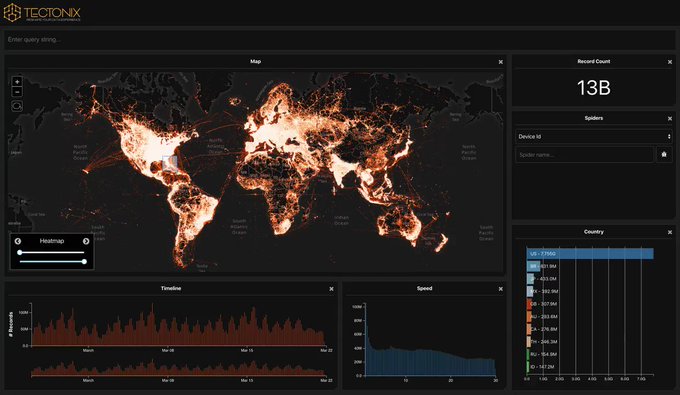
In case you were wondering how far these spring break 'covidiots' traveled for their ill-advised debauchery data visualization company Tectonix used cell phone location data collected by company X-Mode to map out the travels of thousands of spring breakers, using special geo-spatial big-data analysis software.
The data - provided by cell phone companies in near real-time, was anonymized.
Watch:

Amazing.

 @shaneriderMA
This kind of data is obviously incredibly useful and has a wide-range of applications. But while the data used is "anonymized," meaning it is not linked to the phone's owner, researchers have found that it is incredibly easy to link the two. https://techcrunch.com/2019/07/24/researchers-spotlight-the-lie-of-anonymous-data/ …

632 people are talking about this
Fed’s big boost for BlackRock raises eyebrows on Wall Street
New York asset manager is appointed by the central bank to run new easing programmes
On Tuesday, investors poured a record-breaking $1.5bn into an exchange traded fund run by BlackRock, a sum that represents about $2.3m of fees for the asset management giant. And it was all thanks to the Federal Reserve.
A day earlier, the US central bank had announced plans to buy bond ETFs for the first time ever through its New York arm, as part of an effort to ease stresses in the financial system caused by coronavirus. One programme will buy bonds directly when they are issued; another will purchase bonds on the secondary market and buy ETFs; and a third will purchase commercial mortgage-backed securities. All three programmes will be overseen by BlackRock.
The Fed has shared few details of the programme, and the scrutiny will probably prompt BlackRock to hold off from heavy buying of its own funds. But this week’s inflows into the ETF, as investors raced to front-run the central bank’s expected purchases, show how the Fed has already shaped markets to BlackRock’s benefit.
“It is truly outrageous,” said one asset management executive, who declined to speak on the record due to BlackRock’s influence on Wall Street. “BlackRock will be managing a fund and deciding if they want to use taxpayer money to purchase ETFs they manage. There’s probably another 100-200 managers who could do this, but BlackRock was chosen.”
A representative of the company’s Financial Markets Advisory business — a separate unit from the traditional asset management business — said it was “honoured” to have been selected to assist the New York Fed “during this extraordinary time”.
A similar role for the advisory unit in overseeing assets the US central bank acquired in the financial crisis yielded a net $12bn profit for taxpayers, the Fed said in 2018.
“I don’t know of any other firm that can handle this type of thing on short notice,” said John Morley, professor at Yale’s law school, where he focuses on finance. Even if BlackRock were not directly involved, he said, it would have worked with the Fed given the dominance of its ETFs.
“There are not a whole lot of organisations of BlackRock’s size, which gives it a level of expertise and experience in managing these kinds of programmes,” agreed Jill Fisch, a professor of law at the University of Pennsylvania.
Yet BlackRock’s dominance in the ETF market raises questions over conflicts of interest. The fund group’s $566bn in fixed-income ETFs represents about half the global total. The Fed’s buying will probably boost assets across the company’s ETFs, improve their liquidity and could even attract new classes of investor who take comfort that the Fed is there beside them.
For BlackRock, the appointment by the Fed reflects the return of founder Larry Fink to the role of consigliere that he played during the financial crisis a dozen years ago. Then, he spoke to Treasury secretary Hank Paulson more frequently than some chief executives of the big Wall Street banks. At the time BlackRock was a large, influential fund manager. Today, it is a behemoth.
The firm has trebled in assets since then, driven largely by Mr Fink’s 2009 decision to purchase Barclays’ investment management business. That included iShares, its prized ETF business that is now the crown jewel of BlackRock.
On Wednesday last week Mr Fink met Donald Trump at the White House and pressed the president on the gravity of the hour, according to several people familiar with the meeting. Within days the Fed had radically ramped up its crisis-fighting efforts, and the US government was shepherding a $2tn stimulus package through Congress.
The company’s consulting unit has served 250 clients — including central banks and government and regulatory entities — since its 2008 founding in the flames of the crisis. The FMA business has “a capability that certain clients need and there’s not many people in the universe that can provide that capability,” Rob Goldstein, BlackRock’s chief operating officer, said in an interview with the FT last month.
In the last decade, BlackRock has hired extensively from the types of public organisations it seeks to serve in the FMA unit. Philipp Hildebrand, the former head of the Swiss central bank, is BlackRock’s vice-chairman. Stanley Fischer, former vice-chairman of the Federal Reserve, and George Osborne, former UK chancellor of the exchequer, are senior advisers.
Barbara Novick, a BlackRock co-founder who last month announced her departure from the company, was for years its face in Washington. She helped BlackRock avoid the “systemically important” label after the financial crisis.
That decision by federal regulators today looks ironic, said Tyler Gellasch, executive director of Healthy Markets, a trade group. “In this time of crisis, the Fed is turning to BlackRock for help, in part because it is so significant.”
How bad could the US jobs market become?
It’s impossible to overstate how awful yesterday’s figures for last week’s initial jobless claims in the US were.
For reference, they made the weekly claims that occurred during the global financial crisis pale into insignificance, a mere blip:
While the scale surprised many people, we knew we would be in for a sharp shock of the sort not witnessed in modern times.
What also needs to be kept in mind is that however severe the short-term economic loss, the pandemic needs to be contained.
At the same time, with governments everywhere taking actions that curtail citizens’ liberty — including their right to work — people need to be properly compensated.
It was extremely helpful that Congress passed its $2tn stimulus programme the day before these figures came out. There will be a lot of people concerned about both their health and keeping a roof over their heads, and measures such as will ease the pressure somewhat. Our fear now is that the amount might prove insufficient if jobless claims continue to rack up at an alarming rate.
No one knows how the pandemic will develop. It is impossible to say whether it the caseloads will continue to shoot up, or if the warm weather will help contain it. Another uncertainty is whether we are in the midst not of a short, sharp economic slump but of a fundamental paradigm shift from which an entirely new global economic order will emerge.
All of which means we have no idea how bad will the labour market get. Economists have, however, looked into some of the parameters that could define the scale of the job losses. We’re going to focus on two here: by Morgan Stanley and the US Federal Reserve of St Louis.
Morgan Stanley’s forecast for this week’s jobless claims was, at 3.4m, almost spot on. So what do they expect in the coming weeks and months?
For the second quarter, they are predicting an unemployment rate of 12.8 per cent — the highest since modern records began in the 1940s. The job losses are expected to be in the sectors labelled in red:
Meanwhile, a self-described “back of the envelope” forecast from the St Louis Fed is even gloomier. In a note published earlier this week it said it expects unemployment to rise to 32.1 per cent, or 52.81m people, over the current quarter. That would mean a staggering 47.05m people losing their jobs over those three months.
How do it get to this figure? It’s based on two earlier pieces of research. One is a blog post by one of its economists, Charles Gascon. In the post, Gascon identifies 66.7m workers in what he terms “high risk occupations”:
The other paper is by economists Fernando Leibovici, Ana Maria Santacreu and Matthew Famiglietti, and focuses on the number of contact intensive occupations, finding a total of 27.3m jobs qualify:
The 47m figure is the average of the two estimates — that of 66.8m workers at risk, and that of 27.3m.
To add to the disastrousness of the situation, Gascon points out the most vulnerable also tend to be paid less. The average annual earnings of the low-risk occupations is $64,600, about 75 per cent higher than earnings in the high-risk occupations, at $36,600, he says.
All of these estimates come with a huge warning.
We are in uncertain times that make economic conditions even more difficult to predict than usual. The St Louis Fed acknowledges that the jobless count could come in at any point between a bad-but-manageable 10.5 per cent (a scenario using the lower estimate where high contact workers in education and healthcare hold on to their jobs) to a truly terrifying 40.6 per cent, if almost all of those Gascon’s deemed as high risk lose their job.
For better or worse, what is important right now is that government in the US and elsewhere readies preparations for even more help for the world’s workers.
Gapping down
In reaction to disappointing earnings/guidance:
- PRGS -8.2%, AFYA -4.3%, LULU -4.1%, HTHT -1%
Other news:
- AI -19.9% (provides update; will not declare Q1 common dividend)
- BGCP -19.3% (provides operational update in light of COVID-19; reduces dividend)
- CCL -10.7% (continued volatility in the space)
- RCL -8.6% (continued volatility in the space)
- NCLH -8.1% (continued volatility in the space)
- HTZ -6.1% (provides COVID-19 business update)
- VMW -5.3% (withdraws guidance)
- HLT -4.2% (suspends share buybacks and dividend payments)
- RDFN -4.2% (Chairman sends letter to shareholders re liquidity and current inventory)
- CAKE -3.3% (confirms it is not planning to pay rent on leases for the month of April 2020 at this time)
- UTX -3.1% (DOJ announces divestitures needed to allow merger with RTN)
- UAA -2.8% (provides COVID-19 financing update)
- GPS -2.7% (withdraws FY20 guidance, suspends dividend for remainder of FY20)
- GM -2.6% (informs employees of salary cuts/deferrals -- CNBC; also, Reuters report that co will extend a shutdown of its North American plants)
- DELL -2.5% (withdraws full year guidance)
- SAVE -1.4% (provides COVID-19 update; also identified a material weakness in internal controls)
- EQT -1% (suspends dividend)
Analyst comments:
- SIG -8.1% (downgraded to Underperform from Neutral at BofA/Merrill)
- HTZ -6.1% (downgraded to Underweight from Equal Weight at Consumer Edge Research)
- HAL -5% (downgraded to Neutral from Overweight at Piper Sandler)
- CAT -4.7% (downgraded to Neutral from Buy at BofA/Merrill)
- JPM -3.8% (downgraded to Neutral from Buy at BofA/Merrill)
- UAA -3% (downgraded to Hold from Buy at Stifel)
- CAR -2.2% (downgraded to Equal Weight from Overweight at Consumer Edge Research)
- DGX -2.1% (downgraded to Equal-Weight from Overweight at Morgan Stanley)
- SLB -1.8% (downgraded to Neutral from Overweight at Piper Sandler)
- I -1.6% (downgraded to Market Perform from Outperform at Cowen)
- UPS -1.5% (downgraded to Hold from Buy at Berenberg)