Goldman Sachs betrays bitcoin
Remember when Goldman Sachs ❤️d bitcoin?
Back in the heady days of 2017 and 2018, the investment bank was so excited about this potential new asset class that it was said to be considering launching a bitcoin trading desk, a huge step in the direction of “mainstream adoption”.
The bank’s analysts would put out notes predicting all-time highs for bitcoin based on exciting bits of technical analysis, while former executives seemed to be leaving Wall Street in droves to pursue illustrious careers in crypto.
In early 2018 (peak mania), Goldman was said to have “caved” on bitcoin, putting out a nine-page report entitled “Bitcoin as Money”. Could bitcoin succeed as a form of money? "In theory, yes," the bank’s economists wrote.
But then in August 2018, with the price of cryptocurrencies having collapsed, it seemed the party was already over. Sharmin Mossavar-Rahmani, the chief investment officer of the bank’s private wealth management group, said declines would likely continue, and that she didn’t reckon bitcoin fulfilled any of the traditional roles of money.
You can only imagine bitcoiners’ excitement and bullish hopes, therefore, when they discovered the bank was due to hold an investor call on bitcoin on Wednesday, mid global pandemic and economic collapse – the kind of event that, if anything can, justifies bitcoin’s existence.
This was Coin Telegraph, a relatively mainstream crypto site, just four days ago (emphasis ours):
Goldman Sachs will host a conference call on May 27 titled US Economic Outlook & Implications of Current Policies for Inflation, Gold, and Bitcoin...
The news has been heralded as a milestone for the institutional adoption of crypto assets, appearing to signify a complete u-turn on the part of Goldman’s Mossovar-Rhami (sic) — who stated that cryptocurrencies fail as mediums of exchange, stores of value, and units of measurement, in August 2018.
But alas, it seems the milestone in institutional adoption was not a milestone in the direction that the bitcoiners’ wanted.
On Wednesday, slides from the call showed Goldman sticking the knife in, and twisting it. They listed five reasons that “Cryptocurrencies Including Bitcoin Are Not an Asset Class”:
Do Not Generate Cash Flow Like Bonds
Do Not Generate any Earnings Through Exposure to Global Economic Growth
Do Not Provide Consistent Diversification Benefits Given Their Unstable Correlations
Do Not Dampen Volatility Given Historical Volatility of 76% – On March 12, 2020, the price of Bitcoin fell 37% in one day
Do Not Show Evidence of Hedging Inflation
Before concluding:
We believe that a security whose appreciation is primarily dependent on whether someone else is willing to pay a higher price for it is not a suitable investment for our clients.
(And adding, for good measure, that cryptocurrencies “abet illicit activities such as Ponzi schemes, ransomware, money laundering, and darknet markets”.)
Suffice to say, the bitcoiners were not happy.
Coin Telegraph, so upbeat on Goldman just a few days ago, went with “‘What Are You Smoking?’ Winklevoss Pans Goldman Sachs Bitcoin Bashing” for their headline, declaring that “tired claims that Bitcoin and cryptocurrencies are not an asset class say more about Goldman Sachs and the banking system itself” and fuming about Goldman “wheel(ing) out legacy Bitcoin complaints”.
So much legacy systems. So much boring bankers. Lock ‘em all up, we say. Who wants institutional adoption anyway? (When’s the JP Morgan crypto investor call, anyone?)
Back in the heady days of 2017 and 2018, the investment bank was so excited about this potential new asset class that it was said to be considering launching a bitcoin trading desk, a huge step in the direction of “mainstream adoption”.
The bank’s analysts would put out notes predicting all-time highs for bitcoin based on exciting bits of technical analysis, while former executives seemed to be leaving Wall Street in droves to pursue illustrious careers in crypto.
In early 2018 (peak mania), Goldman was said to have “caved” on bitcoin, putting out a nine-page report entitled “Bitcoin as Money”. Could bitcoin succeed as a form of money? "In theory, yes," the bank’s economists wrote.
But then in August 2018, with the price of cryptocurrencies having collapsed, it seemed the party was already over. Sharmin Mossavar-Rahmani, the chief investment officer of the bank’s private wealth management group, said declines would likely continue, and that she didn’t reckon bitcoin fulfilled any of the traditional roles of money.
You can only imagine bitcoiners’ excitement and bullish hopes, therefore, when they discovered the bank was due to hold an investor call on bitcoin on Wednesday, mid global pandemic and economic collapse – the kind of event that, if anything can, justifies bitcoin’s existence.
This was Coin Telegraph, a relatively mainstream crypto site, just four days ago (emphasis ours):
Goldman Sachs will host a conference call on May 27 titled US Economic Outlook & Implications of Current Policies for Inflation, Gold, and Bitcoin...
The news has been heralded as a milestone for the institutional adoption of crypto assets, appearing to signify a complete u-turn on the part of Goldman’s Mossovar-Rhami (sic) — who stated that cryptocurrencies fail as mediums of exchange, stores of value, and units of measurement, in August 2018.
But alas, it seems the milestone in institutional adoption was not a milestone in the direction that the bitcoiners’ wanted.
On Wednesday, slides from the call showed Goldman sticking the knife in, and twisting it. They listed five reasons that “Cryptocurrencies Including Bitcoin Are Not an Asset Class”:
Do Not Generate Cash Flow Like Bonds
Do Not Generate any Earnings Through Exposure to Global Economic Growth
Do Not Provide Consistent Diversification Benefits Given Their Unstable Correlations
Do Not Dampen Volatility Given Historical Volatility of 76% – On March 12, 2020, the price of Bitcoin fell 37% in one day
Do Not Show Evidence of Hedging Inflation
Before concluding:
We believe that a security whose appreciation is primarily dependent on whether someone else is willing to pay a higher price for it is not a suitable investment for our clients.
(And adding, for good measure, that cryptocurrencies “abet illicit activities such as Ponzi schemes, ransomware, money laundering, and darknet markets”.)
Suffice to say, the bitcoiners were not happy.
Coin Telegraph, so upbeat on Goldman just a few days ago, went with “‘What Are You Smoking?’ Winklevoss Pans Goldman Sachs Bitcoin Bashing” for their headline, declaring that “tired claims that Bitcoin and cryptocurrencies are not an asset class say more about Goldman Sachs and the banking system itself” and fuming about Goldman “wheel(ing) out legacy Bitcoin complaints”.
So much legacy systems. So much boring bankers. Lock ‘em all up, we say. Who wants institutional adoption anyway? (When’s the JP Morgan crypto investor call, anyone?)
Asian stocks dropped Friday along with U.S. and European futures, and the yen and Treasuries climbed, ahead of President Donald Trump’s planned press conference to announce fresh steps on China. The dollar retreated.
China’s offshore yuan continued to stabilize after matching a record low earlier this week, and Shanghai stocks were little changed. U.S. contracts and Japanese and Korean equities saw modest drops. Oil dipped. Deteriorating Sino-American ties, stoked by antagonism over the cause of the coronavirus and now China’s imposition of a national-security law on Hong Kong, have cast a cloud over a global stock rally spurred by reopening economies.
US After Hours ZS +18.2%, VMW +8.6%, DELL +7.5%, MRVL +5.8% up nicely on earnings; CRM -3.4%, OKTA -2%, COST -1.9% lower on earnings
Nikkei +0.06% Hang Seng -0.36% CSI +0.19% Shanghai +0.15% Shenzen +0.90%
Eur$ 1.1104 CNH 7.1658 CNY 7.1472 JPY 107.09 GBP 1.2350 CHF 0.9628 RUB 70.45 WTI$ 33.26 -1.23%
S&P -0.23% NAsdaq -0.20% EuroStoxx -0.97% FTSE -0.66% Dax -1.08% SMI -0.82%
Macro :
- Europe May Have to Hit U.S. With Tariffs to Settle Aircraft Row
- Merkel Cancels Meeting With Carmakers Amid Dispute Over Subsidy
- U.K. May Have Given Up on Brexit Deal, EU’s Trade Chief Says
- U.S. Stocks Expensive Any Way You Cut It, Says Oxford Economics
Keep an eye on :
- ADP FP : ADP Says Commercial Flights to Resume at Paris Orly on June 26
- AF FP : Air France-KLM Resumes Italy Flights as France Relaxes Lockdown
- ATRS AV : Atrium European Real Estate Proposes Scrip Dividend Program
- BALDB SS : Balder Says Two Executives Detained on Alleged Insider Crime
- BMW GY : Germany Postpones Decision on Cash-for-Clunkers Car Buying
- SKIN SW : Cassiopea Announces EU23.25m Capital Increase
- CTY1S FH : Citycon Cuts Payout to Boost Financial Stability
- CSGN SW : Big Banks Must Face Forex Manipulation Claims, U.S. Judge Rules
- DAI GY : Germany Postpones Decision on Cash-for-Clunkers Car Buying
- DBK GY : Deutsche Bank Outlook to Negative by Fitch
-EDPR PL : EDP Renovaveis Gets 20-Year Contract at Italian Wind Auction
- EL FP : Essilorluxottica: Successful EU3 Billion Bond Issuance
- CAP GY : Encavis Offering by Holder Prices 2.95m Shares
- ENX FP : Euronext to End U.K. Regulatory Activities by End-June
- FXPO LN : Ferrexpo Chairman Lucas Stands Down After Governance Headaches
- FLTR LN : Flutter Plans $1 Billion Placing as Fox Corp Boosts Investment
- GSC1 GY : Gesco First Quarter Net Income EU0.39 Mln, -90% Y/y
- GMAB DC : Genmab Reports Positive Topline Results in Andromeda Study
- LTG LN : Learning Tech to Offer 64.4m Shrs
- MEKO SS : Mekonomen First Quarter Ebit SEK59 Mln, -65% Y/y
- KN FP : Blackstone Dumps H2O as Adviser to $6 Billion Multistrategy Fund
- NEXT NO : Next Biometrics Offering Prices 25m Shares at NOK2/Share
- NMC LN : *NMC HEALTH PLC FILES FOR U.S. CHAPTER 15 BANKRUPTCY IN DELAWARE
- OBEL BB : Orange Belgium to Absorb Subsidiaries Walcom and Walcom Liège
- 1913 HK : Prada’s Bertelli Says China Sales Up More Than 10% --> +3.6%
- REIN LX : Reinet Investments Full Year Net Asset Value Per Share EU23.89
- RNO FP : Renault to Cut 14,600 Jobs Worldwide in Race to Slash Auto Costs
- RR/ LN : Rolls-Royce Cut to Junk by S&P
- SAF FP : Safran April Revenue Falls Around 50% as Virus Impact Worsens
- SAN FP : Sanofi Names New Heads for Consumer Healthcare, Sanofi Pasteur
- SAP GY : Salesforce Cuts Sales Guidance
- SEBA SS : SEB Proposes No Dividend for 2019; May Revisit Decision Later
- SEM PL : Semapa First Quarter Net Income EU17.2 Mln, -57% Y/y
- SHB LN : Capco Confirms Talks for Purchase of 26.3% Stake in Shaftesbury
- SHI LN : SIG Close to Securing Major Investment from CD&R: Sky News
- FP FP : Total Can Fund Payout, Investment at $35-$40/Bbl: Revenu
- UBSG SW : Big Banks Must Face Forex Manipulation Claims, U.S. Judge Rules
- UPS US : UPS Has 72 Workers Test Positive for Coronavirus at German Hub
- VOW3 GY : Germany Postpones Decision on Cash-for-Clunkers Car Buying
- VOW3 GY : VW Buys Stake in Chinese Battery Supplier to Aid E-Car Rollout
- WGF1 GY : Mark Kleinman: Exclusive: The owner of the Williams F1 team is said to be preparing to launch a strategic review that could lead
>>> Up
* Direct Line Raised to Overweight at Barclays; PT 347 pence
* Hella Raised to Equal-Weight at Morgan Stanley; PT 37 euros
* Provident Raised to Buy at Jefferies; PT 250 pence
* Sartorius PT Raised to 360 euros at Bankhaus Metzler
* Valeo Raised to Overweight at Morgan Stanley; PT 24 euros
>>> Down
* Admiral Cut to Equal-Weight at Barclays; PT 2,304 pence
* BP Cut to Hold at SocGen
* Continental AG Cut to Equal-Weight at Morgan Stanley
* Diageo ADRs Cut to Underperform at Jefferies; PT $109
* Elior Group Cut to Hold at SocGen; PT 7 euros
* Encavis Cut to Hold at Jefferies; PT 13.50 euros
* Eni Cut to Hold at SocGen; PT 9 euros
* Equinor Cut to Hold at SocGen
* Hugo Boss Cut to Hold at Jefferies; PT 27 euros
* Rational Cut to Hold at HSBC; PT 497 euros
* Rosenbauer Cut to Reduce at Baader Helvea; PT 30 euros
* Spirax Cut to Hold at Peel Hunt
* Straumann Cut to Underweight at Morgan Stanley
* Swiss Prime Cut to Reduce at Baader Helvea; PT 88 Swiss francs
* Temenos Cut to Neutral at JPMorgan; PT 140 Swiss francs
* TBC Bank Group Cut to Add at Peel Hunt
* Trainline Cut to Neutral at JPMorgan; PT 517 pence
>>> Initiation
* Ahold Delhaize Reinstated Outperform at Wolfe; PT 25 euros
* Mol Reinstated Neutral at Citi; PT 2,240 forint
* Synthomer Resumed Equal-Weight at Morgan Stanley; PT 350 pence
>>> Call
* European Payments Outlook May Be Better Than Feared: Jefferies
* Choose ‘Green Recovery’ Beneficiaries in Auto Suppliers, MS Says
* Provident’s Target Market to Increase Amid Recession: Jefferies
* Straumann Double-Downgraded on Slow Recovery: Morgan Stanley
After Hours Summary: ZS +18.2%, VMW +8.6%, DELL +7.5%, MRVL +5.8% up nicely on earnings; CRM -3.4%, OKTA -2%, COST -1.9% lower on earningsAfter Hours Gainers:
Companies trading higher in after hours in reaction to earnings/guidance: ZS +18.2% (also acquires Edgewise Networks), WSM +10.1%, VMW +8.6%, GLUU +8.3%, DELL +7.5%, MRVL +5.8%, PAGS +5.1%, OLLI +2.8%, PSTG +2.1%
Companies trading higher in after hours in reaction to news: KPTI +7.7% (reports results from the pivotal, Phase 3 BOSTON study ), AZN +5.3% (announces positive Phase III ADAURA trial results), LGND +3.1% (earns $3 mln milestone payment from Palvella Therapeutics), ALCO +1.7% (Florida has option to purchase 10,684 acres), CGNX +1.2% (announces workforce reduction), APY +1.2% (shareholders approve combo with ChampionX), LOW +1.1% (maintains quarterly dividend), CSCO +0.4% (to acquire privately held ThousandEyes)
After Hours Losers:
Companies trading lower in after hours in reaction to earnings/guidance: CRM -3.4% (also announces multi-year strategic agreement with AT&T), TCOM -3.1%, VEEV -2.5%, OKTA -2% (also announces new integration with Amazon Web Svcs; also announces FedEx has implemented the Okta Identity Cloud), COST -1.9%, DXC -1.5%, ULTA -0.4%, JWN -0.2%
Companies trading lower in after hours in reaction to news: MRNS -8.2% (stock offering), NFG -4.7% (commences 3.25 mln common stock offering), APPN -2.4% (launches 2.5 mln share offering), LADR -2.3% (cuts dividend by 41%), ADVM -1.6% (initiates INFINITY Phase 2 trial)
Closing Stock Market SummaryU.S. stocks trimmed weekly gains on Thursday, as headline uncertainty related to China caused the major indices to falter into the close. The S&P 500 (-0.2%), Dow Jones Industrial Average (-0.6%), and Nasdaq Composite (-0.5%) finished slightly lower. The Russell 2000, which traded lower for most of the session, declined 2.5%.
The market started the session little changed, catching its breath after a strong two-day rally, but also after China approved legislation to tighten its control over Hong Kong, weekly initial jobless claims totaled 2.123 million (Briefing.com consensus 1.950 million), and Q1 GDP was revised down to -5.0% ( consensus -4.8%) from -4.8% in the advance estimate.
Investors, at first, didn't feel inclined to sell given the fear of missing out on further gains amid growing signs of an economic recovery. Buyers, instead, concentrated their efforts toward the defensive-oriented segments of the market, such as the leading S&P 500 utilities (+3.0%), health care (+1.3%), and real estate (+1.2%) sectors.
Sellers later took control after President Trump said late in the session that he will hold a press event about China on Friday. Reports indicated that the president could unveil sanctions on Chinese officials in response to the Hong Kong national security law, threatening to exacerbate U.S.-China tensions.
The S&P 500 energy (-2.9%) and financials (-1.6%) sectors accelerated intraday losses following the headline negativity, while the consumer discretionary (-1.1%), industrials (-1.0%), and communication services (-1.0%) sectors fell into negative territory.
Shares of Facebook (FB 225.46, -3.68, -1.6%) and Twitter (TWTR 31.60, -1.47, -4.5%), meanwhile, were pressured by President Trump's executive-order plans to limit legal protections for social media companies that unfairly stifle free speech.
Separately, Workday (WDAY 182.56, +12.18, +7.2%) and Dollar Tree (DLTR 97.64, +10.11, +11.6%) stood out after pleasing investors with their earnings reports, while HP Inc. (HPQ 15.01, -2.11, -12.3%) disappointed investors with its results.
U.S. Treasuries ended the session mixed. The 2-yr yield was unchanged at 0.17%, while the 10-yr yield increased three basis points to 0.71%. The U.S. Dollar Index declined 0.6% to 98.50. WTI crude futures rose 2.7%, or $0.89, to $33.68/bbl.
Reviewing Thursday's batch of economic data:
- Initial claims for the week ending May 23 decreased by 323,000 to 2.123 million (consensus 1.950 million). Continuing claims for the week ending May 16 decreased by 3,860,000 to 21.052 million.
- The key takeaway from the report will be the downturn in continuing claims, which will feed into the market's upbeat view about reopening prospects.
- New orders for durable goods declined 17.2% m/m in April (consensus -17.0%) following a downwardly revised 16.6% decline (from -14.4%) in March. Excluding transportation, new orders for durable goods declined 7.4% m/m (consensus -8.4%) following a downwardly revised 1.7% decline (from -0.2%) in March.
- The key takeaway from the report is that it wasn't much of a surprise as activity in April seized up with the shutdown measures employed to contain the spread of the coronavirus.
- The second estimate for Q1 GDP showed a downward revision to -5.0% (consensus -4.8%) from the 4.8% decline seen in the advance estimate. The GDP Price Deflator was revised up to 1.4% (consensus 1.3%) from 1.3%.
- The key takeaway from the report is that it's old news for a market that is clearly locked on the idea that economic activity is going to be rebounding in coming months.
- Pending Home Sales dropped 21.8% in April (consensus -4.8%) after declining an unrevised 20.8% in March.
Looking ahead to Friday, investors will receive the Personal Income and Spending report for April, the revised University of Michigan Index of Consumer Sentiment for May, the Chicago PMI for May, and the Advance International Trade in Goods, Retail Inventories, and Wholesale Goods reports for April.
- Nasdaq Composite +4.4% YTD
- S&P 500 -6.2% YTD
- Dow Jones Industrial Average -11.0% YTD
- Russell 2000 -16.1% YTD
Trump Signs Executive Order Targeting Social Media
Measure would seek to limit the broad legal protection that federal law currently provides online platforms
*Trump Signs Executive Order Targeting Social-Media Companies
*Executive Order Will Seek to Limit Broad Liability Protections Provided to Social-Media Companies Under Federal Law
*Order Comes After Twitter Fact-Checked Trump Tweets on Tuesday
WASHINGTON—An executive order President Trump is expected to sign on Thursday would seek to limit the broad legal protection that federal law currently provides to social-media and other online platforms, according to a draft.
As drafted, the order would make it easier for federal regulators to hold companies such as Twitter Inc. and Facebook Inc. liable for unfairly curbing users’ speech, for example, by suspending their accounts or deleting their posts.
The draft, which has been viewed by The Wall Street Journal, isn’t yet finalized and is subject to change, people familiar with the administration’s deliberations said. It comes after Twitter on Tuesday moved for the first time to apply a fact-checking notice to tweets by the president on the subject of voter fraud. Mr. Trump in a tweet on Tuesday accused the company of “stifling FREE SPEECH” and vowed to take action. The president on Thursday again attacked Twitter over its fact-checking of his tweets, calling the move “so ridiculous.”
The executive order would mark the Trump administration’s most aggressive effort to take action against social-media companies, something the president has threatened to do for years to counteract what he and many conservatives see as a systemic bias against their political positions.
The order would likely be challenged in court, experts said, on grounds that it oversteps the government’s authority in restricting the platforms’ legal protections, which federal courts have interpreted broadly. It also could be challenged on grounds that it violates their First Amendment protections.
The White House declined to comment.
Facebook Chief Executive Mark Zuckerberg, in a CNBC interview aired Thursday, backed his stance of largely not interfering with politicians’ posts on the company’s platform.
“I don’t think Facebook or internet platforms in general should be arbiters of truth,” Mr. Zuckerberg said. “I think that’s kind of a dangerous line to get to in terms of deciding what is true and what isn’t.”
Other tech-industry officials criticized the president’s plan. “All Americans should be concerned to find a U.S. president issuing executive orders in response to a company that challenges the veracity of his statements,” said Matt Schruers, president of the Computer & Communications Industry Association.
Jon Berroya, the interim president of the Internet Association, another industry group, said: “Claims of so-called viewpoint bias rely on isolated anecdotes that are undermined by the fact that politicians and political groups successfully use social media to reach millions of followers every day.”
The White House order as drafted would seek to reshape the way federal regulators view Twitter and other social-media companies—not as hosts of speech but as gatekeepers that control millions of Americans’ daily experiences on their platforms.
“In a country that has long cherished the freedom of expression, we cannot allow a limited number of online platforms to hand-pick the speech that Americans may access and convey online,” the draft order says. “When large, powerful social media companies censor opinions with which they disagree, they exercise a dangerous power.”
The draft order also lays groundwork for treating the platforms as places where individuals’ First Amendment rights should be protected, terming them “a 21st-century equivalent of the public square.”
The draft order is far-reaching in scope, setting up multiple ways for the government to attack what the administration views as the problem of online censorship.
The most important way is by seeking to scale back the sweeping legal protections that Washington established for online platforms in the 1990s, in the internet’s early days. Those protections were created by Congress in Section 230 of the 1996 Communications Decency Act. That law gives online companies broad immunity from liability for their users’ actions, as well as wide latitude to police content on their sites.
If President Trump doesn’t like Twitter, he can do everyone a favor and stop tweeting.
— Sen. Charles Schumer
Critics across the political spectrum have argued that the law now provides the tech giants too much power, while the platforms argue that it is essential to the internet’s functioning.
In essence, the White House draft order would assert that tech companies should lose their Section 230 protection if they take action to discriminate against users or limit their access to a platform without providing a fair hearing, or in ways that aren’t spelled out in the platform’s terms of service.
The order would direct the Commerce Department to petition the Federal Communications Commission to set up a rule-making proceeding to clarify the scope of Section 230. A key focus of that proceeding would be to determine when platforms have failed to live up to their obligations to act in “good faith” under the law when they police content.
Some experts say the FCC has no legal authority to enforce Section 230.
Federal regulators, including the Federal Trade Commission, also could begin to look into complaints of online bias once the executive order is promulgated. A reporting tool the administration set up earlier collected more than 16,000 complaints in a matter of weeks, the draft order says. The FTC, for example, could begin to take enforcement action against companies that limit users’ speech in a manner that isn’t fully disclosed in their terms of service, or is contrary to the platforms’ public claims, on grounds that that constitutes an unfair or deceptive trade practice.
The Justice Department also would convene a working group of state attorneys general to look into complaints under the order, and federal agencies would be directed to review their advertising contracts with companies that engage in speech censorship.
Given the legal and regulatory challenges involved, it would likely be months before any actions proposed in the draft executive order would take effect on social-media platforms. For now, the initiative casts Mr. Trump as fighting for the rights of his base against a tech-industry establishment that his supporters widely view as biased in favor of liberal positions.
Trump administration officials have been discussing the executive order in various forms since 2018, as the president grew increasingly frustrated with tech companies, people familiar with the discussions said. In recent weeks, those discussions have picked up again. In mid-May, Mr. Trump tweeted that the “Radical Left” was in “total command & control” of Facebook, Instagram, Twitter and Google and said the administration was “working to remedy this illegal situation.”
Senate Democratic Leader Chuck Schumer of New York said in a tweet on Thursday: “If President Trump doesn’t like Twitter, he can do everyone a favor and stop tweeting.”
Yuan, Stocks Slammed After Trump Confirms China News Conference
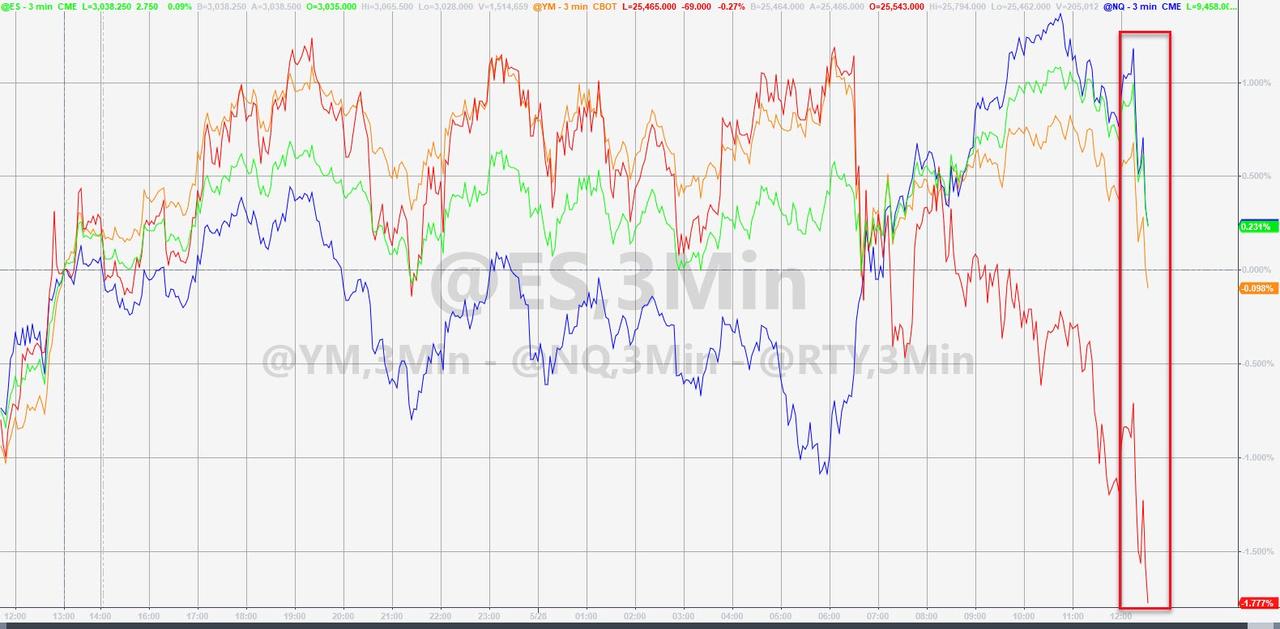
US equity markets legged lower after President Trump confirmed that he will hold a news conference tomorrow on China.
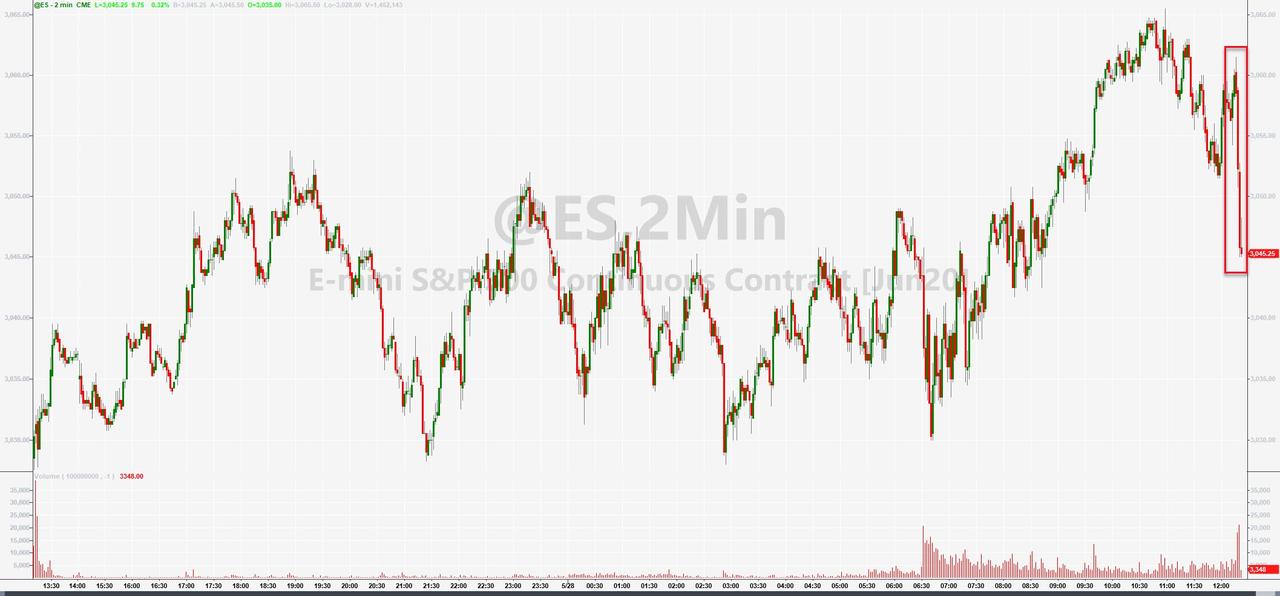
And pushing The Dow into the red on the day...
Yuan also dropped on the headlines...
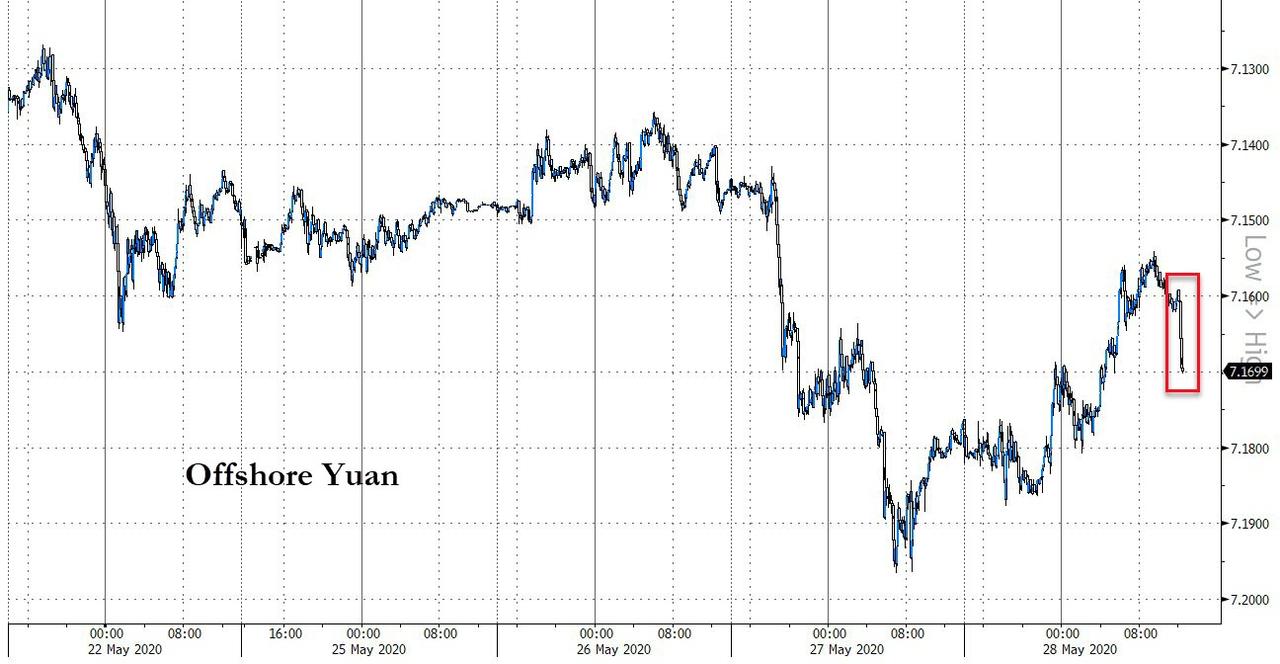
No details were revealed but it's pretty clear he's not going to walk back any of the recent rhetoric over the "China virus", the human rights abuses of Uighurs, or the implicit political invasion of Hong Kong...