Daily Beast : Florida’s Seen a ‘Statistically Significant’ Uptick in Pneumonia D

Florida’s Seen a ‘Statistically Significant’ Uptick in Pneumonia Deaths. The CDC Says It’s Likely COVID.

UNDERLYING CAUSES
There’s a conspiracy theory brewing on the left that Gov. DeSantis is cooking the books. Instead, it’s very likely due to lack of testing.

Since the beginning of this year, Florida has experienced an uptick in the number of pneumonia and influenza deaths, according to data from the Centers for Disease and Control. Experts and Trump administration officials responsible for keeping tabs on mortality rates across the country believe that many of those individuals had likely contracted and died from COVID-19.
According to the data from the CDC’s National Center for Health Statistics, since the beginning of the year there has been a total of 1,519 deaths in Florida where pneumonia and influenza were listed as the underlying cause. By comparison, in the same time period last year, Florida recorded 1,207 such deaths. The CDC has historically counted pneumonia and influenza deaths together. CDC officials told The Daily Beast that most of the deaths included in that category are pneumonia.
Bob Anderson, the chief of the Mortality Statistics Branch in CDC’s National Center for Health Statistics, told The Daily Beast that the increase of deaths in Florida where pneumonia and influenza were the underlying cause was “statistically significant” and that those mortalities were “probably COVID cases that weren’t reported as such.” The coronavirus can cause lung complications such as pneumonia.
The increase has sparked a conspiracy theory on the left, that Florida is deliberately trying to undercount coronavirus fatalities by labeling them as something else. There’s no evidence to suggest any such underhand efforts, or that the state is unique across the country. But officials, including Anderson, do believe that a portion of the pneumonia and influenza deaths in Florida involved patients who were infected with, but never tested for, COVID-19. In such scenarios, though the virus likely contributed to the death, it may not have been recorded as the cause of death by the physician, coroner or medical examiner.
“We’re definitely experiencing an underreporting issue nationwide,” Anderson said, pointing to the CDC’s study of “excess deaths” during the coronavirus. “[In Florida] most likely what we’re seeing are folks dying without having been tested and the best evidence that the doctors or whoever is filling out the death certificate had pointed to the person dying of pneumonia.”
Anderson added that the numbers currently reflected on the CDC’s website for pneumonia and influenza deaths for 2020 are lower than reality because the death certificate reporting system lags by several weeks, especially in states that do not have digitized systems to process the papers.
Though other states are experiencing a similar phenomenon, there has been notable scrutiny placed on Florida, due to Gov. Ron DeSantis’ (R) handling of the coronavirus response and his decision to move to quickly reopen the state. DeSantis allowed some Florida beaches to reopen in the middle of April, even as the number of coronavirus cases and related deaths continued to rise across the state. The governor has since criticized members of the press for rushing to warn that Florida would experience a spike in COVID-19 cases, and calling his actions cavalier. Conservative and Trump supportive commentators have pointed to the absence of a notable uptick as evidence that fears of a hasty reopening were overblown.
DeSantis’ office did not return a request for comment. But the actual story, like much related to the pandemic, appears to be more complicated. And it underscores how much of the public’s understanding of, and opinions about, the pandemic are affected by bureaucratic decisions and accounting formulas related to categorizing fatalities.
As The Daily Beast previously reported, President Trump and members of his coronavirus task force have pressed the CDC to change how the agency works with states to count coronavirus-related deaths, arguing for revisions that could lead to far fewer deaths being attributed to the disease. The administration has also moved to allow nursing homes the ability to only report coronavirus deaths that occurred after May 6—well after facilities across the country experienced a massive uptick in coronavirus-related deaths.
States, as well, have different methods of collecting relevant data and calculating COVID-19 death counts and that, in turn, has sowed speculation about political motivations. On that front, few governors have been as closely watched as DeSantis. Part of that is because of his close relationship with the president. Part of that is because of decisions he has made. Earlier this month the DeSantis administration fired Rebekah Jones, the data manager for the Florida Department of Health who worked on the state’s coronavirus online dashboard. In a statement posted to her website, Jones said she was removed from her position because she pushed back when officials in the health department asked her to “manipulate and delete data in late April as work for the state’s reopening plan started to take off.” The DeSantis administration has since said Jones was fired for insubordination.
With Florida already under a national microscope, news of the state’s pneumonia fatalities circulated on social media this week as liberals accused DeSantis and members of his administration of manipulating data and deliberately downplaying the number of coronavirus deaths. Howard Dean, the former Democrat governor from Vermont, commented on Florida’s statistics Thursday, going so far as to accuse Florida of “cooking the books on COVID-19 deaths.” Andy Slavitt, the former Acting Administrator of the Centers for Medicare and Medicaid Services, said while Florida appears to have the coronavirus under control, it was experiencing an “unprecedented ‘pneumonia’ crisis.”
But Anderson said it is unlikely that a physician with a patient who tested positive for the coronavirus would have marked anything other than COVID-19 as the underlying cause on the death certificate. If individuals die, for example, in their homes or in nursing facilities without having been tested, a medical examiner or coroner could hypothetically mark the individual as having died of pneumonia. That scenario would have likely played out in the early days of the coronavirus outbreak when testing was difficult to access and when physicians were still learning how the coronavirus presented itself, Anderson said. According to a report by the Miami Herald, officials inside the DeSantis administration kept the Florida public in the dark in February for about two weeks as they scrambled to come up with a plan on how to respond to the state’s outbreak.

A similar phenomenon took place in Flint after a switch in water supply exposed thousands of people to lead poisoning and caused one of the largest outbreaks of Legionnaires’ disease in U.S. history. Last year, a team of reporters at PBS Frontline found that there may have been about 70 more deaths from Legionnaires’ during the outbreak than the 12 that were officially recorded. But because the government was not forthcoming about the crisis, doctors were not alerted to it and therefore did not know to look or test for the disease. Many people who died of Legionnaires’ disease were originally reported as having died from other causes, such as pneumonia.
Currently, health officials and statisticians are researching how many of the states’ “excess deaths” over the last several months should be attributed to the coronavirus. One study by the New York City Department of Health and Mental Hygiene published earlier this month said that there were thousands of “excess deaths” in the city from March 11 to May 2. About 18,879 of those deaths were explicitly tied to the coronavirus. But the study said there were also an additional 5,200 deaths that were not identified as either laboratory-confirmed or probable COVID-19-associated cases, but could have been tied to the virus in some other way.
At the CDC, officials found 1,500 individuals who were mistakenly overlooked in the first few weeks the agency was calculating the coronavirus death count, and Anderson’s team is now going back and correcting those calculations to produce a more accurate death toll.
The CDC relies largely on the state department of health systems and a reporting system that is more than 100 years old to calculate the annual death toll in the U.S.. When an individual dies, a doctor, coroner or medical examiner records on the death certificate a sequence of events that contributed to that person’s demise and what ultimately caused it. The certificate then goes to the state’s registrar, or sometimes a funeral director, who examines the certificate and determines whether to send it back to the physician, coroner or medical examiner for more information. Once the state registrar is satisfied with the certificate, he or she sends it on to the state’s department of health. Then, the state sends portions of data from the death certificate onto the CDC.
Anderson’s team is charged with using that death certificate data, along with data from a national digital coding system, to tabulate causes of death per state each year.
The emergence of the coronavirus strained the reporting system in a way that has led to a significant national undercounting, Anderson said, adding that the death-certificate count usually lags anywhere from two to eight weeks.
“We’ve never experienced anything like this before,” Anderson said. “We’re still learning new things about this virus every day. The reporting will only get better.”

WIRED : Security News This Week: This $350 ‘Anti-5G’ Device Is Apparently Just a

Security News This Week: This $350 ‘Anti-5G’ Device Is Apparently Just a USB Stick
Plus: A LiveJournal hack, Qatar's contact-tracing privacy failure, and more of the week's top security news.

AS THE COVID-19 pandemic rages on, states around the US are starting to debut contact-tracing apps built on a Bluetooth-based system engineered by Apple and Google. But a coordinated national effort is noticeably missing, creating the potential for an opaque patchwork of state-specific apps that don't work well together.

At the same time, states are also rolling out manual contact-tracing programs using trained volunteers, but scammers are piggybacking on these urgent public health efforts to send bogus SMS text messages that claim to be related to contact tracing and lure victims to click malicious links. If you don't already use a password manager, now is an excellent time to start in many ways.

On Thursday, the National Security Agency put out a warning that the notorious Russian hacking group Sandworm has been exploiting a known vulnerability in certain popular mail servers. Meanwhile, the confirmation of John Ratcliffe as director of national intelligence is problematic, given his lack of relevant experience and Trump sycophancy. And a jailbreak for the current version of iOS came out this week, delighting security researchers and hobbyists. It's one of the first of its kind in years, raising questions about whether iOS is entering a new era of jailbreaking thanks to more plentiful vulnerabilities.

In good news, the beleaguered internet security guardian Shadowserver is no longer on the brink of collapse after raising enough money to establish a new data center and sustain itself in the near term.

But wait, there's more! Every Saturday we round up the security and privacy stories that we didn’t break or report on in depth but think you should know about. Click on the headlines to read them, and stay safe out there.

UK Regulators Probe '5GBioShield USB Key' That Appears to Be a Normal Flash Drive
As 5G wireless data networks roll out around the world, conspiracy theories have exploded about their alleged deleterious health effects. One product that has emerged from the paranoia is the "5GBioShield USB Key," which claims to be a "quantum holographic catalyzer technology for the balance and harmonisation of the harmful effects of imbalanced electric radiation." The pitch is that the device creates a protective bubble around its owners at all times; you can purportedly boost the range by plugging it into a laptop or other device. The 5GBioShield claims not to block Wi-Fi, though, only 5G. One shield sells for about $350. Researchers who analyzed the device, though, say that it appears to be a simple flash drive, with no extra components and only 128MB of storage. UK Trading Standards officers are investigating the product after the Glastonbury town council's 5G advisory committee recommended it.

26 Million Stolen LiveJournal Credentials Are Being Sold on the Dark Web
Years-old rumors that the social blogging platform LiveJournal had at some point suffered a breach seemed to be confirmed this week. A trove of 26 million usernames, email addresses, and plaintext passwords for the site leaked on the dark web after apparently being traded privately among hackers for years. A ZDNet analysis of the data seems to indicate that it was stolen from LiveJournal in 2014.

Vulnerability in Qatar's National Contact-Tracing App Exposed Data of More Than a Million Users
Amidst the Covid-19 pandemic, the Qatari government has mandated that all residents download its EHTERAZ contact-tracing app or face extremely steep fines. But researchers from Amnesty International found that the app had a major configuration flaw that exposed data of more than a million users who have downloaded the app. Amnesty reported the vulnerability and Qatari officials quickly patched it, but the bug exposed sensitive details like names, national ID numbers, location data, and information about users' health. Amnesty researchers also point out that while it's positive that the issue was fixed quickly, the app still has problematic, privacy-infringing features like GPS and Bluetooth location trackers. It is also set up to store all user data in a central repository.

Chinese Firms Work to Disrupt Massive DoubleGuns Botnet
A botnet for distributing malware has become so large within China that the antivirus firm Qihoo 360 and search giant Baidu have banded together to attempt to take it down. Known as DoubleGuns, the botnet has been around for more than three years and is thought to currently be infecting hundreds of thousands of victim devices. The botnet targets victims with a Windows trojan and is used for spam campaigns and to distribute malicious apps and adware. Qihoo 360 and Baidu have succeeded at temporarily disrupting the botnet, an important step in itself, but are still working to more permanently dismantle its infrastructure.

(ZH) Watch: Russian Jets In Rare US B-1 Supersonic Bomber Intercept Over Black S

Watch: Russian Jets In Rare US B-1 Supersonic Bomber Intercept Over Black Sea

Stunning video uploaded by Russian state-owned television netowk Zvezda shows a pair of Russian fighter jets intercepting a US B-1B long-range bomber reportedly over the Black and Baltic Seas on Friday.
The Russian military released the video, subsequently aired on national broadcasts, and claimed to have diverted the American supersonic bomber over neutral waters as it was initially headed toward the borders of the Russian Federation.


The US side did not immediately acknowledge the incident, which comes on the heels of the US Navy slamming an "unsafe" intercept incident involving Russian jets and a US spy plane over the eastern Mediterranean earlier this week.

Russia's Defense Ministry stated of Friday's Black Sea intercept, according to a rush translation:
“At a considerable distance from the state border of the Russian Federation, American bombers were continuously accompanied by Russian radar controls. To intercept targets, Su-27P and Su-30SM fighters from the air defense duty forces of the Southern Military District were scrambled,” the Russian military department said.
Russian state media further said of the military statement: "It noted that the crews of Russian fighters approached a safe distance from air targets, identified them as B-1B strategic aviation aircraft, after which American bombers changed the direction of flight from the state border of the Russian Federation."
US B-1 Lancer file image, via The Drive.
It does indeed to have appeared a Rockwell B-1 Lancer supersonic heavy bomber used by the United States Air Force, which makes the filmed encounter a relatively rare one.

Though there's been a ratcheting number of such 'intercept' incidents over the past year, this is some of the clearest dramatic footage picked up and presented by the Russian military.
It appears in response to US Air Force and Ukrainian military drills in the region, per a FOX report:
Lucas Tomlinson

✔@LucasFoxNews

In a message to Moscow, U.S. B-1 bombers fly for first time with Ukrainian Su-27 and MiG-29 fighter jets Friday

303 people are talking about this


Yesterday the Pentagon released video of the latest separate 'close call' over the Mediterranean. It involved for the third time in a couple of months American and Russian aircraft entering a close, dangerous encounter over waters near Russia's Hmeimim Airbase in western Syria.
The US Navy published video Tuesday of the prior Mediterranean incident. It appears Russia has further "answered" the US with Friday's latest intercept over the Black and Baltic Seas area:


The Tuesday incident reportedly involved two Russian Su-35 jets which intercepted a US Navy reconnaissance aircraft over the eastern Mediterranean.
The Pentagon blasted their actions as "unsafe","unprofessional" and "irresponsible" in what's emerging as a highly dangerous tit-for-tat.

(ZH) "The Largest Ever Physical Transfer Of Gold"

"The Largest Ever Physical Transfer Of Gold"

Two months ago, when the market was in a state of near-total chaos as a result of a sudden collapse in global supply chains due to the hasty coronavirus lockdowns, one market that saw unprecedented turmoil was that of physical gold.
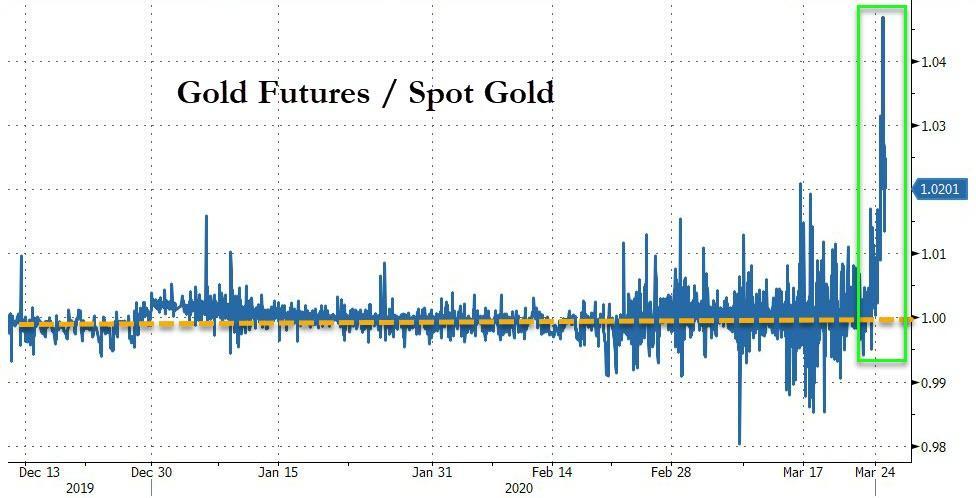
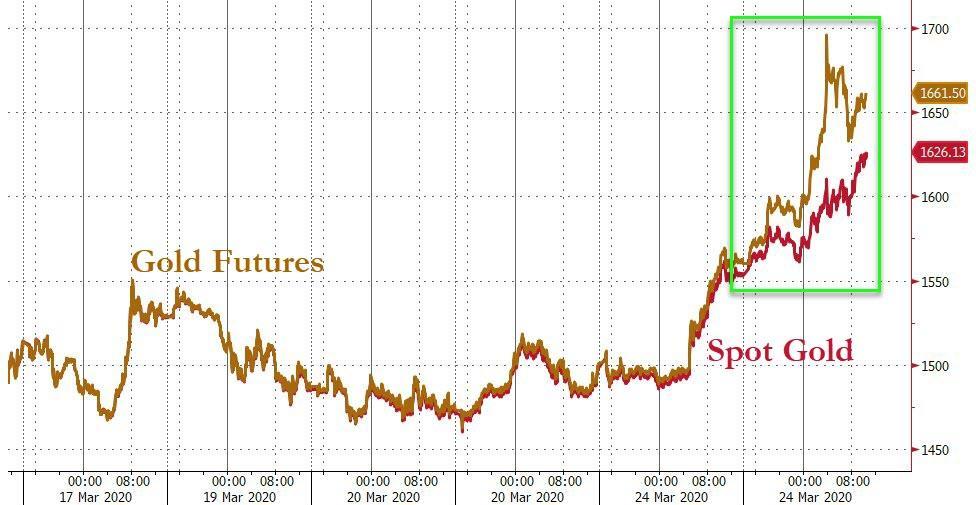
As we pointed out in late March, due to a sudden breakdown in physical gold supply as the world's top gold refiners, those located in the southern Swiss town of Ticino, namely Valcambi, Pamp and Argor-Heraeus, suddenly stopped producing gold, the result was a record divergence in the price of spot gold vs gold futures contracts...
... with gold futures decoupling and trading far above spot prices.

The resulting record divergence in gold futures vs spot (in some way analogous to what happened to the price of the prompt WTI contract in April, when the May WTI contract traded as low as ($40) as traders were willing to pay buyers to store oil in a world where there was suddenly no space for the physical commodity), unleashed a flood of physical gold into the US as a record scramble by traders rushing to take advantage of this arbitrage opportunity by shipping bullion to New York sparked what Bloomberg said "may be one of the largest ever physical transfers of the metal."
"The flows into New York are unprecedented," Allan Finn, the global commodities director at logistics and security provider Malca-Amit told Bloomberg as his company’s teams in New York have been working 24 hours a day to cope with unprecedented demand for physical gold while navigating lockdowns, flight disruptions and social distancing.
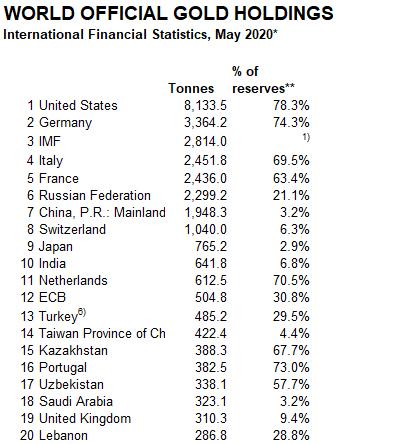
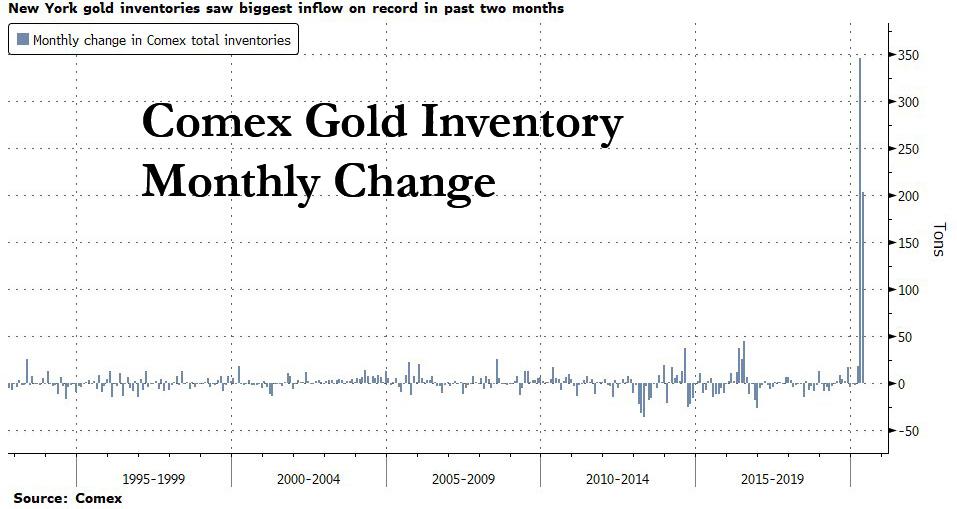
Since late March, no less than 550 tons of gold - worth $30 billion at today’s price and roughly equal to global mine output in the period - have been added to Comex warehouse stockpiles; hundreds of tons of that was imported. On its own that amount of gold would represent the 11th largest sovereign holding, larger than the ECB's official 504.8 tons of gold.
Traditionally, while tens of billions of dollars of gold change hands every day in financial markets, a much smaller amount tends to physically move between vaults in trading hubs like London, Zurich and New York. But that has not been the case in the past two months: it all started to change as the Covid-19 crisis affected the supply chain. As Bloomberg explains what we first highlighted two months ago:

"when planes were grounded and Swiss refineries closed in late March, traders were worried they wouldn’t be able to get gold to New York in time to deliver against futures contracts. That caused futures, which typically trade in lockstep with the London spot price, to soar to a premium of as much as $70 an ounce.
That created an opportunity for enterprising traders: buy gold somewhere in the world at the spot price, sell futures, and benefit from the difference by shipping the metal to New York."
The scale of the trade has been revealed in exchange reports, import and export data and comments from some of the leading precious metals shipping and vaulting companies. It all came to a head on Thursday, when traders declared their intent to deliver a record 2.8 million ounces of gold against the June Comex contract, the largest daily delivery notice in exchange data going back to 1994.
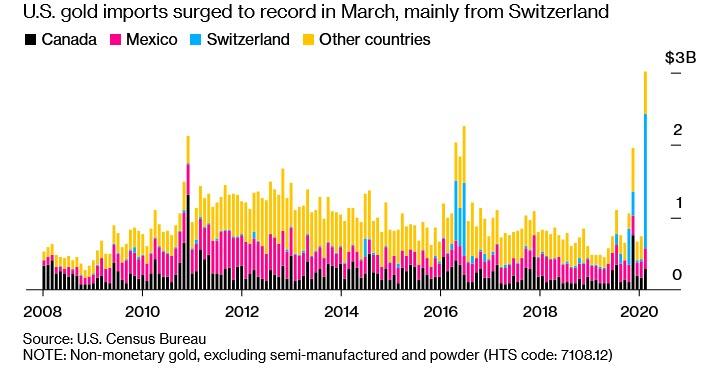
The bulk of this gold came from Switzerland, as Swiss gold exports to the US surged, reaching 111.7 tons in April, the highest on record. Already in March gold imports topped $3 billion, according to the Census Bureau, the highest in at least a decade.
To meet the unprecedented demand for physical gold, refineries as far away as Australia have ramped up output of kilobars - the form typically delivered on the Comex - to ship to New York.
For Brink’s Managing Director Mark Woolley, the spike in demand to ship gold to New York has been unlike anything he’s seen in 20 years in the market.
“The amount of metal that we’ve successfully moved into New York is pretty significant,” he said Thursday on a webinar hosted by the London Bullion Market Association. “It’s probably not far off the total amount of metal that’s been mined in this period.”
As discussed previously, the CME Group which owns Comex, responded to the unprecedented market dislocation and the sudden lack of physical gold in New York by introducing a new contract allowing the delivery of 400-ounce bars, the type traded in London. Still, “other changes need to be at least considered,” according to LBMA Chairman Paul Fisher.
Valcambi 400 oz "Good Delivery" Gold bar.
With investor demand for physical off the charts, the enormous movement of gold has been a blessing for logistics companies but also a curse: not only have passenger flights - on which shipments are typically transported - been grounded, but New York City, where many Comex warehouses are located (recall JPM's giant gold vault just happened to be located right next to the NY Fed's), has also been a hotspot for the virus.
To deal with flows, Loomis International U.K. opened up additional vault capacity. Malca-Amit considered using airports in Boston and Philadelphia, but hasn’t needed to yet, Finn said.
That said, while large volumes and virus-related restrictions at vaults and airports caused some delivery delays, much of the spike in the premium for futures contracts in March - which left banks such as HSBC suffering hundreds of millions in losses - was driven by perception rather than reality, Finn said.
"My own personal opinion is that any assessment on the inability to get gold in was ill-informed at the time and was made on assumptions rather than fact," he said.
Still, the bonanza for precious metals shippers may last a while. As we pointed out last week, large deliveries have seen June Comex futures drop to a discount to spot prices this week, but later dated futures are still at a premium. In fact, according to BofA, in a world in which central banks are flooding markets will trillions in freshly printed fiat and faith in the monetary system is quietly shrinking one day at a time, the one asset the "smart money" wants - as it dumps stocks - is, you guessed it, gold.
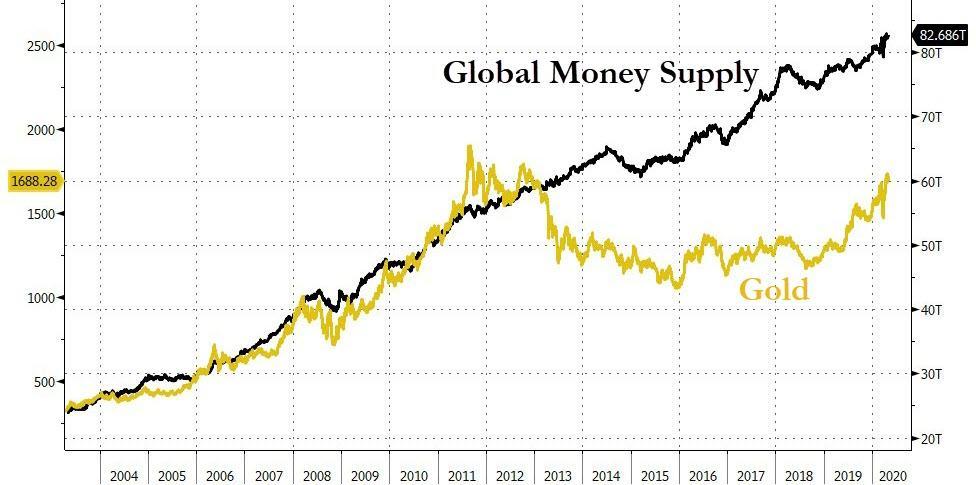
In fact, a simple correlation between the flood in the global money supply and the price of gold suggests the yellow metal has about $1000 of upside.
Meanwhile, as investor interest in other precious metals picked up, futures for silver and platinum have also traded at premiums to spot: “The guys in New York have done a great job,” said Brian Hayward, head of Loomis International U.K.
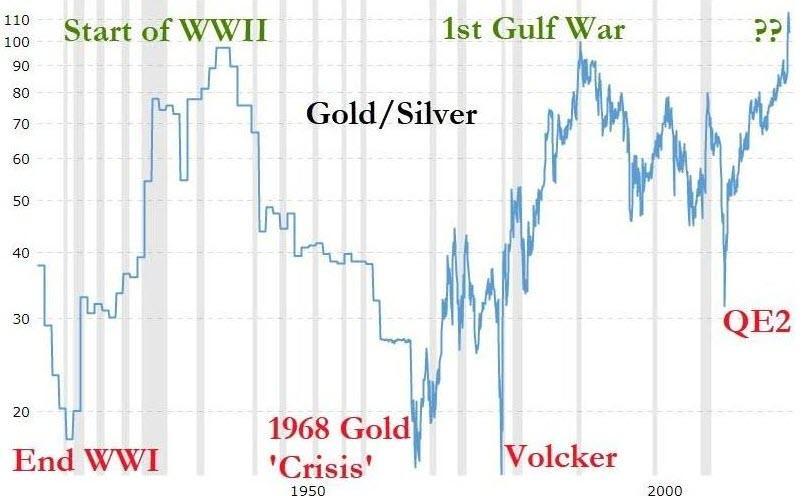
"We’re seeing a lot of silver head that way right now" Hayward said in what may be very good news for fans of silver, which recently hit record lows against gold...
... a move which may very soon reverse violently.

NYT : Black Americans Have a Message for Democrats: Not Being Trump Is Not Enoug

Black Americans Have a Message for Democrats: Not Being Trump Is Not Enough
Joe Biden wants to heal the soul of the country in this moment of protest and loss, and win the White House. Simply telling people to vote in November may not help with either goal.

COLUMBIA, S.C. — In an on-camera address after a week of destructive protests, former vice president Joseph R. Biden Jr. pleaded with his audience to imagine life for black people in America. Imagine, he said, “if every time your husband or son, wife or daughter left the house, you feared for their safety.” Imagine the police called on you for sitting in Starbucks.

“The anger and frustration and the exhaustion, it’s undeniable,” he said.

Exhaustion. For many black Americans across the country, what a year this month has been. The coronavirus pandemic has continued to disproportionately kill black people, and a spate of high profile killings in recent months in Georgia, Kentucky, and Minnesota, the latter two at the hands of the police, led to widespread demonstrations nationwide.

Protests shook more than three dozen cities on Saturday as crowds expressed outrage over the death of George Floyd, a black security guard who was killed in police custody in Minneapolis. Demonstrators shut down freeways, set fires and battled police batons and tear gas, the pain and frustration of the moment spilling out into the streets.

In Columbia, the city where Mr. Biden delivered his victory speech after the South Carolina primary just over three months ago, demonstrators on Saturday said they were demanding more than what it seemed like an election in November would deliver. Not only justice for the death of George Floyd, but change in political and economic power that would prevent the death of another black person in police custody, another brutal video going viral.

“I’m tired of coming out here,” said Devean Moon, a 21-year-old Columbia resident, one of hundreds who participated in the peaceful protests in the city. “I’m tired of feeling forced to do all this.”

It dawned on Sierra Moore, 24, who attended the protests carrying a homemade sign that read “No Justice, No Peace,” that she and her grandmother have been protesting the same issues over the course of a century.

She looked at the racially diverse group of thousands, which gathered for a short program on the State House steps before leading a march to the local police station.

Next to her was another sign: “Respect my existence or expect my resistance.”

“I just don’t think that’s how change happens,” Ms. Moore said of voting. “They’ve been telling us to do that for so long — and we’ve done it — and look at everything that’s still going on.”

Her words — expressing a sentiment shared by her peers — serve notice to politicians, civil rights groups and Mr. Biden, the presumptive Democratic nominee who has urged unity amid the frustration. “If you want change in America, go and register to vote,” said Mayor Keisha Lance Bottoms of Atlanta, but interviews with activists and leading Democratic figures including Stacey Abrams of Georgia, the longtime civil rights leader and former presidential candidate Jesse Jackson, and Representative Ayanna Pressley of Massachusetts, flipped that typical framework: If Democrats want people to vote, party leaders need to listen to why people are angry.

Ms. Abrams described the events of the past week as what happens when people are desperate for “their pain to be validated.”

“You cannot motivate someone to a behavior that they don’t believe will actually bring change,” she said. “We have to start by saying what you feel and what you fear is real.”

As he seeks to win the White House for the Democrats, the party that is the political home of most black Americans, Mr. Biden has attempted to strike this balance. He made clear that he has spoken to Mr. Floyd’s family. “We are a nation enraged, but we cannot allow our rage to consume us,” he said in a statement released early Sunday morning. “We are a nation exhausted, but we will not allow our exhaustion to defeat us.”

“The very soul of America is at stake,” he said, tying the tension between the police and black communities to removing President Trump from the White House.

The moment may still test Mr. Biden’s priorities, as a weary black electorate desires far greater change than the promise of a return to normalcy that has fueled his campaign. Energizing those voters, activists and elected leaders say, means addressing their demands for change and the realities of racism. But the former vice president, one of the Senate architects of the modern criminal justice system, cannot confront racism without addressing systemic inequalities, and he cannot address systemic inequalities by simply returning to a pre-Trump America.

“Our needs aren’t moderate,” Mr. Jackson said in a recent interview. “The absence of Trump is not enough.”

Mr. Biden’s win in South Carolina was a turning point for his once-flailing campaign. His support came from across all demographics, but his particular strength was older black voters — people who said the community’s familiarity with and trust of Mr. Biden, combined with his perceived ability to beat Mr. Trump, earned their backing.

To win in November, and to deliver on his promise of American unity, Mr. Biden is likely to need more than the coalition that brought him his primary victory. And to engage younger voters, he’ll need to offer more than the promise of ousting Mr. Trump as an answer to current despair.

On the policy front, a task force with criminal justice experts that supported Senator Bernie Sanders of Vermont has already been convened. Mr. Biden recently released a “Plan for Black America,” covering economic inequality and voting rights. Mr. Jackson, who supported Mr. Sanders in the primary, said Mr. Biden is “a consensus builder” and, if surrounded by the right people, the quality should serve him well.

But Mr. Biden also must minimize mistakes, said Mayor Stephen Benjamin of Columbia, alluding to the recent controversy in which Mr. Biden apologized after saying “you ain’t black” to black people uncertain whether to support him or Mr. Trump.

“The greatest asset that every candidate has, for better or for worse, is authenticity,” Mr. Benjamin said. He views authenticity as a prerequisite to leveling with people who are used to being disappointed. “I do believe, that if the vice president is authentically Joe, a legitimately good man who cares, I think people will gravitate to that authenticity.”

Engaging with a community that feels disaffected by the political system can be difficult. Mr. Trump has made a public show of trying to coax black Americans away from the Democratic Party, though he inadvertently made clear in comments to reporters on Saturday how little progress he has made: “MAGA is Make America Great Again,” he said, discussing his voting base. “By the way, they love African-American people, they love black people. MAGA loves the black people.”

Last October, Mr. Trump was in Columbia to address a forum on policing and criminal justice — many of the issues protesters are taking to the streets over — held at Benedict College, a historically black institution. He spoke a day ahead of some of the 2020 Democratic candidates, including Mr. Biden.

“The Democratic policies have let African-Americans down and taken them for granted,” Mr. Trump said then.

Progressive black leaders are extremely critical of Mr. Trump, as are many black voters. But they also believe that Democrats have sometimes been their greatest obstacle in addressing police brutality and racial inequality.

“Part of the reason these are systemic inequalities is that they transcend not only party, but time,” said Ms. Abrams, who is among those being vetted by Mr. Biden as a potential running mate. She also noted that:“We have to be very intentional about saying this is not about one moment or one murder — but the entire infrastructure of justice.”

Ms. Pressley, one of the House members who introduced a resolution to condemn police brutality, racial profiling, and the excessive use of force in Congress this past week, pointed to the confluence of issues facing black communities: a public health crisis, an economic crisis and, with the threat of police violence, “just trying to stay alive.”

Economic experts have predicted that even as the country faces a nationwide downturn, black communities may be hit particularly hard. Access to capital will dry up more quickly, especially for black business owners, and a coming “avalanche of evictions” could displace black renters across the country.

Ms. Pressley, an insurgent progressive in 2018 who beat a Democratic incumbent partly with a strategy to engage nontypical voters, said if elected officials want to speak to people’s pain, they have to understand the “deficit of trust” they’re operating under.

“People don’t participate, not because they’re ignorant and they don’t know enough,” she said. “It’s because they know too much. They live it every day.”

At Saturday’s march in South Carolina’s capital, thousands gathered at a state capitol rich with its own racial back story. The Old Carolina State House was burned to the ground during the Civil War, and the new building includes monuments to 19th-century state figures who were open racists — such as Dr. J. Marion Sims, a pioneer in the field of surgery who experimented on enslaved black women, and Benjamin Tillman, a former U.S. senator and South Carolina governor who spoke positively about lynch mobs that killed black residents.

On Saturday, the state house steps were filled with many black South Carolinians, demanding the right to live without fear, an echo of what some people fought for more than a century ago, in the days of Mr. Sims and Mr. Tillman.

“Clearly our voices are not enough,” said Kayla Brabham, a 28-year-old student at Benedict College who skipped Mr. Trump’s speech at her school.

“It’s not just the last couple years or months, it’s the whole time I’ve been alive,” she said. “We should not have to come out here to make y’all feel like we’re important.”

Even her name, she said, was a reminder of the country’s legacy of black violence.

“B-R-A-B-H-A-M, ” she said, spelling it out. “We got that from our slave masters. My great-great-grandmother was a slave in Hampton, South Carolina.”


WWD : L.A. Protests Cause Rodeo Drive, Luxury Retail to Shut Down

L.A. Protests Cause Rodeo Drive, Luxury Retail to Shut Down
Fearful of riots and looting, many stores are preemptively closing just days after beginning to reopen in LA.


As thousands of demonstrators protesting the death of George Floyd by a Minnesota police officer moved westward in Los Angeles, luxury retail started to board up in fear of riots and looting.
The entirety of famed luxury shopping strip Rodeo Drive was blocked to traffic by early afternoon on Saturday, as protestors were still miles to the east. The Beverly Center, a mall in West Hollywood that houses a number of luxury brands, also decided to close entirely on Saturday, a representative confirmed. The center had just reopened on Friday, after L.A. officials suddenly announced earlier in the week that in-store shopping could resume after months of being prohibited due to the coronavirus pandemic.


Gucci’s just reopened store on Rodeo Dr. was quickly boarded up on Saturday in fear of protests. Kali Hays/WWD
On Rodeo, the likes of Gucci, Prada, Dior, Rolex, and Louis Vuitton were being hurriedly boarded up by workmen as of midday on Saturday. A number of the stores had slowly started to reopen since Wednesday, allowing shoppers inside and refreshing merchandise displays. On Saturday, the same stores were again locked and emptied of all merchandise as police stood at traffic barricades.
In Beverly Hills and the Downtown area of L.A., an 8 p.m. curfew was mandated by late afternoon. West Hollywood is expected to do the same, although the neighborhood has not made it official. A curfew of the same hour enacted the previous night in Minneapolis, where George Floyd was killed and protesting began early this week, did not curtail protestors in that city.


Just before 4 p.m., police in riot gear had started to gather on Rodeo Dr. in L.A.
A policewoman on duty confirmed the police presence in Beverly Hills and the actions of the retailers on Rodeo were due to the protests in the area and the rioting Downtown the night before. On Friday night, a second night of protests in L.A. had turned to looting of some local jewelry stores.
As the protestors moved apace from further inside L.A., mainly near the Grove shopping center (which was planning to reopen on Monday for the first time since the pandemic) Beverly Hills police could be seen activating drones headed in the direction of the oncoming crowd. As the thousands of protestors began to stream onto Elm St. in Beverly hills, still heading west, they chanted “No justice, no peace,” “Black lives matter” and “Prosecute killer cops” as onlookers cheered, filmed with their phones and honked their car horns in support. There were two police helicopters overhead, but no police interaction could be seen on the ground as the large group walked, blocking traffic for a time.
In other regions of the country, days of protests over Floyd’s death (one of several recently publicized deaths and racist encounters experienced by Black men and women) erupted by Wednesday night into looting and vandalism in some areas.
While most of the affected businesses have been smaller, independent operations, Target has closed dozens of stores in the Minneapolis region. Luxury brands like Dior and Louis Vuitton are said to have had looting at stores in Atlanta and Oregon on Thursday night, both cities where protests took place. Both brands had again closed their stores in L.A. by Saturday and declined to comment on any looting in the other areas. A spokeswoman for Vuitton did say that the brand does not have a date for reopening stores right now.


As for the Beverly Center, The Webster, which faces the street, had been boarded up Saturday afternoon. By evening there was graffiti covering the pink plywood the store had used. At the Gucci store on Rodeo, by 6 p.m. its blue plywood had been tagged with “Eat the rich” and then broken in some spots, according to local news reports. At The Grove shopping center, graffiti of “Black lives matter” was visible by evening. Rumors of vandalism in other shopping areas of L.A., like on Melrose Ave. and Robertson Blvd., started percolating by evening as well, but could not be confirmed.
A spokeswoman for the Beverly Center, a Taubman property, said there had been no damage. The decision to close the mall was actually led by the luxury tenants that decided to preemptively close their doors on Saturday due to fears of looting. Despite the Beverly Center being largely indoors, brands like Gucci, Louis Vuitton and Prada, which were open at the center on Friday and were seeing shoppers spend money, didn’t want to take a chance by remaining open.
Dior On Rodeo Dr. in Beverly Hills, L.A., on Saturday afternoon, preemptively boarded up. Kali Hays/WWD
“Many tenants proactively informed us that they would not be opening today as a result of last night’s protests,” the spokeswoman said. “Out of an abundance of caution, we did not open the center today.”
The tentative plan is to reopen the center on Sunday, “barring any unforeseen circumstances.”

>>> Barron’s Weekend Summary

Barron’s Weekend Summary: The travel industry faces a long recovery even as the economy reopens; Not all tech stocks are benefiting from the remote work trend.

* Cover story: The broader economy is in recession, but the travel industry is arguably going through a depression, and won’t return to normal right away even as the country gradually reopens; Barron’s looks at seven stocks in travel and in ancillary businesses—SAVE, LUV, DAL, STAY, LIND, MPC, LVS—that appear insulated from the worst of the uncertainty and could be lifted over the next year by an emerging revival in travel; related cover stories are positive on MPC, VLO, and PSX, noting that driving is rebounding as the economy reopens, based on the belief cars are safer than trains, planes, and other mass transit; and on STAY, which unlike large hotel chains such as MAR and HLT hasn’t had to make radical changes to its operations, allowing it to keep hotels open during the crisis.

* Tech Trader: Cautious on HPQ: Tech stocks have done well during the pandemic, but the stay-at-home, remote-work trend isn’t good news for the whole sector, and with most offices shuttered by the pandemic, there is little need for commercial customers to buy printers or ink, a situation that isn’t likely to change soon—the company acknowledged that printer sales could get even worse in the current quarter.

* Trader: For now, the Nasdaq might be experiencing a lull as investors turn to cheaper, more economically exposed names, but with Big Tech such a huge part of the S&P 500—MSFT, AAPL, AMZN, GOOGL, and FB make up 20% of the index—a stall could be problematic for the market.

* Interview: Salim Ramji, global head of iShares and index investments for BLK, keeps a close eye on long-term trends—he talked with Barron’s about the outlook for ETFs, sources of growth, why the active/passive debate still exists, and says “Companies that manage sustainable risks better tend to also manage other risks better, and tend to be better-managed.”

* Profile: Don Kilbride, manager of the $38.9B Vanguard Dividend Fund, says that because the world has changed dramatically during the past few months, even the most reliable dividend payers may need to “reorder their priorities,” he says, by putting the needs of their employees, customers, and communities ahead of shareholder payouts (top 10 holdings: UHC, MCD, JNJ, KO, MDT, MSFT, TJX, NKE, CL, MRK).

* Features: 1) Positive on TWTR: Trump’s threat to issue an executive order stripping away the company’s protections under Section 230 of the Communications Decency Act didn’t cause much concern on Wall Street—analysts say the law has long been tested in court, and can’t be easily overturned, though the situation could create short-term “overhang” for tech stocks; 2) Positive on CTRE: Covid-19 has taken an outsize toll on nursing homes and long-term-care facilities, with tens of thousands of deaths among their elderly residents and staffers, and investors must pay close attention to balance sheets; CareTrust looks like a standout among senior-living REITs, with manageable debt and a seemingly safe dividend; 3) Positive on HIG, CB: As global insurers take a massive hit from the coronavirus pandemic, Hartford Financial and Chubb look particularly well-positioned, given their balance-sheet strength and demonstrated ability to compound value over time—shares of both are depressed based on price to book value, and could rally as Covid-19-related losses become clearer and as industry pricing improves; 4) Positive on LIND: The company, which specializes in “adventure cruises” to places such as Antarctica, the Amazon rainforest, and Patagonia, may offer investors an alternative to the cynical view of cruise ships as “floating petri dishes,” and could come out of the shutdown stronger than large cruise operators; 5) As families decide how to manage long-term care for elderly parents or other relatives in the wake of Covid-19, experts say it’s critical to realize that not all senior-living facilities are regulated the same way—and this divergence in oversight has led to an acute health crisis during the pandemic.

* European Trader: Positive on BAE Systems: The UK-based defense contractor, which helps make the F-35 combat aircraft and the Eurofighter Typhoon, is one of the few firms to come out of the first quarter unscathed by Covid-19, making it a defensive play, and its healthy order book and clarity on multiyear programs put it in a strong position.

* Emerging Markets: Threats to evict some 150 Chinese companies, including e-commerce giant BABA and other hot tech stocks, from US exchanges are real and mounting—but whether investors should care is another matter.

* Commodities: “Palladium trades nearly 30% below the record prices in February, and there are signs of more demand, but though the metal has managed to hold a gain for the year despite economic pain brought on by the coronavirus pandemic, it is far from a bargain.”

* Streetwise: Glenn Fogel, chief executive of BKNG, whose services including Booking.com and Priceline, has a measured view of the travel recovery—think years, not quarters, he says—while UBS analyst Myles Walton just issued his first airline Buy rating since the pandemic, on LUV.

FT : US pension plans warned they will run out of money by 2028

US pension plans warned they will run out of money by 2028
Seven struggling public funds could have a severe impact on state finances as their funded ratio drops

The weak financial condition of seven US public pension plans threatens to deplete their assets by 2028, leading to severe risks for the living standards of thousands of American employees and retired workers.

Many US public pension plans had not fully recovered from the 2007/08 financial crisis before coronavirus struck, triggering turmoil across financial markets. The correction in the US stock market has increased the long-term structural problems across the entire US public pension system, particularly for the weakest funds.

“Public plans with extremely low funded ratios in 2020 may face the risk of running out of assets in the foreseeable future if markets are slow to recover,” said Jean-Pierre Aubry of the Center for Retirement Research at Boston College, which carried out a detailed study on the plight of US public pensions.

More than 320,000 members of the New Jersey Teachers and Chicago Municipal public pension plans face the biggest risks as severe cash outflows are draining the assets of these two schemes. 

A slow recovery for the US stock market could result in Chicago Municipal’s funded position falling from 21 per cent this year to just 3.6 per cent by 2025. This would leave assets to cover just three months of the fund’s retirement payments, according to CRR’s analysis.

New Jersey Teachers is also burning through cash, with its funded position projected to decline from 39.2 per cent to 23.2 per cent over the next five years. By that time, New Jersey Teachers would have assets to cover 19 months of retirement payments.

Mr Aubry did not expect any US public pension plan to run out of money over the next five years, but more severe problems could then emerge. If stock market weakness persists, the public pension plans of Kentucky and Providence along with Dallas Police and Fire, Charleston Fire and Chicago Police could all end up with less than three years of retirement benefit payments saved as assets. The Chicago Teachers fund, which is also bleeding cash, might have enough assets to cover a little more than three years of benefit payments. 

Thomas Aaron, a senior credit officer at Moody’s, the rating agency, said that the unfunded liabilities of Chicago’s pension funds would continue to grow for more than a decade even if investment return targets were met.

“Chicago has particularly high pension risks. The city has built up very large unfunded liabilities through years of very weak pension contributions,” said Mr Aaron.

The crunch point of a plan running out of assets is known as the “depletion date”. After this point, a US plan would move to a so-called “pay-as-you-go” arrangement where retirement benefits are paid solely from contributions by employers and employees.

“Reaching an actual depletion date can have a severe impact on a state’s finances because a sudden transition to a pay-as-you-go plan may result in costs [benefit payments to retirees] that far exceed recent employer contributions,” said Les Richmond, an actuary at Build America Mutual, a New York-based bond insurer.

Mr Aubry noted that pay-as-you-go costs for both New Jersey Teachers and Chicago Municipal were more than 50 per cent higher than their contributions, emphasising the high costs that both states would face if assets in these vulnerable plans became exhausted.

FT : We may be heading towards a post-dollar world

We may be heading towards a post-dollar world
Continued erosion of trust in America politically could have an impact on the primacy of its currency

Unfettered globalisation is over. That is not a controversial statement at this point for obvious reasons, from the post-Covid-19 retrenchment of complex international supply chains to the decoupling of the US and China. It’s hard to imagine a reset to the 1990s neoliberal mindset, even if Joe Biden wins the US presidential elections, or if the EU experiences a moment of renewed cohesion in response to the pandemic.

The world is more likely to become tripolar — or at least bipolar — with more regionalisation in trade, migration and even capital flows in the future. There are all sorts of reasons for this, some disturbing (rising nationalism) and others benign (a desire for more resilient and inclusive local economies).

That begs a question that has been seen as controversial — are we entering a post-dollar world? It might seem a straw-man question, given that more than 60 per cent of the world’s currency reserves are in dollars, which are also used for the vast majority of global commerce. The US Federal Reserve’s recent bolstering of dollar markets outside of the US, as a response to the coronavirus crisis, has given a further boost to global dollar dominance.

As a result, many people would repeat the mantra that in this, as in so many things, “you can’t fight the Fed”. The dominance of the US banking system and dollar liquidity, both of which are backstopped by the Fed, will give the American dollar unquestioned supremacy in the global financial system and capital markets indefinitely.

Others argue that “you can’t replace something with nothing”. By this they mean that even though China, Russia and other emerging market countries (as well as some rich nations such as Germany) would love to move away from dollar dominance, they have no real alternatives. This desire is especially sharp in a world of increasingly weaponised finance. Consider recent moves by both Beijing and Washington to curb private sector involvement in each other’s capital markets. Yet, the euro, which represents about 20 per cent of global reserves, can’t compare in terms of liquidity and there are still big questions about the future of the eurozone. The gold market is far too tight, as evidenced by the fact that it is now virtually impossible to buy the physical metal.

But there are economic statistics, and then there is politics. It’s telling that China has been a big buyer of gold recently, as a hedge against the value of its dollar holdings. It is also testing its own digital currency regime, the e-RMB, becoming the first sovereign nation to roll out a central bank-backed cryptocurrency. One can imagine that would be easy to deploy throughout the orbit of China’s Belt and Road Initiative, as an attractive alternative for countries and businesses that want to trade with one another without having to use dollars to hedge exchange-rate risk.

This alone should not pose a challenge to the supremacy of the greenback, although it was enough to prompt former US Treasury secretary Hank Paulson, a man who does not comment lightly, to write a recent essay surveying the future of the dollar. But it isn’t happening in a vacuum.

The European Commission’s plan to bolster its recovery budget for Covid-19 bailouts by issuing debt that will be repaid by EU-wide taxes could become the basis of a true fiscal union and, ultimately, a United States of Europe. If it does, then I can imagine a lot more people might want to hold more euros.

I can also imagine a continued weakening of ties between the US and Saudi Arabia, which might in turn undermine the dollar. Among the many reasons for central banks and global investors to hold US dollars, a key one is that oil is priced in dollars. Continuing Saudi actions to undermine US shale put a rift in the relationship between the administration of US president Donald Trump and Riyadh. It is unlikely that a future President Biden, who would probably follow Barack Obama’s pro-Iran stance, would repair it.

Even with oil prices this low, Dallas Fed president Robert Kaplan recently told me that energy independence remains “strategically important” to the US and that “there will still be a substantial production of shale in the US in the future”. Who will fill the Saudi void, then? Very probably China, which will want oil to be priced in renminbi. A decoupling world may be one that requires fewer dollars.

Finally, there are questions about the way in which the Fed’s unofficial backstopping of US government spending in the wake of the pandemic has politicised the money supply. The issue here isn’t really a risk of Weimar Republic-style inflation, at least not any time soon. It’s more about trust. Some people will argue that the dollar is a global currency and that its fortunes do not really depend on perceptions of the US itself. Certainly, events of the past few years would support that view.

But there may be a limit to that disconnection. The US can get away with quite a lot economically as long it remains politically credible, but less so if it isn’t. As economist and venture capitalist Bill Janeway recently told me: “The American economy hit bottom in the winter of 1932-3 after [Herbert] Hoover lost all credibility in responding to the Depression and trust in the banks vanished with trust in the government.”

It could be that one day, trust in the dollar and trust in America will reconverge.