WWD : Louis Vuitton Men’s Show Sets Record for Livestreams in China

Louis Vuitton Men’s Show Sets Record for Livestreams in China
The physical show, held in Shanghai, also fanned business to heights across Asia, the brand said.

Louis Vuitton attracted a sizable online audience for its physical men’s wear show, held in Shanghai on Thursday. The spectacle, which featured giant inflatables and models stepping out of cargo containers, generated more than 100 million views worldwide, the brand said Friday.
The livestreamed show, which closed with Chinese actor-singer Kris Wu, drew 68 million views on Weibo, 18 million on Douyin, eight million on Tencent and one million on OOH, a spokesman for Louis Vuitton said. In addition, 3.3 million people watched it on Instagram, 1.6 million on Twitter, 335,000 on Facebook and 84,000 on the Vuitton web site.
Michael Burke, chairman and chief executive officer of Vuitton, said the social networks told Vuitton it set audience records with the outdoor fashion spectacle, the first roving show for the brand since its men’s creative director Virgil Abloh revealed it would switch to a seasonless model.


What’s more, the event is already fanning robust business across Asia.
“The Taiwan market, China and Korea all had the biggest sales in their history this week,” Burke said.
He credited a show that blended several collections, even reprising fall looks, for strong sales ahead of Thursday night’s event, plus healthy preorders for the spring 2021 collection, titled “Message in a Bottle,” that will be delivered to boutiques in about four months.

“When you do an event like this and the buzz is so huge, everything sells,” he said.
He also attributed the enormous interest on social networks to “pent-up demand and frustration with not seeing live shows” since the coronavirus pandemic scuttled summer fashion weeks in London, Milan and Paris, prompting organizers to post creative films online instead.
“There’s no more trickle-down,” Burke said in an interview. “Everybody wants immersive, simultaneous access to the information. What made it even stronger was the fact that [Shanghai] was Act 2. There’s this narrative, and we’re weaving it together and that makes it more compelling.”
Act 1 took place during Paris Fashion Week in July, when Abloh unveiled a teaser film for the Shanghai showing titled “Zoooom With Friends,” unveiling a cast of kooky animal-like characters that jump into shipping containers on a barge that sets sail from Paris.
For comparison, that teaser generated 15.4 million views worldwide after its release. Meanwhile, the last Vuitton men’s show to be livestreamed in China in January 2019 drew 18.7 million views just on Weibo.
Act 3 will be another large-scale live event in Tokyo on Sept. 2 at 7:30 p.m. local time.
“It looks like this could be a new model going forward,” Burke hinted. “If the audience could not come to Paris, then we take the collection to the audience, and I think that’s going to remain.”
Burke also attributed heightened interest in Thursday’s show to the fact a major luxury house was unveiling a new collection in China first. Typically, European brands have done repeat shows, adding a few new looks — and often flying over seamstresses, production teams and others.


By contrast, not a single person from Vuitton headquarters was in Shanghai for Thursday’s event — with all production, casting and logistics done there — and Burke said this is the way forward.
“We think the traveling runway is the future,” he said. “The engagement is so much higher when it’s localized.”
Vuitton was also able to engage with more VIP clients, as it could only fly limited numbers to Paris Fashion Week displays.
Counterfeit invitations for Abloh’s fifth effort for Vuitton were said to be on offer for as much as 5,000 euros. Vuitton employed its blockchain to issue official tickets and ensure security at the event, the first live fashion show in China since COVID-19 swept through many parts of the country.
Not everyone was thrilled by Abloh’s latest collection, however. Belgian designer Walter Van Beirendonck posted to Instagram an image of a masked model wearing a T-shirt with the slogan “I Hate Fashion Copycats.”
In his Stories, he reposted several collages pointing out similarities between Vuitton’s spring 2021 clothing and eyewear designs and Van Beirendonck’s fall 2016 collection. Fellow Belgian designers Olivier Theyskens and Jean-Paul Lespagnard expressed their solidarity with Van Beirendonck in separate posts.
Vuitton said there was no link. “Van Beirendonck’s past work is not referenced in our spring 2021 collection. We never saw a collection of his with a similar treatment,” a spokesman for the brand said, adding that Abloh was inspired by stuffed animals he bought in a children’s store near his studio in Paris in January 2020. “They integrate into garments and bags, animate them,” he added.

(ZH) US Dollar Devalues By 99% Vs Gold In 100 Years As Gold Price Crosses $2,067

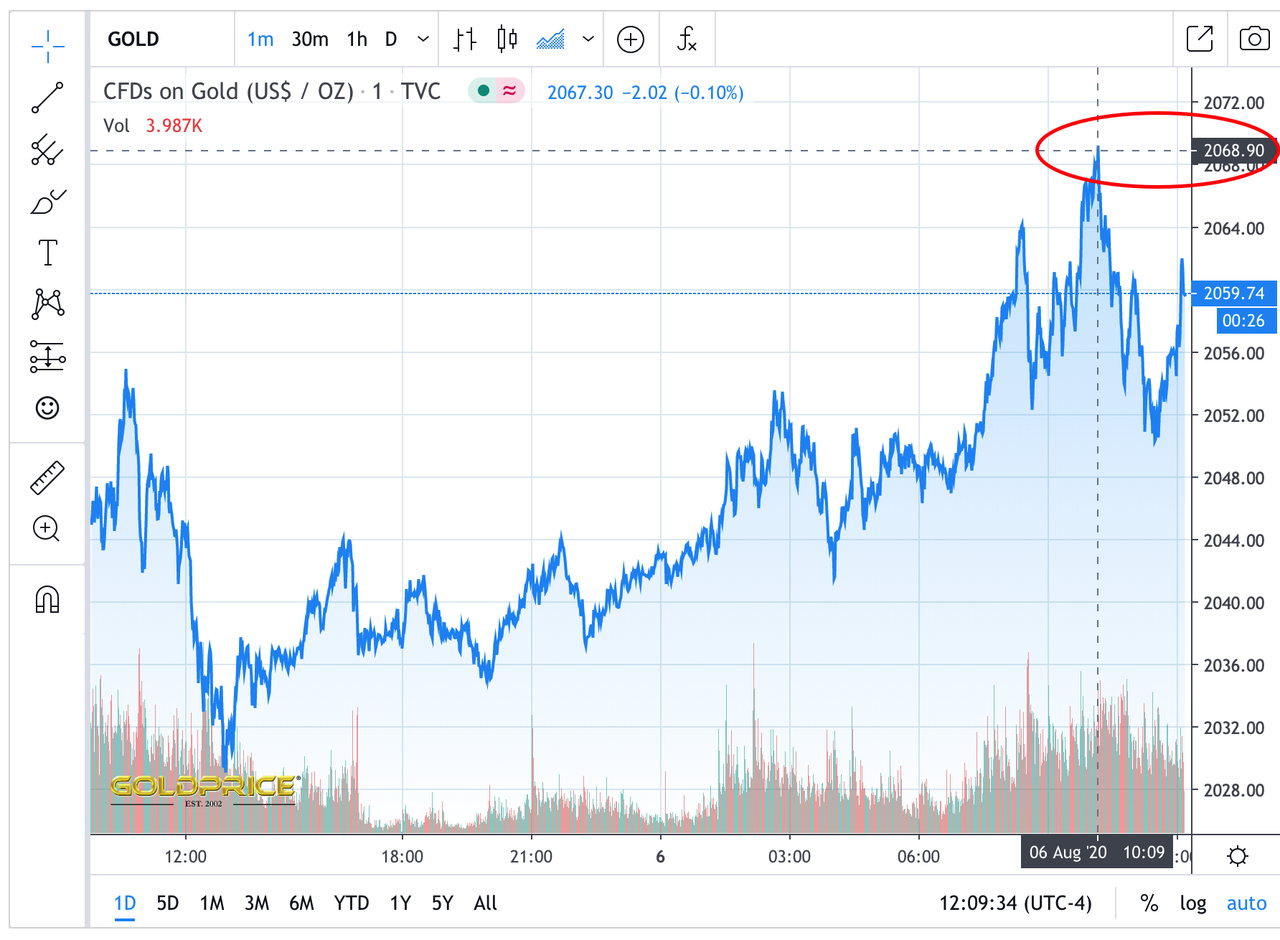
US Dollar Devalues By 99% Vs Gold In 100 Years As Gold Price Crosses $2,067

Submitted by Jan Nieuwenhuijs of Voima Gold,
A world reserve currency is supposed to be superior in storing value, but through boundless money-printing the U.S. dollar hasn’t been able to compete with gold by a long shot...
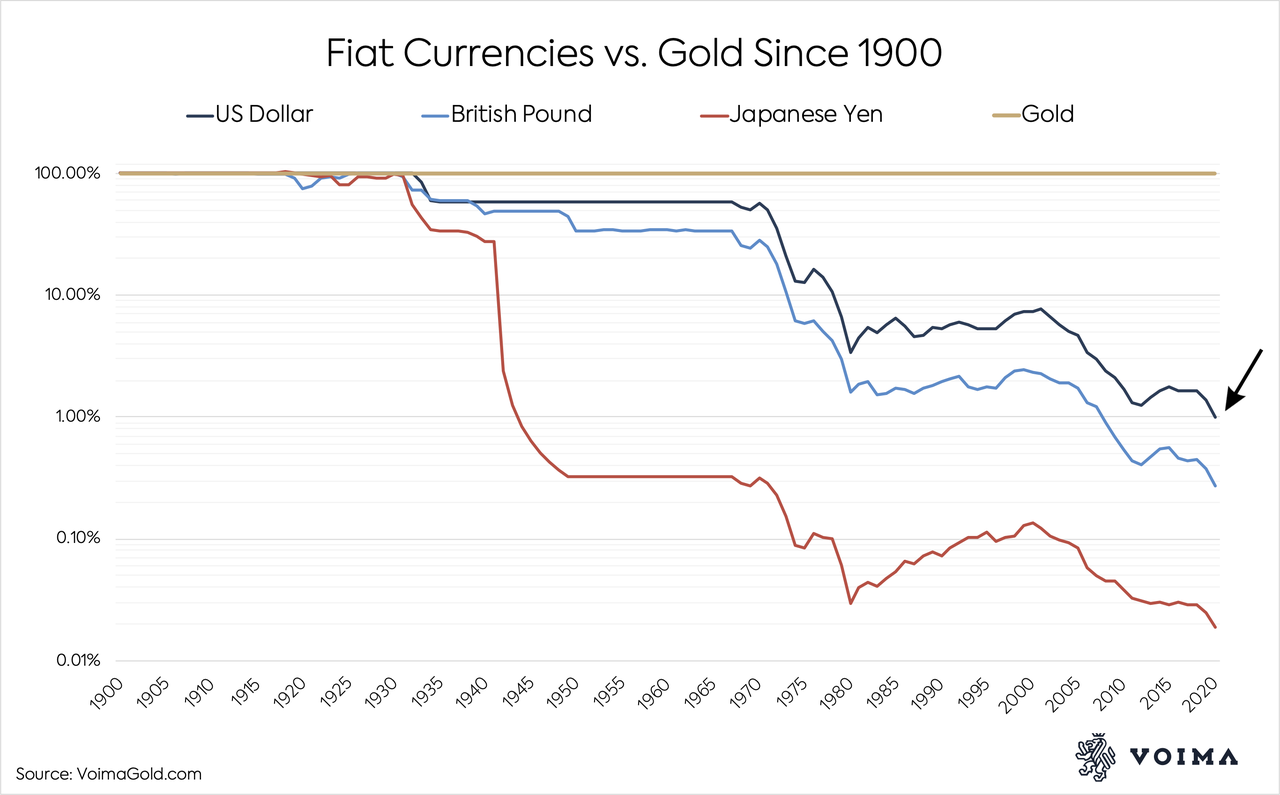
In 1932 the gold price was $20.67 dollars per troy ounce, today it crossed $2,067 dollars.

That’s a 99% decline in value of the dollar against gold. Other reserve currencies such as the British pound and Japanese yen have done even worse. The yen has lost 99.98% of its value against gold in 100 years. Note, the chart below has a log scale.
Gold doesn’t yield, if you don’t lend it, but it's the only globally accepted financial asset without counterparty risk. Because of its immutable properties gold sustained its role as the sun in our monetary cosmos after the gold standard was abandoned in 1971. Central banks around the world kept holding on to their gold, despite its price reaching all-time highs such as now. This is due to Gresham’s law, which states “bad money drives out good.” If the price of gold rises central banks are more inclined to hoard gold (good money) and spend currency that declines in value (bad money).
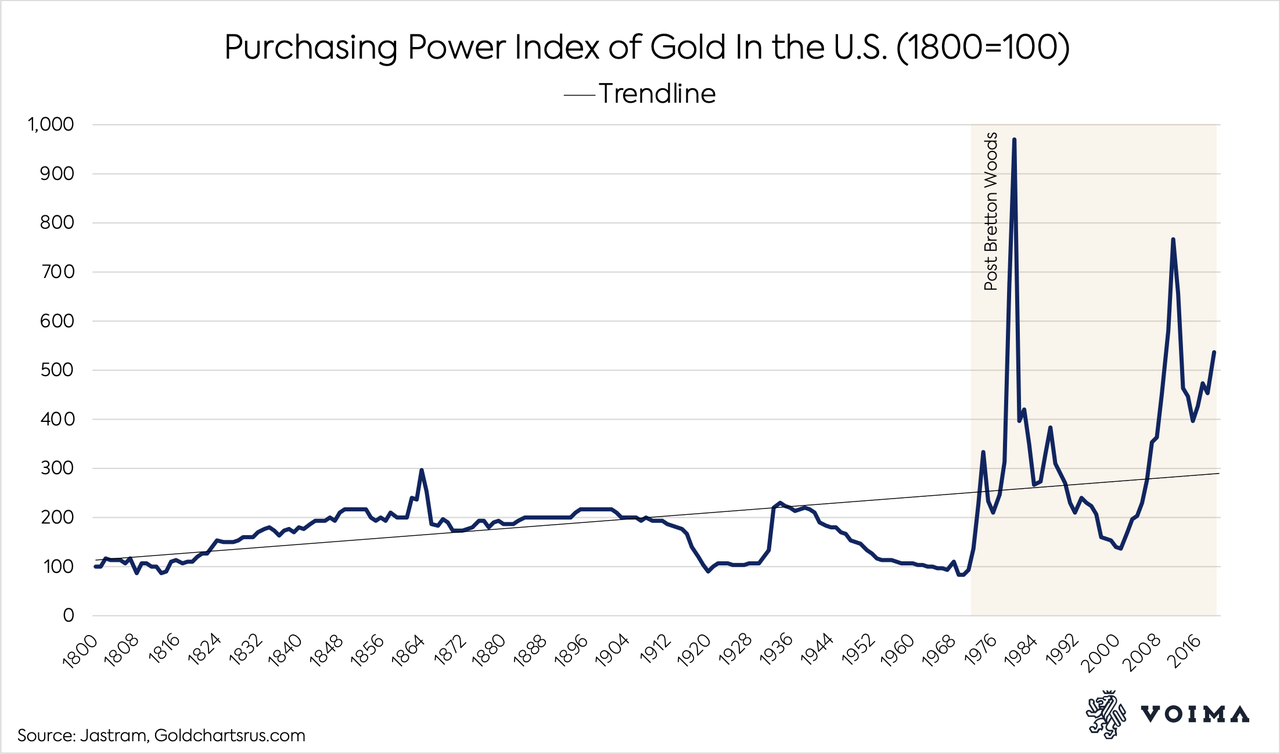
In the chart below you can see that gold's purchasing power is remarkably stable. As the gold price rises through time it mainly compensates for fiat currencies being devalued versus goods and services. In other words, the price of gold goes up by the same amount that consumer prices rise. Gold even shows a tendency of increasing in purchasing power, which might reveal inflation numbers published by governments are too low. Another theory is that sound money, like gold, should rise in purchasing power as technological development makes goods increasingly cheaper to produce.

You might think that dollars with interest, for example U.S. government bonds (Treasuries), would have outperformed gold since the gold standard was abandoned in 1971. But this isn't true. Gold has performed better than Treasuries.
In my view, the gold price will continue to rise and will be incorporated in a new international monetary system. The current all-time high in dollar or euro terms is just a nominal measure. When taking into account inflation gold is not at an all-time high, more importantly I’m expecting central banks to debase their currencies way more in the years ahead because the world has never been this much in debt. The debt levels around the world are completely unsustainable and can only be lowered through debt relief or inflation. The Federal Reserve and other central banks are communicating they choose inflation. A few months ago the President of the European Central Bank, Lagarde, said: “We should be happier to have a job than to have our savings protected.” That is a clear admission that (in this case) euro savings will be wiped out.
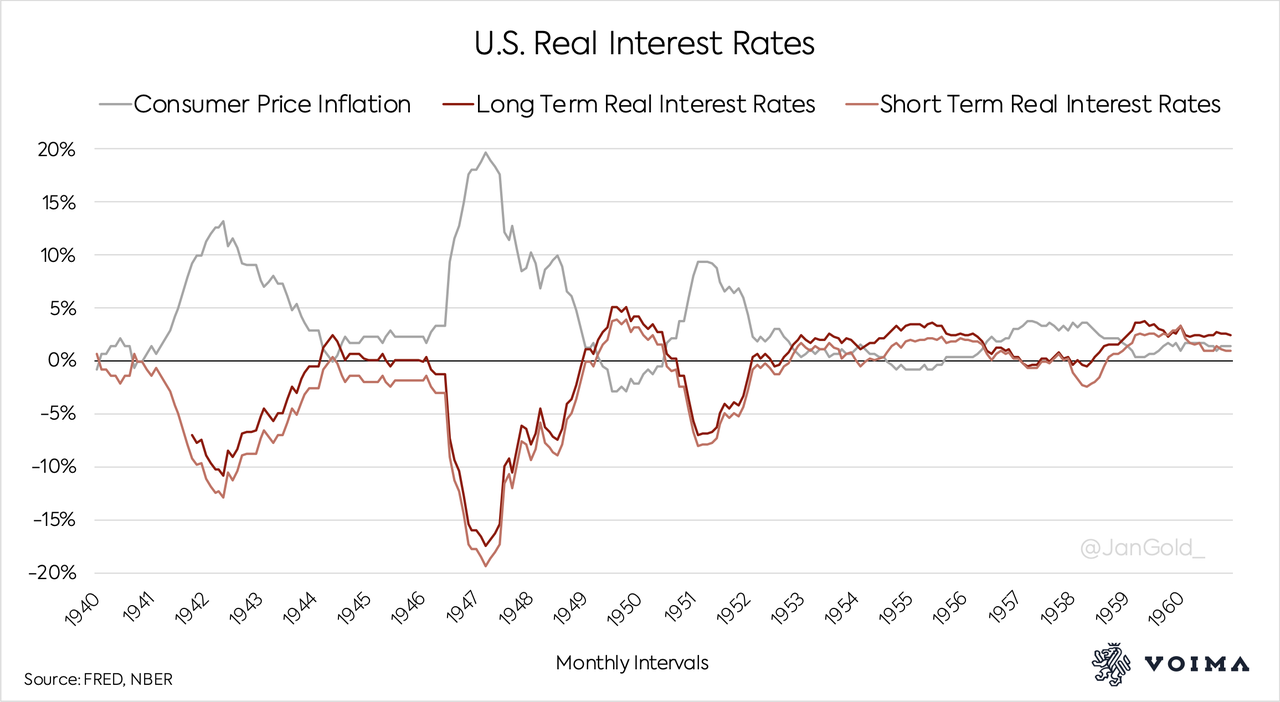
Lowering the debt burden through inflation is “the most expedient, least well-understood, and most common big way of restructuring debts.” It has been done many times before in history (see chart below), and will be done again.
After the Second World War the U.S. government capped interest rates at very low levels while boosting inflation. The results were deeply negative real interest rates (nominal rates minus inflation).
Owning physical gold stored outside the banking system offers protection of your purchasing power from currency debasement.

Barron's : How to Invest in Lennar and Other Dual-Share Companies at a Discount

How to Invest in Lennar and Other Dual-Share Companies at a Discount

Lennar is one of the country’s leading home builders. It is also among the companies with dual classes of stock—a structure intended to give control to a founder, family, or influential shareholder through supervoting shares.

In the case of Lennar and a few others, the high-vote stock trades at a sharp discount to the lower-vote stock. This offers investors a cheaper way to gain ownership, with the potential bonus of a closing of the gap between the two stocks. Holders also get a slightly higher yield as both share classes pay the same dividend.

Other examples are Brown-Forman and Liberty Broadband and Liberty Formula One, both controlled by media mogul John Malone.

Lennar (ticker: LEN) is notable because its supervoting class B share voting shares (LEN.B) trade at a discount of 25% to the lower-vote class A shares—the largest percentage gap among sizable companies with dual-class stock. The B shares fetch about $55 and the A shares, $73.

The B shares allow investors to align themselves with Lennar’s 63-year-old chairman Stuart Miller, who controls Lennar with a 58% stake in the class B stock, which has 10 votes against one for the A shares.

At the family-controlled distiller Brown-Forman, which has a great long-term record, the voting stock (BF.A) trades around $61, a nearly 10% discount to the nonvoting B shares (BF.B) at $67. A Brown-Forman spokeswoman notes that over the past 40 years, there have been times when the A share commanded a premium to the B and vice versa.

Brown-Forman has long traded at a premium relative to other liquor companies on the strength of its Jack Daniel’s franchise and potential takeover. But the shares are no bargain now, with the nonvoting shares fetching more than 40 times earnings.

High-vote stock is generally less liquid than the lower-vote shares with considerably less public float. With both Lennar and Brown-Forman, their high-vote stocks are not in the S&P 500, giving some institutions little reason to own it.

Indeed, dual-class stock isn’t viewed as good corporate governance. S&P Dow Jones Indices won’t admit such companies to the S&P 500 index or S&P MidCap 400 or SmallCap 600. S&P 500 components like Alphabet (GOOGL) with its multiple classes were grandfathered when the change was made in 2017.

A risk with low-price supervoting stock is that the discount to lower-vote shares may persist—or may even widen—and the controlling shareholder does nothing about it.

Nonetheless, longtime Barron’s Roundtable member Mario Gabelli has often invested in cheaply priced supervoting shares. His firm, Gamco Investors, holds higher-vote stock in Lennar, Brown-Forman, and others.

“In general we try to acquire a unit of economic ownership at the cheapest price; when that coincides with superior voting representation (which theoretically has value), it is a bonus,” says Chris Marangi, co-chief investment officer at Gamco. “Those discounts tend to vary over time and can be resolved in an acquisition or through the ability to convert one share class into another.”


GoodHaven fund manager Larry Pitkowsky holds the Lennar B shares and likes the discount to the A shares and the fact that they trade around book value. Home building has been strong, and the Lennar A shares are up 32% this year, while the B shares have gained 24%. Lennar’s A shares trade for about 12 times estimated 2020 earnings of $6.32 a share, while the B shares fetch around nine times.

“We have been very impressed with management’s execution of a well- articulated business plan to become more capital-light, and while we have had a positive view for the outlook for single-family housing previously, it has lately been reinforced by certain new trends like de-urbanization and work-from-home,” he says.

News Corp, the parent of Barron’s publisher Dow Jones, has two classes of stock, as does Fox, also controlled by the Murdoch family. The Fox and News Corp voting and nonvoting shares trade at close to parity.

The leading proponent of supervoting stock has been Malone, who uses supervoting stock to effectively control or exert considerable sway over a group of companies generally with a sub-10% economic interest. Investors have not seemed to mind ceding control to Malone, given his record of delivering for shareholders. With his Liberty companies, there usually are three classes of stock, thinly traded class B shares that he holds with 10 votes, class A shares with one, and class C stock with a K at the end of the ticker with no votes.

The Liberty Formula One voting shares (FWONA) trade around $34, a 6% discount to the nonvoting shares at $36 (FWONK). Liberty Broadband’s class A stock (LBRDA) trades around $140, a 2% discount to the C shares (LBRDK) at $142.

Liberty Broadband could be the better choice because it offers a discounted way to play Charter Communications (CHTR), the well-run cable TV and broadband company. Liberty Broadband owns a 23% economic stake in Charter and trades at an estimated discount of about 18% to the value of that stake based on the C shares and an even bigger one based on the A shares.

All stock isn’t equal, and where it exists, cheaply priced voting stock can be an attractive play for investors.

Barron's : Vodafone Looks to Recharge Its Growth. What That Means for the Stock.

Vodafone Looks to Recharge Its Growth. What That Means for the Stock.

Vodafone Group has disappointed both consumers and investors over the past few years.

The British telecoms giant posted a 455 million euro ($534 million) loss for the year ended on March 31, and the year before it cut its shareholder dividend for the first time ever.

Its United Kingdom–listed shares (ticker: VOD.UK) and American depositary receipts (VOD) are down 20% so far this year, to 117 pence ($1.52) and $15.53, respectively.

In the U.K., Vodafone—the world’s second-largest mobile-phone operator, as China Mobile has more subscribers—was rated the worst mobile network for eight consecutive years. But a €1 billion cost-cutting plan; upcoming asset disposals; buzz around the introduction of fifth-generation, or 5G, handsets; and demand for data from locked-down customers could mean the shares have bottomed.

Robert Grindle, an analyst at Deutsche Bank, has marked the company a Buy, forecasting a 93% rise in its U.K.-listed shares to 225 pence. Analysts at New Street Research also mark the stock a Buy, with a target price of 180 pence.

Grindle wrote in a July note that Vodafone believes that with the coronavirus pandemic, governments recognize the importance of telecoms infrastructure and “want to encourage greater sector resilience” which could be through mergers and acquisitions and network planning policies.

The firm, based in Newbury, 100 miles west of London, has a market value of 30 billion pounds sterling ($38.4 billion) and employs 95,219 people. It fetches 15.8 times this year’s expected earnings and is valued in line with its peers.

The 2020 loss of €455 million was on sales of €44.9 billion, a slight increase from 2019 sales of €43.6 billion. A first-quarter trading update in July saw total revenue down 2.8%, to £10.5 billion, on an organic basis, which compares sales from the same parts of the business over the same period but a year apart.

CEO Nick Read said in a July statement that while the company has seen “the direct impact on our revenue from travel restrictions and business project delays, we have also seen increased usage in voice and data.”

Vodafone was created in 1980 from an agreement between Ernest Harrison, chairman of Racal Electronics, and Lord Weinstock’s General Electric Co. , to establish commercial use for GEC’s tactical battlefield radio technology. In 1988, Racal Electronics floated it on the London Stock Exchange, changing the name to Vodafone Group in 1991.

In 1999, Vodafone merged its U.S. business with Bell Atlantic to form Verizon Wireless, and a year later Vodafone staged a £112 billion merger with Germany’s Mannesmann, then the largest corporate merger ever.

Last year, Vodafone completed the acquisition of Liberty Global’s (LBTYA) operations in Germany, the Czech Republic, Hungary, and Romania for €18.4 billion. Germany is now its biggest market where Vodafone offers fixed line, broadband, mobile, and TV.

Read looks set to release some value with asset sales. He just announced that the phone-masts business—its network of 68,000 masts that receive and transmit signals across nine countries—will float on the Frankfurt exchange in 2021. It’s a hidden gem.

Vodafone Egypt is being sold to Saudi Telecom. And the merger between Vodafone and Hutchison Australia has been completed.

As countries begin to ease travel restrictions, Vodafone should benefit from roaming charges and increased handset sales boosted by a likely 5G iPhone in October. Investors could decide that Vodafone’s growth is recharging.

FT : Pretty in pink: the rise of rosé

Pretty in pink: the rise of rosé
How it became the most successful wine category of the past two decades

Pink wine is surging. It’s been by far the most successful wine category of the past two decades, with a 40 per cent rise in global consumption between 2002 and 2018 while other still‑wine categories barely managed single-digit rises. Global pink-wine production has tripled in the past quarter of a century.

This is little celebrated in wine circles, where orange or cloudy yellow are the fashionable hues. The kind of pink wines that have ploughed their way to market prominence are wistful rose-petal pinks, in designerly clear-glass, with scents and flavours that don’t detain so much as disarm, sinking through the mouth and down the throat like foam, cream or a soft-fruited smoke of dry ice.

There’s little for geeks here: no handles or horns. And that, indeed, may be a part of their attraction for the rest of humanity. At last: a wine category that doesn’t require months of study to understand, and in whose aromas and flavours drinkers are not urged to identify the contents of an Arcimboldo painting.

You’ve probably guessed already: this apparent simplicity is misleading. Such artful pinks are the most technically sophisticated still wines ever made. They require swift pre-dawn harvesting on a single, perfectly calibrated day; optical sorting machines to defenestrate sub-par grapes; chilling equipment for grapes and juice; subtle pressing under inert gases; cool fermentation and cunning use of lees; bottling under more inert gas.

Their appeal is based on the impression of freshness allied to a graceful weight and presence in the mouth, with all-important creaminess. They are dry but rounded — without the vulgarity of sugar. Their acidity is subtle and gently fruit-infused, never “crisp”; by dint of the softly sinewy quality of vinosity, they can partner food as well as satisfy and slake on their own. Not simple at all, but cunning little wine machines that whirr and click with minutely engineered understatement.

The description above constitutes the Provence rosé ideal, and Provence has trounced the opposition in the pink-wine explosion, with regional exports up 500 per cent in the past 15 years, and with 89 per cent of its vineyards now producing rosé


The model for Provençal success has been Sacha Lichine’s Ch d’Esclans and Caves d’Esclans, together with its all-conquering Whispering Angel brand — now the top-selling still French wine by dollar sales in the US. Lichine’s wines alone account for 6.5 per cent of the entire production of the enormous Côtes de Provence appellation.

The success of Lichine’s endeavour, regarded as a Quixotic tilt by the vendor of Ch Prieuré-Lichine in Bordeaux’s Margaux when he began in 2006, has been such that Moët Hennessy acquired a majority shareholding in December 2019.

It derived from two key insights. One was the application of vanguard techniques from Bordeaux and Burgundy (like those outlined above) to the making of ambitious Provence rosé. The other was to co-ferment white Rolle grapes with red (up to 20 per cent Rolle, according to the vineyard planting rules). This variety, also known as Vermentino in Italy, works brilliantly with the fruit-bringing Grenache and Cinsault, adding to the wines’ aromatic subtlety, chew and wealth of mouthfeel — as well as pulling the colour back.

Cédric Jenin is chief winemaker and research director at Castel Frères, which has its own Provence estate (Ch Cavalier) as well as owning the rosé giant Listel, and Barton & Guestier, which makes rosé in Bordeaux, Anjou and Provence.

He stresses the complex requirements of the style, from the usefulness of irrigation (to avoid stressing the vines and degrading acid levels in the grapes) to picking at the perfect moment (just before full phenolic or flavour maturity) and fining the juices to rein back colour and help keep oxidation at bay.


“Provence,” he notes, “has had 30 or 40 years to focus both technical developments and vineyard investments on rosé.” Master of Wine (and Provence resident) Elizabeth Gabay, author of the useful Rosé: Understanding the Pink Wine Revolution, also feels Provence’s success has been due to “timing.

It was ahead of the game with improving quality throughout the 1990s so that by the time 2003 and subsequent hot summers came, it was ready. Then you had Lichine, Brad Pitt and Angelina Jolie . . . ”

The film-star reference is to rosé-producing Ch Miraval, once a home to (and still owned by) the now-parted actors — and such a prodigiously successful and beautifully packaged Provençal rosé brand in its own right that it is rumoured to be a reason why no divorce settlement has been finalised.

This brand-friendliness is another advantage for Provence and for rosé in general: the iconography of the Côte d’Azur makes a perfect springboard for commercial as well as oenological endeavour, for design as well as content.

Rapper Post Malone has just released a Provence rosé called Maison No 9 — and managed to sell 50,000 bottles over one weekend of pre-sale on Vivino. Jon Bon Jovi and his son Jesse produce several pink wines (from Languedoc this time, made in conjunction with Gérard Bertrand) branded Hampton Water. Kylie Minogue’s newly launched Rosé, a Vin de France, is hurtling out of Tesco, while Cameron Diaz’s Avaline, another Vin de France but sourced from Provence, was launched in July.

Imaginatively speaking, no wine style offers more creative potential than pink; it has more in common with perfumes than with other wines. Indeed, the Tuscan producer Ruffino has just launched a new pale rosé in an ultra-pretty, intricately fluted bottle that wouldn’t (size aside) look out of place on a shelf of fragrances. Its perfumey name is Aqua di Venus.


All of this is, perhaps, a pity for the rest of the pink-wine universe, which Gabay says is “hugely exciting” yet which often confronts and even contradicts the Provence aesthetic: three Gabay suggestions for expanding your horizons are listed below.

The next pink-wine frontier, meanwhile, is sparkling rosé — a challenge that has defeated Provence so far. The all-important petal pink is very hard to maintain through the full cycle of the traditional sparkling wine method used in Champagne; it’s easier to achieve by the tank method used for Prosecco and some other Italian sparklers. Basic Prosecco regulations have, significantly, been extended to pink wines. They’ll be with us by Christmas.

How far can pink wine go? Much further, most feel, including Gabay, who predicts that it will account for 25 per cent of global wine consumption before long. Cédric Jenin reports that pink sales have been rising throughout lockdown; indeed, pink wine has outsold white in France since 2009.

If that can happen in the land of Montrachet, Yquem and Haut-Brion Blanc, nowhere is beyond the reach of the pale pink tide.

FT : What the doomsayers for commercial property stocks are missing

What the doomsayers for commercial property stocks are missing
Institutional buyers are sniffing around listed developers after the coronavirus sell-off

It is a measure of our tendency for histrionics that on forced separation from the office the first thing we imagined was its demise.

The first wave of commentary and analysis that followed March’s work from home orders had all the melodrama of rote songwriting. “You can’t go on/When I’m gone,” we wailed. The tone has mellowed a little since then, though predictions remain deeply maudlin. Covid-19 might not mean the death of the office, it is now agreed, but we need to know where it went wrong, find the strength to carry on, etc.

This week’s Royal Institution of Chartered Surveyors’ quarterly survey, a key sentiment barometer for the commercial property market, delivered some of the gloomiest numbers in more than a decade. Respondents predicted sharp falls in office rents and capital values nationwide, with few seeing any reason for optimism on the horizon.

A net balance of 79 per cent of RICS respondents said demand for office space had deteriorated over the second quarter. The vast majority, 93 per cent, expected businesses to scale back their space requirements over the next two years. Nearly two-thirds predicted an accelerated migration from city centres to suburbia. Expectations of waning demand for prime office space meant overall confidence levels for sales and rents over the next quarter were weaker than during the 2008 financial crisis.

Such pessimism has already been baked into share prices. The share prices of Land Securities and British Land — the UK’s biggest listed developers, which have more than half their portfolios by value tied up in offices — are both down by more than 40 per cent in the year to date. Derwent London and Great Portland Estates, whose offices provide at least three-quarters of their portfolio values, have fallen more than a quarter, while smaller pure-play office landlords such as Helical, CLS and Workspace have dropped by between 35 per cent and 50 per cent.

Deciding whether these moves are overreactions demands considerable guesswork. The depth and breadth of economic uncertainties erode the usefulness of reported net asset values.

As rent collections have stalled, there is still scope for book values to head much lower. A coming wave of unemployment and freefall in the retail sector both point to broader devaluation of commercial property. Secular change, such as whether the Zoom call will do for offices what Amazon did to retail, is by now a familiar theme.

Yet prime office space has so far been resilient as tenants delay making decisions, keeping supply tight. Knight Frank, the estate agent, says London West End and City office rents have held steady so far this year with little change to availability levels. At a time when calculating how many square metres are needed per desk depends more on a vaccine than on commercial considerations, hesitation is understandable.

Even the macro picture is not entirely negative. Rock-bottom interest rates, rising inflation expectations and negative real yields — adjusted for those expectations — are boosting the present value of future cash flows from real estate. But the trend is only really visible in safe propositions such as Segro. The warehouse owner’s market value has risen 9 per cent this year in tandem with its online retail customer base, equating to a near 40 per cent premium to its December 2019 net asset value.

Among the diversified operators everything looks very different. British Land and Landsec both trade more than 40 per cent below estimated net asset value for the current year, RBC Capital Markets estimates. Derwent London and Great Portland are priced at discounts of about 10 per cent and 18 per cent respectively.

Public markets tend to put a lower value than private investors on commercial real estate. Reliance on debt funding and an unavoidable exposure to economic trends mean dividends are never guaranteed, while portfolio assets are difficult to sell in a hurry. These uncertainties irk small shareholders more than infrastructure funds capable of staying the course through the cycle. Given the current steep discounts to expected book value, private equity funds not signing up to doomsday views on future occupancy are highly likely be taking an interest.

They have already been sniffing around. Brookfield Asset Management, the Canadian group that part-owns Canary Wharf, revealed in May that it had bought a 7.3 per cent stake in British Land. A month earlier Tristan Capital Partners picked up a 13.2 per cent stake in City developer McKay Securities. On the continent Merlin Properties, the €3.6bn-valued Spanish developer, was this week reported to be a takeover target for Brookfield.

This disconnect between public and private market valuations is a natural consequence of economic uncertainty. And for as long as it persists, the chances that office developers remain independent grows ever slimmer.

FT : Global threats are reordering supply chains, says report

Global threats are reordering supply chains, says report
Covid-19 and other risks mean quarter of products could be sourced from new countries in 5 years

Companies could shift a quarter of their global product sourcing to new countries in the next five years, according to a new study which warns that rising threats to supply chains are taking a heavy toll on profits. 

Goods worth $2.9tn-$4.6tn, or 16-26 per cent of global exports in 2018, are in play, the McKinsey Global Institute estimates in the report.

Cost considerations and government pressures to become more self-reliant could see more than half of pharmaceutical and apparel production move to new countries, it adds.

The study underscores the extent to which the Covid-19 crisis forced companies to rethink the just-in-time supply chains on which the global economy has come to depend. But it emphasises that the pressures for this new focus on supply chain resilience and regionalisation were building before the pandemic hit. 

Trade tensions, cyber attacks and climate risks from heatwaves to hurricanes are all exposing companies to increasingly costly interruptions, said Susan Lund, a partner at MGI, the research arm of the global consultancy.

As a result, the report found, companies can on average expect a disruption lasting more than a month to hit them every 3.7 years, costing more than 40 per cent of a year’s profits every decade.

That is changing the calculus behind investments in diversifying supply chains or bringing them closer to home, Ms Lund said: “You can invest in supply chain resilience and still come out ahead,” she said: “This is not a trade-off between efficiency and resilience.” 

The MGI study’s headline finding echoes simulations published by the consultancy BCG last month, which found that two-way trade between the US and China could shrink by about 15 per cent or about $128bn by 2023 from 2019 levels.

A report from Kearney similarly concluded in June that the knock-on effects of Covid-19 would accelerate companies’ “fundamental reassessment” of their supply chains. Technology had already diminished the importance of labour arbitrage, the consultancy noted, while growing consumer demand for rapid delivery was already creating pressure for shorter “multi-local” supply chains.

Some analysts caution against expecting a rapid reversal of decades of globalisation, however. S&P Global Ratings this week noted that US manufacturers saw few options for replacing their Chinese suppliers. Beyond the “potentially prohibitive costs” of finding alternative manufacturing, S&P’s analysts said, US companies may be reluctant to risk losing access to the world’s second-biggest economy.

“There will continue to be a lot of production in China because there are [more than] 1bn consumers there,” Ms Lund said, adding that she did not expect many to move production back to the US altogether. However, many US companies in particular had concluded that their supply chains had become too long and complex, she said. 

The pandemic had accelerated companies’ digital investments aimed at improving their understanding of supply chain vulnerabilities, she added: “When I order from Amazon I know when the order has been received, fulfilled and shipped, but most companies can’t do that. I can’t tell you the number of industries where people are still faxing orders to suppliers.”

FT : Private prison companies move to cut debt as activists hit home

Private prison companies move to cut debt as activists hit home
Geo Group and CoreCivic to change structure as social pressure reduces access to capital markets

Geo Group and CoreCivic, the two largest publicly traded private prison operators in the US, are changing their structure to slash debt, as rising pressure from social activists cuts their ability to access capital markets.

CoreCivic said it will drop its real estate investment trust (Reit) status and become a taxable C corporation, a shift that comes with a higher tax bill but which will allow the company to cut its dividend and put more cash toward reducing debt. Geo Group will also lower its debt by curtailing its dividend. It is targeting a $100m reduction this year. Both companies are exploring asset sales.

Damon Hininger, chief executive of CoreCivic, said the company’s cost of capital had been increased by its “incorrect” characterisation as a “non-ESG investment”. Geo Group’s chief executive George Zoley also noted that “the current political rhetoric and mischaracterisation of our role as a government services provider has created concerns regarding our future access to capital.”

The changes come on the heels of announcements last year from several major banks, including JPMorgan Chase, Bank of America and Wells Fargo, that they would stop financing private prison companies, following a years-long public pressure campaign from divestment activists.

While private prison companies “still have access . . . ultimately, the question becomes, at what cost,” Joe Gomes, senior research analyst at Noble Capital Markets, said. “At a certain interest rate . . . the projects that you’re bidding on, it makes it difficult to make them economically viable.”

Both Geo Group and CoreCivic have seen their share prices plummet more than 40 per cent since the beginning of March, even as US stocks have largely recovered from the corona-induced market sell-off.

While the divestment campaign has been going on for years, private prison operators, which house 8.6 per cent of the country’s prison population, have come under additional scrutiny in the past two years over their treatment of asylum seekers in detention centres.

The industry has also suffered financial losses related to the pandemic, as a push to decrease prison populations for fear of coronavirus spikes has left beds empty. 

Close to 90,000 inmates across the country have tested positive for the virus to date, according to data collected by the non-profit criminal justice newsroom The Marshall Project.

While both Geo Group and CoreCivic emphasised their Covid-19 action plans in Thursday’s calls, Geo Group is facing a shareholder lawsuit, filed last month after a report published by The Intercept, over allegations the company “blundered” the coronavirus response in one of its halfway houses and caused damage to its shareholders’ value. 

Geo Group did not respond to a request for comment on the lawsuit.

On top of that, the protests over police violence and racial injustice this summer have put private prison operators on the radar as investors try to identify companies that are inhibiting the move toward a more racially just society, says Olga Emelianova, executive director on MSCI’s ESG research team. 

Despite the controversies, it is rare for a divestment campaign to actually inflict financial harm on its target, says David Webber, a law professor at Boston University who wrote a book on pension divestment.

Throughout history, divestment campaigns, “in terms of the actual economic impact, . . . have often been underwhelming,” Mr Webber says.

Within the private prison industry, however, “there seems to be some of the strongest evidence I’ve seen to date that divestment campaigns . . . can actually work in that bottom-line sense of hurting the target economically, and not just raising attention.” 

>>> Barron’s Weekend Summary: Cover story says investors should hedge their bets

Barron’s Weekend Summary: Cover story says investors should hedge their bets and prepare for several possible scenarios after the November presidential elections.

* Cover story: While it seems likely that Democratic presidential candidate Joe Biden will take the White House, with less than 100 days to go before this year’s presidential election, anything could change, from voter sentiment to the candidates’ standing to the trajectory of the coronavirus pandemic—all the more reason for investors to hedge their bets and prepare for several possible scenarios, each with different implications for policy, the economy, and financial markets.

* Tech Trader: Cautious on AAPL: For years, bulls asserted that Apple shares looked cheap on most typical valuation metrics, but the rally has driven the stock to its highest level in at least a decade based on a range of metrics, a situation that makes some analysts nervous as the release of the iPhone 11 draws nearer and the company faces a number of challenges across its businesses.

* Trader: Against a backdrop of a dreadful economy and little hiring action in recent manufacturing and services surveys, it’s getting harder to make the argument that the stock market is forecasting a stellar recovery—and yet it continues to climb; Positive on DIS: The company’s decision to bring the much-delayed remake of Mulan to its Disney+ streaming service could change the way people watch movies—though the company claims this strategy is an exception because of the pandemic, some analysts think the approach is likely to be repeated.

* Profile: Doug Foreman, manager of the Virtus KAR Mid-Cap Growth fund, which invests in quality growth companies, has returned an average of 22.9 percent a year, better than 99 percent of its mid-cap growth peers (top 10 holdings: MELI, TTD, AVLR, DOCU, FICO, BILL, SITE, TDOC, MKTX, PAYC).

* Interview: Carla Harris, vice chair of global wealth management and a senior client advisor at Morgan Stanley, also works with the bank’s Multicultural Innovation Lab, which provides support for startups led by women and people of color and is now working with its fourth cohort of entrepreneurs.

* Features: 1) Politicians have long used the tax code to “fix” or change the economy, markets, and investor or consumer behavior, and as the presidential election approaches, Joe Biden and Donald Trump will start touting tax plans they hope will bring the nation out of the downturn; 2) Trump believes that the economy’s fundamental “resiliency” can drive a strong recovery if the government maintains its commitment to “growth-focused policy,” while Joe Biden believes that the severity of the coronavirus downturn has been exacerbated by the US government’s longstanding failure to protect Americans from economic volatility; 3) Positive on EL: The company was a winning stock before the pandemic hit, but shares dropped as consumers shifted spending to necessities, creating an opportunity to buy on the dip—analysts expect Estée Lauder to emerge from the current crisis in a better competitive position, and they predict about 20% upside for its shares; 4) Positive on LEN: The company’s super-voting class B shares trade at a discount of 25 percent to the lower-vote class A shares, the largest percentage gap among sizable companies with dual-class stock, offering investors a cheaper way to gain ownership, with the potential bonus of a closing of the gap between the two stocks; 5) Over the past four years, the Portopiccolo Group has quietly built a nursing-home portfolio that rivals some of the nation’s largest chains, but longstanding industry issues such as understaffing and infection-control problems that have made some nursing homes particularly vulnerable to Covid reveal a tension between patient care and profit motives with private equity owners.

* Follow-Up: Pawnshop chains such as FCFS have taken a hit during the pandemic, especially because of a strong presence in the Sunbelt, and it could take well into 2021 for the company to experience a rebound; Positive on Tencent: With stakes in companies such as ATVI, Ubisoft, SNAP, SPOT, and TSLA, Tencent is a sprawling business that tech investors can’t ignore—and with direct revenue exposure to the US market at just two percent, Trump’s executive order about Chinese companies may have little effect on it.

* European Trader: Cautious on VOD: The company, which has long disappointed consumers and investors, should benefit from roaming charges and increased handset sales boosted by a likely 5G AAPL iPhone in October, though it will take some time to determine whether that will spark true growth.

* Emerging Markets: While US politicians demand the dismemberment of Chinese-created social network TikTok, the country’s budding electric-vehicle industry is globalizing, and investors in Chinese EV companies such as BYD and battery maker Contemporary Amperex Technology are betting on a bright future, even as Covid-19 depresses sales within China by a third.

* Commodities: “Corn prices look set to rise over the next few weeks as extreme weather and agricultural pests put a dent in the harvest of the world’s two largest producers of the grain”; Investors looking to profit from the surge in prices can buy December-dated futures on the CME futures exchange or try CORN, which holds a basket of corn futures.

* Streetwise: TikTok might give MSFT a path to one day competing with the likes of NFLX on streaming, says New York University marketing professor Scott Galloway, who adds that TikTok “taps in to Joy, whereas Instagram is for communicating to other people how much better your life is than theirs.”