>>> Barron's Week-End Summary

Barron’s Weekend Summary: The bond market has been a barren field for income, but there are solid choices for investors who know where to look

* Cover Story: The bond market has been a barren field for income, as fixed-income yields remain stuck at historic lows, but there strong choices for investors who know where to look; Barron’s looks at top picks from 12 sectors, including energy pipelines (AMLP, SMM, EPD), US dividend stocks (VYM, INUTX, NOBL), overseas dividend stocks (IEFA, IEMG, GSK), electric utilities (XLU, D, ED), real estate investment trusts (VNO, SPG, VNQ), telecommunications (VZ, DTEGY, KT), convertibles (CWB, LUV 1.25% bonds due 2025), junk bonds (HYG, ANGL), tax-exempt municipals (VWITX, EALTX, BTT), taxable municipals (BAB, NBB, MGVAX), preferred stock (PFF, JPC, QRTEP), and Treasuries (TLT, TIP, SHV).

* Tech Trader: +/- INTC: The chipmaker’s decline, highlighted by activist investor Daniel Loeb’s recent letter calling for change, can be traced to its decision 15 years ago to not make processors for AAPL’s iPhone, a move that benefited TSM and Samsung, giving them increased scale and practice at making advanced, energy-efficient chips—though Intel remains a heavyweight with considerable underlying value.

* Trader: There’s no guarantee the post-pandemic world will feature sustained inflation above two percent, or that central bankers will respond sooner than expected with higher interest rates, but it’s a large enough tail risk—with significant enough implications—that it can’t be ignored; The SEC’s decision at the end of the year to allow ICE’s New York Stock Exchange to alter its rules to allow companies to raise money through direct listings may be a better way go public than with increasingly popular special purpose acquisition companies.

* Interview: Liz Ann Sonders, chief investment strategist at SCHW, who produces outlook and commentary not for professional investors focused on price targets and short-term “alpha generators,” but for individual investors, talks about the current environment and what lies ahead in 2021.

* Profile: Brooks Taylor and Kevin Schmitz, co-managers of the MFS Mid Cap Value fund—which has returned more than 10 percent a year on average, better than 79 percent of its mid-cap-value peers—focuses on high-quality companies that offer the best balance of risk and reward relative to their sector peers on a three- to five-year time horizon (top 10 holdings: SWK, EMN, ETN, ZBRA, PCG, LHX, AJG, ZBH, PEG, TOL).

* Features: 1) Positive on BAC, KO, CVS, BATRK, MSGS, SYY, DIS: With a growing number of investors and strategists betting that 2021 will finally be the year when value stocks outperform growth, Barron’s looks at seven stocks that might not at first glance appear cheap, but that meet some definition of value and could outperform in years to come; 2) Barron’s kicks off its centennial year with a story about how the railroads were the internet of their day, connecting people and commerce and sparking change, while also facing backlash from regulators; 3) Positive on JWN: Department stores, “the dinosaurs of retail,” faced extinction even before the pandemic, but just as some dinosaurs shrank to survive, Nordstrom, helped by reduced competition, investments in e-commerce, and other efforts, looks like a survivor and even a long-term winner.

* European Trader: Positive on Rexel: The French electrical distributor has built a loyal group of customers by driving down prices from suppliers and imparting expert advice, and shares could rise further as it benefits from a shift toward sustainability, automation, and energy efficiency.

* Emerging Markets: China’s regulatory attacks on billionaire Jack Ma’s companies, BABA and Ant Group, is probably the start of a broader effort to rein in the country’s e-commerce and fintech industries, home to many of the biggest and hottest emerging market stocks, and Tencent and Meituan could be next.

* Commodities: “A drop in corn production will result in reduced supplies of the grain, propelling prices higher over the next few months, experts say—US corn inventory at the end of the 2020-21 growing season will be 1.3 billion bushels, far lower than the 1.7-billion-bushel level expected by the US Department of Agriculture.”
* Streetwise: GS says that 70 percent of people in developed markets will be vaccinated by fall, and that US corporate profits this year will hit new records, and though the starting point for stock valuations seems high, it predicts 15 percent more upside this year for the S&P 500 index.
WSJ : China’s State Capitalism Collides With Its Technological Ambitions

China’s State Capitalism Collides With Its Technological Ambitions
Enduring power of China’s state-owned enterprises looks like a potential Achilles’ heel

Can China’s hybrid state-capitalist economy learn to worship—or at least genuflect a bit deeper—at the altar of efficiency? As relations with wealthier, technologically advanced countries deteriorate, that is probably the most crucial economic question of the 2020s.

There are signs of real progress, much of it ironically driven by foreign pressure and the fear of stagnation as links with more open economies erode. But the enduring power of Chinese state-owned companies and their pull over the financial sector still represent huge vulnerabilities.


One clear and underappreciated example of progress is in intellectual property. Rhetoric from Washington notwithstanding, a majority of U.S. companies actually say IP protection in China is getting better, albeit from a low base, according to an American Chamber of Commerce survey this summer. Since 2014, China has set up a system of specialized IP courts and litigation has exploded, with over 481,000 IP cases in 2019, up nearly 50% from 2018.

New bankruptcy courts are also helping dispatch struggling companies more quickly, which could help address China’s chronic problem with “zombie” companies and free up scarce resources. The average length of bankruptcy cases in China is high: around 1.6 years on average over the past decade, or 60% longer than in the U.S., according to a recent National Bureau of Economic Research working paper.

But cases handled by the special courts—now roughly half of total bankruptcies, up from a negligible percentage in 2011—proceed about 35% more quickly than those in regular civil courts. Bankruptcy cases have also skyrocketed in numerical terms, rising from less than 5,000 in 2015 to nearly 19,000 in 2018 according to the Supreme People’s Court of China.

The news on bankruptcies isn’t all good, however. The recent surge in bankruptcy cases coincided with a crackdown on China’s shadow banking system that fell heavily on private companies, which have less access to formal bank loans than their state-owned counterparts.


The enduring problem of parasitic state-owned enterprises remains obvious. Despite a spate of SOE bond defaults in November, the extra yield that private industrial companies pay to borrow compared with SOEs has barely budged, according to data from Wind. Tough talk from Beijing has so far failed to comprehensively remove the impression that SOE debt is a safer bet.

That is a significant problem for China’s technological ambitions. Notably, China’s two poster children for technological prowess and global success—Huawei and Bytedance, owner of TikTok—aren’t state-owned enterprises. Bytedance enjoyed early support from U.S. venture capital. Huawei grew up with various forms of state support but ultimately thrived competing head-to-head in global export markets.

As relations with the U.S. erode, rising Chinese tech companies will probably encounter higher barriers to both foreign financing and foreign markets. If key internal Chinese markets remain unfairly tilted toward companies with good political connections, rather than the best products, China may struggle to birth many new companies truly pushing the technological frontier.

China’s would-be semiconductor champions, many of them state-owned, are in fact running into trouble at an escalating rate. Tsinghua Unigroup has now defaulted on multiple bonds. Semiconductor Manufacturing International Corp. is being added to a U.S. government export blacklist which could hamstring the company’s ambitions to develop current-generation chips.


The troubles of these state chip makers are therefore shaping up as an interesting litmus test of how much play China is really willing to give market forces in high technology. If, for example, SMIC starts losing customers or quality suffers as a result of escalating U.S. restrictions, will Beijing pressure companies like Huawei to keep buying from them anyway? Will state banks stand behind them?

If so, that will mean fewer resources available for companies that might have a better chance of really pushing the technological frontier—either in chip making or something else. SMIC already raised billions in new equity funding in 2020 and enjoys incredibly low bond finance costs: an SMIC bond maturing in 2022 currently yields just a little higher than a one-year central government bond, according to Wind data.

Beijing is essentially now engaged in a massive, long-shot attempt to build from the ground up an advanced semiconductor manufacturing capability that doesn’t depend on foreign suppliers—churning through gargantuan amounts of the Chinese people’s money in the process. Rather than trying to reinvent the wheel, a better economic strategy would be to mend its relations with the West and reform China’s dysfunctional credit system—then import chips and let Chinese markets and Chinese companies decide what China is really good at.

Sadly, that seems unlikely, given the current leadership’s ideological bent. If Beijing persists in a mercantile, actively hostile approach to core Western values and interests, the U.S. has options to respond. One strategy might be to do what it can to stay ahead at home by bolstering public investment in areas like research and education, while simultaneously taking targeted steps with allies to make Beijing’s moonshot as costly and wasteful as possible.

WSJ : Office Landlords Will Be Squeezed by Secondhand Market

Office Landlords Will Be Squeezed by Secondhand Market
Companies are subletting space they no longer need from London to San Francisco. The trend could force property owners to lower rents.

Office landlords have fared better than shopping-mall owners during the pandemic so far. However, they may soon be competing with their own tenants as companies sublet space they no longer need.

Asking rents for offices in global hubs like London and New York have been surprisingly stable in 2020, even as many employees continue to work from home. Manhattan rents fell 3% in the third quarter compared with the same period of 2019, while rates for the best locations in the U.K. capital are down by roughly the same amount, Savills data shows.


Scratch the surface though and these markets are becoming tougher for landlords. Few businesses will commit to a new lease until they understand how remote working will change their real estate needs, so competition for tenants is intensifying. Any company that is willing to sign a 10-year lease in central London today can get up to 28 months rent-free, compared with the 24 months on offer before the pandemic.

Landlords’ next challenge will come from tenants that are beginning to unload space they no longer want. Although companies cannot break leases without reputational damage, they are able to sublease all or part of their offices—an option that both Twitter and Airbnb have

Rents typically begin to fall when this secondhand supply reaches 30% of total office vacancy, according to property experts at Green Street. Sublet offices are offered at a discount, pressuring landlords to slash rents in the primary market. Subleasing activity is already at this 30% threshold in San Francisco, numbers cited by Green Street show, while tenant-controlled space on offer in Austin, Texas, and Seattle is more than double the rate both cities recorded at the peak of the global financial crisis. So-called grey space is approaching one-fifth of vacant supply in Manhattan.

Across the Atlantic, Britain’s commercial landlords such as Derwent London may be more vulnerable to the trend than peers in Mainland Europe. U.K. office leases are 10 years on average, which encourages tenants to push supply into the grey market during slowdowns. In London, occupier-controlled space already makes up 30% of vacant supply based on Savills analysis.

Not every tenant wants to inherit the previous occupier’s lease terms, and second-hand office space can be poorer quality. But sublets have appeal in a shaky economy. They often come fully fitted out, saving companies the cost of refurbishment. And rents tend to be cheaper than the going rate. In Manhattan, average asking rents for sublet properties are a fifth lower than signing a direct lease based on Colliers International statistics.

Investors in listed office landlords such as Manhattan-focused SL Green and U.K.-based British Land should look beyond headline rent figures to get a real idea where the market is heading.

(ZH) Bitcoin Explodes Above $33k As Supply Squeeze Continues

Bitcoin Explodes Above $33k As Supply Squeeze Continues

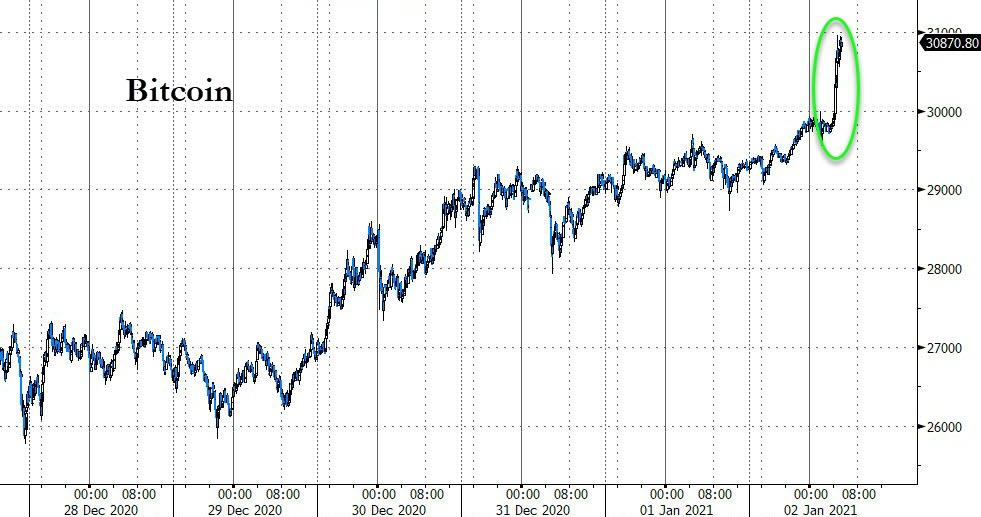
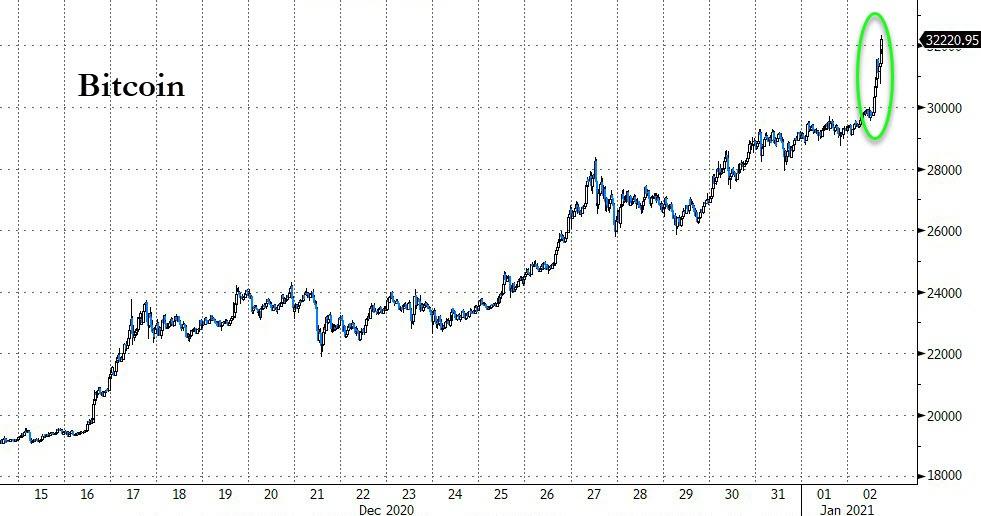
Update (1115ET): Well that escalated quickly. Less than an hour after first breaking above $30,000, Bitcoin has spike beyond $31k, then $32k...
Source: Bloomberg
...and now $33k...

Source: Bloomberg
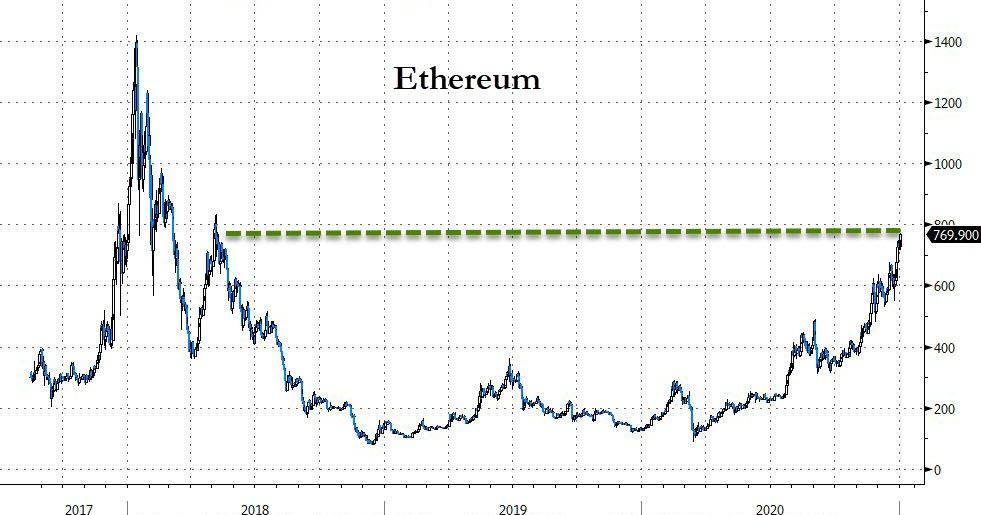
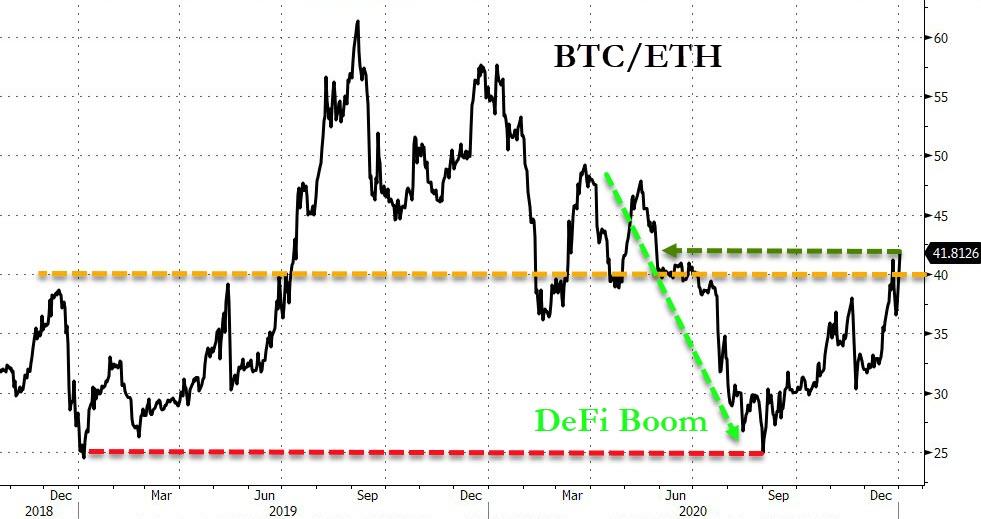
Ether is also extending gains, nearing $780, but BTC is now trading at almost 42x ETH - its highest since May, erasing much of the DeFi boom's effects on Ethereum...
Source: Bloomberg
* * *
Bitcoin prices accelerated overnight, surging through $30,000 for the first time and nearing $31,000 as we write...
Source: Bloomberg
Now over $10,000 beyond 2017's record high...
Source: Bloomberg
Ethereum was also bid to a new cycle high at $770, but well below its $1400-plus record from Jan 2018...
Source: Bloomberg
The area immediately below $30,000 had proven a source of intense selling pressure throughout the past few days, a setup similar to that which Bitcoin disrupted at $20,000 just weeks ago.
"If you're looking for an entry to HODL Bitcoin long term, don't nickel and dime an entry. You're not going to sweat a few thousand dollars of non-perfect entry when it's $100k,$200k,$300k in a year," popular statistician Willy Woo summarized on Friday.
"The main bull phase is here. Capital inflows has gone nuts."
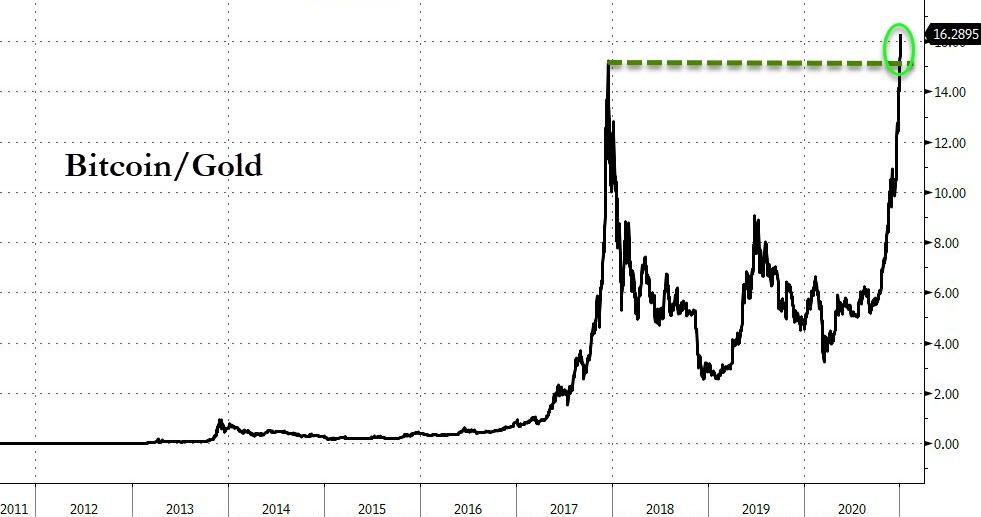
But while the crypto currency is rising in value against the dollar, Bitcoin price claimed another all-time high, this time against gold, offering further confirmation that demand for digital assets is on the rise...
Source: Bloomberg
As Bitcoin nears $31,000, the digital currency trades at over 16 ounces of gold, surpassing the 2017 highs (15.6).
As we detailed previously, Bitcoin’s biggest proponents believe the digital currency is eating away at gold’s market cap as investors opt for the efficiency, portability and proven scarcity of the asset. Astonishingly, that view is also shared by JPMorgan Chase analysts, who believe Bitcoin’s digital gold narrative is drawing capital away from precious metals.
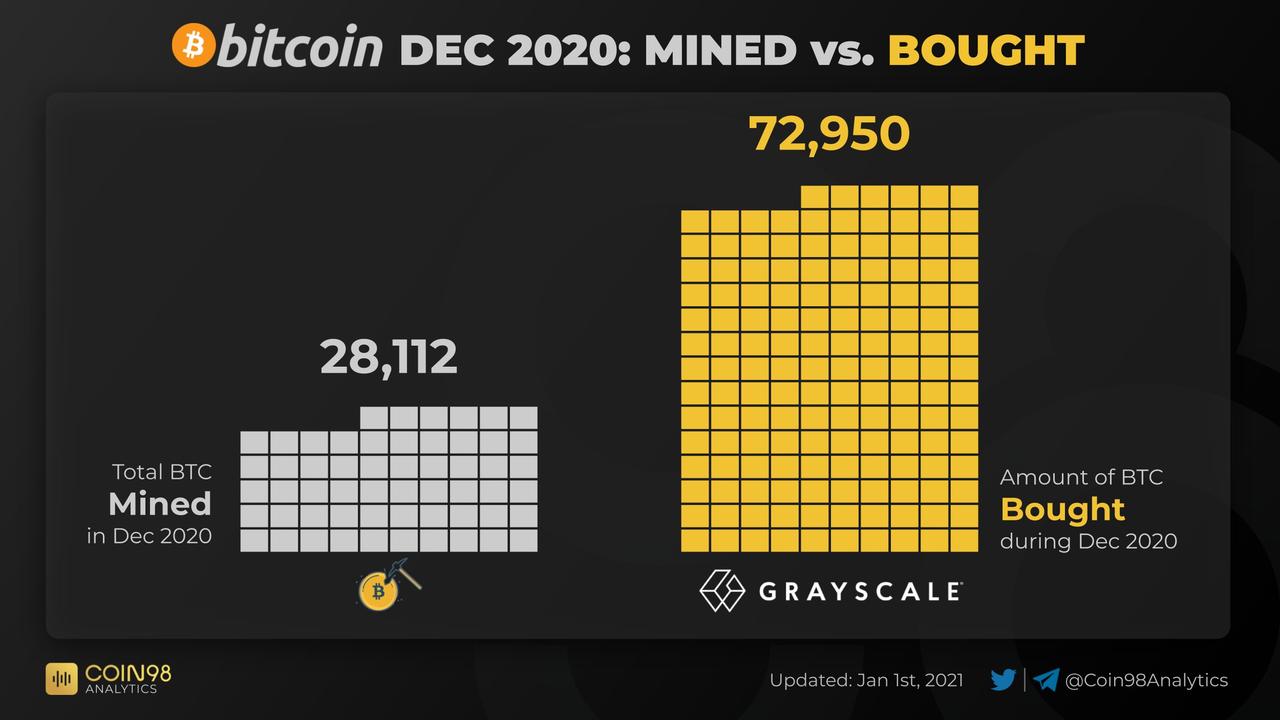
Additionally, as CoinTelegraph notes, some believe that Bitcoin’s supply squeeze could send prices higher over the course of 2021. Specifically, digital asset manager Grayscale bought up nearly three times the BTC mined in December. Demand from PayPal, Cash App and others has also contributed to an apparent supply shortage of BTC.
It's official: Miners can't produce enough Bitcoin
Last month, the company added a total of 72,950 BTC ($2.132 billion) to its assets under management (AUM). During the same period, miners generated just 28,112 BTC ($821.7 million) — 38.5% of Grayscale's buy-in.
The figures underscore what many have described as an ongoing liquidity squeeze in Bitcoin, where large buyers suck up any available supply and remove it from circulation, sending it to cold storage for long-term hodling.
As Cointelegraph reported, the phenomenon was already visible in November 2020, but December 2020 saw a clear increase in demand from Grayscale and other institutional entities.
BTC mined vs. bought by Grayscale in December 2020. Source: Coin98 Analytics/ Twitter
Grayscale now controls $20 billion in crypto
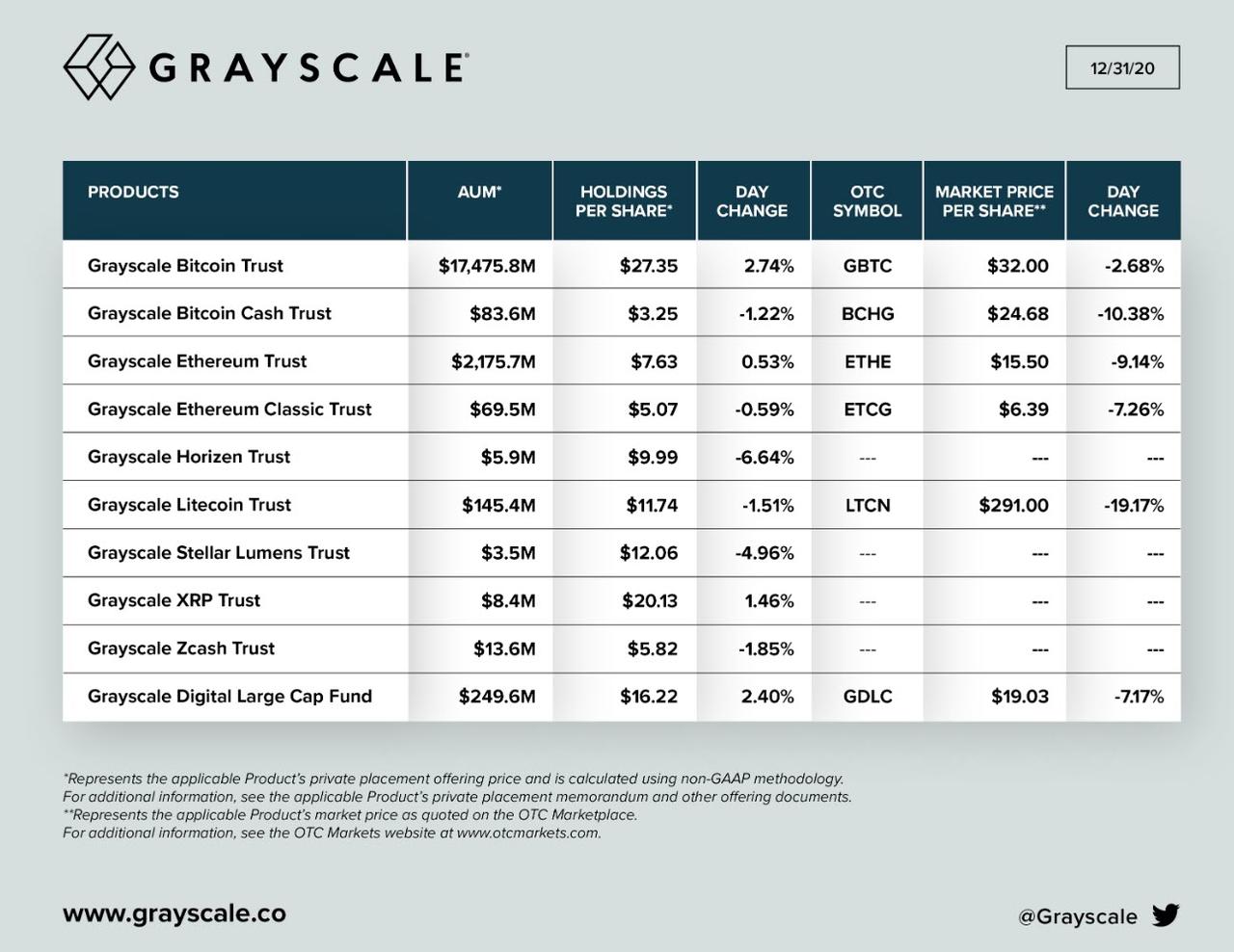
As the clock chimed midnight on New Year's Eve, meanwhile, Grayscale CEO Barry Silbert celebrated bringing the company's total AUM across its various crypto funds to over $20 billion. Just one year ago, the figure stood at a mere $2 billion.
Grayscale crypto assets under management as of Dec. 31, 2020. Source: Grayscale/ Twitter
The company remains the largest institutional player on the Bitcoin scene, with its $17.475 billion in BTC far outstripping any other market participant. Newcomer MicroStrategy, while not an investment business, now controls 70,470 BTC ($2.06 billion).
Going forward, analysts predict that more demand for the fixed supply of "new" Bitcoin from miners will only serve to create a bidding war and push up the price. Sellers already faced stiff resolve from buyers in December 2020, when new all-time highs failed to produce significant long-lasting pullbacks.

TechCrunch : Tesla delivers nearly 500,000 vehicles in 2020

Tesla delivers nearly 500,000 vehicles in 2020


Tesla delivered 499,550 vehicles in 2020, a 36% increase over the previous year and just a few dozen short of hitting an historic and long-awaited milestone that CEO Elon Musk has been aiming for more than five years.

Tesla reported Saturday that it produced 509,737 electric vehicles in 2020.

Tesla was able to reach the 500,000-vehicle target by ticking up production and sales in the fourth quarter — a final push that has mirrored numerous other end-of-the-quarter efforts by the company. Tesla delivered 180,570 in the fourth quarter, setting a new quarterly record and 30% higher than the previous quarter.

The company’s production and sales figures were also driven by the launch of the Model Y, its mid-sized SUV, and a new factory coming online in China.

The fourth quarter and annual figures shows the rise in demand for its more affordable and newer models and waning interest in its flagship Model S sedan and Model X SUV. The company delivered 18,920 Model S and Model X vehicles in the fourth quarter and 57,039 for the year. Sales of the Model 3 and Model Y hit nearly 162,000 in the fourth quarter and 442,511 for the year. Tesla doesn’t break out sales figures for each model, instead combining its older vehicles into one bucket and its newer Model 3 and Model Y vehicles in another. The company also doesn’t provide regional sales figures.

Producing and selling more than 500,000 vehicles a year seemed unreachable for Tesla just a handful of years ago. But Musk has taken a bullish view of the company, noting in 2015 that he remained confident that Tesla would be producing half a million cars in 2020.

“That’s five years from now,” Musk said at the time. “If you go five years in the past for Tesla, we were producing 600 cars per year—now we can produce 600 cars in three days. So I think going from here to 500,000 cars a year is a much smaller leap.”

Musk has reiterated that target periodically, including in January of last year when he noted that deliveries should comfortably exceed 500,000 units. Tesla didn’t adjust that forecast even as the COVID-19 pandemic upended the economy and forced the company, along with every other automaker, to temporarily pause production for several weeks last spring.


NY Post : Ex-Viacom shareholders can sue Shari Redstone over ViacomCBS merger

Ex-Viacom shareholders can sue Shari Redstone over ViacomCBS merger

A Delaware judge ruled this week that former Viacom shareholders may pursue a lawsuit accusing Shari Redstone of engineering a “patently unfair” merger that created ViacomCBS so she could become a media magnate like her late father, Sumner Redstone.

Vice Chancellor Joseph Slights of the Delaware Chancery Court said it was reasonable to infer from the plaintiffs’ claims that the December 2019 merger was “not entirely fair,” and that Redstone used it “to consolidate her control of Viacom and CBS at the expense of the Viacom minority stockholders.”

Shari Redstone’s National Amusements Inc had controlled about 80 percent of the voting power of both Viacom and CBS, despite owning about 10 percent of the respective shares.

Viacom shareholders, led by the California Public Employees’ Retirement System, the largest US public pension fund, accused Redstone of relentlessly pursuing a merger to advance her interests, including by replacing “subversive” directors with friends and relatives to get her way.

In his 76-page decision, Slights let the shareholders pursue breach of fiduciary duty claims against Redstone, National Amusements and Viacom directors who negotiated the merger.

He dismissed the same claim against ViacomCBS Chief Executive Bob Bakish, finding no evidence of wrongdoing and saying it appeared Bakish “deliberately chose not to flaunt his power as chief executive.”

ViacomCBS’ businesses include CBS television, CBS News, Showtime, Comedy Central, MTV, Nickelodeon and the Paramount movie studio. Redstone is the New York-based company’s non-executive chairman.

Slights’ decision is dated Tuesday. Lawyers for the defendants and the shareholders did not immediately respond on Thursday to requests for comment.

ViacomCBS is not a defendant. A related lawsuit by former CBS shareholders against Redstone, National Amusements and former CBS directors is pending in the Delaware court.

The ViacomCBS merger followed unsuccessful merger attempts in 2016 and 2018. Sumner Redstone had split the companies at the beginning of 2006. He died on Aug. 11 at age 97.

NY Post : A Harvard professor says an alien visited in 2017 — and more are comin

A Harvard professor says an alien visited in 2017 — and more are coming
When the first sign of intelligent life first visits us from space, it won’t be a giant saucer hovering over New York. More likely, it will be an alien civilization’s trash.
Avi Loeb, the chair of Harvard’s Department of Astronomy, believes he’s already found some of that garbage.
In his upcoming book, “Extraterrestrial: The First Sign of Intelligent Life Beyond Earth” (Houghton Mifflin Harcourt), out Jan. 26, the professor lays out a compelling case for why an object that recently wandered into our solar system was not just another rock but actually a piece of alien technology.
The object in question traveled toward our solar system from the direction of Vega, a nearby star 25 light-years away, and intercepted our solar system’s orbital plane on Sept. 6, 2017.
On Sept. 9, its trajectory brought it closest to the sun. At the end of September, it blasted at about 58,900 miles per hour past Venus’ orbital distance, and then, on Oct. 7, it shot past Earth’s before “moving swiftly toward the constellation Pegasus and the blackness beyond,” Loeb writes in the book.
The object was first spotted by an observatory in Hawaii containing the Panoramic Survey Telescope and Rapid Response System (Pan-STARRS) — the highest definition telescope on earth.
The space object was dubbed ‘Oumuamua (pronounced “oh moo ah moo ah”), which is Hawaiian for — roughly — “scout.”
As space travelers go, it was relatively small at just about 100 yards long, but it was a big deal in the scientific community.

For starters, it was the first interstellar object ever detected inside our solar system. Judging from the object’s trajectory, astronomers concluded it was not bound by the sun’s gravity — which suggested it was just traveling through.
No crisp photos could be taken, but astronomers were able to train their telescopes on the object for 11 days, collecting reams of other data.
At first, scientists thought it was an ordinary comet. But Loeb said that assumption ran the risk of allowing “the familiar to define what we might discover.”
“What would happen if a caveman saw a cellphone?” he asked. “He’s seen rocks all his life, and he would have thought it was just a shiny rock.”
Loeb soon opened his mind to another possibility: It was not a comet but discarded tech from an alien civilization.
A number of unusual properties about the object helped Loeb make this conclusion.
First were ‘Oumuamua’s dimensions.
Astronomers looked at the way the object reflected sunlight. Its brightness varied tenfold every eight hours, suggesting that was the amount of time it took for it to complete a full rotation.
Scientists concluded the object was at least five to ten times longer than it was wide — sort of like the shape of a cigar.

No naturally occurring space body we’ve ever seen has looked like it — or even close.
“This would make ‘Oumuamua’s geometry more extreme by at least a few times in aspect ratio — or its width to its height — than the most extreme asteroids or comets that we have ever seen,” Loeb writes in his book.
What’s more, ‘Oumuamua was unusually bright. It was at least “ten times more reflective than typical solar system [stony] asteroids or comets,” the author writes.
He likens its surface to that of shiny metal.
But the anomaly that really pushed Loeb toward his E.T. hypothesis was the way ‘Oumuamua moved.
“The excess push away from the sun — that was the thing that broke the camel’s back,” he said.
Using physics, scientists can calculate the exact path an object should take and what speed it should travel due to the gravitational force exerted by the sun. The sun’s pull will speed up an object massively as it gets closer, then kick it out the other side, only for the object to slow considerably as it gets farther away.

But ‘Oumuamua didn’t follow this calculated trajectory. The object, in fact, accelerated “slightly, but to a highly statistically significant extent,” Loeb writes, as it moved away from the sun.
In other words, it was clearly being pushed by a force besides the sun’s gravity alone.
At first the explanation seemed simple. Comets show a similar acceleration, because as they approach the sun, their surface is warmed, releasing once-frozen gases, which act like a rocket engine.
Those released materials, however, form a comet’s distinctive tail. Scientists looked carefully for that tail or any sign of gases or dust that might propel ‘Oumuamua and came up empty.
Loeb calculated that with these and other anomalies, the chances that ‘Oumuamua was some random comet was around one in a quadrillion, leading him to his blockbuster hypothesis.
But what was it exactly?
One possibility, weirdly enough, could be found in technology we already have here on earth.

Some 400 years ago, astronomer Johannes Kepler observed comet tails blowing in what looked like a solar breeze and wondered if that same force could propel rocket ships through space like the wind pushes boats through water.
It was a smart idea that scientists now use to develop light sails for probes. Thin, reflective sheeting is unfurled in space to capture the particles streaming off the sun, propelling a ship at great speeds through the empty void. Alternatively, powerful lasers from earth could be aimed at the sail to make it go even faster.
Loeb, who is involved in a light-sail project to send a tiny, unmanned craft to a nearby star, said if we earthlings have thought of this idea, then why couldn’t aliens?
He and a colleague crunched the numbers and hypothesized that ‘Oumuamua was not actually cigar-shaped but possibly a disk less than a millimeter thick, with sail-like proportions that would account for its unusual acceleration as it moved away from the sun.
As to its purpose, Loeb isn’t entirely sure. He speculated it could be “space junk” that once served as a kind of space navigation buoy used by a long-ago civilization.
“The only way to look for [alien civilizations] is to look for their trash, like investigative journalists who look through celebrities’ trash,” Loeb said.
Of course, not everyone in the scientific community agrees with his theory.
In July 2019, the ‘Oumuamua Team of the International Space Science Institute published an article in Nature Astronomy concluding, “We find no compelling evidence to favor an alien explanation for ‘Oumuamua.”
Loeb admits his theories have raised astronomers’ eyebrows, but he is resolute about his findings. “Some people do not want to discuss the possibility that there are other civilizations out there,” he told The Post. “They believe we are special and unique. I think it’s a prejudice that should be abandoned.”
Loeb said the skeptics are bending over backwards to assign natural origins to the object and that the explanations they’ve given to explain its weird properties don’t stand up to scrutiny.
For example, some scientists have suggested that ‘Oumuamua’s acceleration was caused by frozen hydrogen on its surface turning to gas and driving it like a comet, and that hydrogen would have been invisible to Earth’s infrared cameras, which is why we didn’t detect it.
But Loeb and a colleague published a paper showing that “a hydrogen iceberg traveling through interstellar space would evaporate long before it reached our solar system.”
Whatever the truth, the stakes are high.
The acceptance that an alien race has made contact — even through its trash — would trigger a serious search for more trash, leading us to scour the moon and Mars, for example, for debris that might have crash-landed thousands or millions of years ago.
And if more evidence is found, we earthlings would have to start building tools to help us grapple with extraterrestrials, such as space treaties and academic fields like astro-linguistics and astro-economics.
But, perhaps more important, any further discoveries could redefine our place in the universe.
“It would put us in perspective,” Loeb said. “If we are not alone, are we the smartest kids on the block? If there was a species that eliminated itself through war or changing the climate, we can get our act together and behave better. Instead, we are wasting a lot of resources on Earth fighting each other and other negative things that are a big waste.”
Since ‘Oumuamua’s appearance, a second interstellar object known as 2I/Borisov was spotted entering the solar system by a Crimean telescope in 2019. But that turned out to be a plain old comet.
Until recently, our instruments have not been sensitive enough to pick up these kinds of visitors. But Loeb said technology will soon make it possible to locate more space travelers, and the only way the mystery of ‘Oumuamua will be settled is if a similar object is spotted and more thoroughly investigated with a probe.
He said his book “should motivate people to collect more data on the next object that looks weird.”
“If we find another and we take a photo and it looks like a light sail, I don’t think anyone will argue with that.”