Business Of Fashion : The 10 Themes That Will Define the Fashion Agenda in 2021


(ZH) Natelson: There Is No Constitutional Ground For Impeachment Of President Tr

Natelson: There Is No Constitutional Ground For Impeachment Of President Trump

Any effort to impeach the president for comments made to Washington demonstrators would be flatly unconstitutional...
The Constitution permits impeachment and removal of the president for “Treason, Bribery, or other high Crimes and Misdemeanors.”
There’s no reasonable claim that President Donald Trump’s speech, which largely focused on disputed, but credible, claims of election irregularities, was treasonous or involved a bribe. And in the absence of proof of deliberate incitement to riot, it wasn’t a “high Crime.”
So, as in the former Trump impeachment, the only potential basis for removal from office would be commission of a “high … Misdemeanor.” (We know from founding-era evidence that in the Constitution the adjective “high” modifies “Misdemeanor” as well as “Crime.”)
The previous impeachment proceedings were marked by a debate over the meaning of the phrase “high misdemeanor.” Each of the four academic experts who testified at the House of Representatives Judiciary Committee offered their own definitions. The prosecutors and the president’s defense team offered their own definitions, too.
This disagreement reflected an academic dispute that had been going on for many years. Based on incomplete surveys of the founding-era record and on British impeachment trials, researchers had reached very different conclusions about the meaning of “high misdemeanor.”
Unfortunately, however, almost no researcher (including me) had thought to examine the sources that might define the phrase authoritatively. Those sources were 18th century English and American law books.
The Constitution is first and foremost a legal document—the “supreme Law of the Land.” Most of its framers were lawyers, as were most of those who explained it to the general public. Moreover, at the time the American general public was unusually knowledgeable about law.
Thus, if the phrase “high misdemeanors” had a clear legal meaning and no other clear meaning, then we would expect the legal meaning to control. In this respect, the phrase “high misdemeanors” would be like other recognized legal terms in the Constitution: “Habeas Corpus,” “Equity,” “bail,” “Privileges and Immunities,” and so forth.
The Trump impeachment proceedings inspired me to undertake a comprehensive survey of founding-era legal sources to see if “high misdemeanors” had a defined legal meaning. If it did, that would resolve the long-standing debate.
In constitutional research, the sources frequently don’t yield overwhelming, one-sided evidence for an indisputable result. But it happened here. I was very surprised by this outcome, which contradicted what I had written previously. Nevertheless, I quickly admitted my mistake and duly published (pdf) the new findings.
It turns out that “high misdemeanor” was in fact a precisely defined legal term: It meant “serious crimes not meriting the death penalty.”
Here’s the background:
In 18th century England and America, the legal word “misdemeanor” technically included all crimes of any level of gravity. The most serious misdemeanors were denominated felonies (or high crimes). Felonies traditionally were punishable by death. The most serious felony was treason, and a person convicted of treason usually suffered a particularly horrible death: a man was drawn and quartered; a woman was drawn and burnt.
Lesser felonies—at common law there were nine of them—traditionally were punished by hanging. Examples are murder, rape, burglary, and robbery. (Happily, I can report that by the time of the founding, first offenders often received more lenient sentences.)
Serious offenses other than treason and felony were punished by prison time and by heavy fines rather than by death. These offenses included, among others, bribery, attempted murder, assisting a duel, certain kinds of blackmail, and so forth. Offenses in this category were called great misdemeanors, great misprisions, or high misdemeanors.
Lesser offenses were simply called “misdemeanors.”
This criminal-law usage arose in England, but it was followed in America as well. For example, in my research I uncovered several congressional statutes passed in the 1790s that designated serious crimes as “high misdemeanors” and imposed penalties accordingly. As in England, Congress labeled lesser crimes merely as “misdemeanors.”
So a “high misdemeanor” was a serious crime not meriting the death penalty. The icing on the cake from this conclusion was that it resolved some other questions that had puzzled scholars as well. And it explained the structure of the Constitution’s Impeachment Clause: the words “Treason, Bribery, or other high Crimes and Misdemeanors” provide one example of a high crime (treason), one example of a high misdemeanor (bribery), and include generic clauses covering other crimes in the same two categories.
Observe what is excluded from the grounds for impeachment. Congress may not impeach and remove for a minor crime. Nor may it do so because an officer is reckless, negligent, or has obnoxious political opinions. The constitutional penalty for those breaches is, for lesser officers, removal by the president and, for the president and vice-president, re-election defeat.
It’s significant that in the biennium since these findings were published, no scholar has even attempted to rebut them. Nor can they be convincingly rebutted, given the volume and consistency of the evidence.
While debate over the meaning of the term continued, the House of Representatives could reasonably assume that non-criminal behavior could constitute a “high misdemeanor.” But that’s no longer true. Now we can say unequivocally that whatever you may think of the president’s speech, it’s not a basis for impeachment.
* * *
Robert G. Natelson is a leading originalist scholar who served as a law professor for 25 years. He is a senior fellow in constitutional jurisprudence at the Independence Institute in Denver. His research articles on the Constitution’s meaning have been cited repeatedly by justices and parties in the Supreme Court.

(ZH) Nearly Half Of Republicans Approve Of Capitol Riot

Nearly Half Of Republicans Approve Of Capitol Riot

The U.S. Capitol building was stormed by an angry pro-Trump mob on Jan. 6. Overall, five people died as a result of the riot – one woman shot as she tried to break into a room of lawmakers, three people who died of medical emergencies in the crowd and one Capitol Police Officer who later died due to head injuries sustained from an attack by a rioter.
The attack occurred during the early moments of Congress counting all electoral votes in a largely ceremonious declaration of President-elect Biden as the incoming successor to Trump. Continued claims of election fraud from Trump over the last two months, parroted by a minority of Republicans in the House and Senate, led to a few lawmakers objecting to certain swing states’ electoral votes.
At times during the attack, Capitol Police either nonchalantly allowed rioters to get closer to the Capitol or outright encouraged the mob to gather right at its doors and windows. Several videos show sections of police using little or no force in stopping the mob, with some standing to take selfies. Three of the four Capitol Police Board members have since resigned.
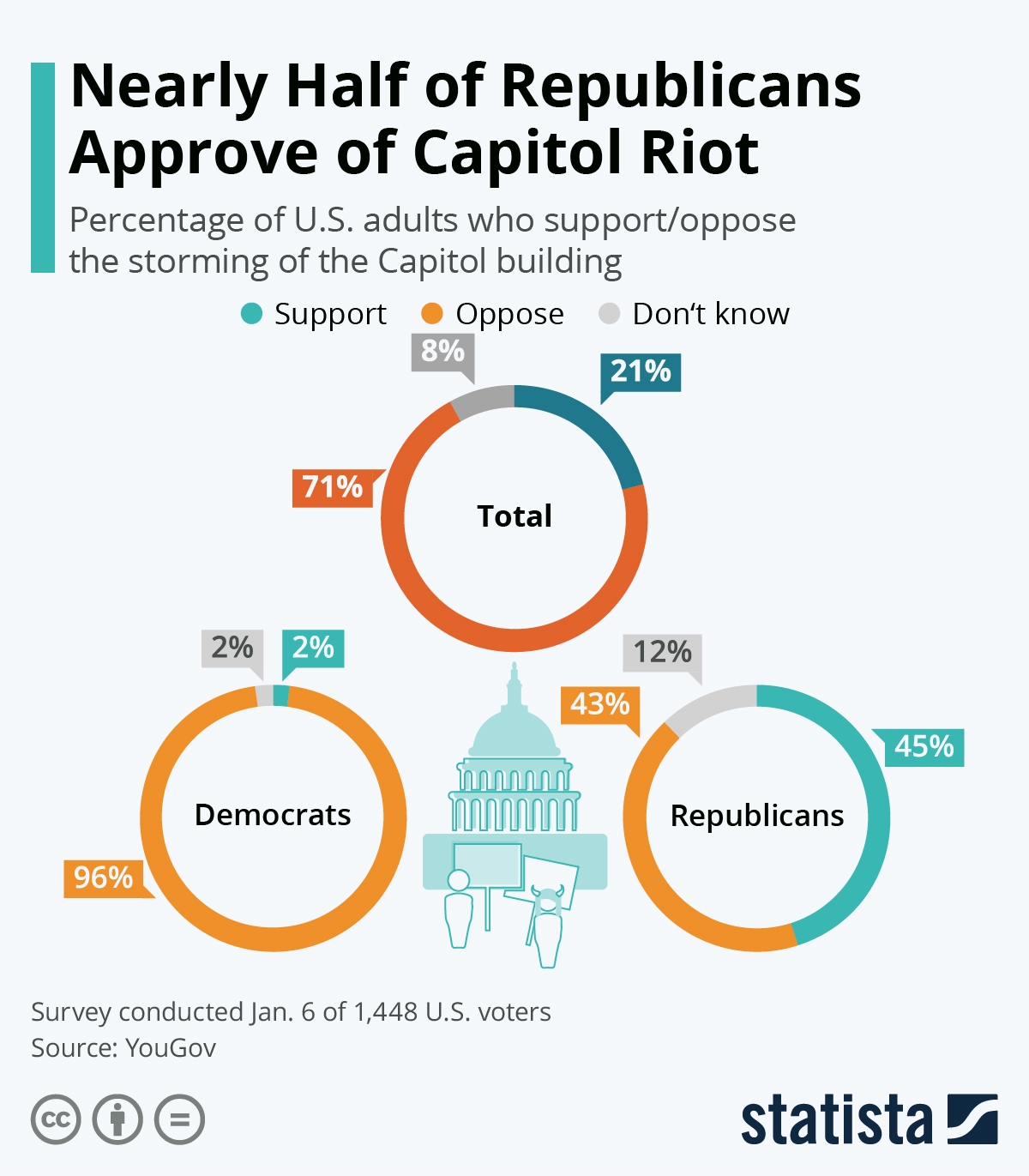
According to a recent YouGov survey, while a majority of Americans oppose the violent attack on the U.S. Capitol, 45 percent of Republicans say they’re in support of the riot and believe it’s justified. That’s roughly 33 million voters across the country...
You will find more infographics at Statista
As YouGov notes, the partisan difference in support could be down to differing perceptions of the nature of the protests.
While 59% of voters who are aware of the events at the Capitol perceive them as being more violent than more peaceful (28%), the opposite is true of Republicans. By 58% to 22%, Republicans see the goings on as more peaceful than more violent.
Democrats are swiftly moving to draft articles of impeachment against Trump before his term ends in less than two weeks. The party is also hoping to implement the 25th amendment, which would have two-thirds of Congress vote to remove Trump from office and install Vice President Pence for the remainder of the term. Both appear unlikely to gain enough Republican support, but huge cracks within the GOP are emerging following the Capitol attack as anger builds across both parties.
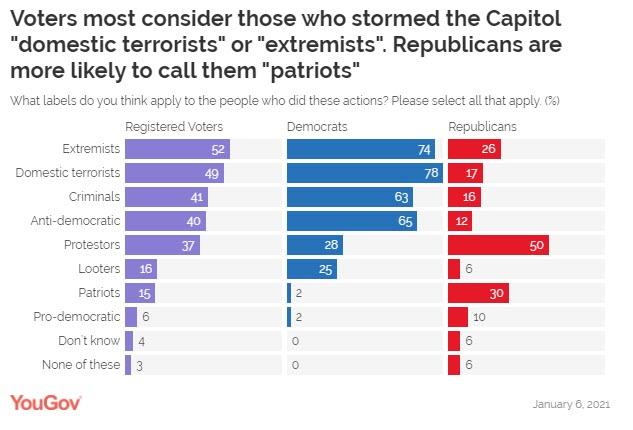
Those on both sides of the dispute are at odds in their descriptions of those currently occupying the US Capitol.
About half (52%) of voters agree with the “extremist” label, the most commonly selected of all the terms we put to respondents (but the split between Republicans and Democrats is vast). Nearly as many (49%) think “domestic terrorists” is an appropriate title, and 41% consider them “criminals.”

(ZH) Record Investor Euphoria Is Now Literally Off The Chart

Record Investor Euphoria Is Now Literally Off The Chart

The past few months can best be characterized as a period of unprecedented market optimism and sheer euphoria, and we have done just that with several recent articles...
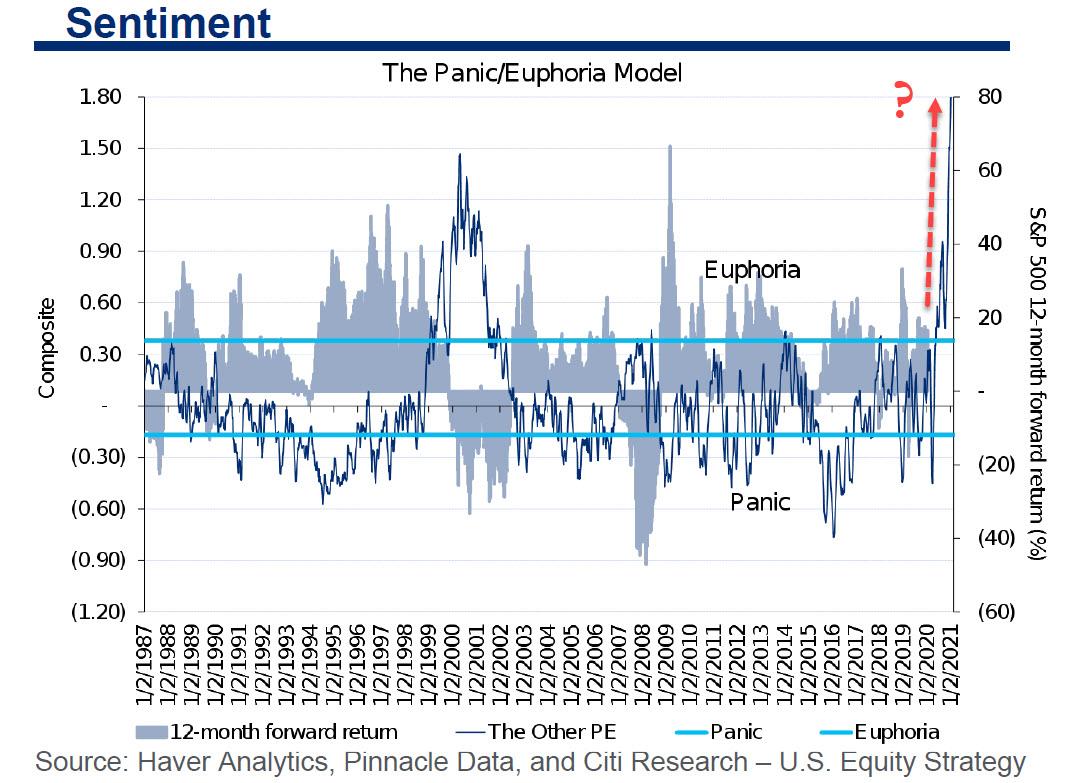
... and so on. But whereas in the recent past, the euphoria was always bounded by the upper limit reached during the insatiable buying spree of the dot com bubble, the first week of the year is when we went off the chart. Literally.
As the latest Citi Panic/Euphoria model shows, this week’s Panic/Euphoria jumped to a record 1.83 versus an upwardly revised 1.69 in the prior week.
What does this mean? It's simple: as Citi chief economist Tobias Levkovich writes when looking at market returns following previous euphoria extremes, there is now a "100% historical probability of down markets in the next 12 months at current levels."
"Nasdaq Volume as % NYSE (though volatile), retail money market funds, margin debt, AAII & II bullishness, put/call premiums and NYSE short interest ratio all contributed to the elevated reading" according to Citi.
And just to make it extra confusing, in the same report Levkovich writes that "the normalized earnings yield gap analysis is 1.56 standard deviations below its 40-year average, yielding an 88% probability of higher markets in a year’s time, based on history." So... 100% probability the market will be lower and 88% probability it will be higher: brilliant.
It wasn't just Citi stunned by the record market euphoria: in his latest Flows and Liquidity report, JPM quant Nick Panigirtzoglou took a break from bashing bitcoin (well not really, more on that in a subsequent post, suffice to say anyone who listened to him and sold last Friday has missed out on 35% gains in the past week), and instead muses at the resilience of the market, driven by - what else - investor euphoria, to wit:
This week's Democratic sweep added more fuel to risk markets and pushed US government bond yields to new highs. Neither the violent scenes from Capitol Hill nor the potential negatives from a Democratic sweep, i.e. tax rises and stricter regulations, managed to unsettle risk markets this week. Risk markets exhibited similar resilience in December. At the time, neither the lack of any new policy impulse by the Fed, pension fund rebalancing flows nor fears about the UK variant of the virus managed to unnerve risk markets.
What, according to JPM, explains this remarkable resilience of equity and risk markets more generally since December? The answer is simple: central banks, or rather liquidity, "which appears to be reverberating once again in an intense manner via retail investors, in a repeat to Q2 of last year." Panigirtzoglou points to retail investors' activity, especially that of younger cohorts, and says that as the "anticipation of further US stimulus checks", or stimmies as they are better known...
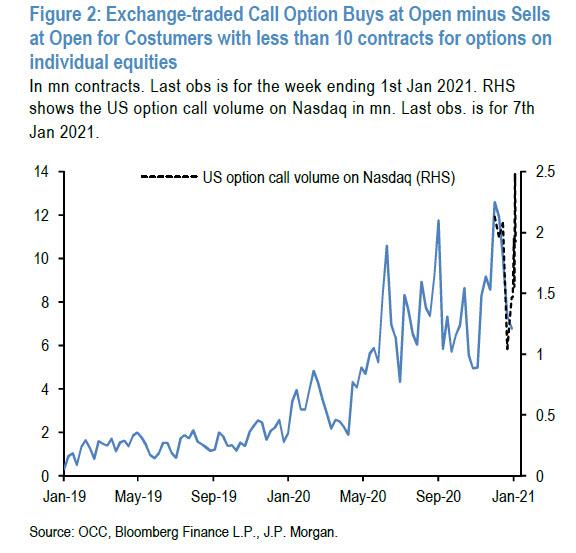
... "this force is likely to be sustained over the coming weeks", JPM says and points to several indicators of euphoric retail trader activity including record call option trading both on exchange, which is forcing yet another gamma-squeeze (or as JPM puts it "To the extent this accumulation of long call options by retail investors continues, it could eventually result in a rise in vol via the delta-hedging of accumulated short call option positions by dealers taking the other side, similar to last August")...
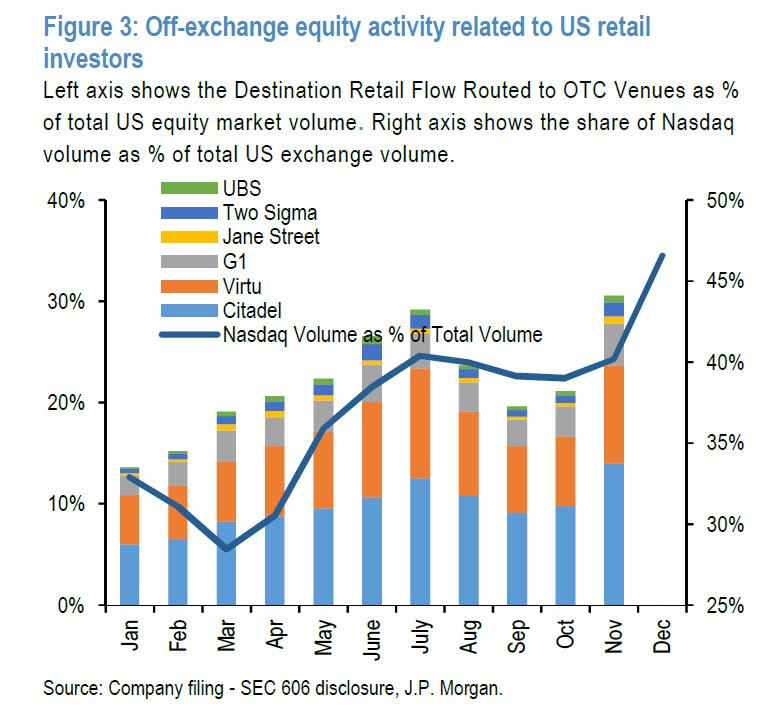
... as well as off.
To quantify the latter, JPM looks at the six main OTC market venues used by retail brokers: Virtu Americas LLC, Citadel Execution Services, G1 execution services, Two Sigma Securities LLC, Wolverine Securities LLC and UBS Securities LLC. The chart below shows the aggregate share to OTC transaction routed to different market venues (destination flow) by retail brokers, again as percentage of total US equity market volume. After slowing during the third quarter, US retail activity has "rebounded strongly in November.
And this chart is only through November: one can only imagine that we will need a bigger chart for the December print here too.
In summary, JPM concludes that the record euphoria is due to "the liquidity force" - i.e., central banks and the latest round of fiscal stimulus - which "appears to be reverberating once again in an intense manner via retail investors, in a repeat of Q2 of last year. Given the anticipation of further fiscal support (e.g. additional US stimulus checks of $1400 to get to the original proposal of $2000), this force is likely to be sustained over the coming weeks."

WSJ : The Top Stock Funds of 2020

The Top Stock Funds of 2020
Morgan Stanley’s Inception Portfolio, under Dennis Lynch, won the stock-fund race with a gain of 150%

Over the past 12 months, a pandemic has led to the deaths of hundreds of thousands of Americans, and lockdowns have pummeled businesses and the economy.

The stock market, however, shrugged off much of this gloom. Even when knocked off course by a wave of fear, share prices repeatedly bounced back, leaving bellwethers like the Dow Jones Industrial Average and the S&P 500 index setting new records by year’s end.

Investors in actively managed mutual funds fared even better, according to data from Refinitiv Lipper. While the Dow climbed 7.2% in 2020 and the S&P 500 wrapped up the year with a gain of more than 16%, the average diversified U.S. stock fund rewarded investors with a 19.1% increase.

The Wall Street Journal’s quarterly Winners’ Circle survey of top-performing actively managed U.S. stock mutual funds reveals that a baker’s dozen delivered gains of at least 100% for the 12 months ended Dec. 31, leaving a lucky subset of fund investors feeling that 2020 wasn’t such a grim year after all. The best of the bunch, measured only by raw performance numbers over that period, was Morgan Stanley Institutional Inception fund (MSSGX), which posted a gain of 150.6%, including a 19.5% surge in the final four weeks of the year, according to data from Morningstar.

“We had this perfect storm, with low rates creating little in the way of alternatives” to stocks last year, says Dennis Lynch, head of the Counterpoint Global team at Morgan Stanley Investment Management, who oversees the fund. His team also manages three other funds that posted triple-digit gains in 2020, including Morgan Stanley Institutional Discovery fund (MPEGX). It posted a gain of 142.6% for the year, making it the fifth-best performer in our quarterly survey.

These and other Morgan Stanley funds had “more than our fair share of investments in companies benefiting from e-commerce, people working from home, streaming entertainment and e-commerce,” Mr. Lynch says. Companies such as Square Inc., SQ 0.82% Tesla Inc., TSLA 7.84% Zoom Video Communications, ZM 2.08% Spotify Technology SA SPOT 6.56% or Twilio Inc., TWLO 0.87% he has said in previous discussions with The Wall Street Journal, have formed part of his portfolios in recent years, as he and his team recognized their potential to shake up how businesses function. During the pandemic, that process accelerated, transforming these stocks into market darlings.

“This isn’t just a one-year thing,” says Ron Baron, founder and manager of Winners’ Circle runner-up Baron Partners fund (BPTRX), which delivered a 148.5% return to investors in 2020. “We’re seeing the benefits of decisions we made five years ago” or more, he says. Nor does Mr. Baron claim any credit for anticipating either the pandemic or the form that stock-market returns would take as a result. “We just gravitate to entrepreneurial companies with disruptive businesses changing the world—businesses that have irreplaceable assets,” he says.

In third place at the end of 2020 was American Beacon ARK Transformational Innovation fund (ADNIX), which posted a gain of nearly 148%, more than 30 percentage points higher than its third-place finish for the 12-month period ended Sept. 30. The fund, managed by Catherine Wood, chief executive officer of ARK Investment, also has benefited from investing in disruptive, future-oriented business models. The pandemic, Ms. Wood has noted, “accelerated the uptake” rate of an array of products and services provided by companies in which the ARK team already had established positions.

To produce these quarterly rankings of top U.S. equity funds, The Wall Street Journal draws on data from Morningstar for the trailing 12-month period. We limit the universe we examine to those diversified funds that are actively managed by portfolio managers and teams of analysts, and exclude index funds and quantitative funds based on models rather than on research and stock selection by managers. We also don’t include in these rankings any sector fund, or funds that use leverage to amplify their returns. Neither do we add exchange-traded funds to this mix.

Our goal is to shed light on how managers who have performed well recently approached the market, and what led them to invest in the stocks that contributed most heavily to their outperformance. Investors shouldn’t view this as any kind of recommendation, however, and should always undertake their own research into whether these funds—or any others—are suitable for them. Some may have above-average fees, uneven return patterns, or may not be readily accessible to individual investors, for instance.

Looking at the funds that have dominated our list of outperforming stock funds over the course of the year does produce some interesting insights, however.

Score at the Quarter
After U.S.-stock funds began the year with two startling quarters—one down, one up—the positive returns continued in the third and fourth quarters. Average total return for U.S. diversified funds, compared with international-stock funds and bond funds (funds focusing on intermediate-maturity, investment-grade debt).


For starters, there was the Tesla factor. Funds that owned shares in the electric-car maker were pretty much guaranteed to end up on the top of the heap in 2020, thanks to the 743% surge in its stock price. Mr. Baron, for instance, says that as of last week his portfolios own Tesla stock valued at $47.75 billion: of that, he says, $45 billion is profit on a position he first established in 2014. Mr. Baron expects SpaceX, the rocket and satellite-launch business created by Tesla’s founder, Elon Musk, to be just as lucrative for its potential investors in the years to come.

While most top-performing mutual-fund managers oversaw relatively concentrated funds and could boast of being early investors in some of the pandemic’s biggest beneficiaries like Zoom or Spotify, they emphasize that their smaller-than-average portfolios are surprisingly diverse.

Mr. Lynch, for instance, has built a position in Utz Brands Inc. UTZ -0.83% since the chip-and-pretzel maker went public (via a merger with a special-purpose acquisition vehicle) in August. The new company’s share price has been volatile since its debut, but Mr. Lynch isn’t worried. “They have a big brand, they are one of the few companies to have a national distribution platform, and they are a family-owned business that has been well-run for a long time,” he says of the 99-year-old company. Retail spending is struggling, but Mr. Lynch says this is the kind of holding that will help his funds continue to deliver healthy returns.

Mr. Baron, meanwhile, remains a fan of resort and travel companies like Hyatt Hotels Corp. H -0.28% and Vail Resorts Inc. MTN -2.27% Savvy management will help them ride out the pandemic, he says, and position them for renewed growth once the Covid-19 vaccine has been widely distributed. Mr. Baron’s son and co-manager, Michael Baron, says, “We knew that Hyatt could weather the storm since they had built up enough cash on their books to last for three years.” Some companies worry about how they will woo back their customers, but the younger Mr. Baron says Hyatt already has a strategy in place.

Combining the perspective of two generations in building the portfolio has led to some great discussions, father and son agree. “Michael is more skeptical that travel will look like it did before,” says the elder Mr. Baron. The younger Mr. Baron points to the investment rationale behind the fund’s stake in gaming company Activision Blizzard Inc. ATVI 1.82% “I’ve never been a gamer myself,” he says, “but I do understand how these games provide a social element, and how Activision is blurring the line between gaming and video entertainment.”

For his part, Mr. Lynch is not only broadening the nature of his holdings but adding significantly to their number. A year ago at this time, the concentrated funds that he manages and that frequently appeared on The Wall Street Journal’s list of outperformers had fewer positions than they do today. The Discovery Fund, for example, had anywhere from 30 to 40 active investments; today that number is between 40 and 60. He declined to comment on recent portfolio changes.

What Mr. Lynch does note is that the pandemic and the drop in interest rates have caused investors to bid up the prices of many of those companies and industries that have beaten the odds and continue to generate growth. In an investment environment where bitcoin has become one of the top-performing “asset classes,” investors of all stripes are willing to tolerate premium valuations.

“A lot of market returns have been pulled forward” in time, he says. Even if those companies whose stocks soared last year—as investors sought pockets of above-average growth—continue to deliver solid gains in revenue and earnings in 2021 and beyond, their stock prices could plateau.

The result, Mr. Lynch says, is that future stock-market returns could be a lot lower. He adds that his own expectations are “much lower,” even though he remains comfortable hanging on to many of those stocks that have transformed his funds into top performers. Still, the gap between what those favorite stocks can deliver and the likely returns of the stocks that Mr. Lynch until now has put to one side as being less appealing already has narrowed. “Our level of conviction just isn’t as high as it was a year ago,” he says.

FT : Saudi Arabia tries to lure multinationals from Dubai

Saudi Arabia tries to lure multinationals from Dubai
Crown prince spearheads campaign as part of vision to become regional business hub

Saudi Arabia’s Crown Prince Mohammed bin Salman is spearheading a campaign to convince multinationals from Google to Siemens to relocate their regional headquarters from Dubai to Riyadh. 

Under the initiative, dubbed “Programme HQ”, Saudi authorities are offering incentives to blue-chip companies in sectors such as IT, finance and oil services to move to Riyadh, according to consultants advising the government and executives who have heard the pitch.

The aim of the initiative is to bolster foreign investment and support the crown prince’s ambitious vision to establish the kingdom as a regional business hub. “They are looking at the regional HQs, not the operating units, so they basically want the senior leadership,” said an executive briefed on the plans. “I think it’s about the optics: ‘we are a serious player, we are the largest market, we want the companies that do business here to be based here’”.

The campaign underscores how Saudi Arabia, the Gulf’s biggest economy, is using its financial clout to step up competition with Dubai, the regional trade, finance and tourism hub, as Prince Mohammed drives the development of a string of megaprojects. Virtually all big companies operating in the oil-rich Gulf have their regional headquarters in the United Arab Emirates. The Saudi move comes as Gulf economies are struggling because of the pandemic and the collapse of the oil price.

The campaign has gathered momentum ahead of the annual investor conference organised by the Public Investment Fund, the sovereign wealth fund chaired by the crown prince, scheduled to begin on January 26. 

One executive said he believed the kingdom hoped to showcase memorandums of understanding with companies that had provisionally agreed to make the switch from Dubai to Riyadh to highlight progress made with Prince Mohammed’s “Vision 2030” plan to modernise the kingdom and overhaul its economy. 

“What they are saying, very constructively, [is] what do you need? What sort of environment, ecosystem, infrastructures [do you need] to be based here,” the executive said. 

A consultant working in the kingdom said “it’s more like who hasn’t been tapped up,” in reference to the companies being approached.

Saudi Arabia wants to lure groups to the King Abdullah Financial District, a vast development of 59 skyscrapers in northern Riyadh that lacks tenants, executives said. “It’s about attracting key international anchor tenants,” said a Saudi government adviser briefed on the plans.

Incentives on offer include a 50-year tax holiday, waiving quotas on the employment of Saudis — which has proved to be a burden for companies — and guarantees of protection against future regulations, said three consultants. 

But executives said companies were lukewarm to “Programme HQ” as they balanced the implications of relocating senior executives from Dubai, which is more liberal, better connected and has state of the art infrastructure including good schools, with the need to placate influential Saudi officials.

Companies are nonetheless considering shifting various business units — if not their regional management — to Riyadh to appease Saudi concerns, consultants and executives said.

Many businesses have already put aside any concerns about the reputational risk of working in the kingdom after the brutal 2018 murder of Jamal Khashoggi by Saudi agents and other human rights abuses. 

Google Cloud last month agreed with Saudi Aramco, the state oil company, to deliver cloud computing services infrastructure, which will lead to the tech company opening its first office in the kingdom.

Saudi Telecom also announced a $500m deal with Alibaba Cloud, part of the Chinese group, for similar services. Western Union invested $200m for a 15 per cent stake in STC’s mobile wallet unit.

“My phone’s been ringing off the hook by high-tech companies wanting to expand in Saudi Arabia the last few weeks,” said Sam Blatteis, a former Gulf head of government relations for Google, who advises tech multinationals. “The coronavirus [pandemic] has created fertile soil for them in Saudi Arabia.”

Saudi Arabia’s investment ministry declined to comment. The Riyadh city commission did not respond to an emailed request for comment. 

FT : Airbnb hosts use platform to lure clients into private rentals

Airbnb hosts use platform to lure clients into private rentals
Property owners look to avoid fees after being badly burnt by pandemic refunds

The pressures of the pandemic are driving more Airbnb hosts to lure users into booking their properties privately, further straining the already fraught relationship between the company and some of its larger hosts.

The shift comes as hosts have been badly burnt by the pandemic, in particular by being forced to provide full refunds for cancelled stays.

As a result, some “professional” hosts — those with multiple listings — have stepped up efforts to circumvent the company’s policies, essentially using Airbnb as a marketing platform in order to arrange future off-site rentals that avoid its fees.

Airbnb strictly prohibits hosts from collecting guests’ personal information, other than for logistic needs related to a specific trip. To get around this, one tactic being deployed by hosts is the use of digital “guidebooks” which require guests to give their email address in order to gain access to the property. Hosts then use this to privately offer them subsequent stays.

“In order for the guest to get access to the property, they have to view the digital guidebook,” said David Jacoby, from Hostfully, a software provider to short-term rental hosts. “In order to view the guidebook, they need to provide contact info.”

Another is the use of WiFi networks to compel each guest — not just the person who made the booking — to enter their contact details before being able to connect to the internet.

Airbnb’s decision in March last year to force all of its hosts to offer full pandemic refunds regardless of previously agreed terms has left many with a desire to cut out the middleman.

“I have a little bit of PTSD,” said the co-owner of one company that manages 30 properties in the upstate New York area. “[The pandemic refunds] really kind of smacked us in the face. Airbnb said everyone can have free cancellations without penalty. It was definitely the scariest time in our business, we weren’t sure if we would survive.”

Efforts by Airbnb to appease hosts fell short, she said. Since then, her company had shifted from “completely relying on Airbnb” to instead taking in as much as 90 per cent of its business via direct booking through its own website — the result of a concerted effort to take as many of its eggs out of Airbnb’s basket as possible.

In a survey of its users, Hostfully said it had seen a notable increase in the past year in its clients prioritising direct bookings, adding that it thought it “unlikely hosts and managers will abandon this strategy in 2021 and coming years”.

The frequency of repeat bookings will be a metric followed by investors in the newly public Airbnb, valued at about $90bn after a roaring stock market debut at the end of last year.

According to financial filings, 69 per cent of bookings on Airbnb in 2019 were made by customers who had used the platform at least once before — a strength that allowed the company to yank almost its entire marketing budget to cut costs.

But the changing nature of bookings during the pandemic — longer stays, closer to home — has changed customer behaviour too, one host said, noting that most of her direct bookings originated via Airbnb searches. “People started getting a little more savvy. They were looking to book 30 days, 60 days, 90 days. And those were thousands of dollars in fees paid to Airbnb.”

The president of one Colorado hosting company, with more than 100 properties under its control, said Google was becoming “the real battleground”. “If you can be found on Google,” he said, “the chances are you can start a direct relationship, even though Airbnb might have been in the conversation in the very beginning.”

The hosts asked not to be named, fearing it might draw scrutiny from Airbnb. The company takes a dim view of attempts to divert business, threatening to suspend hosts repeatedly caught in the act.

Commenting on the practices, Airbnb said: “We take the privacy of our community very seriously and have policies in place which prohibit efforts to pull guests off-platform or otherwise misuse their contact information.

“If examples of this behaviour are detected by our automated defences or brought to our attention, users are subject to sanctions, including account suspensions or full account removals.”

Airbnb was unwilling to say how many hosts had been suspended for violating these terms — and would not comment specifically on the companies offering products designed to collect guests’ data.

>>> TSLA - CEO Musk: would like Tesla to sell 20M vehicles/year in 10 years (v ~

CEO Musk: would like Tesla to sell 20M vehicles/year in 10 years (v ~499.6K in 2020); will have basically almost no possessions with a monetary value, apart from the stock in the companies, for the sake of colonizing Mars - press interview

“I will have virtually nothing of value left from a financial point of view, other than stocks in companies. When the situation is tense at work, I’d rather sleep right in the factory or in the office. And, obviously, some kind of housing is needed if there are children. But I can just shoot it or something else. “

WSJ : Markets Rally Highlights Bets on Recovery

Markets Rally Highlights Bets on Recovery
Optimism about Covid-19 vaccines and stimulus prolong the 2020 stock boom, fueling worries that hot parts of the market are overextended

Investors are showing signs of increasing exuberance, reflecting optimism about a vaccine-fueled global recovery and the changed economics of the post-coronavirus world.

The Dow Jones Industrial Average rose 1.6% for the first week of 2021, marking its fourth-straight weekly gain despite a mob storming the U.S. Capitol Wednesday and a decline in nonfarm payrolls reported Friday.

The advance, which took the 30-stock index past 31000 in just 29 trading days, has been led by banks and energy firms. Bond yields have risen, taking the yield on the 10-year U.S. Treasury note to 1.105%, the highest since March.


When economically sensitive sectors and bond yields rise together, it often signals Wall Street is embarking on the classic reflation trade that anticipates a full-fledged economic recovery. It is important because it can herald rising incomes, stronger results at firms from retailing to manufacturing to technology, and further market gains.

But the blistering, stimulus-fueled rally over the past year may complicate that formula. While the case for economic recovery appears sound and many fund managers expect the market advance to continue, skeptics say stocks remain vulnerable to fallout from the pandemic, including still-high unemployment and questions about the pace of the vaccine rollout. Supercharged gains in assets from some favored stocks to cryptocurrencies to some commodities could turn out to be unsustainable.

That is likely a recipe for volatility as earnings season begins. The S&P 500’s 1.8% rise over the first week of the year pushed the benchmark above year-end price targets of firms including Bank of America Corp. , which has told clients to brace for muted returns after last year’s 16% advance.

“The stock market is already making the assumption we’ve crossed the bridge and are getting to the full reopening of the economy,” said Mike Wilson, a chief U.S. equity strategist at Morgan Stanley. “Things are getting stretched and one-sided now.”

Businesses at the center of the economy, such as banks and energy firms, are often among the earliest beneficiaries of an economic upturn. Goldman Sachs Group Inc. and Exxon Mobil Corp. are among the winners so far this year.

A more surprising big gainer: Used-car retailer Carvana Co. , up 16% this year, has risen more than 800% off last year’s lows, a market bright spot that few would have predicted.

Sales of used cars soared last year while purchases of new vehicles declined. Some of that buying was attributed to consumers using their stimulus checks, while auto dealerships had trouble getting new vehicles from the factory.

“A used car bought a year ago is worth more now,” said Cole Smead, a portfolio manager at Smead Capital Management.

Investor favorites of the stimulus era are also rising, in some cases at a pace that prompts traders to invoke past market manias. Electric-car maker Tesla Inc., a presumed beneficiary of green-energy-related stimulus efforts favored by the Democrats who now control Congress, is up 25% this year. Tesla CEO Elon Musk is worth more than Exxon, thanks to the rally.

Bitcoin, the cryptocurrency that made its debut more than a decade ago as an alternative to fiat currencies distributed by governments and central banks, has risen 38% in 2021 to $40,132, more than doubling the high it set three years ago.

The risk buyers take on across the market right now “is unequivocally worse than eight or nine months ago because of price,” Mr. Wilson said.

The case for a robust recovery is widely held. Economists at Goldman this year raised their 2021 forecast for U.S. economic growth to 6.4%, reflecting in part expectations of a $750 billion fiscal stimulus in February or March. The World Bank’s estimate, which is closer to the Wall Street consensus, calls for growth of at least 3.5% this year.

Whenever the economy does fully reopen, it will look very different. Employment remains down by nearly 10 million compared with February of last year, and wage growth has been muted.

The bad news has been countered in part by the stimulus programs of the government and the Federal Reserve, an onslaught that with Democratic wins this month in the Senate has put investors on inflation watch. The 30-year Treasury yield has jumped by almost one-quarter of a percentage point since the start of the year to settle at 1.863% on Friday, its highest since March. When bond yields rise, prices fall and that means investors who own these bonds lose money, on paper at least.

While sub-2% long-bond yields hardly say inflation is at hand, price worries add to a challenging business climate.

Mario Gabelli, chief executive of Gamco Investors, said investors should look at sectors of the consumer market that can withstand economic slowdowns.

His flagship fund, Gabelli Asset Fund, has a stake in Genuine Parts Co. , an Atlanta-based distributor of replacement auto parts that has risen more than 6% over the last month. The company said last year that it was able to pass some costs tied to the U.S.-China trade war on to consumers.

“Inflation is like toothpaste: Once it gets out of the tube, it can’t get put back in,” said Mr. Gabelli, paraphrasing late German economist Karl Otto Pöhl. “So you see what companies can pass through rising prices.”

Many investors and analysts say conditions remain ripe for stocks to keep rising, at least outside some of the most crowded trades. The greatest threat to a roaring bull market typically is a Federal Reserve interest-rate increase, and that doesn’t appear likely for at least another year or two.

Another risk: the prospect that Congress won’t pass the stimulus bill Wall Street has come to expect. Friday’s rally cooled on reports questioning U.S. Sen. Joe Manchin’s (D., W.Va.) support for $2,000 checks.

Even so, many forecasters expect ultralow rates and economic improvement to mean more record closes ahead. Goldman Sachs predicts the S&P 500 will end 2021 at 4300, up 12% from Friday’s close, while Wells Fargo says the S&P 500 could climb 5%.

“We like equities,” said Scott Wren, senior global market strategist at the Wells Fargo Investment Institute.

WSJ : Ford, Other Auto Makers Cut Output on Chip Shortage

Ford, Other Auto Makers Cut Output on Chip Shortage
Sector starts 2021 by idling plants, faces a ‘chipageddon’ with semiconductors in short supply

A chip shortage that has disrupted vehicle production in other parts of the globe is reaching U.S. shores, stifling output for major car companies and dimming prospects for a smooth recovery from the pandemic.

Ford Motor Co. is planning to idle its Louisville, Ky., factory for a week starting Monday, because of parts shortages stemming from limited supplies of semiconductors now vital to everything from display screens to transmissions. The move will lead to the temporary layoffs of about 3,900 workers at the plant, which builds two popular SUVs, the Ford Escape and Lincoln Corsair.

Honda Motor Co. , Fiat Chrysler Automobiles NV and others are also wrestling with the shortage, leading them to reduce output on everything from big pickup trucks to compact sedans.

As manufacturers globally try to recoup production lost last spring because of the pandemic, many have been hit with sporadic parts shortages, shipping bottlenecks and other challenges related to the health crisis, such as high absenteeism.

Now, they are also dealing with chip shortages. The problem was first observed at Chinese factories late last year and is spreading to the rest of the world, as demand for electronics has surged during the health crisis, particularly with many people still spending most of their time at home. The global chip industry has struggled to meet demand.

Auto executives, lawyers and analysts said they were startled at how quickly the shortages cut into U.S. production, with several companies moving to revise production forecasts downward in the first working week of the new year.

“It’s incredible how quickly this just blew up,” said Jeff Schuster, president of global forecasting at industry firm LMC Automotive.

The auto industry has emerged as a major consumer of computer chips in recent years, rivaling the personal-electronics sector. Demand is increasing as more car companies update the tech in their vehicles, decking them out with big, tabletlike displays and other features that consume more computing power than was needed in the past.

Additionally, the industry’s pivot to electrified vehicles is putting greater emphasis on the need for more software-based systems, analysts said.

Most of today’s cars have at least 40 different chips, with higher-end models having up to 150, said Sam Abuelsamid, an analyst at Guidehouse Insights.

“If even one has a production disruption, you can’t ship the car,” he said.

Problems appeared last month, when Volkswagen AG said it would cut production in the first quarter in China, Europe and North America because of a shortage of chips.

General Motors Co. sent a letter last month to its suppliers asking they move quickly to stockpile an entire year’s supply of chips to insulate from the shortage, according to a copy of the letter reviewed by The Wall Street Journal.

Production isn’t currently being affected, a GM spokesman said.

Executives at two U.S.-based suppliers for Japanese auto makers say their customers started to scale back North American output last week.

Honda is cutting production of its Civic and Accord sedans by roughly 2,200 cars this week in North America, down roughly a fifth from what had been originally scheduled, according to the executives.

Honda is evaluating options to mitigate production disruptions that are due to the shortages, a spokesman for the company said.

Toyota Motor Corp. now plans on making roughly 40% fewer of its full-size Tundra pickups at its Texas assembly plant in January than it had originally intended, a spokesman for the company said. The auto maker anticipates the chip shortages could stretch through the spring, the spokesman said.

Fiat Chrysler will idle its Jeep plant in Mexico and a sedan plant in Canada because of the microchip shortage, the company said Friday.

The shutdowns will last through the rest of January, according to a person familiar with the company’s plans. Affected vehicles include the Jeep Compass SUV, Chrysler 300 sedan and the Dodge Charger and Challenger muscle cars.

Fiat Chrysler doesn’t plan to reduce production at any other factories.

Dan Sharkey, a Detroit-area lawyer who works with auto suppliers, said he has been advising clients around the clock on the issue and can’t recall a similar crisis disrupting the whole global industry at once.

“One of our clients is calling it ‘chipageddon,’” Mr. Sharkey said.

Suppliers say the chip shortages and customers cutting back on orders adds to a growing list of problems they have to manage as the auto industry’s recovery stretches on.

High absenteeism caused by the pandemic, along with higher-than-usual shipping costs and other snags in the logistics network are also major problems. Some companies that have already cut costs during the pandemic say they don’t have much in reserve.

“In normal years, you might have some fat and could probably weather the storm,” said one of the supplier executives, who wasn’t authorized to speak to the media. “But we’re already beat up.”