9to5 : Unlock your iPhone with Apple Watch in iOS 14.5 Beta


Apple today released the first developer betas of iOS 14.5 and watchOS 7.4, bringing a major change to the integration between iPhone and Apple Watch. For the first time, you can now use your Apple Watch to unlock your iPhone when you’re wearing a face mask. Here’s how it works.

There are few things worth noting right off the bat. First and foremost, this requires the latest developer betas of iOS 14.5 and watchOS 7.4. As of right now, there is no public beta available, but we expect that one could be released as soon as this week. Then, we expect iOS 14.4 and watchOS 7.4 to be released to the general public sometime in the next few months.

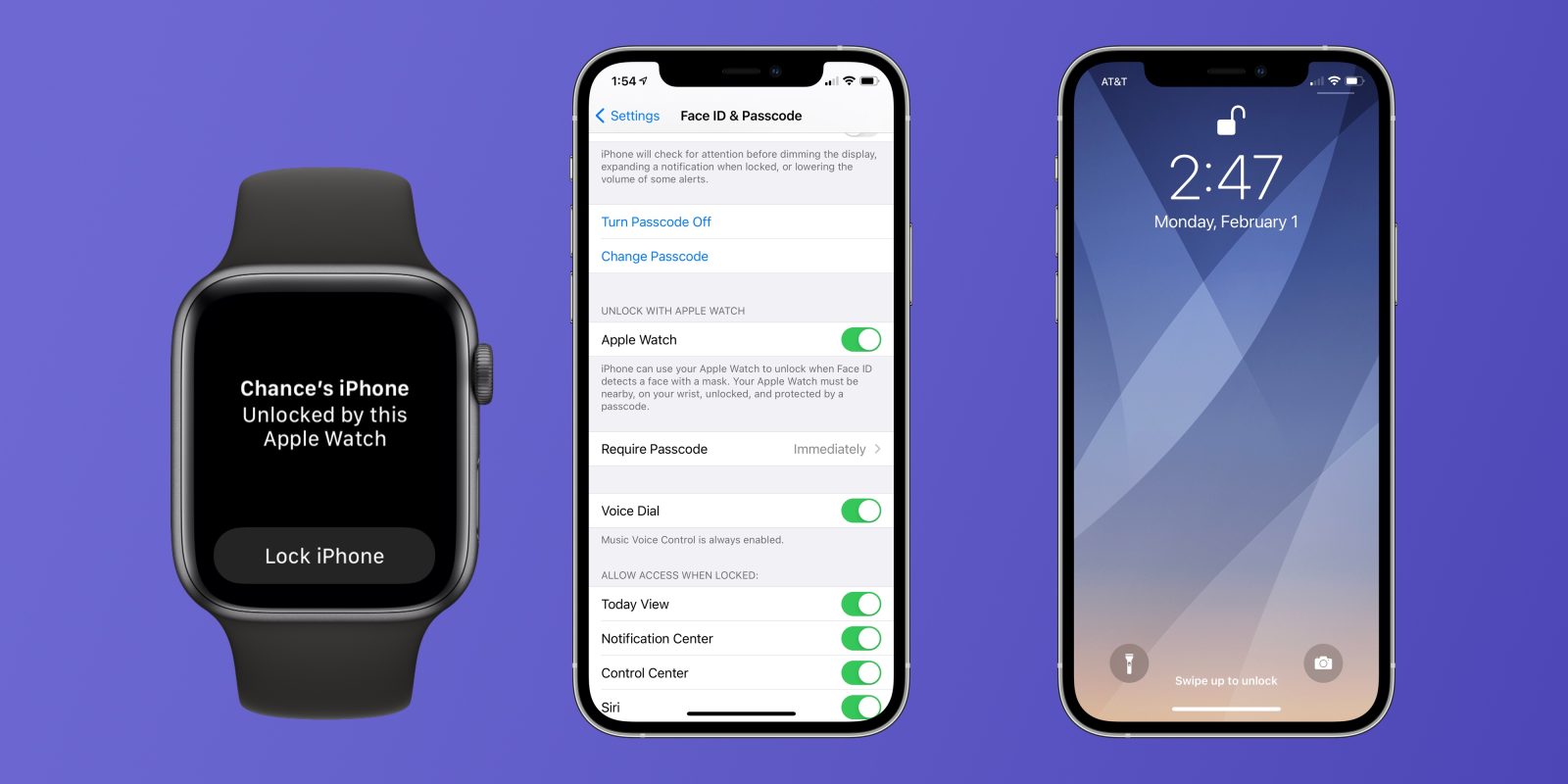
Unlock your iPhone with Apple Watch
To enable the Unlock with Apple Watch feature, open the Settings app on your iPhone, then look for the “Face ID & Passcode” setting. Once you flip this toggle, your Apple Watch will be able to authenticate your iPhone as long as the following conditions are met:
  • Face ID detects a mask
  • Your Apple Watch is nearby
  • Your Apple Watch is on your wrist
  • Your Apple Watch is unlocked
  • Your Apple Watch has a passcode enabled
Another thing to keep in mind here is that if you disable the Apple Watch wrist detection feature, then you will not be able to unlock your iPhone with your Apple Watch.

Once you enable the feature, your iPhone will unlock automatically with your Apple Watch the next time you wear a face mask. When your iPhone unlocks, you’ll receive a haptic feedback notification on your Apple Watch telling you that your iPhone was unlocked by the Apple Watch. There is also the option to quickly “Lock iPhone” directly from that Apple Watch notification.


9to5Mac’s Take
The feature is similar to how the Apple Watch unlock feature works on the Mac, but it appears to be both faster and more reliable in my early testing. On the Mac, the Apple Watch can be used for a variety of different authentication tasks, including accessing controls in System Preferences, making Apple Pay purchases, and more.


On the iPhone, Apple Watch unlock is limited solely to unlocking your iPhone while wearing your mask. It does not work if your iPhone can’t detect if you’re wearing a mask, and it does not work for things like Apple Pay, credit card auto-fill in Safari, or accessing Apple Card features in the Wallet app. In those instances, you’ll still have to enter your passcode if you’re wearing a mask.

The “Lock iPhone” button is an important security step as it allows you to re-lock your iPhone if it were to be unlocked by someone else wearing a face mask.

Ultimately, what’s important to keep in mind here is that the Unlock with Apple Watch feature is not as secure as unlocking with Face or a passcode, but it is far more convenient.

Despite its limitations, support for unlocking your iPhone with your Apple Watch while wearing a mask is a huge change amid the COVID-19 pandemic. What do you think of the feature? Let us know down in the comments!

>>> US Close Dow +0.76% S&P +1.61% Nasdaq +2.55% Russell +2.53%

Closing Stock Market Summary

The S&P 500 rose 1.6% on Monday in a broad-based advance paced by the mega-caps, as investors used last week's decline as an opportunity to buy the dip. The Nasdaq Composite (+2.6%) and Russell 2000 (+2.5%) outperformed with gains over 2.0%, while the Dow Jones Industrial Average increased 0.8%. 

Key leadership was provided by market favorites like Microsoft (MSFT 239.65, +7.69, +3.3%), Amazon (AMZN 3342.88, +136.68, +4.3%), Alphabet (GOOG 1901.35, +65.61, +3.6%), and Tesla (TSLA 839.81, +46.28, +5.8%), which in turn boosted the information technology (+2.5%), consumer discretionary (+2.8%), and communication services (+1.9%) sectors. 

Every other S&P 500 sector also closed higher, with the consumer staples sector (+0.02%) eking out a fractional gain. The Philadelphia Semiconductor Index bounced back 3.9%. 

Because last week's decline was largely attributed to the short-squeeze mania, it's worth noting that GameStop (GME 225.00, -100.00, -30.8%) shares dropped 31% on Monday in a move that might have comforted fundamentally-oriented investors and restored risk sentiment. Wall Street strategists also eased concerns about the mania having a contagion effect on the broad market.  

The silver market, meanwhile, appeared to be the latest short-squeeze target, although the price action was noticeably tamer. Silver futures settled higher by 7.9% to $29.21/ozt. 

In positive-sounding macro developments, the January ISM Manufacturing Index checked in at 58.7% (consensus 60.1%) for its eighth straight expansionary reading, President Biden was said to be committed to his $1.9 trillion stimulus bill despite a $600 billion proposal from GOP senators, and reports indicated that COVID-19 vaccination rates are increasing. 

The market is expecting additional fiscal stimulus, whether it be targeted or broad, especially after the Congressional Budget Office (CBO) said it doesn't expect employment to recover to pre-pandemic levels until 2024. Note, the CBO also projected that real GDP would return to pre-pandemic levels in mid-2021. 

U.S. Treasuries finished on a higher note despite the rebound effort in the stock market, signaling a cautious-minded sentiment. The 2-yr yield decreased one basis point to 0.11%, and the 10-yr yield decreased two basis points to 1.08%. The U.S. Dollar Index advanced 0.5% to 91.05. WTI crude futures rose 2.6%, or $1.38, to $53.56/bbl.

Reviewing Monday's economic data:

  • The ISM Manufacturing Index for January slipped to 58.7% (consensus 60.1%) from a downwardly revised 60.5% (from 60.7%) for December. The dividing line between expansion and contraction is 50.0%. January marked the eighth straight month the ISM Manufacturing Index has been above 50.0%.
    • The key takeaway from the report is the recognition that manufacturing activity overall remained at a healthy level in January despite the surge in coronavirus cases, shutdown measures enacted to contain the spread of the coronavirus, and the political tumult in the U.S.
  • Total construction spending increased 1.0% m/m in December (consensus 0.8%) after increasing an upwardly revised 1.1% (from 0.9%) in November. Total private construction spending rose 1.2% m/m and total public construction spending increased 0.5%.
    • The key takeaway from the report is that residential construction spending continued at a solid clip, fueled by robust demand for new homes.
  • The January IHS Markit Manufacturing PMI increased to 59.2 from 59.1 in December.

There is no economic data of note scheduled for Tuesday.

  • Russell 2000 +7.7% YTD
  • Nasdaq Composite +4.0% YTD
  • S&P 500 +0.5% YTD
  • Dow Jones Industrial Average -1.3% YTD

FT : Clubhouse’s stock is surging. It’s the wrong Clubhouse.

Clubhouse’s stock is surging. It’s the wrong Clubhouse.
We detect The Elon Effect. In all its exuberant, ebullient, entirely rational glory.

We’ve already seen The Elon Effect on dogecoin, bitcoin, and GameStop (and OK yes, Tesla too). And now, The Elon Effect has reached Clubhouse.

In the wake of Mr Elon Musk tweeting on Sunday that he would be talking live on the social media audio app currently taking the world by storm at 10pm that night, stocks in Clubhouse Media Group soared by more than 100 per cent in early trading on Monday, before easing back a bit to trade up a modest 83 per cent up on the day at pixel time.


The only problem is that . . . it’s the wrong Clubhouse. The Clubhouse that is currently mooning is in fact pink-sheet Clubhouse Media Group Inc, ticker $CMGR, which according to Bloomberg “provides medical treatment, scientific research, teaching, prevention, and healthcare services”.

So Clubhouse Media Group Inc is a healthcare company that used to be called Tongji Healthcare Group and which is based in Guangxi, China? Why is a Chinese healthcare company called Clubhouse Media Group?

Well according to a press release from the company, Tongji Healthcare in August acquired West of Hudson Group Inc, owner of “The Clubhouse,” “a collection of content creation houses located in the scenic mansions of Southern California that houses [sic] some of the most prominent and widely followed social media influencers, together carrying an estimated base in excess of 70 million followers across all the Clubhouse influencers”.

So there you have it. The company that doubled in value earlier on Monday is actually a company dealing in “content creation houses” (alas, yes, those really do exist) that is owned by what appears to be a shell company in China. It has no connection to the Clubhouse app launched in 2020, which is a private company that was valued at $100m last May after investment from Andreesen Horowitz.

We are open to the idea that there is still room for content-creation-house stocks to go up in value, but we didn’t see any news on Monday or over the weekend that would justify such a sudden share price reaction. We are therefore not entirely convinced that those who are currently piling into Clubhouse Media Group know what they are doing (unlike, of course, those who have been piling into GameStop, or bitcoin, or Tesla).

Stay safe, kids. It’s ridiculous out there.

FT : UK fashion industry facing ‘decimation’ over Brexit trade deal

UK fashion industry facing ‘decimation’ over Brexit trade deal
More than 400 leading figures send letter to PM demanding urgent action on red tape

The UK’s £35bn fashion and textile industry is facing “decimation” as a result of red tape and travel restrictions thrown up by the new post-Brexit trade agreement with the EU, Boris Johnson has been warned.

In an open letter to the UK’s prime minister leading fashion industry and chief executives and icons, including models Twiggy and Yasmin Le Bon, said that Brexit was strangling the complex international supply chains and relationships that underpinned their industry.

“The deal done with the EU has [left] a gaping hole where promised free movement for goods and services for all creatives, including the fashion and textiles sector, should be,” they wrote in the letter co-ordinated by the Fashion Roundtable, an industry forum. 

Ms Le Bon said the ability to travel freely in the EU for work purposes was “crucial” to an industry where models could be assigned to a shoot with just a few hours notice.

“The wealth of these creative industries is in our ability to move and change quickly. For once we need to be listened to and for the government to work with us before it is too late.”

The concerns echo those raised recently by the music industry about the need for work permits for each EU member state and paperwork for moving products and equipment, and they called for urgent action from the government.

The industry, which employs nearly 900,000 people according to research by Oxford Economics, warned last summer that the Covid-19 pandemic had placed 250,000 jobs at risk.

Last week Samantha Cameron — whose husband David, then prime minister, called the 2016 Brexit referendum — warned her fashion business was finding post-Brexit trading with the EU “challenging and difficult”.

Many of the 52,000 smaller companies that make up the backbone of the sector could not afford the professional help needed to navigate the new controls, the letter added, with customers on both sides of the Channel rejecting purchases because of unforeseen VAT and tariff charges.

Katharine Hamnett, the fashion designer best known for political T-shirts and championing ethical business practices, said: “We need a radical overhaul of customs arrangements including VAT on all goods shipped into the EU by the end of February, or British brands will die.”

Helen Brocklebank, the chief executive of Walpole, the luxury sector group whose members include Alexander McQueen and Burberry, said the government needed to simplify the post-Brexit trading regime and boost the retail tourist trade.

“With 42 per cent of all British luxury export sales coming from the EU, the costs and administrative burdens of trading in continental Europe mean many of our members — not least the SMEs — have concluded they simply can’t afford to continue selling to those countries,” she said.

Isabel Ettedgui, the chief executive of Connolly, the Savile Row fashion brand that sells Scottish cashmere and manufactures leather goods in Spain, said the financial ramifications of Brexit could be existential. “The result could be the possible closure of a 185-year-old company that holds the Royal Warrant,” she said.

Other signatories included Nick Knight, the fashion photographer; Jefferson Hack of Dazed Media Group; John Horner, the chief executive of the Models 1 agency and head of the British Fashion Models Association; Sam McKnight the hair stylist who worked with Diana, Princess of Wales; the designer Roksanda Ilinčić, the London-based Serbian designer whose dresses are worn by the Duchess of Cambridge and Michelle Obama; Laura Bailey, the model and Vogue contributing editor and Andrea Thompson, the editor-in-chief of Marie Claire magazine.


The more than 400 signatories demanded “urgent action” from the government to protect an industry that is highly fragmented but is estimated to be worth 1.6 per cent of UK gross domestic product according to research by Oxford Economics for the British Fashion Council last year. By contrast the German industry is worth 0.8 per cent of GDP.

Among the Fashion Roundtable table demands is that the government immediately adds garment workers to the list of “shortage occupations” for UK visas to help fill thousands of vacancies in UK clothing factories. It also calls for tax breaks to encourage sustainable practices and negotiations for paperwork-free travel for British creatives and their equipment in the EU.

The group also renewed calls on the government to rescind its decision to scrap the Retail Export Scheme which had allowed international visitors to claim back 20 per cent of VAT on their purchases, but was ended on January 1.

The Cabinet Office said it was working closely with businesses in the fashion industry to adjust to the new trading environment and was aware that some businesses were facing challenges.

“We are operating export helplines, running webinars with policy experts and offering businesses support via our network of 300 international trade advisers,” a spokesperson said. “This is on top of the millions we have invested to expand the customs intermediaries sector.”

FT : Billionaire Tilman Fertitta floats entertainment empire in $6.7bn Spac deal

Billionaire Tilman Fertitta floats entertainment empire in $6.7bn Spac deal
Restaurant and gambling group returns to public markets after 11 years

Houston billionaire Tilman Fertitta is returning his business empire to the public markets after a gap of more than a decade. Holding company Fertitta Entertainment, which includes Golden Nugget casinos and Landry’s restaurants, will be floated through a reverse-merger with a special purpose acquisition company.

The deal takes advantage of investor enthusiasm for Spac deals and values Fertitta Entertainment, whose restaurant chains include Del Frisco’s and Morton’s, at $6.7bn during a volatile time for both the gaming and restaurant industries.

Fertitta, which runs regional casinos in Nevada, Louisiana, and Mississippi, was walloped by the onset of the pandemic, according to an investor presentation accompanying the deal. Group revenues fell an estimated 40 per cent in 2020, it said.

Mr Fertitta’s personal empire also includes ownership of the National Basketball Association’s Houston Rockets and has propelled him to entrepreneurial fame, with his own programme on business network CNBC. The Rockets are not included in the public transaction, however.

Fertitta Entertainment’s merger with Fast Acquisition, a blank-cheque company that raised $200m in its initial public offering in August, will give Mr Fertitta a nearly 60 per cent stake worth more than $2bn.

“In today’s opportunistic world, I determined that in order to maximise the opportunities in the gaming, entertainment and hospitality sectors, it was preferable to take my company public,” Mr Fertitta said in a statement on Monday. He will remain chairman and chief executive.

Roughly three-quarters of Fertitta Entertainment group revenues — $3.41bn in 2019, pre-pandemic — are derived from the restaurant industry, which has been depleted during coronavirus-imposed shutdowns. Meanwhile, profits for the five regional casinos under the Golden Nugget division have fallen less sharply than those at larger global operators such as Wynn and MGM. 

In a presentation, the company said it was poised to benefit from the economic recovery as weaker restaurants have shuttered during the pandemic.

The Spac merger will make for the second public listing of Fertitta Entertainment, after Mr Fertitta took the organisation private in 2010. He had considered merging Golden Nugget/Landry’s with Caesars Entertainment two years ago but Caesars ultimately selected another bidder.

It is also not Mr Fertitta’s first tie-up with a Spac. Late last year, he spun off the mobile wagering segment of his business, Golden Nugget Online Gaming, through a public listing with the blank-cheque company Lancadia Holdings. Fertitta Entertainment still has voting control and ownership of about half of the outstanding shares of GNOG, worth roughly $700m.

The latest deal includes a fundraising of $1.24bn in new equity from a group of unnamed investors, which will go towards reducing the company’s debt to just above $3bn.

Fast Acquisition, a Spac founded by chain restaurant veterans Doug Jacob and Sandy Beall, will own 1 per cent of the public Fertitta Entertainment, while the undisclosed co-investor group will hold 35 per cent of shares.

FT : South African Covid strain prompts ‘surge testing’ in England

South African Covid strain prompts ‘surge testing’ in England
Hancock promises to ‘come down hard’ on variant after 11 UK cases found with no connection to country of origin

The UK was forced on Monday to confront that the South African variant of coronavirus was spreading within the country, as the health secretary pledged to “come down hard” on the strain.

The news came as the UK saw the number of people given their first jab of a Covid-19 vaccine rise to 9.3m with another 319, 038 first doses delivered. The government also hinted that it may share some of its vaccine supplies with other countries later in the year.

Speaking at a Downing Street press conference, Matt Hancock said the South African variant had been found in 11 people who had not travelled to the country where it was first detected. “There’s currently no evidence to suggest this variant is any more severe. But we need to come down on it hard, and we will,” he said.

Isolated cases of people infected with the variant, known as 501Y.V2, have been found in parts of London, the West Midlands, the East of England, the South East and the North West. “Surge testing” will be rolled out in all neighbourhoods where the new variant has been detected.

Everyone over the age of 16 living in the affected areas is being encouraged to get tested, whether or not they have symptoms, Mr Hancock added. “It is vital that we do all we can to stop transmission of this variant and I strongly urge everyone in these areas to get tested, whether you have symptoms or not,” he said.

There has been particular concern about the 501Y.V2 variant which has spread like wildfire across South Africa, because it has shown some signs of resistance to the current crop of vaccines. Moderna found that its vaccine produced six times lower antibody levels against the 501Y.V2 variant compared with other strains in circulation. 

Like the B.1.1.7 variant that has come to dominate coronavirus infection across England, 501Y.V2 is more transmissible than older forms of the virus. Which of the two is more contagious is not known. But South African scientists studying 501Y.V2 have found no evidence that it results in worse outcomes.

But Susan Hopkins, senior medical adviser to Public Health England, said trials had suggested that the three vaccines approved in the UK remained effective against the new strain.

“We expect all other vaccines to have a similar level of effectiveness, particularly in reducing hospitalisation and death,” she said, adding it was likely that “a booster shot — a bit like the annual flu vaccine” would be required to improve immunity.

Mr Hancock also announced that an additional 40m doses of the Valneva vaccine had been ordered by the UK and it would potentially share vaccine supplies later this year once the most vulnerable had been jabbed.

“I want to say this to our international partners — of course I’m delighted how well this is going at home but I believe fundamentally the vaccine rollout is a global effort. We will protect UK supply and play our part to ensure the whole world can get the jab.”

Rooting out and preventing onwards transmission of each individual case of infection with this variant is seen as a crucial precautionary measure in case vaccines and therapeutic treatments continue to prove less effective, or it is determined that the strain leads to more severe outcomes.

“The discovery of a handful of cases with no links to travel to Africa, indicates that it might be more widespread in the community than previously thought,” said Simon Clarke, associate professor in cellular microbiology at the University of Reading.


A total of 105 cases of the 501Y.V2 variant have been found in the UK since December 22, most of which came from people who had recently travelled from South Africa.

The cases were identified by taking random samples of about 5-10 per cent of positive test results from around the country and sequencing the virus.

“As only 5 per cent of cases are tested to determine if they are the variant, there is a high probability that further local cases are in circulation,” said Rowland Kao, professor of veterinary epidemiology and data science at the University of Edinburgh, making it more difficult to contain its spread.

One senior government official said it was believed the 11 cases that did not directly originate from South Africa did nonetheless have some sort of “travel link”. “Clearly not a first-generation travel link, but second or third,” the official said.

“We’re trying to restrict the spread and get on top of this in a way we were not able to with the first variant,” the official added, saying that there was no evidence so far that the variant identified in South Africa was any more transmissible than the B.1.1.7 variant first identified in Kent and London.

In Surrey, where door-to-door testing started on Monday, the council said: “Residents in the affected areas . . . should remain calm and continue to follow the national restrictions that are currently in place.”

Meanwhile, prime minister Boris Johnson said he was “optimistic” that Britons would be able to have summer holidays. “I don’t want to give too much concrete by way of dates for our summer holidays. I am optimistic . . . but some things have got to go right,” he said during a visit to Yorkshire.