>>> TradeGate Pre-Market Indications

DAX:
  • Siemens (SIE TH) -0.9%
  • Continental AG (CON TH) -4.1%
    • Continental to Suspend FY 2020 Dividend Amid Negative Net Income
    • Schaeffler CEO Rejects Breaking Up Group, Sueddeutsche Reports
MDAX:
  • MorphoSys (MOR TH) +1.4%
  • Aixtron (AIXA TH) +1.2%
  • HelloFresh (HFG TH) +1.1%
  • Fraport (FRA TH) +0.9%
  • Sartorius (SRT3 TH) +0.9%
  • Varta (VAR1 TH) -2.5%
    • Varta Loses Sole Buy Rating as Berenberg Downgrades to Hold
  • United Internet (UTDI TH) -2.6%
  • K+S (SDF TH) -2.6%
  • Stroeer (SAX TH) -2.9%
SDAX:
  • Global Fashion Group (GFG TH) +5.4%
  • SAF-Holland SE (SFQ TH) +2.7%
    • SAF-Holland SE Prelim FY Sales Beat Estimates
  • Encavis (CAP TH) +2.2%
  • Talanx (TLX TH) +2%
  • Borussia Dortmund (BVB TH) +1.6%
  • Deutsche PBB (PBB TH) -0.7%
  • LPKF (LPK TH) -0.8%
  • ADVA Optical (ADV TH) -0.9%
  • Westwing (WEW TH) -2.2%
  • SMA Solar (S92 TH) -3.4%

>>> Stoxx 600 Pre-Market Indications

  • Faurecia SE (FAU TH) +4.5%
    • Faurecia: Full-year 2020 results and 2021 guidance
  • Rio Tinto (RIO1 TH) +3.9%
    • Watch European Miners as Metals Jump on Demand Optimism
  • NEL (D7G TH) +3.6%
  • Anglo American (NGLB TH) +2.1%
  • BHP Group Plc (BIL TH) +1.9%
  • Telecom Italia (TQI TH) -1.7%
  • Banco Santander (BSD2 TH) -1.9%
  • Barclays (BCY TH) -1.9%
    • Lloyds, HSBC, NatWest Poised for Return of Mortgage Competition
  • Renault (RNL TH) -2%
  • Aegon (AEND TH) -2.2%
  • AMS (DQW1 TH) -2.2%
  • United Internet (UTDI TH) -2.6%
  • Rational (RAA TH) -2.8%
  • Varta (VAR1 TH) -3.6%
    • Varta Loses Sole Buy Rating as Berenberg Downgrades to Hold
  • Continental AG (CON TH) -4.3%
    • Continental to Suspend FY 2020 Dividend Amid Negative Net Income
    • Schaeffler CEO Rejects Breaking Up Group, Sueddeutsche Reports

FT : Cable makers wired into clean energy boom

Cable makers wired into clean energy boom
World’s biggest suppliers draw investors looking at green boom

The prosaic business of making and laying cables is one of the hot sectors in the clean energy transition, as demand for products such as undersea high voltage lines leads to order backlogs of two to five years.

The world’s three biggest listed cable makers — Milan-based Prysmian, the Paris-based Nexans and the Danish NKT — had their market valuations at least more than double since lows last March, boosted by the EU green deal and by the Biden administration’s clean energy drive.

The trend was highlighted last week when Nexans, which supplies about one-fifth of global submarine cable market, said it would sell about a third of the company business to focus solely on electricity..

“Everything that requires electricity, requires cables,” Nexans’ chief executive Christopher Guérin told the FT. His new strategy will involve selling the units that make cables for the automotive sector, shipbuilding, and telecoms industry — which make up about 27 per cent of sales — in favour of the faster growing electricity business which makes up about 55 per cent of sales.

Guérin said the company would use the proceeds make further acquisitions in the electricity sector, spending between €1.5bn to €2bn over the next three years. 

Historically, cable makers have produced a wide range of cables — including fibre-optic cables, wiring for cars and ships, and for buildings, as well as electricity transmission lines — but competition is growing to capture the lucrative segment linked to renewables.

The biggest cable projects, typically with the highest margins, are offshore wind cables and undersea interconnectors, which involve laying heavy cables on the seabed floor up to 1500m deep using specialised ships. 

While cables revenues are presently relatively modest, with annual turnover of Prysmian, Nexans and NKT at about €10bn, €6bn, and €1.5bn respectively, the market is destined to grow alongside the offshore wind industry and the clean energy transition.

“The connection of offshore wind farms, solar farms, nuclear — there are 200GW of new offshore wind that will be connected in the coming nine years,” Guérin said. “It is a huge market that is emerging for us.”

For a typical offshore wind project, about 25 per cent of the cost is spent on cables that connect the turbines to a substation, and the substation to the shore, according to data from Prysmian. (By comparison, 37 per cent of the cost is the wind turbine, and 23 per cent of the cost is the turbine foundation.)

The offshore wind cable market in Europe and the US is expected to expand from €1.5bn in 2019, to about €5.9bn in 2035, Credit Suisse estimated.


“There is a growing market for the subsea power,” said Sean McLoughlin, head of industrial and clean energy research at HSBC, pointing to both offshore wind cables, and interconnectors. “It is the sexy part of the business . . . and it is all tied to the changing energy mix.” 

McLoughlin added that cable companies used to be considered low-growth businesses that merited low valuations, but that was no longer the case.

Demand for interconnectors is rising as the EU and other countries work to develop more flexibility in their grid systems, boost cross-border electricity trade, and connect new renewable power to the cities where it is in demand. The market for interconnectors is expected to grow 14.3 per cent per year over the next decade, according to a report by consultancy Roland Berger and Nexans.

Another big area of growth for cable makers will be the US, where several large offshore wind projects are under way on the East Coast and wind development is expected to accelerate under the Biden administration.

Analysts also noted cable companies were benefiting from a “scarcity premium” among so-called green stocks.

“There is a ‘green premium’ on a lot of these stocks,” said Max Yates, research analyst at Credit Suisse, giving the example of highly valued wind companies Vestas and Orsted. “But there is also a very real reason behind this, which is that ultimately the outlook for these companies has dramatically improved.”

Prysmian said about one-third of its investors were ESG funds, a level that had increased greatly over the last 12-18 months, but rejected the suggestion that its share price had been pushed up by the hype.

Chief executive Valerio Battista said that, unlike Nexans, Prysmian had decided to hold on to a diversified cable-making portfolio, which includes cables for telecoms, buildings, ships and railways, because these businesses generated cash. “Not a lot [of cash], but constant,” he added.

The Milan-based group, which accounts for about 40 per cent of global undersea interconnector installation, also said it was eyeing a new frontier — laying ultra-deep cables as far as 3km below the ocean surface.

This would enable cables to be laid across the Mediterranean, potentially connecting solar resources in north Africa with power demand in Europe, said Battista. Such projects were previously not technically feasible but could happen “in the next few years”, he said.

>>> Europe : Brokers Upgrades & Downgrades - 22nd of February 2021

>>> Up
* Airbnb Raised to Buy at Loop Capital; PT $240
* AstraZeneca Raised to Buy at Intron Health; PT 9,000 pence
* DNB Raised to Market Perform at KBW; PT 165 kroner
* Eni Raised to Sector Perform at RBC; PT 10 euros
* Glencore Raised to Overweight at JPMorgan; PT 350 pence
* Snap Raised to Overweight at Morgan Stanley; PT $80
* Standard Life Aberdeen Raised to Equal-Weight at Barclays
* Temenos Raised to Neutral at Credit Suisse; PT 121 Swiss francs

>>> Down
* B&M European Cut to Hold at Peel Hunt; PT 575 pence
* EDP Renovaveis Cut to Hold at Commerzbank; PT 19 euros
* Fastighets AB Trianon Cut to Hold at Handelsbanken
* Fuller Smith & Turner Cut to Hold at Peel Hunt; PT 850 pence
* Gecina Cut to Neutral at JPMorgan; PT 130 euros
* Smith & Nephew Cut to Hold at Commerzbank; PT 1,550 pence
* Varta Cut to Hold at Berenberg

>>> Initiation
* Norwegian Property Reinstated Buy at SEB Equities
* Technip Energies Rated New Equal-Weight at Barclays

>>> Call
* B&M Cut, Forecast Momentum is Coming Toward an End: Peel Hunt
* Eni Upgraded at RBC Capital Amid More Constructive Oil View
* European Internet Stocks Can Maintain Outperformance, RBC Says
* Saab ‘Hard to Pigeonhole,’ Price Target Raised at Jefferies
* Varta Loses Sole Buy Rating as Berenberg Downgrades to Hold

>>> What to look at today - 22nd of February 2021

The bond selloff continued Monday as Treasury yields climbed and sovereign debt in Australia and New Zealand slid on concerns about faster inflation, tempering stock market optimism from positive vaccine news.
Benchmark 10-year Treasury yields climbed to the highest in about a year. A gauge of Asian stocks edged lower, erasing earlier gains amid a surge in metals that could fan price pressures. Japanese shares outperformed while other key markets lagged. S&P 500 and European futures dipped after the U.S. index slipped Friday.
Copper hit the highest in more than nine years in a sign of optimism about the global recovery. Crude oil climbed to $60 a barrel as the market assessed the fallout from the big freeze across Texas. Bitcoin notched another record over the weekend, spurring a rally in the shares of Asian cryptocurrency stocks.

Nikkei +0.46% Hang Seng +0.07% CSI -2.33% Shanghai -0.785 Shenzen -1.35%

Eur$ 1.2120 CNH 6.4610 CNY 6.4612 GBP 1.4014 CHF 0.8983 RUB 74.1406 TRY 6.9763 WTI$ 59.96 + 1.22% Gold 1,791 BTC 55950 -1630

S&P -0.20% Nasdaq -0.33% EuroStoxx -0.46% FTSE -0.62% Dax -0.45% SMI -0.39%

Spacs
- Apex Clearing Is Said To Have Agreed to Go Public via SPAC
- Starboard SPAC Nears Deal for Data-Center Company Cyxtera, Sources Say
- Lucid Motors Is Said to Near Deal to Go Public via Klein’s SPAC
- Michael Dell-Backed SPAC Files to Raise $500 Million
- Elliott Files Two SPAC IPOs for Total of $1.5b
- MSD Spac Backed by Ex-Goldman Sachs Banker, Dell CEO Seeks IPO
- Joyy Says Bing Jin to Step Down as CFO at End of April
- Churchill Capital Corp. IV Among Most Cited in StockTwits

Macro :
- U.K.’s Johnson to Say All Schools in England to Open March 8 (1)
- Bubble Warnings Go Unheeded as Everyone Is a Buyer in Stocks
- U.K.’s Johnson Plans to Ease Some Covid Curbs by Easter: Tel.
- Copper Passes $8,900; Tin Powers Higher: N.A. Materials Wrap

Keep an eye on :
- AIR FP : Boeing Supports Decisions by Japan Civil Aviation Bureau, FAA
- ALM SM : Almirall FY Ebitda Beats Estimates; Names New CEO
- ASTM IM : ASTM Receives Voluntary Tender Offer From NAF 2 @ E25.60/Share (28.8% Premium vs Friday Close)
- BAYN GY : Bayer Sues for Patent Royalties on Ecomed’s Sales of CT Syringes
- EN FP : Paris Reaches Deal With Mobile Operators on 5G Launch, AFP Says
- CAI AV : Starwood’s $4.1 Billion CA Immo Takeover Offer Opens Monday
- CBK GY : Commerzbank Expects to Shed 1.7 Million Customers, WamS Reports
- CON GY : Continental to Suspend FY 2020 Dividend Amid Negative Net Income
- CVAL IM : Credit Agricole: Block Purchase Pact for 919,488 Creval Shares
- BN FP : Artisan Partners ‘Encouraged’ by Danone’s Greater Transparency
- EDF FP : Siemens Gamesa Wins Order for 64 Offshore Wind Turbines
- FFP FP : FFP to Change Name to Peugeot Invest
- GALP PL : Galp 4Q Adjusted Net Misses Estimates
- HIK LN : Hikma Sues to Block Generic Version of Gout Drug Mitigare
- ICAD FP : ICADE Sees 2021 NCCF Growth Per Share About +3%
- IPN FP : Ipsen Announces Positive Phase II Data for Lanreotide
- KNIN SW : Kuehne + Nagel Buys Apex International; No Price Disclosed
- KSS US : Kohl’s Is Said to Face Activist Group Seeking Control of Board
- NEX FP : Nexans Plans up to EU2b in Acquisitions in Next 3 Years: FT
- PAH3 GY : Porsche Lifts Savings Target to $12 Billion, Automobilwoche Says
- PFG US : Elliott Is Said to Take Stake in Insurer Principal Financial
- RBI AV : Raiffeisen Suspends Work on Polish FX-Loan Settlements: RP.PL
- RTX US : United Plane Showers Debris Near Denver After Engine Failure
- SFQ GY : SAF-Holland SE Prelim FY Sales Beat Estimates
- SAGA LN : Saga in Talks to Secure 170 Million-Pound Debt Package: Sky News
- SHA GY : Schaeffler CEO Rejects Breaking Up Group, Sueddeutsche Reports
- SHLTN SW : SHL Telemedicine Mulls Dual Listing in U.S. or Tel Aviv
- SGRE SM : Siemens Gamesa Wins Order for 64 Offshore Wind Turbines
- SIG LN : Billionaire Sawiris Said to Back $4.7 Billion Signature Takeover
- VOW GY : Volkswagen’s Largest Factory Faces Battery Cell, Chip Shortages

(ZH) "Two Weeks That Changed The World": A Goldman Post-Mortem On "The Squeeze"

"Two Weeks That Changed The World": A Goldman Post-Mortem On "The Squeeze"

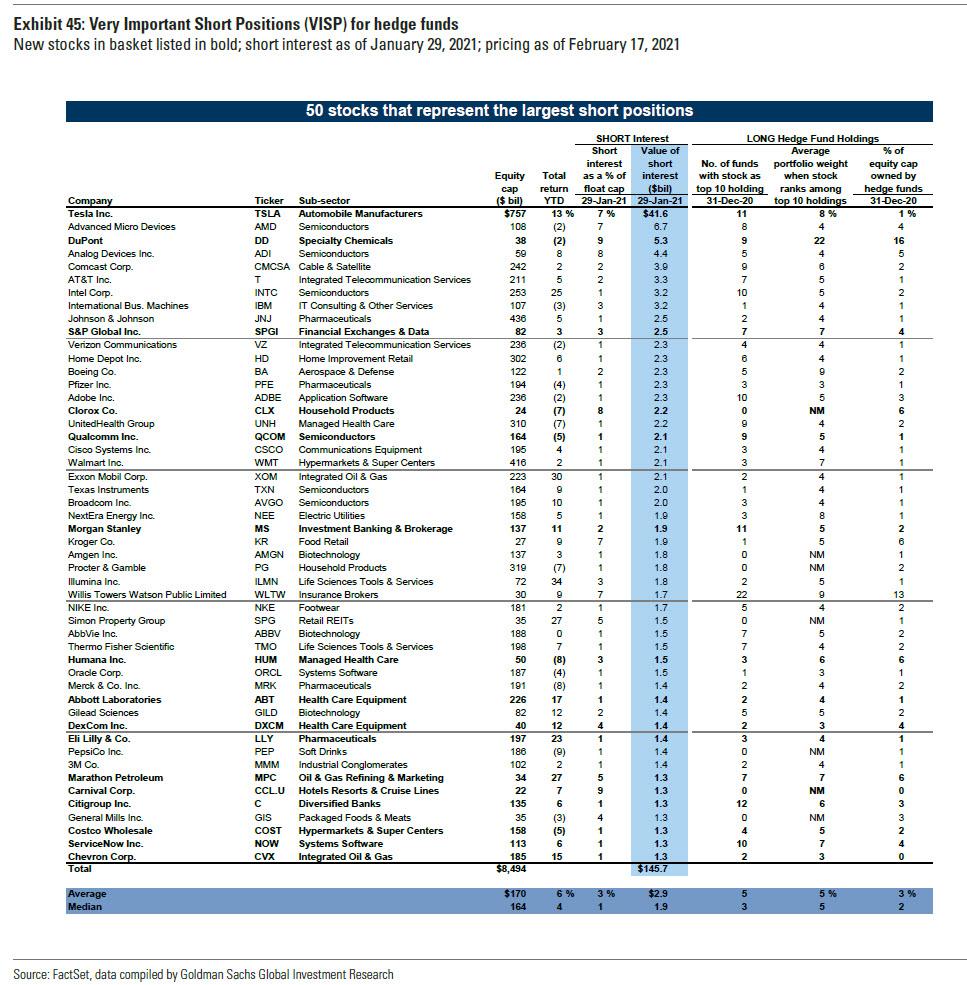
It was almost exactly three months ago, long before the Reddit short squeeze fireworks, when we were parsing through the latest quarterly Hedge Fund Tracker report from Goldman Sachs which famously breaks down the 50 most popular hedge fund long and short positions, when we repeated what we have said for much of the past decade:
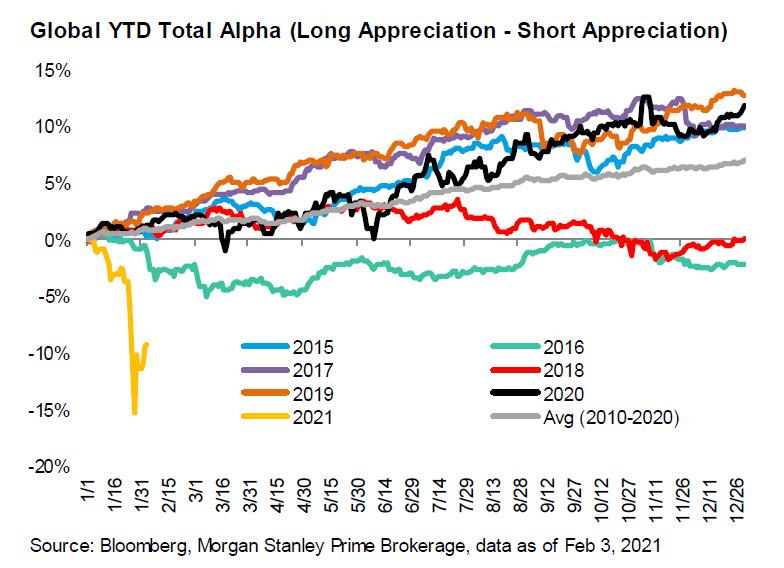
... since it is the most shorted stocks that end to do far better than the most popular ones, especially during market-wide squeezes such as the one seen since March, here is also the list of 50 most-shorted stocks. As usual, our advice is to go long the most hated names and short the most popular ones - a strategy that has generated alpha without fail for the past 7 years, ever since we first recommended it back in 2013.
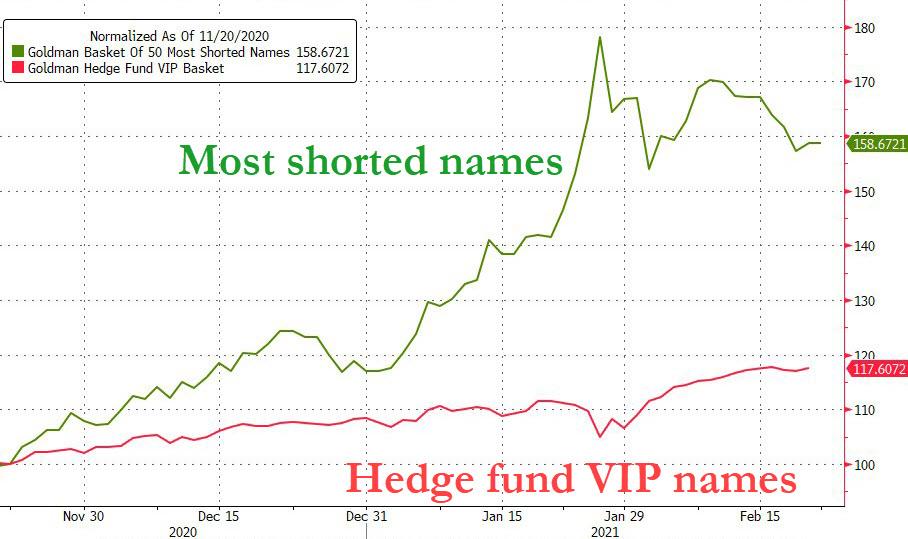
We said this on November 20, 2020, which we bring up because as everyone knows by now, what transpired since has been the biggest coordinated short squeeze in history, and anyone who listened to our advice and put on the abovementioned pair trade is now up some 40% in the past 3 months, an annualized return of over 160%.
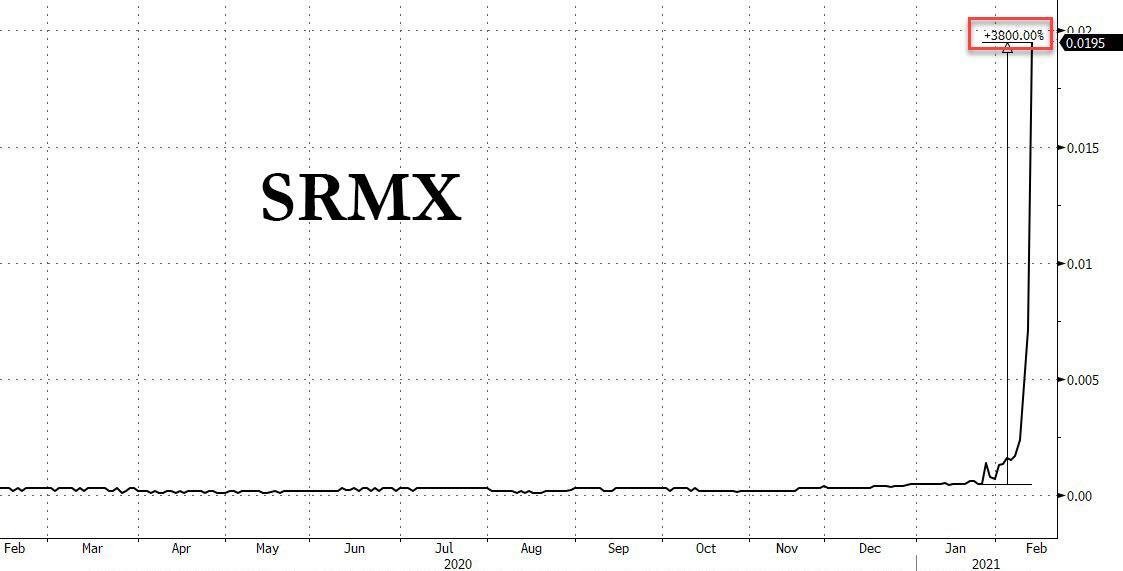
Actually, those who were reading us during this historic short squeeze meltup may already have retired, because while many were chasing Gamestop, one of our favorite squeeze trades was to go long a heavily shorted microcap, SRMX, as we revealed on Jan 27, and just two weeks later, SRMX was up 3,800%, double the peak performance of Gamestop.
Yet while our readers profited handsomely from January's epic moves, in many cases generating historic returns, there were also just as many who had a terrible month: they are better known as hedge funds. And it is their plight that Goldman's latest Hedge Fund tracker focuses on.
What follows below will not be surprising or new to any of our readers, who were presented with front-row seats to the historic events as they unfolded in January and early February. Still, what Goldman's Ben Snider has done in his latest Hedge Fund Trend monitor (in which he analyzes the holdings of 820 hedge funds with $2.8 trillion in gross equity positions), is a good recap of some of the key catalysts and milestones behind what was to many financial professionals, two weeks that changed the world of finance starting with the January 22 breakout in Gamestop stock, and ending with the February 5 collapse in the most shorted names and the apparent return to normalcy.
As Snider writes, January’s short squeeze showed the risk posed to both hedge fund returns and broad market performance by record leverage and a high degree of crowding, two factors (both the byproduct of years of "idea dinners") which we have repeatedly warned in the past would one day come and bite the hedge fund industry in the ass.
As we noted at the time...
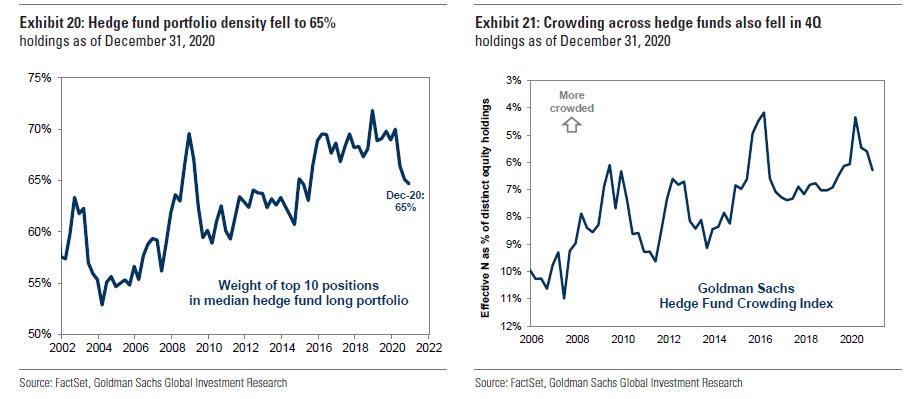
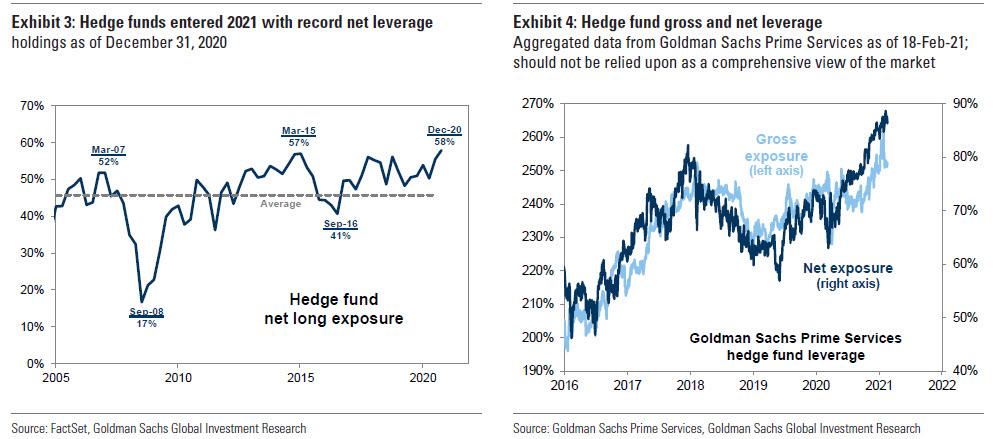
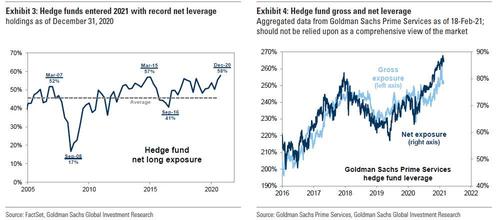
... hedge funds entered 2021 with the highest levels of net and gross exposure on record. And although the average fund’s portfolio concentration and the degree of crowding across hedge fund portfolios declined in 2020, both of those measures remained elevated relative to history, Snider notes.
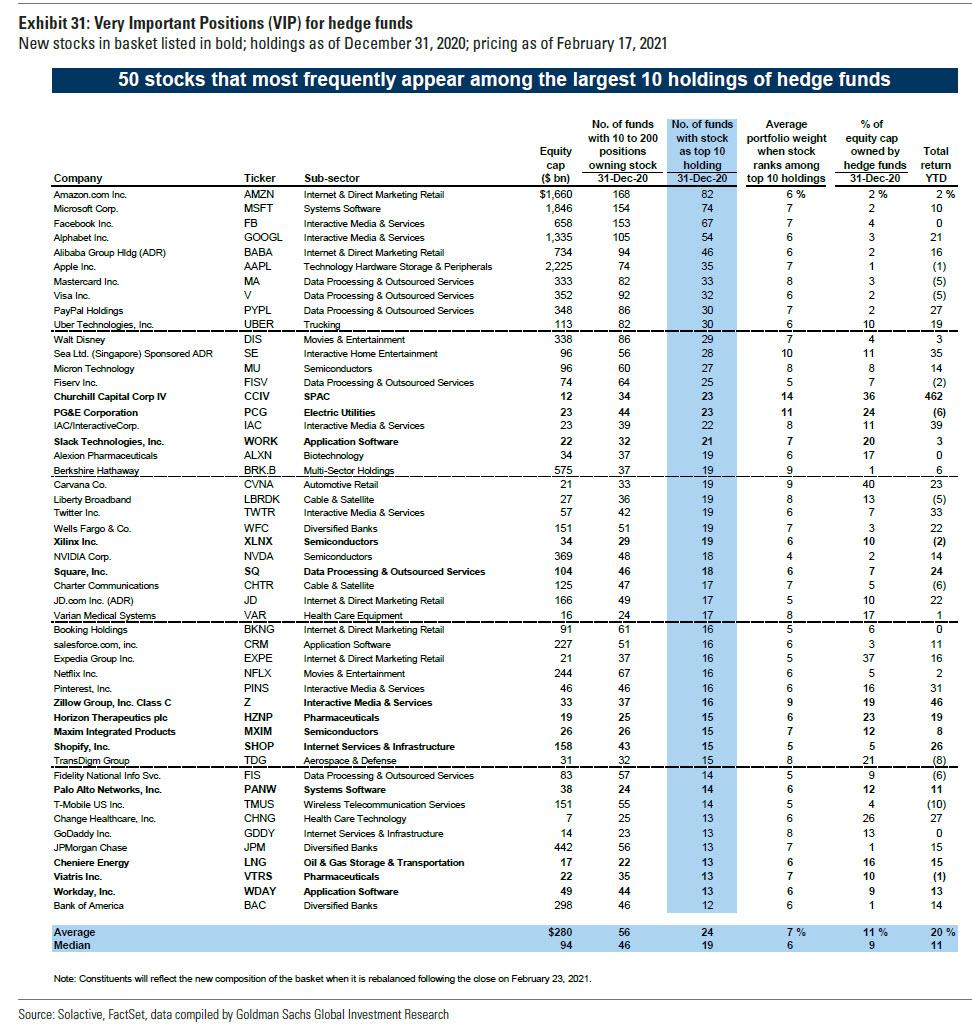
As an illustration, the top five constituents of Goldman's Hedge Fund VIP list of the most popular hedge fund long positions have remained unchanged for 10 consecutive quarters, including this quarter’s rebalance (although while 13Fs showed positions as of Dec 31, this may well have changed after the January fireworks).
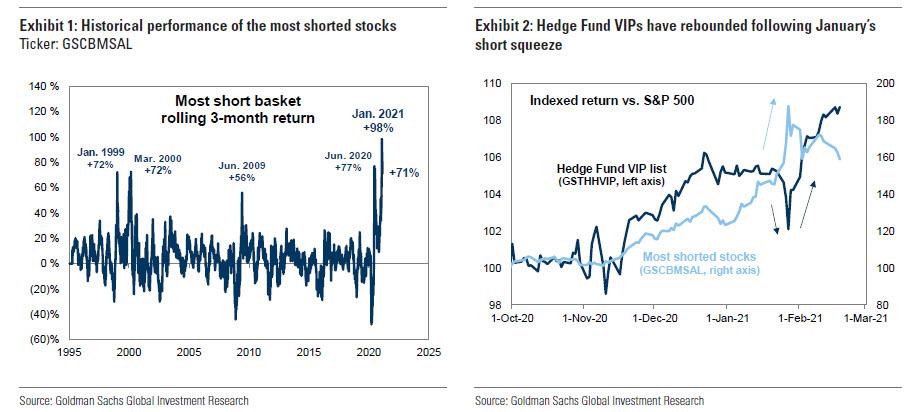
That's because short covering that began following vaccine efficacy announcements in November accelerated in January, leading eventually to broad hedge fund de-grossing that weighed on popular hedge fund long positions and the aggregate S&P 500.
Meanwhile, as we predicted well in advance, Goldman retroactively points out that a rolling basket of the Russell 3000 stocks with the highest short interest as a share of float rose 42% in January, capping a record three-month return of 98% for the most heavily-shorted stocks (to those who listened to us and put this basket on as a long, congratulations).
As Goldman then notes, "this tipped a chain of dominoes that led to the largest week of active hedge fund de-grossing since February 2009, according to Goldman Sachs Prime Services, which caused our Hedge Fund VIP list to decline by 6%, the S&P 500 to dip by 4%, and an average January return of -1.2% for long/short equity hedge funds."
Conveniently, starting with the day Robinhood decided to block most purchases of most shorted stocks - effectively putting a stop to the process that "scared" Interactive Brokers CEO Thomas Peterffy said brought markets "frighteningly close" to breaking during the Reddit Raid - hedge fund performance has rebounded in the weeks since the short squeeze, and leverage - while off its peak - remains close to the highest levels on record. In fact, hedge funds are now even more levered:
"Aggregate hedge fund net leverage calculated based on publicly-available data registered 58% at the start of 2021, surpassing the previous record level of 57% in early 2015. Higher-frequency exposures calculated by our colleagues in Goldman Sachs Prime Services also showed record leverage prior to the January short squeeze. According to their data, net and gross leverage each now register at the 99th percentile."
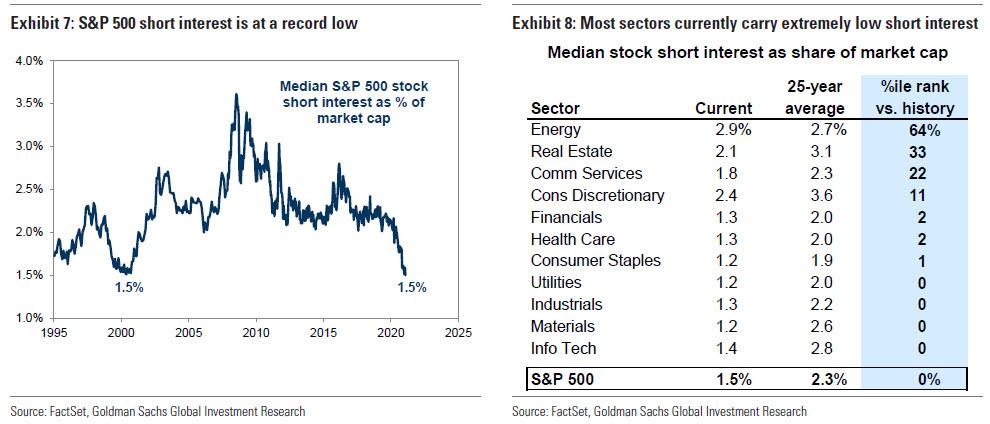
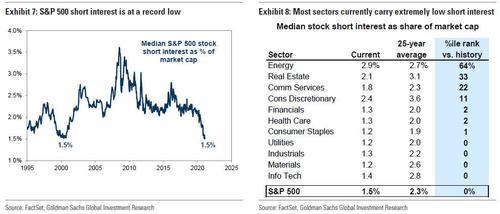
This should not be a surprise: consider that January's short squeeze occurred against the backdrop of already extremely low aggregate short interest - largely a function of the short extinction-level event unleashed by the Fed last year which sent stocks soaring to record highs - and which has continued to decline. In fact, the median S&P 500 stock has outstanding short interest equating to just 1.5% of market cap, matching the record low in 2000. In most sectors, short interest outstanding currently ranks in the bottom decile of the last 25 years, with Goldman noting that only Energy sector shorts registering above the historical average (this is why JPMorgan believes that the next massive squeeze will focus on energy names starting some time in March).
Yet while most hedge funds suffered through a devastating January, where the alpha drawdown among the hedge fund universe was the worst on record leading to cascading VaR shocks...
... Retail investors were by and far the big winners. That's why Goldman writes next that the January short squeeze and apparent pockets of froth in the equity market have turned investor focus to the impact of individual retail traders: "Broker activity, trading volumes in penny stocks, and inflows into levered ETFs all reflect the surge in retail trading activity that contributed to the sharp recent rally in heavily shorted stocks."
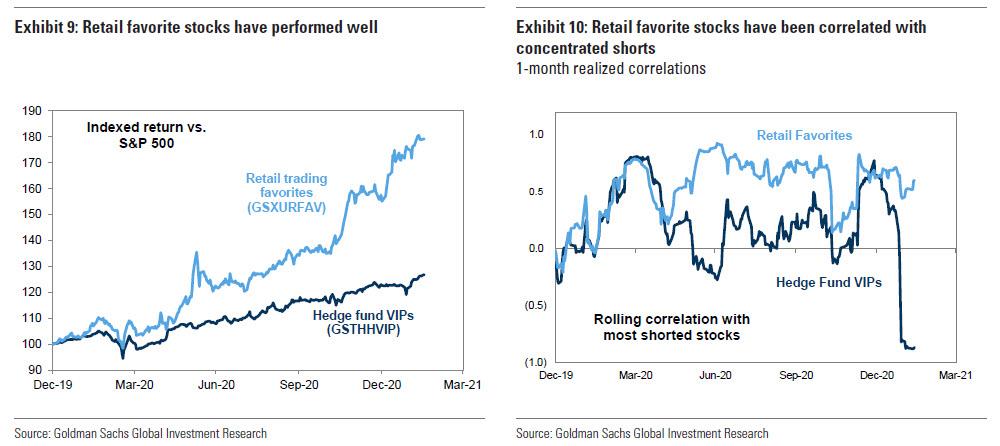
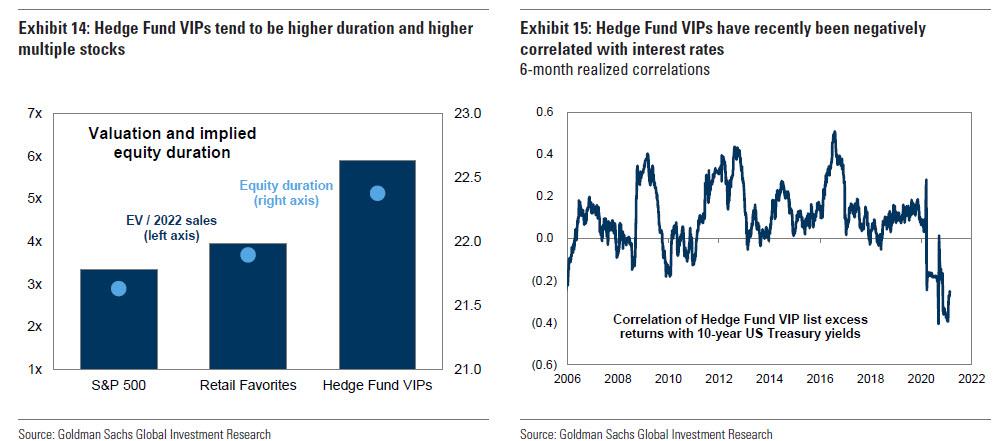
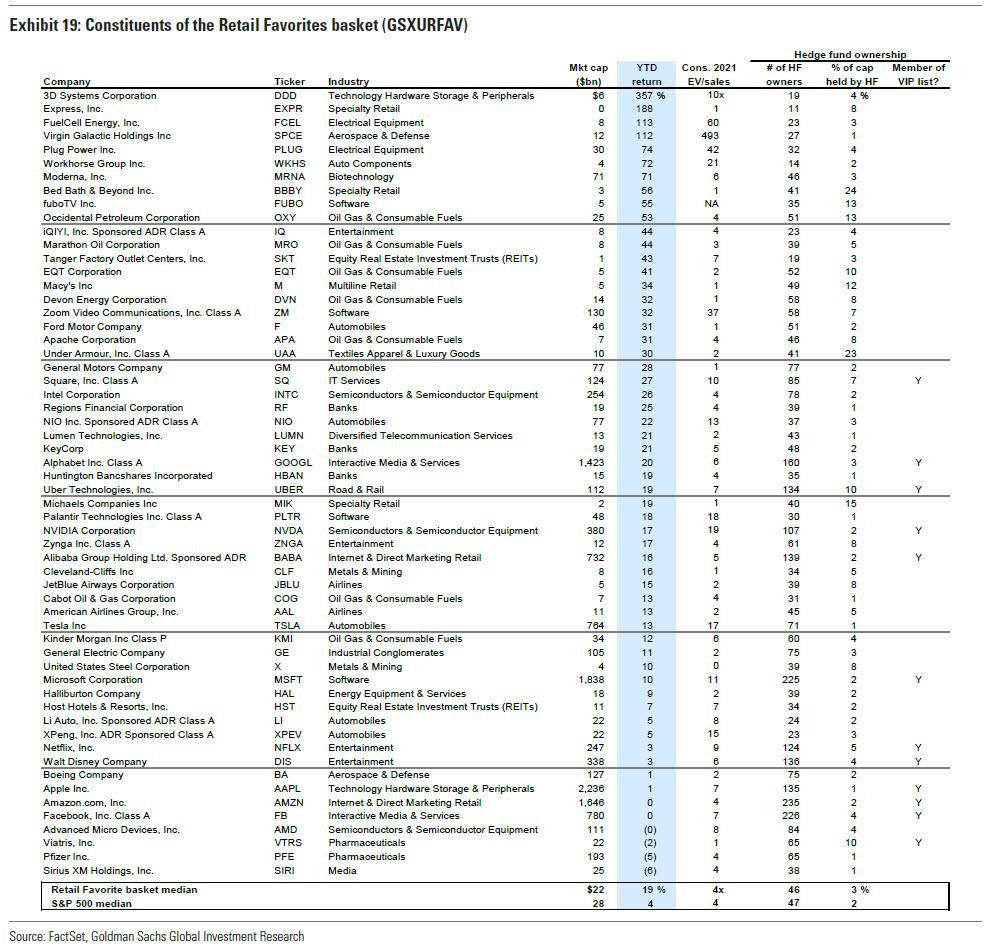
In general, the most popular stocks among retail investors have performed well; a basket of Retail Favorites (ticker: GSXURFAV) has returned 18% YTD, outperforming both our VIP basket of the most popular hedge fund long positions (+8%) and the broad S&P 500 (+4%). Notably, the retail favorites have been positively correlated with the most heavily-shorted stocks, in contrast with the recent sharply negative correlation of our Hedge Fund VIP basket (Exhibit 10).
The dramatic gains by retail investors also explain the substantial outperformance of value over growth names in 2021. Goldman explains:
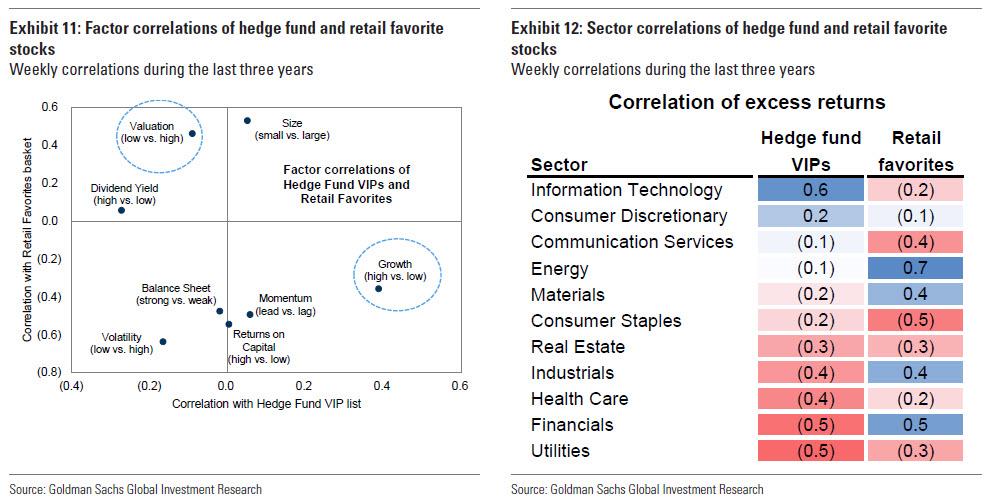
In general, the favorite retail trading stocks tend to be tilted toward Value as a factor, while hedge fund favorites are more correlated with Growth. Similarly, at the sector level, the largest weight and correlation of Hedge Fund VIPs is with Info Tech stocks, whereas retail favorites have been more correlated with cyclical value sectors like Energy and Financials.
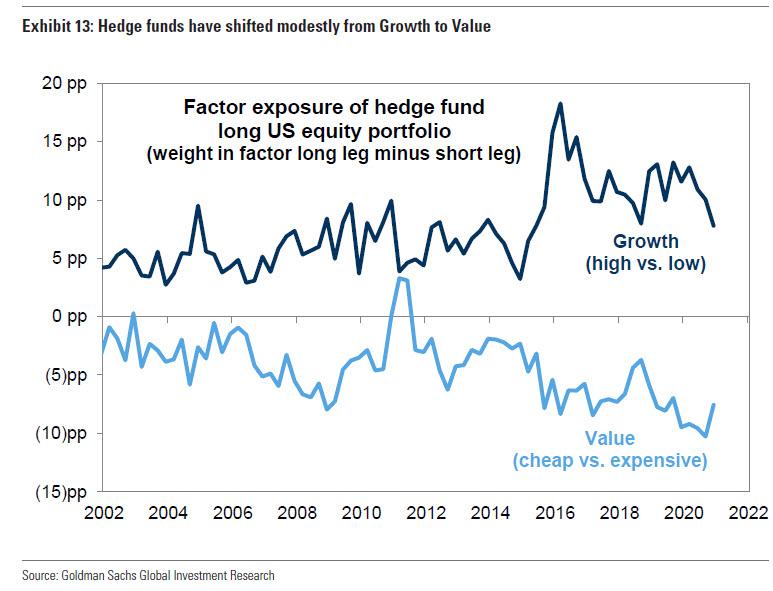
As a result, while hedge funds have shifted "slightly" toward Value in recent quarters, Goldman notes that they remain firmly in the Growth camp.
This is similar to events in the second half of last year, when ahead of vaccine efficacy results and the 2020 elections, funds rotated modestly toward Value, including lifting positions in Financials. However, the rotations fizzled in the 4th quarter, as vaccine news surpassed expectations but Election Day 2020 failed to result in a large “Blue Wave.” At the factor level, funds continued to shift from Growth to Value, but changes in sector and subsector tilts generally favored secular growth over cyclicality.
Of course, between hedge funds' even higher (record) net leverage and continued bets on growth stocks, what happened in January may very well happen again - in fact it is virtually assured following the next big reflationary catalyst. We are starting to see that already, because as yields rise it is the growth and high-duration stocks that are getting hammered the hardest:
Consistent with their factor tilt toward Growth, the most popular hedge fund long positions have recently been very negatively correlated with interest rates. Hedge Fund VIPs generally have higher implied equity duration and higher valuation multiples than both the retail favorite basket and the S&P 500. For more on equity duration and sensitivity to interest rates, see Q&A on rates and equities, February 7, 2021
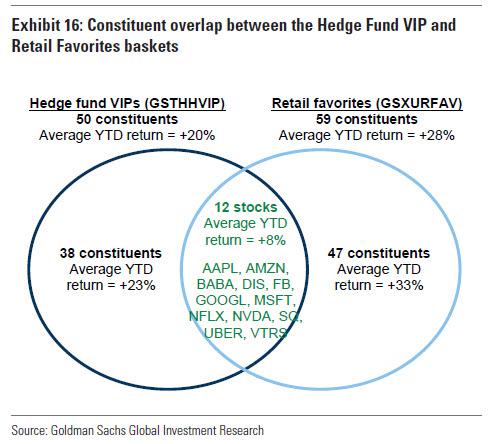
And yet despite their investing differences, hedge funds and retail investors do share some commonality in their portfolios. 12 stocks in Goldman's Hedge Fund VIP basket also appear in the Retail Favorites basket: AAPL, AMZN, BABA, DIS, FB, GOOGL, MSFT, NFLX, NVDA, SQ, UBER, VTRS.
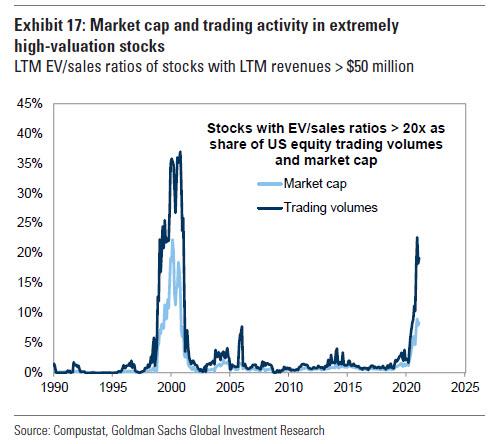
Furthermore, Goldman notes that both investor groups have also contributed to the surge in trading activity among extremely high-growth, high-valuation stocks; each basket contains a number of stocks trading above 20x EV/sales, although none of those stocks appear in the overlap between the two baskets.
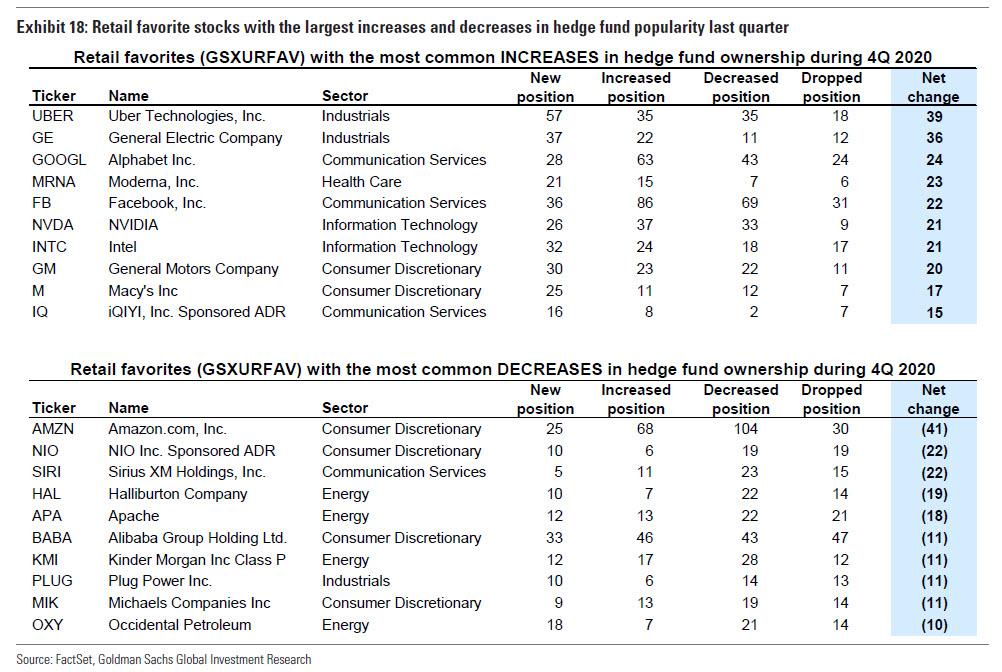
Goldman concludes, as usual, by looking ahead in the rearview mirror, and in the table below lists the retail favorite stocks with the largest increases and decreases in hedge fund popularity last quarter....
... while the next chart shows the entire Retail Favorites basket. The basket is rebalanced monthly to include the stocks with the highest dollar notional volume of small share trades during the previous month
And while all of this information is great, what would have been far more practical - not to mention lucrative - is for Goldman not to do a "post mortem" but to predict ahead of time, that the most shorted stocks would explode and the most popular ones would collapse- you know, as analysts used to do once upon a time when they correctly called the future... like for example we did in our Nov 20 post.
And since all of the above confirms that absolutely nothing has changed, we will end this post the same way we end all our hedge fund performance wraps - by telling our readers that the most profitable decision they can make is to once again go long the most shorted names...
... while shorting the hedge fund hotel of 50 or so "VIP" names that have emerged after countless shadowy and collusive (if not collusive enough to warrant a Congressional hearing) idea dinners.
(ZH) Just As COVID Vaccine Found To Be 99% Effective In Preventing Death, Japan

Just As COVID Vaccine Found To Be 99% Effective In Preventing Death, Japan Discovers New, More Contagious Strain

With each passing day, covid gets closer to being a distant memory.
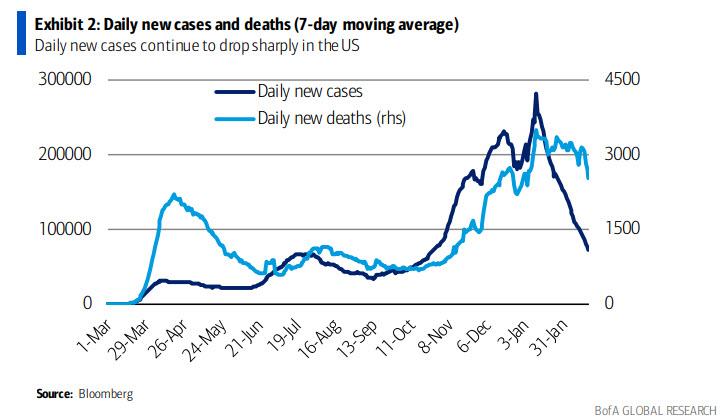
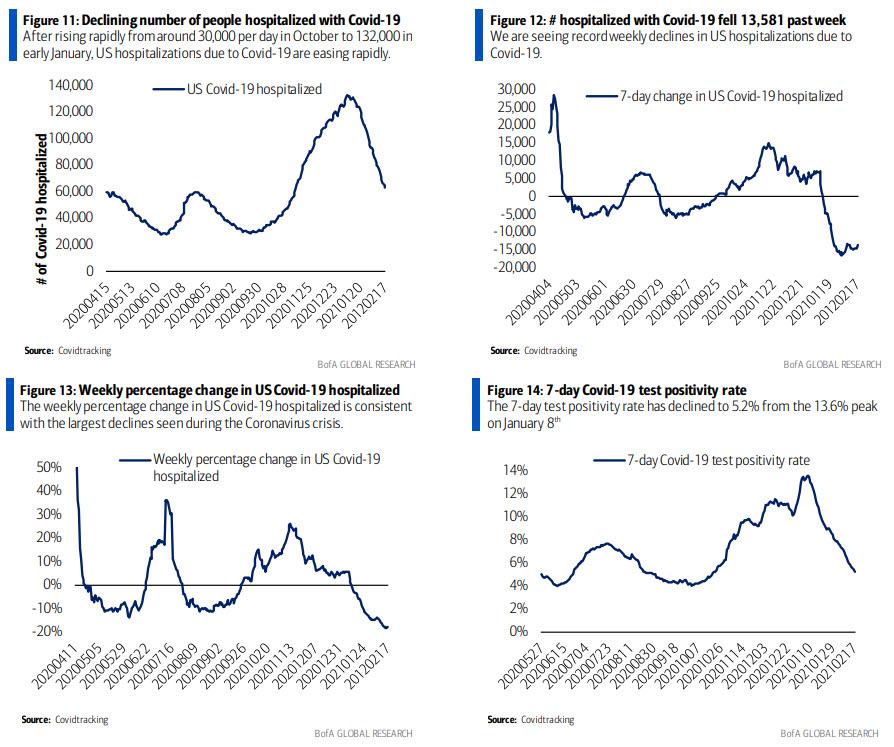
The seven-day average of new cases in the US is down to 77,700 in the US, 69% below the mid-January peak...
... while in the top 5 European nations, the seven-day average has declined to 61,800, down 55% from the mid-January peak. US Covid-related hospitalizations have dropped by 50% and Covid-related fatalities are also continue to decline, with daily deaths almost 25% below the recent peaks in the US (at 2,560) and 30% below in the five major European countries (at 2,350).
Globally, the 7-day average of new cases stood at over 366k, a 12.8% decrease from a week ago. Meanwhile, the 7-day average of Covid-related fatalities across the globe was 10.8k yesterday. A Johns Hopkins professor wrote a WSJ op-ed predicting that the US will hit herd immunity by April, even as Fauci continues to fearmonger that 2022 is when normality will return.
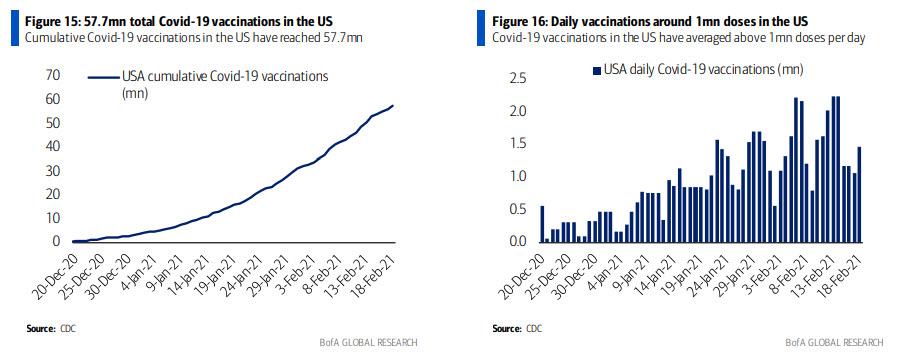
More importantly, every passing day brings us closer to herd immunity: the US administered 11.5m vaccine doses over the past week, increasing the total to 56.3m. Europe administered 11m doses this past week, for a total of 45.3m. The US administration announced that Covid-19 vaccine deliveries allow for an increase in supply to the states to 13.5 million doses per week, up from the current 11.5 million.
Since early February, the pace of US vaccinations has steadily improved from 9 million shots per week to 11.5 million (equivalent to 3.5% of the population).
Over the same period, weekly vaccinations in the UK have flat-lined at just below 3 million (4.4% of the population), following a surge since the start of the year, while those in the four largest Euro area member states have remained at around 2 million in total (1% of the population).
In the latest positive pandemic development, the Jerusalem Post reported that the Pfizer coronavirus vaccine was proven to be about 99% effective in preventing hospitalization, serious disease and death for those who are past two weeks from the second dose, new data released by the Israeli Health Ministry on Saturday night showed. The protocol to administer the Pfizer vaccine involves two injections three weeks apart. Israel started to administer the vaccine on December 19. The report included the figures collected by the ministry up to February 13.
The news came just as Israel was preparing to send 1.1 million children back to their classrooms – 500,000 more than attended last week – and open up gyms, hotel rooms, malls and street shops.
The Health Ministry measured the level of effectiveness of the vaccine both seven days after the second shot – when the immunity is considered to kick in – and another seven days later. The ministry compared the morbidity and mortality rates between those who vaccinated and those who did not.
“Thanks to the strong health care system of the State of Israel, which has enabled us to reach an unparalleled extensive vaccination rate in a short period of time, as well as to our ability to carry out comprehensive epidemiological tracking, we are the first country in the world to demonstrate the effect of the corona vaccine in the real clinical world,” Health Ministry Director-General Chezy Levy said.
According to the document, a week after the second dose, the jab was 91.8% effective in preventing individuals from contracting the virus, 96.9% from developing symptoms such as fever and respiratory difficulties, and 95.6%, 96.4% and 94.5% against hospitalization, serious illness and death respectively.
In addition, two weeks after the second shot, the efficacy improved even further: 95.8% against contracting the virus, 98% against developing symptoms such as fever and respiratory difficulties, and about 99% against hospitalization, serious illness and death – 98.9%, 99.2% and 98.9%. The data clearly shows a significant decrease in cases among the population over 60 as a higher rate of them became fully vaccinated.
“The vaccine significantly reduces morbidity and mortality and its effect can be seen in the morbidity data in the country,” Levy said. “Our goal is to continue to vaccinate the entire population over 16, and when the time comes also those under the age of 16, in order to achieve the extensive coverage that will allow us to return to the normal life we all long for.”
Israel’s infection rate has been decreasing for several days. Some 3,011 cases were recorded on Thursday and on Friday the number of serious patients dropped for the first time under 900 in several weeks – to 858.
Sadly, too much good covid news is not acceptable - as it minimizes the leeway politicians have to inject further trillions in stimulus thereby entrenching government cronyism and perpetuating corruption - and so just as it seemed that covid is on its way out Japan confirmed on Friday that a new coronavirus variant had infected nearly 100 people.
Reuters reported that Chief Cabinet Secretary Katsunobu Kato told reporters that 91 infections were documented in the Kanto area of eastern Japan and two other cases were discovered at airports.
Of course, the latest and greatest covid strain had be scary enough to be even scarier than whatever prevailing mutant forms are currently out there, and sure enough...
"It may be more contagious than conventional strains, and if it continues to spread domestically, it could lead to a rapid rise in cases," Kato said.
The variant has a mutation on the spike protein that could lower the efficacy of vaccines. The National Institute of Infectious Diseases said that the variant appears to have originated overseas, but it is different from other variants circulating in Britain, South Africa and Brazil.
Japan has over 422,000 cases of the virus and 7,360 deaths, according to data from Johns Hopkins University. The country's health ministry reports Japan has reported 150 cases of the other variants first found in Britain, South Africa and Brazilian travelers.
The variants have complicated the outbreak's outlook, with speculation that the highly infectious strain first documented in the U.K. could become the dominant one in the U.S. in March. Experts have said it is now a race to get as many people vaccinated as possible to help control the spread of the variants.
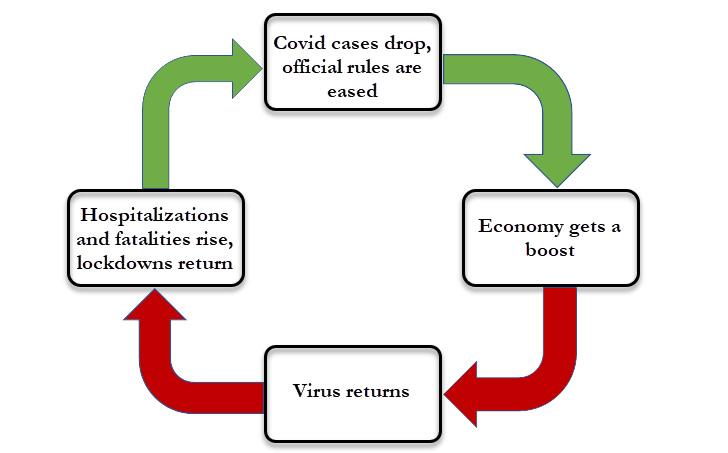
Naturally, the scramble for vaccines has to be reset the moment a strain emerges that is immune to the latest technology, which appears to be taking place now, which is why we would not be surprised if just a few months from now the number of covid cases is once again "found" to soar on the back of economies reopening and social distancing easing, which in turn brings us back to our favorite flow chart...
... which virtually assures an economic slump in the second half of 2021, just in time to greenlight the next giga-stimulus and next round of monthly government handouts from the Biden administration.

FT : Corporate US urges Biden to avoid hiking taxes to fund infrastructure

Corporate US urges Biden to avoid hiking taxes to fund infrastructure
Business lobby groups argue broader economic recovery would be at risk if levies are included in spending bill

Joe Biden is facing mounting pressure from corporate America to avoid tax increases to fund the multitrillion-dollar infrastructure investments the US president has promised in the coming months.

The stand-off between the White House and US business is emerging as a new political hurdle for Biden’s economic agenda, even as he moves closer to clinching congressional approval for an immediate $1.9tn fiscal stimulus plan, likely by mid-March.

The Biden administration and business groups largely agree on the need for additional large-scale government funding to modernise US infrastructure, finance research and development and promote green energy.

But the most influential lobby groups representing corporate America in Washington are warning the president against increasing their taxes to pay for the measures. They argue that including the tax hikes in a bill later this year would be economically harmful and could torpedo the legislation.

“I can simply say that from the business community’s perspective, raising the corporate tax rate is going to make American companies less competitive at the very moment that we need a broad economic recovery,” Neil Bradley, the chief policy officer at the US Chamber of Commerce told the Financial Times. “And it’s going to make passing a bill probably next to impossible.”

The Business Roundtable, whose members include the largest blue-chip companies, is also opposed to an increase in corporate taxes to fund infrastructure spending.

During the 2020 campaign, Biden called for an increase in the US corporate income tax from 21 per cent to 28 per cent, partially reversing the tax cuts enacted by his predecessor Donald Trump in 2017, as both a matter of budgetary prudence and a matter of fiscal equity.

The White House has not laid out any details of its next economic proposal centred around infrastructure, transport, and clean energy, but internal discussions are under way and the president has met publicly with business and trade union leaders as he develops the plan.

Analysts are expecting the administration’s proposals to potentially cost between $2tn and $4tn depending on the specifics. The White House has not confirmed any price tag.

The longer-term spending would come on top of the temporary stimulus package already in train. The House of Representatives is set to move forward this week with a bill containing $1.9tn of pandemic relief, including for individuals and state and local government.

“The president has long talked about how critical it is that — when we turn to plans for our economic recovery — we invest in America, create millions of additional good-paying jobs, combat the climate crisis, advance racial equity, and build back better than before,” a White House spokesperson told the FT.

“For permanent policies that incur ongoing costs, the president is committed to paying for them by asking the wealthiest Americans and corporations to pay their fair share,” the spokesperson added. In addition to higher corporate taxes, Biden has proposed increasing capital gains taxes on individuals earning more than $1m and higher payroll taxes for high income households.

The debate over the need to cover the expense of long-term government investments will mark a further test of the shifting politics around debt and deficits in Washington. Both Republicans and Democrats have become less concerned by the need for fiscal prudence in recent years.

If the administration were to back away from the higher taxes in order to gain support from Republicans and pass the second phase of its economic agenda, it would be disappointing for many Democrats, but it may not sink the plan.

“[Biden officials] are committed to a progressive tax structure, the question is when to do it. Right now the first priority is relief,” Ro Khanna, the Democratic lawmaker from California, told the FT. “I think that people recognise that in a low interest rate, low-inflation environment, getting money out to people is . . . important.”

Business groups are suggesting that instead of funding a bout of new infrastructure spending by increasing the corporate tax rate, other sources of revenue could be explored.

These could include raising the federal gas tax, which has been stuck at 18.4 cents per gallon since the early 1990s with no indexing for inflation. However, that would pose its own political challenges, since it would hit rural states particularly hard and disproportionately affect low-income households that drive a lot, making it regressive and possibly violating Biden’s pledge not to raise taxes on households earning less than $400,000 per year.

“We may think, well, for stimulus purposes, we don’t want to pay for everything, we just want to inject some money into the economy. That’s not an unreasonable position in the short term coming out of a recession as we are right now, but it would not be a way to set us up for long-term success,” Matt Sonnesyn, the Business Roundtable’s vice-president of infrastructure, energy and environment, said during a panel last week.

“It would be a really terrible shame if Congress fails to address the long-term funding and financing issues for our nation’s infrastructure when they do this package,” he said.

WSJ : Bond Selloff Prompts Rethink by Stock Investors

Bond Selloff Prompts Rethink by Stock Investors
If yields rise more quickly and unpredictably than expected, that would be disruptive to assets like shares, many analysts say

The sharp increase this month in U.S. government-bond yields is sending tremors through stocks, weighing on hot technology shares and some other sectors while prompting a deeper reassessment of the threat posed by rising interest rates.

For now, many investors remain optimistic because the reasons behind the bond retrenchment are mostly positive. Stuck near historic lows for most of last year, Treasury yields have climbed in recent months along with investors’ expectations for a strong economic rebound, driven in part by more debt-financed government spending.


Rising yields, which result from falling bond prices, often reflect investors’ expectations of faster growth and an accompanying rise in inflation, which erodes the purchasing power of bonds’ fixed payments and can eventually lead the Federal Reserve to raise short-term interest rates. More government borrowing also can boost yields by increasing the supply of bonds. Though many investors are keeping an eye on inflation data, analysts and portfolio managers say so far there is little reason to believe price levels will rise enough to prompt the Fed to raise rates any time soon, which looms as perhaps the greatest risk to major stock indexes.

“The market has principally been saying, ‘Hooray, the pandemic is coming under control and the economy is starting to grow again,’” said Brad McMillan, chief investment officer at Commonwealth Financial Network, an investment adviser and brokerage firm. “But now we’re actually starting to see the consequences of that in the form of higher rates, and I think the market’s processing that.”

As of Friday, the yield on the benchmark 10-year U.S. Treasury note stood at 1.344%, up from 1.157% just five trading sessions earlier and roughly 0.9% at the start of the year.

Treasury yields got a big lift in the fall when Pfizer Inc. announced promising results from its coronavirus-vaccine trial, and in early January when Democrats won two pivotal Senate elections, opening the door to trillions of dollars in government spending.

The move over the past week caught investors’ attention because no specific catalyst was apparent. That raised the prospect that yields could rise more quickly and unpredictably than expected—an outcome that many believe would be more disruptive to other assets such as stocks than a slow, orderly climb.

The S&P 500 fell 0.7% for the week, dragged down largely by technology stocks, which after big gains in recent years are seen as especially vulnerable to rising yields. Banks, meanwhile, rose as investors bet that higher long-term interest rates and an improving economy would boost profitability.

Investors this week will monitor the latest developments in Washington, where House Democrats hope to finalize a $1.9 trillion stimulus package, as well as figures on consumer spending and earnings from consumer companies such as Home Depot Inc. HD -1.20% and Macy’s Inc. M 4.54%

They will also keep watching Treasury yields, whose rise can hurt stocks in a few different ways, according to investors and analysts.

As yields move up, borrowing costs for most businesses should also rise, crimping profits. Higher yields could also attract to bonds some investors who were previously invested in stocks because they felt they had no other alternative to earn a meaningful return.

Finally, many investors use the 10-year Treasury yield as a discount rate in formulas to value stocks. All else equal, the expected cash flows of companies are considered less valuable when yields are higher. That poses a threat to many tech stocks because much of their earnings are expected to come further in the future.

Treasury yields remain extremely low by historical standards, but they aren’t so low relative to stock prices, some argue. In recent years, the 12-month forward-earnings yield of world technology companies—their expected earnings per share as a percentage of their stock price—has generally exceeded the 10-year Treasury yield by at least 2.5 percentage points.

But the yield differential has recently fallen below that threshold—one sign that the stock-market rally that was previously justified by ultralow bond yields “is turning irrational,” Dhaval Joshi, chief European investment strategist at BCA Research, a Montreal-based investment research firm, wrote in a report last week.

Still, many investors aren’t too worried about rising yields, seeing them mostly as a welcome sign that the economic outlook is improving.

“Our base case is for the positives of a higher rate regime to outweigh the negatives,” said Matt Peron, director of research at Janus Henderson Investors. Most professional stock investors have already baked higher yields into their valuation models, and the largest tech companies generally have earnings that justify their prices, he added.

Even so, rising yields could cause investors to rethink their allocations to different sectors, Mr. Peron said. His own team started adding exposure in the second half of last year to companies such as certain retail brands and online travel businesses that stand to benefit from an economic recovery and are less vulnerable to rising rates.

Of course, the threat to stocks from the bond market depends a lot on how high and how quickly yields can rise, analysts said. Many analysts forecast that the 10-year Treasury yield will reach anywhere from 1.5% to 2% by the end of the year as investors start preparing for future rate increases from the Fed.

Still, there are factors that could cause a more disorderly selloff in the bond market.

Under a worst-case scenario for bonds, large amounts of government spending could start generating the type of inflation that at this point is only theoretical, investors and analysts said. That could intensify speculation about tighter monetary policies even as investors are forced to absorb larger quantities of new Treasury debt.

So far, though, rising yields reflect uncertainty about the future more than any tangible changes in the economy. Earlier this month, the Labor Department reported that core consumer prices, excluding the often volatile food and energy categories, were essentially flat for the previous two months.

Treasury yields fell at the time, only to begin their latest steep ascent just two days later.