(ZH) Evergrande Denies Rumors Of Bankruptcy As Crisis Boils Over, Social Unrest

Evergrande Denies Rumors Of Bankruptcy As Crisis Boils Over, Social Unrest Breaks Out Across China

China Evergrande Group, the largest and most indebted, and certainly most insolvent property developer in China, is - together with its $300+ billion in debt - rapidly approaching its "China moment."
Five days after reports of a technical default at Evergrande, which slammed China's property market and sent Chinese junk bond yields to the highest level since March 2020, the company took the unprecedented step of publishing a statement on its website, according to which it is "indeed facing unprecedented difficulties but it firmly fulfills responsibilities." The company added that it will go all out to resume work and production, ensure to deliver buildings, do everything possible to restore normal operations, and protect the legitimate rights and interests of customers.
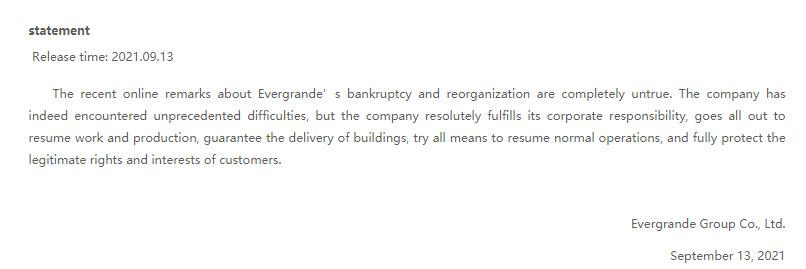
The company's statement was also prompted by the growing operational and liquidity crunch that has crippled Evergrande's business and balance sheet, and as Bloomberg reports this morning is now manifesting itself in mounting protests by homebuyers, retail investors and even its own employees, raising the stakes for authorities in Beijing as they try to prevent the property giant’s debt crisis from sparking social unrest.
According to Caixin, police descended on Evergrande’s Shenzhen headquarters late Monday after dozens of people gathered to demand repayments on overdue wealth management products. Protesters numbered in the hundreds on Sunday.
In what appears the sad - and inevitable - beginning of the end for Evergrande, the largest Chinese developer told employees at its office in Shenyang, near the border with North Korea, to work from home after staffers who bought the company’s WMPs staged a protest over the weekend, Bloomberg reported citing a person familiar with the matter said. In Guangzhou, angry homebuyers surrounded a local housing bureau last week to demand Evergrande restart stalled construction.
Videos of protests against the developer in other parts of China were being shared widely on China's microblogging platform, Weibo. For now, there has been indication that any of them have turned violent.
As a reminder, among its creditors, Evergrande lists - in addition to official creditors - various shadow banking conduits such as Wealth Management Products (or WMPs). It is these shadow bank funding sources that are being throttled now as the company finds itself increasingly insolvent.
Monday's uproar follows Evergrande’s proposal late last week to impose lengthy repayment delays on holders of WMPs, the lightly regulated investment vehicles that have become a key source of funding for the developer. While Evergrande tweaked its plan on Monday in an attempt to mitigate the backlash, retail and institutional investors will still face delays unless they accept repayment in the form of Evergrande-developed properties.
And while small-scale protests over troubled investment products aren’t unheard of in China, but they’re rare enough to attract attention from authorities who put a premium on social stability and have little tolerance for unsanctioned gatherings. Whether they prompt Xi Jinping’s government to change tack on Evergrande remains to be seen.
As a reminder, last week we learned that late in August, China’s top financial regulator signed off on the developer’s plan to renegotiate payment deadlines with banks and other creditors. It’s unclear if officials had given explicit guidance on WMPs.
The immediate reason for the public anger is the realization that (most of the) money may be gone: Evergrande proposed three repayment options for WMPs on Monday, according to Bloomberg source: they included repayment through cash installments, properties or investors’ payables on residential units they have already purchased, the people said. Retail investors can choose to be repaid 10% of their principal and interest every quarter, starting the final working day of the month due. The new proposal treats all investors equally, in contrast to an interim plan released late last week that prioritized smaller investors, according to people familiar with the matter.
When Evergrande stopped repaying some investors last Thursday, those holding less than 100,000 yuan ($15,488) were to be paid in full and those with exactly 100,000 yuan were to get half back, according to two investors briefed earlier. Those holding more than 100,000 yuan were to see payments extended by two to four years and amortized.
Apart from the cash option, the new plan allows investors to purchase Evergrande’s residential units, offices, stores and parking units at deeper discounts to offset wealth products due. If investors have bought Evergrande’s residential units by Sept. 12, they can also request to use the money they’re owed to offset payments. Details are still pending for the second and third option. Evergrande doesn’t disclose details of its WMP issuance, making it difficult to gauge the size of its outstanding products.
A local TV station in Anhui province reported that thousands of people in the province hold overdue Evergrande WMPs that total between 1.3 billion and 1.8 billion yuan, citing a wealth management consultant at Evergrande named Liu Yuntin. The consultant said 70% to 80% of Evergrande’s own employees in Anhui purchased such products and that’s likely to be the situation for branches nationwide. Evergrande repeatedly told staff that it would be responsible for interest and principal and that Hui Ka Yan himself would guarantee payments, Liu said.
Then there is the question of bondholders.
With more than $300 billion in liabilities, Evergrande has long been seen as the most systemically important distressed company in China, which unlike its similarly insolvent peer Huarong, has not yet been given an explicit bailout backstop from the government. On top of its obligations to WMP investors and bondholders, it owes about $147 billion in trade and other payables to suppliers and received down payments on yet-to-be-completed properties from more than 1.5 million home buyers as of December according to Bloomberg calculations.
Meanwhile, Evergrande’s bonds are pricing in a near-certain likelihood of default, with its dollar note due 2022 falling by about 2 cents to 31 cents on Monday.
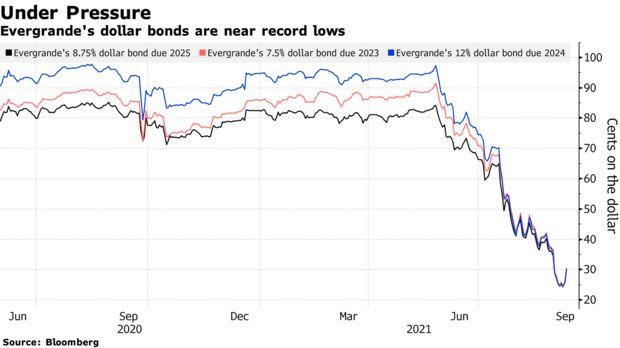
China Evergrande Group may undergo one of the country’s biggest-ever debt restructurings, if the developer’s distressed-level bond prices are any indication.
It’s “almost unavoidable,” said Nomura International Hong Kong Ltd. credit analyst Iris Chen. Her base case is a government-supervised deal that ensures Evergrande delivers homes and pays suppliers, where dollar debt investors would get 25% of their money back. Luther Chai, a senior research analyst at CreditSights Singapore LLC, also predicts Evergrande may default and enter restructuring. That risk is being priced in, with many of Evergrande’s dollar bonds trading near 30 cents.
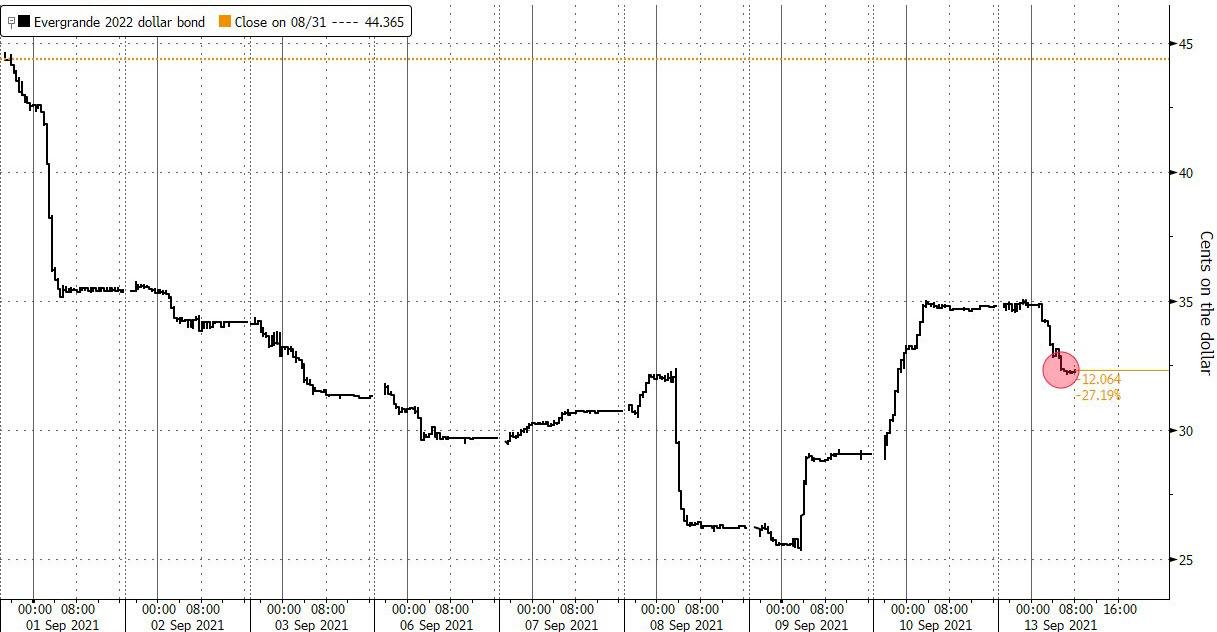
According to an analysis published on Sunday, Evergrande would undergo one of the country’s biggest-ever debt restructurings, if the developer’s distressed-level bond prices are any indication.
It’s “almost unavoidable,” said Nomura International Hong Kong Ltd. credit analyst Iris Chen. Her base case is a government-supervised deal that ensures Evergrande delivers homes and pays suppliers, where dollar debt investors would get 25% of their money back. Luther Chai, a senior research analyst at CreditSights Singapore LLC, also predicts Evergrande may default and enter restructuring. That risk is being priced in, with many of Evergrande’s dollar bonds trading near 30 cents.
The trick is that nobody really knows what would happen in case of a full-blown bankruptcy. Debt defaults at developers the size of Evergrande are so rare in China that investors, analysts and regulators would only have a few case studies to go on. Kaisa Group Holdings Ltd. in 2015 became the first Chinese builder to default on dollar bonds. The restructuring of another, China Fortune Land Development Co., is currently under negotiation.
Any disorderly failure by the firm may pose a threat to the financial system. The lack of clear precedents also means Chinese authorities have yet to test mechanisms in solving a debt problem quite like Evergrande, which has more than $300 billion in liabilities.
Evergrande restructures its debt and bondholders recover a portion of their funds. This would be an “orderly wind down,” says Omotunde Lawal, head of Barings LLC’s emerging-market corporate debt group. There may be some contagion across China’s property issuers at first, according to Nomura’s Chen, though sentiment would improve as a key overhang would be removed. She expects only a 5% recovery rate for investors in Evergrande unit Scenery Journey Ltd.
It’s essential that normal operations continue after any potential default of a Chinese developer, wrote Morgan Stanley analysts led by Kelvin Pang in an Aug. 18 note. In other words, construction projects would be completed and homes would be delivered. And because dollar debt funding is “crucial” for developers, a defaulted property developer may not necessarily favor onshore creditors over those offshore, according to Morgan Stanley.
In a scramble to shore up its liquidity, the developer said it’s exploring the sale of interests in its listed electric vehicle and property services units, as well as other assets, and seeking to bring in new investors and renew borrowings. It’s also discounting properties aggressively to boost sales, with mixed success. Contracted sales, including those to suppliers and contractors to offset payments, tumbled 26% last month from a year ago.
Evergrande said in August it was forced to suspend work on some projects due to overdue payables. The company’s billionaire founder, Hui Ka Yan, pledged to complete projects this month, issuing what he called a “military order” to ensure property construction and delivery.
(ZH) Japan Scrambled Recon Aircraft & Destroyers After Chinese Submarine Surface

Japan Scrambled Recon Aircraft & Destroyers After Chinese Submarine Surfaced Near Its Territory

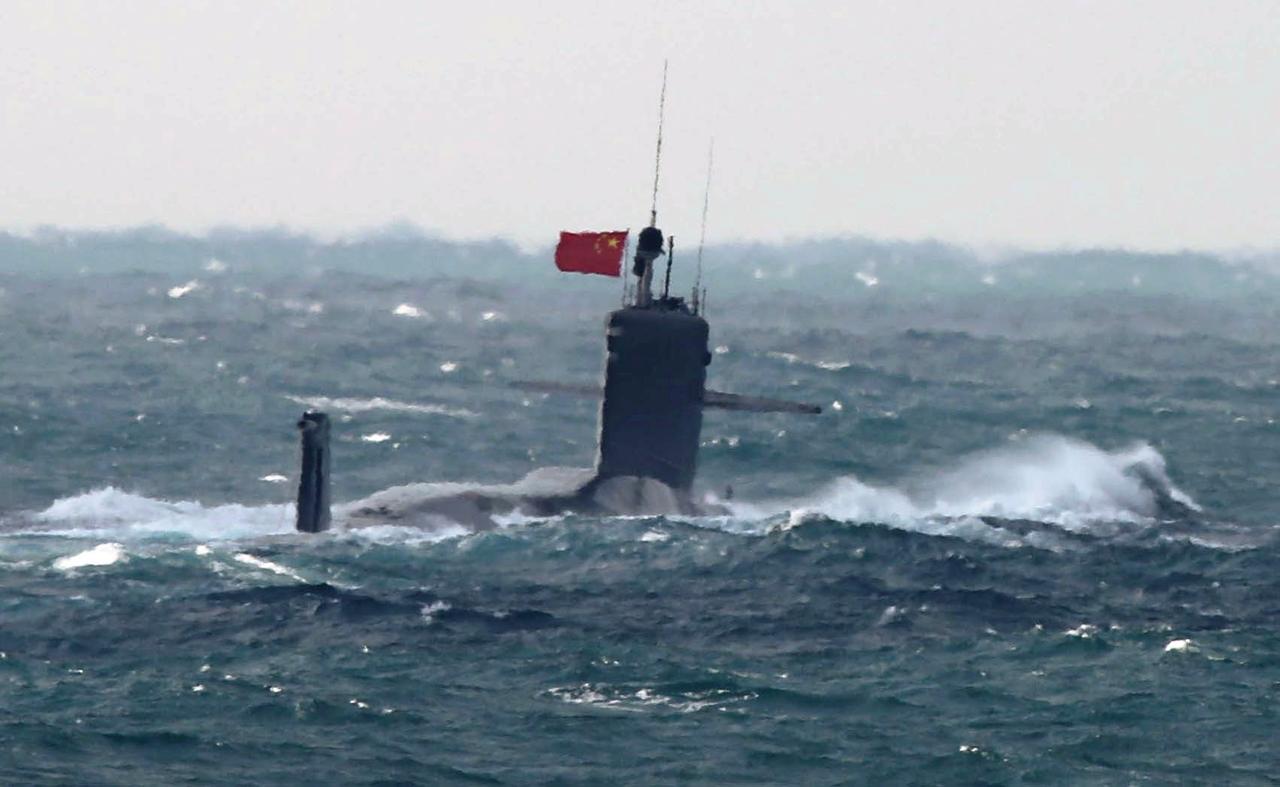
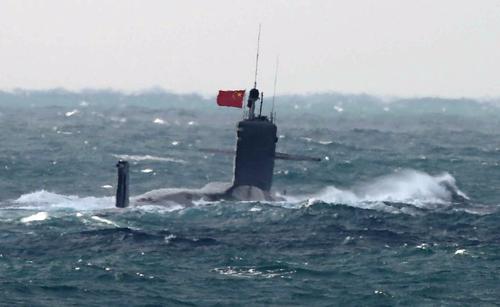
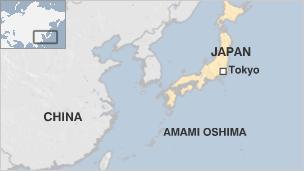
Japan's defense ministry has announced that it believes a Chinese submarine is in waters near its southern islands, saying the submarine was spotted Sunday traversing to the northwest just outside Japanese territorial waters near Amami Oshima island.
During the same sighting a Chinese destroyer was also spotted in the area. It's unclear whether the submarine ever breached Japan's waters - based on official statements it doesn't appear so - and the incident comes after years of Tokyo complaining of such aggressive Chinese incursions.
Prior 2018 Chinese sub sighting off Japan, via Japanese Ministry of Defense
According to Reuters, the weekend announcement indicated Japan's Maritime Self-Defense Force "identified the vessels in a contiguous zone, which is outside territorial waters where vessels are required to identify themselves." Amami Oshima Island is far south off the Japanese mainland.
Japan's Defense Minister Nobuo Kishi ordered his staff "gather information and maintain vigilant surveillance with a sense of urgency," according to the statement.
The Japanese military response included sending three reconnaissance aircraft and two destroyers to the area in order to assess and observe the Chinese vessel's intentions.
After the sighting, and as Japan continued to monitor the vessel, "The submarine continued underwater westward in the ocean near Yokoate Island," the defense ministry said. It's said to now be heading west into the East China Sea, near islands currently controlled by Japan but claimed by China.
International maritime law and norms requires that any submarine passing off a foreign county's coast must surface and identify itself by flying a national flag should it come to within that country's territorial waters.
In recent years such hostile Japan-China encounters, particularly around disputed islands claimed by both, have become increasing occurrences, also as Tokyo has lately more openly declared itself in Washington's corner when to comes to the intensifying Taiwan status issue.

BreakingViews : Mini-Salesforce puts mighty multiple in $9 bln IPO,A fresh force

Mini-Salesforce puts mighty multiple in $9 bln IPO

A fresh force

Marc Benioff’s $252 billion Salesforce.com is a giant among giants. But the initial public offering of Freshworks, a much smaller software firm seeking a $9 billion market capitalization in an upcoming float, might be bigger in one way: its valuation. It shows how small things can pack a mighty punch.

Freshworks, like Salesforce, helps businesses manage customers as a so-called software as a service company. Smaller organizations, like the Los Angeles Community College District, are its bread and butter. But helping salespeople keep track of leads is a valuable proposition for companies of all sizes, and Freshworks is supercharging its expansion by making inroads among bigger clients like Sotheby’s.

Revenue grew 53% in the first half of 2021, compared with the same period the previous year, to $169 million. The company is also churning out cash despite its expansion, an important but unusual quality. In the first half of the year, cash from operations was $8.7 million, resulting in free cash flow of $3.7 million after capital investment.

Even more encouraging is that revenue is growing faster than the number of paying customers, which grew just over 20% in 2020. It suggests that customers that try software from Freshworks tend to get hooked and sign up for more. The percentage of annual recurring revenue from customers paying over $5,000 is steadily rising, indicating the company is landing larger clients, too. That could supercharge growth for some time.

Assume Freshworks keeps growing at a 50% clip over the next four quarters, not a wild assumption given these characteristics. Its sales would be closing in on $500 million by this time next year. At the top of the company’s IPO range, it would be worth about 17 times sales, after netting out cash. Sure that’s twice the multiple attached to Salesforce, according to Refinitiv, yet Freshworks is projected to grow twice as fast.

The irony is that Salesforce might have offered not only a road map for Freshworks but opened up the market to a competitor, too. A some point customers might stop choosing the little guy over the established firm. But with Freshwork’s sales at about 1% of those at Salesforce, there is still plenty of business to go around.

FT : UK cancels €1.4bn Covid vaccine deal with France’s Valneva

UK cancels €1.4bn Covid vaccine deal with France’s Valneva
Doses were to be manufactured in Scotland with deliveries starting in 2022

The UK has terminated a €1.4bn agreement with French biotech Valneva for the supply of at least 100m doses of a Covid-19 vaccine, saying the group was in breach of its obligations under the deal.

Manufacture of the vaccine, which is in late-stage trials and still awaiting regulatory approval, was planned to take place in Scotland and deliveries were set to start next year.

The disclosure of the termination by Valneva sent shares in the Paris-listed company down by 42 per cent on Monday. The group added that it “strenuously” denied breaching its obligations, but declined to comment further.

The vaccine performed less well than rivals in a recent UK trial, named Cov-Boost, that explored the effectiveness of various potential booster jabs, according to people familiar with the results, which are yet to be published. Valneva did not respond to a request for comment.

Competition for vaccines has proved politically explosive, with the EU this month settling an acrimonious dispute with AstraZeneca over delayed supplies. The French government came under fire last year when the UK first struck a supply deal with Valneva.

Downing Street said on Monday that the dispute with Valneva was an “ongoing commercial issue”.

The government had announced in August last year that it was investing a multimillion-pound sum in Valneva’s manufacturing plant in Livingston, Scotland, supporting 100 skilled jobs. At the time, Kwasi Kwarteng, the business secretary, hailed the plant as a potential “vaccine production powerhouse”.

The termination comes as the UK prepares to become the first big country to administer “mix and match” coronavirus vaccines for its booster programme.

Results of Valneva’s late-stage trials are expected in the fourth quarter, with UK approval possible before the end of the year, the company said.

Given the timeline, it is unlikely the shot would have played an immediate role in the booster campaign in which patients will be given a third shot that is different from the two they received earlier in the vaccination drive.

“The MHRA (regulator) has not approved the vaccine,” Downing Street said. “It does not form any part of our vaccine rollout in autumn and winter.”

Humza Yousaf, the SNP health secretary for Scotland, told the BBC that the cancellation of the contract was a “blow for the facility in Livingston”.

“We are very keen and will be reaching out to the company to try to get security and secure a future for that facility in Livingston,” he said.

Headquartered outside the French city of Nantes, Valneva is not a newcomer to vaccines. Its jabs for cholera and Japanese encephalitis have received approval from regulators either in the US or EU, and it has several others under development.

The company had warned in April that exporting vaccines between the EU and the UK could be a “substantial risk” to its operations. Although the vaccine was due to be manufactured in Scotland, the company said it would be put into vials and packaged in the EU.

Its vaccine candidate uses a whole inactivated virus to elicit an immune response against coronavirus, a technique that can prolong the manufacturing process but provides greater coverage against all variants. Most other shots are designed to target the spike protein of the virus.

Addressing the termination, Valneva said it had worked “tirelessly, and to its best efforts” on its collaboration with the UK, adding that it would “increase its efforts with other potential customers to ensure that its inactivated vaccine can be used in the fight against the pandemic”.

In late August, a French official said the country still planned to use Valneva’s vaccine as part of its autumn booster campaign, if the company secured European regulatory approval.

It is unclear if those plans have since changed, and France has let the company negotiate its potential contract with the EU instead of directly with France.

“We are one of the countries who have signalled interest in the Valneva vaccine, but we are prioritising a collective approach,” said a French government spokesman on Monday.

Frédérique Vidal, France’s minister in charge of higher education, research and innovation, declined to comment on the UK’s decision.

“Discussions are still under way with the European Union,” she told TV station BFM Business. “This case shows the challenges in biotech where when you try to do innovation you cannot succeed every time.”

FT : Peter Thiel, Jeff Bezos and the quest for immortality

Peter Thiel, Jeff Bezos and the quest for immortality
The billionaires’ race to reconfigure death is the latest manifestation of a timeless human fascination

According to the second law of thermodynamics, we cannot outrun entropy, the wearing down and eventual death of all systems, including the universe itself. So what would it mean to escape the inevitability of death? How counterintuitive is the idea of living forever? 

Max Chafkin’s upcoming book, The Contrarian: Peter Thiel and Silicon Valley’s Pursuit of Power is a sharp biography scrutinising the venture capitalist and entrepreneur who has also invested millions of dollars into life extension research seeking to “cheat death”. Part of Thiel’s personal branding is his strong connection to parabiosis, a field of experimental biology studying the anatomical and physiological union of two organisms. A disrupter and a Christian determined to fight death, Thiel has argued that if we accept that the future is unknowable, we might as well abdicate our agency. 

Since stepping down as Amazon’s chief executive in July, Jeff Bezos has also joined the contest by investing in Altos Labs, an anti-ageing start-up pursuing biological reprogramming, aiming to reverse time within a live mammal. Calico, a biotech company focused on longevity and funded by Google co-founder Larry Page, has been around since 2013 but new fields have since cropped up, such as liquid computers targeted to shut down cells carrying viral diseases, another niche area close to Thiel’s heart.

Memento mori, medieval Christians warned: remember that you have to die. That principle is now contested. It used to be the case that a man’s life lasted less than 30,000 days but Aubrey de Grey, a biomedical gerontologist, speculates that the person who will live a thousand years has already been born. In Silicon Valley, as the obsession with longevity has turned into a race to reconfigure death, billionaires are looking into a range of methods to increase and tweak their lifespans. Plasma from young donors, reprogramming DNA, tissue engineering, printing organs, cryonics and digital consciousness are a few examples of the utopian dream. But what if indeed we were able to live forever? 

Think of the fountain of youth appearing in the writings of Herodotus, the peaches of immortality in Chinese mythology or the elixir of life in the Epic of Gilgamesh from ancient Mesopotamia. Tech moguls, accustomed to the belief that there is a technological fix for every problem, see life as somehow reparable. Think of the ankh representing eternal life in ancient Egypt, blue roses — impossible to come by in nature — portrayed in literature and art as symbols of immortality. Forget Matthew Arnold, who in the 19th century claimed that life is long enough to contain everything.

Any biologist will tell you that mortality appears to be programmed into every cell of our bodies. Flowers die, stars die, cry the poets. Anti-ageing intervention is a tool for the wealthy, shout the activists. It is a narcissistic dream, the survival of the richest, say the sceptics. Some in Silicon Valley agree. In his Stanford commencement address of 2005, Steve Jobs said that mortality is “the single best invention in life”. Elon Musk said he does not want to live forever, that he would be happy with 100 good years. 

In his story “The Immortal”, Jorge Luis Borges suggested that life gets its meaning from death as with infinite time, there is no motivation. In Wagner’s opera The Flying Dutchman, a ship’s captain is cursed with immortality after attempting to sail in a terrible storm, then doomed to glide around the seas. Perhaps the best shot at immortality is through one’s oeuvre. Or perhaps not. “I don’t want to achieve immortality through my work,” Woody Allen said. “I want to achieve immortality through not dying. I don’t want to live on in the hearts of my countrymen; I want to live on in my apartment.”

What if we could upload our consciousness, then have our bodies frozen using the technologies of cryopreservation so we could one day wake up from a long sleep? Wouldn’t that diminish the joy of wasting our days? Isn’t life meant to be tenuous and unknowable? If real life is full of peril and adventure, then what feeling would a simulated reality offer that we could cherish? Death may be annihilation but in chasing eternal life we will end up like sliding red buses in liquid-filled pens.

The English moral philosopher Bernard Williams argued that it is a good thing that we are not immortal since it would be impossible to remain attached to life forever and continue to be the same person. Williams insisted that it would be bad to live forever, even under the best of circumstances. To avoid ennui, super-seniors would lose their desires — which is what motivates us to live, after all — and would replace them with different ones again and again. This would ultimately mean abandoning one’s identity, which is tantamount to death. Isn’t most of life leap and recoil, waiting for things we dream of to happen? If so, then we would go on living — but it would no longer be us.

FT : S4 Capital: Sorrell turns up the heat on adversaries

S4 Capital: Sorrell turns up the heat on adversaries
Digital-only agency founded to disrupt the advertising establishment is at full steam

Revenge for Sir Martin Sorrell is a dish best served piping hot. S4 Capital, the digital-only agency he founded to disrupt the advertising establishment, is certainly at full steam. Organic net revenues should now grow by 40 per cent this year, S4 said on Monday. The economic recovery and the accelerating shift to digital support the group’s third upgrade to top line expectations. 

Sorrell will rely on both trends to gain a march on an industry he helped to build, but now thinks is outdated. As with his previous company WPP, his acquisitions bolster organic growth. There have been nine deals so far this year — expect more to come.

S4 still looks small compared to industry behemoths such as WPP. Net revenues at the group Sorrell built were 20 times larger in the first half. S4’s fast-swelling market value of £4bn, which is up 12 times in the past two years, offers a better clue as to the industry’s direction.


The law of large numbers weighs on WPP, which recorded organic growth of 11 per cent in the first half. Sorrell has created a leaner model at his new shop. Its single structure removes the internecine rivalries inherent in large advertising and marketing holding companies.

The former’s scale has enabled it to retain the biggest clients. Digital customers prefer the ability to react quickly to new trends and are best served by internal collaboration. The approach is underpinned by financial incentives at S4, tied to the share price rather than individual profit and loss accounts.

Then again, its fully valued shares in S4 already reflect any excitement. Up more than fourfold since the start of 2020, they trade at a record valuation of 60 times this year’s earnings, suggesting a punchy price to earnings growth ratio of 2.4 times. Getting that PEG ratio below a more reasonable 1 times requires earnings to compound at more than 30 per cent annually in the coming three years.

Even assuming trends hold, that looks like a stretch target requiring plenty more acquisitions. No doubt Sorrell’s ambitions will remain a hot topic among his rivals for some time.

FT : Apple/Epic: iPhone 13 will overshadow App Store case

Apple/Epic: iPhone 13 will overshadow App Store case
Sticking with Apple’s payment system could be the easiest option for most app developers

Apple and Epic Games both claim that Apple won the bitter legal fight over App Store fees. The reality is that neither side has emerged completely intact. 

Epic’s decision to wage war on Apple’s 30 per cent commission for in-app purchases looks like an own goal. It lost on most counts and must pay commission on payments that skirted Apple’s system. It has also failed to prove that being big is the same thing as being a monopolist. 

Yet Apple’s days of silencing developers who want to tell customers they can download games and make purchases outside the App Store appear numbered. That has the potential to lower revenues at one of the company’s highest margin businesses. 

Apple says that its control over in-app payments, which go via its own payments system, help to protect developers and users from potential fraud. Epic is not the only company to disagree with that claim. Match Group, which owns Tinder, has said that Apple’s app policies remove choice for consumers. 

Apple does not disclose App Store revenues, opting to roll App Store fees into services revenue, which reached almost $54bn in the last fiscal year. Jefferies estimates the figure at $18.5bn for 2020. If developers encourage users to pay elsewhere in 20 per cent of purchases, Apple stands to lose about $4bn.

Do not discount user apathy, however. Clicking a new link may dissuade users from making purchases altogether. Sticking with Apple’s payment system could be the easiest option for most app developers. 

More importantly, Apple’s $2.5tn equity value is still pinned to smartphones, which contributed half of all sales last year. This week a new iPhone launches. Continuing demand for 5G enabled phones suggests a hit in the making. Wedbush estimates that 250m of Apple’s near billion iPhones have not been upgraded for over three years, which means a huge pool of potential buyers. That should be more than enough to eclipse an Epic fight.

FT : Media companies linked to Guo Wengui pay $539m to settle SEC case

Media companies linked to Guo Wengui pay $539m to settle SEC case
US regulator alleges that companies engaged in illegal offerings of stock and digital assets

Three media companies linked to Guo Wengui, a Chinese businessman and prominent critic of the Chinese Communist party living in exile in the US, will pay $539m to US securities regulators to resolve allegations that they issued illegal securities to more than 5,000 investors.

The US Securities and Exchange Commission announced on Monday the civil action against GTV Media Group, its parent Saraca Media Group and Voice of Guo Media for an alleged unlawful offering of GTV stock, the regulator said in a statement. GTV, which owns and operates a social media platform, and Saraca were also accused of illegally issuing a digital asset security called G-Coins or G-Dollars.

“Thousands of investors purchased GTV stock, G-Coins, and G-Dollars based on the respondents’ solicitation of the general public with limited disclosures,” Richard Best, director of the SEC’s New York regional office, said in a statement.

The companies have been linked to Guo in numerous US media reports. The SEC failed to register both offerings, from which they raised about $487m in total. They agreed to pay more than $539m to settle the claims without either admitting or denying the regulator’s findings.

A lawyer for GTV and Saraca said in a statement that the companies “are pleased to have reached this resolution, which achieves our goal of returning funds to our supporters, an objective we have had since these regulatory matters commenced”.

The GTV stock offering memorandum touted a recently launched social media platform focused on news that would be “the first ever platform which will combine the power of citizen journalism and social news with state of the art technology, big data, artificial intelligence, blockchain technology and real-time interactive communication”, according to the SEC’s order.

The new platform aimed to be “the only uncensored and independent bridge between China and the Western world” the memorandum said, according to the SEC.

GTV and Saraca also claimed the digital coins would likely offer “significant returns” based on the development of an online platform on which investors could use G-Coins or G-Dollars, the SEC said.

Guo fled from China to the US in 2014, where he allied with demoralised overseas dissidents and China hawks, including Steve Bannon, the former White House adviser to Donald Trump.

Bannon was listed as a director at GTV Media and was a central figure together with Guo behind the company’s launch, according to the Wall Street Journal.

Last year, the former adviser was reportedly arrested on Guo’s yacht on fraud charges not linked to the Chinese businessman. He was later pardoned by Trump.

Guo was at the centre of Chinese political drama in 2017 when he publicly criticised the Chinese Communist party via social media, casting doubt on the integrity of Beijing’s anti-corruption purge, which was spearheaded by China’s vice-president Wang Qishan on behalf of Xi Jinping.

Lawyers for Voice of Guo Media did not immediately respond to requests for comment.