FT : Dubai’s billionaire ruler targeted ex-wife with NSO’s Pegasus spyware

Dubai’s billionaire ruler targeted ex-wife with NSO’s Pegasus spyware
UAE’s Sheikh Mohammed authorised agents to use military-grade software during court battle over welfare of children

Sheikh Mohammed bin Rashid al-Maktoum, the billionaire ruler of Dubai, targeted the phone of his estranged wife Princess Haya with a military-grade spyware tool during a London court battle over their two children, a High Court judge has found.

Sheikh Mohammed permitted his “servants or agents” to use an Israeli manufactured and commercially sold covert surveillance weapon called Pegasus to target the phones of Princess Haya and her divorce lawyer Baroness Fiona Shackleton, according to a High Court ruling.

Pegasus spyware, the military-grade software licensed by the Israeli company NSO Group, is only supposed to be deployed by sovereign states to prevent terrorism and serious crime, according to the company, and is sold only with approval of the Israeli government. It is licensed to the United Arab Emirates.

But rights groups such as Amnesty International and the Citizen Lab have traced the spyware to the smartphones of dozens of journalists, politicians and human rights activists across the world.

This is the first known ruling by a court in any jurisdiction on the abuse of Pegasus, though the software is the subject of legal action in the US and Israel. The High Court ruling that the spyware was misused to snoop on Princess Haya during a court case about the welfare of their two children is also highly embarrassing for Sheikh Mohammed, the vice-president and prime minister of the UAE. The case is still ongoing and has been largely ignored by UAE media.

Over the past quarter of a century, Sheikh Mohammed has overseen the development of Dubai into the region’s dominant trade, finance and tourism hub. His Godolphin stable is a dominant force in horseracing and he has been a regular fixture alongside Queen Elizabeth in the royal box at Ascot, one of Britain’s most prestigious sporting events.

Sir Andrew McFarlane, president of the High Court’s family division, concluded in a fact-finding ruling, which can now be reported for the first time, that “it is more probable than not” that the phone hacking “was carried out by servants or agents of the father, the Emirate of Dubai or the UAE and that the surveillance occurred with the express or implied authority of the father”. 

Sheikh Mohammed “is the probable originator of the hacking” and he is “prepared to use the arm of the State to achieve what he regards as right”, the judge concluded, adding that the royal had “harassed and intimidated” Princess Haya, who is a half-sister of Jordan’s King Abdullah, even after she fled to England with her two children in 2019.

The High Court noted that Sheikh Mohammed filed no evidence in response to the allegations and he did not confirm or deny that the UAE has or had any contract with NSO for the Pegasus system. His legal team also chose to “float various suggestions” including that other states such as Jordan were responsible for the hacking, according to the ruling. The case has been heard in private but a number of judgments have now been made public.

McFarlane noted in his ruling that Shackleton, Haya’s divorce solicitor, was first tipped off about the phone hacking on August 5 2020 by two separate lawyers — one of whom was Cherie Blair QC, a barrister and the wife of former UK prime minister Tony Blair.

Blair, who advises NSO on human rights issues, had alerted Shackleton, previously divorce lawyer for Prince Charles and Sir Paul McCartney, about the phone hacking after receiving a call from a senior NSO manager.

Blair, who gave a witness statement to the fact-finding hearing, testified that NSO was “very concerned” and “it had come to the attention of NSO that their software may have been misused” to monitor the mobile phones of Shackleton and Haya, according to the ruling.

Blair was never told about the identity of the NSO customer suspected of carrying out surveillance but testified: “I recall asking whether their client was the ‘big state’ or the ‘little state’. The NSO senior manager clarified that it was the ‘little state’, which I took to be the state of Dubai,” according to the judgment.

The emirate of Dubai is one of seven members of the UAE, the capital of which is oil-rich Abu Dhabi. Dubai retains significant autonomy within the federation, including its own security service.

In a December 2020 letter to the court, NSO said it could not disclose its clients but its investigation into the phone hacking recommended that “the contract with the customer should be terminated”, according to the ruling.

An NSO spokesperson on Wednesday said: “Whenever a suspicion of misuse arises, NSO investigates, NSO alerts, NSO terminates,” adding that the company had already cancelled contracts worth $300m with various clients. The company did not fall within the jurisdiction of the UK courts, it said.

In his fact-finding judgment, McFarlane concluded there had been hacking or attempted infiltration by Pegasus of six phones and in the case of Princess Haya’s phone “a very substantial amount of data” had been “covertly extracted”.

Pegasus is designed to mirror a phone’s contents surreptitiously, thus defeating the encryption of apps such as WhatsApp or Signal, and can turn on cameras and microphones to record conversations and track the location of the device.

Bill Marczak, senior research fellow at Citizen Lab, said in this case the targets were members of high society, and while he welcomed the fact that NSO took action he added that it would have been “nice if they afforded that due process to journalists and activists who get hacked all the time using their technology”.

Sheikh Mohammed in a statement denied the allegations. He said that neither Dubai nor the UAE were party to the court proceedings and added: “The findings are therefore inevitably based on an incomplete picture.” He said the findings were also based on evidence “that was not disclosed to me or my advisers” and that “they were made in a manner which was unfair”. Baroness Shackleton, Blair and Princess Haya have declined to comment.

London’s Metropolitan Police said its central specialist crime command had launched a probe last year after it received allegations about the interception of digital devices. Officers investigated for five months and explored all possible lines of inquiry but closed their probe in February 2021 due to “no further investigative opportunities”. It said any new evidence would be reviewed.
WSJ : From a Trillion-Dollar Coin to Invoking the 14th Amendment, How the U.S. C

From a Trillion-Dollar Coin to Invoking the 14th Amendment, How the U.S. Could Address the Debt Ceiling
President Biden says Congress must act to increase borrowing limit; others see alternatives

The federal government could soon run out of money to pay its bills, raising questions about what the U.S. can do to avoid a historic default.

Washington lawmakers have acted 25 times since 1993 to raise or modify the federal borrowing limit, or debt ceiling, according to the Congressional Research Service. The narrowly divided Congress is still considering approaches this time around, creating speculation about other possible options. Those range from changing Senate filibuster rules to the Treasury Department minting a trillion-dollar coin to pay government debts.

The Treasury Department since August has been taking measures to conserve cash after the nation’s debt limit was reinstated at roughly $28.5 trillion following a two-year suspension. Treasury Secretary Janet Yellen said the agency is likely to exhaust those measures by Oct. 18 if Congress doesn’t act, creating uncertainty about whether the Treasury could meet all the nation’s commitments afterward.

Here are some theories on how the debt ceiling stalemate might be resolved.

What can Congress do?
Democrats, who control both chambers, have a number of tools that they could use. One would increase the debt ceiling using a procedure called budget reconciliation that requires a simple majority vote, requiring no Republican support.

Democrats have also been discussing whether to make filibuster rules, or a supermajority vote, not apply to debt-ceiling legislation—or even whether to eliminate the filibuster for one day—to raise the borrowing cap. This would require all 50 Democrats to vote to change Senate procedures that require 60 votes to pass most legislation.

Other options include recruiting 10 Republicans to join Democrats in voting to clear the 60-vote hurdle or Republicans agreeing to give Democrats unanimous consent to call up the legislation.

President Biden and Ms. Yellen said they believe Congress alone is responsible for raising the limit, which would allow the Treasury to raise cash by tapping bond markets.

What’s this about a $1 trillion coin?
At least one Democratic lawmaker, Rep. Jerrold Nadler (D., N.Y.), has long backed the idea, also discussed widely on social media, that the Treasury Department could work around any Congressional impasse by minting a platinum coin to create new money.

The idea is that the Treasury could mint a coin of a large denomination, such as $1 trillion, deposit the coin in its bank account at the Federal Reserve and pay its bills that way. Federal law gives the Treasury secretary authority to mint platinum coins but doesn’t specify what their denomination must be.

Ms. Yellen has indicated this idea is essentially a nonstarter for resolving the debt-ceiling issue.

“I’m opposed to it and I don’t believe that we should consider it seriously,” she told CNBC in a recent interview. “It’s really a gimmick and what’s necessary is for Congress to show that the world can count on America paying its debts.”

Ms. Yellen said minting a platinum coin would also compromise the independence of the Federal Reserve by conflating monetary and fiscal policy.

Could President Biden invoke the 14th Amendment?
In remarks earlier this week, Mr. Biden said he couldn’t guarantee that the U.S. would be able to pay its debts if Congress doesn’t raise the limit.

Some legal experts disagree. They believe Mr. Biden has the authority to instruct the Treasury to continue issuing government bonds, regardless of what Congress does. One legal theory that such action would be justified relies on the 14th Amendment to the U.S. Constitution, which says “the validity of the public debt of the United States…shall not be questioned.”

Neil H. Buchanan, an economist and professor of law at the University of Florida, said that amendment essentially renders the debt ceiling unconstitutional, meaning Mr. Biden has room to act.

“The debt ceiling casts doubt on the validity of the debt because what it says is that if the debt ceiling becomes binding, the country won’t be able to pay some of its obligations,” Mr. Buchanan said.

The idea of using the 14th Amendment as justification for continued government borrowing has been raised previously, including by former President Bill Clinton leading up to a debt ceiling standoff during the Obama administration. Then, the White House said the president didn’t have authority to act on his own to issue new debt.

The current administration takes a similar view, a Treasury spokeswoman said.

Mr. Buchanan noted that Mr. Biden would likely face legal challenges if he appealed to the Constitution to overstep debt limit statutes.

Who gets paid first if the ceiling isn’t raised?
If the debt ceiling isn’t raised, Treasury could confront the possibility of using available cash to pay certain parties over others, such as paying interest to bondholders before sending out Social Security payments.

In fact, Federal Reserve and Treasury Department officials during a similar debt-ceiling scenario in 2011 during the Obama administration formalized a plan to give priority to certain payments over others. The officials had planned to make on-time payments on Treasury debt, while delaying payments for other bills.

In response to a question about how the Treasury might prioritize payments, an agency spokeswoman said the “only way for the government to address the debt ceiling is for Congress to raise or suspend the limit.”

President Biden ‘s Council of Economic Advisers, in a recent blog post, warned that a U.S. default on its debt could cause an economic recession, roil financial markets, leave many American families without access to financial assistance they rely on and cripple basic functions of the federal government.

Still, it is plausible that the Treasury Department could opt for a plan similar to the one considered in 2011 this time around, said Shai Akabas, director of economic policy at the Bipartisan Policy Center.

“It would come with a lot of operational question marks,” Mr. Akabas said. “And in addition, there are the legal question marks about if some people are getting paid and not others, does it generate lawsuits about ‘You got paid, and I didn’t.’”

FT : Putin steps in as energy crisis intensifies

Putin steps in as energy crisis intensifies
Gas prices fall back after Russian president offers to help stabilise markets

Good evening from London,

There was some late afternoon drama today as Russian president Vladimir Putin said his country was prepared to step in and stabilise soaring energy prices, which have rocked financial markets and fuelled fears that the global economic recovery could be knocked off course.

UK gas contracts for November delivery surged nearly 40 per cent as trading opened this morning to hit £4 per therm, having begun 2021 below 50p. But Putin’s offer — aimed at fending off criticism from Europe that Russia was holding back supplies — saw markets dramatically change course, sending the price down to £2.87.

Aside from the demand caused by economies emerging from the pandemic, traders have pointed to multiple reasons for the spike in prices, including the sharp fall in domestic production in Europe. The UK, which has very limited storage capacity, is especially vulnerable to higher energy costs.

Investors meanwhile have been increasingly worried that the increases will feed through into broader price rises across the economy, with UK inflation expectations at their highest level since 2008. This has resulted in government bond prices falling as well as hurting equities because of the effect on company profits.

In the EU, member states are urging Brussels to take action to halt the price rises, with some arguing that the Green Deal to make the bloc climate neutral by 2050 would only push up energy costs further and could lead to social unrest. One senior EU politician has warned that the Green Deal could become “the symbol of high energy prices and we will have instead of gilets jaunes, gilets [protesting over] energy poverty everywhere”.

Putin also hit out at EU policy, blaming “poorly thought through decisions” by Brussels officials for creating “serious imbalances” in European energy markets.

But the gas price rises in Europe are just one sign of a wider energy crunch that is playing out across the world, as consumer countries battle to secure fuel supplies. US oil prices this week hit their highest level in seven years after Opec+ decided to maintain current production levels, while the price of coal topped its previous all-time peak set in 2008.

China and India, seen by the IMF as the two biggest drivers of global growth and both heavily reliant on coal, have been hit by severe power shortages. China has suffered a “triple whammy” of emissions restrictions on power generation, a shortage of coal and price caps on electricity that mean demand is unaffected as input costs go up. India, which relies heavily on coal for its thermal power plants, has just four days of stocks left.

Ting Lu, chief China economist at Nomura, has highlighted the global implications of the power shortages in China. “Global markets will feel the pinch of a shortage of supply from textiles [and] toys to machine parts . . . [and this will] very likely result in a shortage of goods for Thanksgiving and Christmas”, he said.

(ZH) Merck Charging US 40 Times What It Costs To Make Govt-Financed COVID Pill

Merck Charging US 40 Times What It Costs To Make Govt-Financed COVID Pill

Merck's new 'not Ivermectin' Covid-19 treatment, molnupiravir, costs $17.74 to produce - yet the company is charging the US government $712 for the treatment- a 40x markup , according to The Intercept, citing a report issued last week by the Harvard School of Public Health and King’s College Hospital in London.
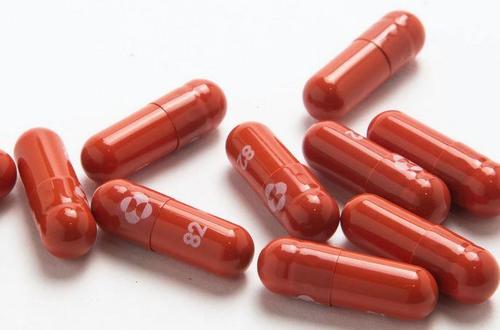
Molnupiravir pill from Merck. Photo: Merck Sharp & Dohme Corp.
The pill, originally developed using US government funds as a possible treatment for Venezuelan equine encephalitis, cut the risk of hospitalization and death in half in a randomized trial of 775 adults with mild/moderate Covid who were considered at high risk for disease due to comorbidities such as obesity, diabetes and heart disease. The trial was stopped early so the company could apply for and emergency use authorization (EUA). The drug did not benefit patients who were already hospitalized with severe disease.
News of the oral 'wonder drug' sent shares of Merck higher last week, as the company says it can deliver 10MM doses by the end of the year.
Clearly, the pill could bring in massive profits to Merck and its partner on the drug, Ridgeback Biotherapeutics - which licensed the drug from Emory University in 2020 and then sold the worldwide rights to the drug to Merck for a sum which has not been disclosed.
Meanwhile, the Defense Threat Reduction Agency, a division of the Department of Defense, funded development of the drug by Emory University to the tune of $10 million between 2013 and 2015, according to nonprofit group Knowledge Ecology International discovered.
Yet, as Quartz points out, only Merck and Ridgeback will profit from the new antiviral - which they say "could be one of the most lucrative drugs ever," bringing in as much as $7 billion by the end of this year alone.
Despite its initial investment, the U.S. government seems to be facing a steep markup in prices. In June, the government signed a $1.2 billion contract with Merck to supply 1.7 million courses of the medication at the $712 price. The transaction is due to take place as soon as molnupiravir receives emergency use authorization from the Food and Drug Administration.
Good government advocates are pointing out that because federal agencies spent at least $29 million on the drug’s development, the government has the obligation to ensure that the medicine is affordable. “The public funded this drug, and therefore the public has some rights, including the rights you have it available under reasonable terms,” said Luis Gil Abinader, senior researcher at Knowledge Ecology International. -The Intercept
Pushing back
Ridgeback co-founder Wendy Holman told CNBC in an interview last week that they asked for, but "never got government funding" for the manufacture of molnupiravir. The company also claimed in a press release touting the study that "since licensed by Ridgeback, all funds used for the development of molnupiravir have been provided by Merck and by Wayne and Wendy Holman of Ridgeback."
Critics, meanwhile, say the $700+ price point is absurd - with health advocates concerned that people some countries will not be able to afford the new drug.
"Offering someone a $700 treatment when they don’t yet feel that ill is going to mean that a lot of people are not going to take it," said King's College Hospital physician Dzintars Gotham, co-author of the report - which suggests that Merck would still reap a 10% profit margin if they priced molnupiravir at $19.99.
"If you can’t afford medicine because it’s 1,000 times more than you can afford, or because it’s 100 times more than you can afford, it doesn’t matter," said Melissa Barber, a doctoral candidate at the Harvard School of Public Health and co-author of the report on molnupiravir, adding "those are both bad."
Barber and Gotham acknowledge that the $17.74 cost of producing a five-day course of the antiviral pills is an estimate but said that the algorithm they used, and have employed to estimate the production costs for hundreds of drugs, tends to result in overestimates in the long run.
Meanwhile, the prices that private companies charge for drugs tend to go up rather than down. “For all these deals that have happened for therapeutics or vaccines, the price has only increased as uncertainty has decreased,” she said. “One price is given and then, for the next sale, the price goes up. The price went up for other drugs and vaccines, so I would be very surprised if this price didn’t go up, too.” -The Intercept
If only there were another option for mild-moderate Covid-19 cases that was inexpensive and used around the world for decades with an extremely positive drug safety profile.
We're just going to leave this here (as we noted last month):
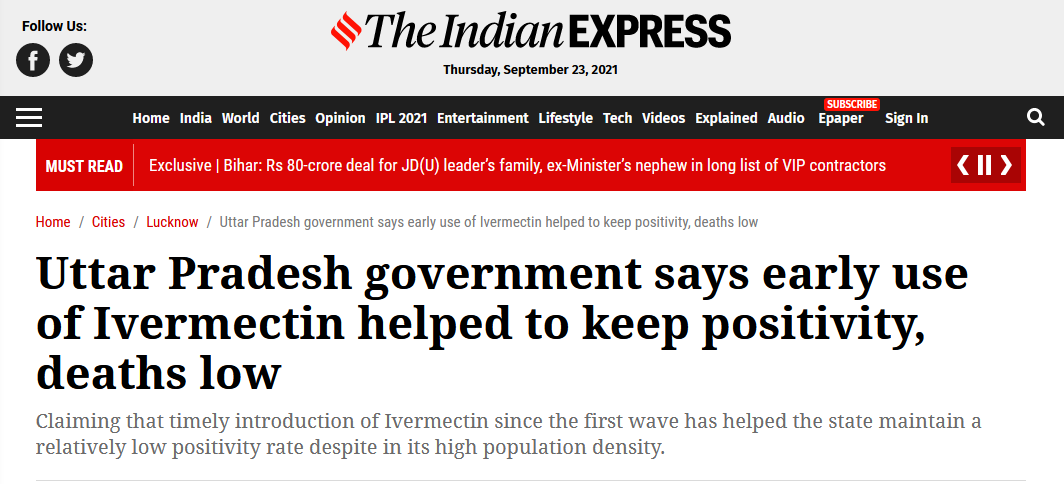
Widely prescribed anti-parasitic Ivermectin (also made by Merck) has shown massive efficacy worldwide in the treatment of mild and moderate cases of Covid-19, plus as a prophylactic. India's Uttar Pradesh province, with a population of over 200 million, says that widespread early use of Ivermectin 'helped keep positivity [and] deaths low.'
(source, May 12th)
Separately, there have been several studies funded by the Indian government, primarily conducted through their largest govt. public medical university (AIIMS).
  • Role of ivermectin in the prevention of SARS-CoV-2 infection among healthcare workers in India: A matched case-control study (source)
Conclusion: Two-dose ivermectin prophylaxis at a dose of 300 μg/kg with a gap of 72 hours was associated with a 73% reduction of SARS-CoV-2 infection among healthcare workers for the following month.
  • Ivermectin as a potential treatment for mild to moderate COVID-19 – A double blind randomized placebo-controlled trial (source)
Conclusion: There was no difference in the primary outcome i.e. negative RT-PCR status on day 6 of admission with the use of ivermectin. However, a significantly higher proportion of patients were discharged alive from the hospital when they received ivermectin.
  • Clinical Research Report Ivermectin in combination with doxycycline for treating COVID-19 symptoms: a randomized trial (source, double-blind randomized, peer-reviewed)
Discussion: In the present study, patients with mild or moderate COVID-19 infection treated with ivermectin in combination with doxycycline generally recovered 2 days earlier than those treated with placebo. The proportion of patients responding within 7 days of treatment was significantly higher in the treatment group than in the placebo group. The proportions of patients who remained symptomatic after 12 days of illness and who experienced disease progression were significantly lower in the treatment group than in the placebo group.
Here are more human studies from other countries on the 'horse dewormer':

Peru:
  • Sharp Reductions in COVID-19 Case Fatalities and Excess Deaths in Peru in Close Time Conjunction, State-By-State, with Ivermectin Treatments (source, peer-reviewed, University of Toronto, Universidad EAFIT)
For the 24 states with early IVM treatment (and Lima), excess deaths dropped 59% (25%) at +30 days and 75% (25%) at +45 days after day of peak deaths. Case fatalities likewise dropped sharply in all states but Lima
Spain:
  • The effect of early treatment with ivermectin on viral load, symptoms and humoral response in patients with non-severe COVID-19: A pilot, double-blind, placebo-controlled, randomized clinical trial (source, University of Barcelona, peer-reviewed)
Findings: Patients in the ivermectin group recovered earlier from hyposmia/anosmia (76 vs 158 patient-days; p < 0.001).
Bengladesh:
  • A Comparative Study on Ivermectin-Doxycycline and Hydroxychloroquine-Azithromycin Therapy on COVID-19 Patients (source - peer reviewed, though not govt funded)
Conclusion: According to our study, the Ivermectin-Doxycycline combination therapy has better symptomatic relief, shortened recovery duration, fewer adverse effects, and superior patient compliance compared to the Hydroxychloroquine-Azithromycin combination. Based on this study's outcomes, the Ivermectin-Doxycycline combination is a superior choice for treating patients with mild to moderate COVID-19 disease.
  • A five-day course of ivermectin for the treatment of COVID-19 may reduce the duration of illness (source, peer-reviewed double blind randomized, though small sample size)
Discussion: A 5-day course of ivermectin resulted in an earlier clearance of the virus compared to placebo (p = 0.005), thus indicating that early intervention with this agent may limit viral replication within the host. In the 5-day ivermectin group, there was a significant drop in CRP and LDH by day 7, which are indicators of disease severity.
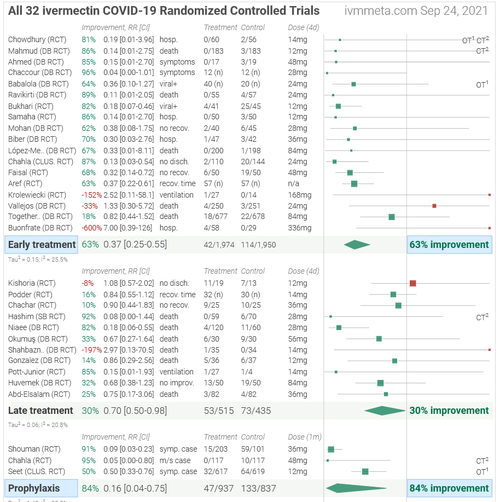
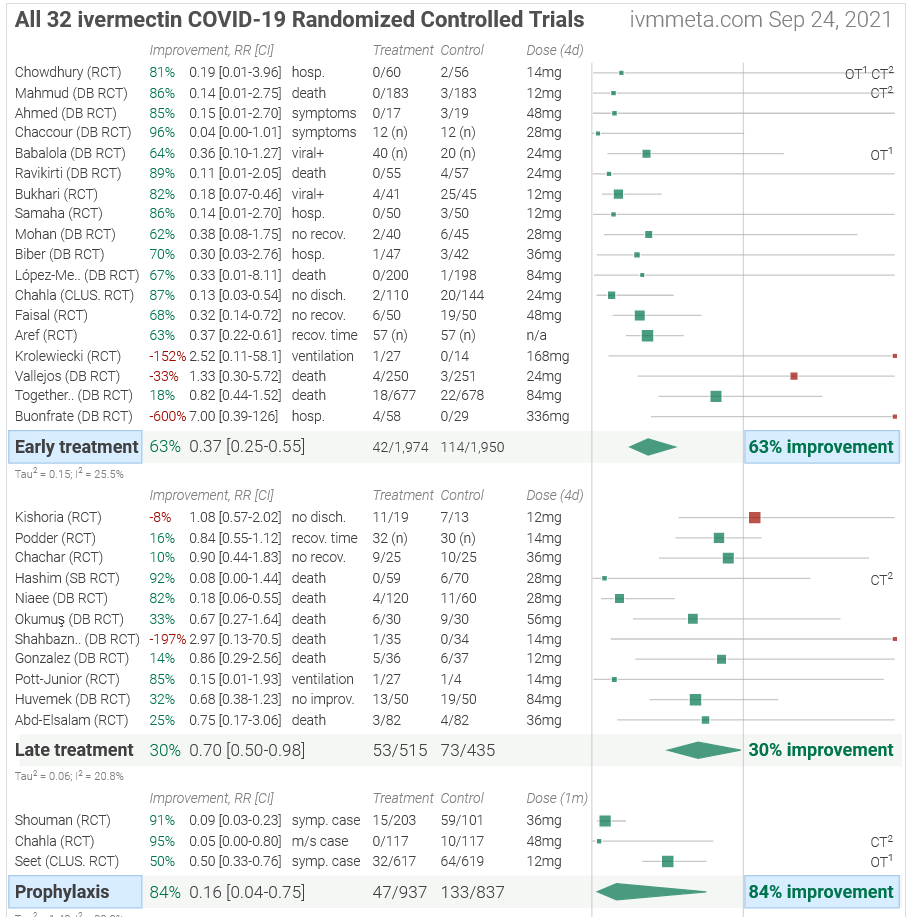
Meanwhile, There are currently 76 ongoing or completed clinical trials on Ivermectin around the world. Below are the results of 32 which have been completed. One can visit ivermeta.com and dig down on any of these / read the entire study. The site recommends Ivermectin in conjunction with vaccines to confer the best protection against Covid-19, however we'll leave that to you and your doctor to discuss.
Screenshot, http://ivermeta.com/
Perhaps those who can't pony up $700 will seek other options.

>>> US Gapping down

Gapping down
In reaction to earnings/guidance
:

  • HOV -1% (lowers Q4 revenue guidance due to supply chain delays)

Select Index ETFs showing early weakness:

  • QQQ -1.3%, IWM -1.2%, SPY -1.1%, DIA -1%, .

Other news:

  • TSHA -15% (files for $350 mln mixed securities shelf offering)
  • MANU -13.4% (announces 9.5 mln share offering by selling shareholders)
  • HESM -9.9% (prices secondary offering of 7.5 mln shares of common stock at $26.00 per share)
  • TAK -8.9% (suspends Phase 2 TAK-994 clinical program)
  • RGS -5.8% (being removed from S&P SmallCap 600)
  • INDI -2.7% (expands perception-enabled vision processing capabilities by establishing a new business unit)
  • SWX -2.1% (D to sell Questar Pipelines to SWX for $1.975 bln)
  • TRIT -2.1% (provides update on financial audit)
  • UMC -1.6% (Sep revs)
  • RIOT -1.2% (reports Sept production and operation updates)

Analyst comments:

  • GOGO -6.3% (downgraded to Underweight from Equal-Weight at Morgan Stanley)
  • X -4.4% (downgraded to Sell from Neutral at Goldman)
  • AAL -3.8% (downgraded to Sell from Neutral at Goldman)
  • ITRI -3.3% (downgraded to Perform from Outperform at Oppenheimer)
  • JBLU -2.7% (downgraded to Neutral from Buy at Goldman)
  • CDW -1.9% (downgraded to Equal-Weight from Overweight at Morgan Stanley)
  • AGNC -1.2% (downgraded to Neutral from Overweight at Piper Sandler)

>>> US Gapping up

Gapping up
In reaction to earnings/guidance
:

  • AYI +1.7%

Other news:

  • PLTR +8.3% (selected by US Army for intelligence systems and analytics)
  • STIM +7.9% (announces commercial agreement with Success TMS)
  • ONCT +5.9% (announces pre-clinical data from ONCT-534 was accepted for presentation)
  • CLXT +5.1% (announces new initiative to provide plant-based synthetic biology solutions to expanded end markets)
  • RDHL +4.3% (Medi-Cal adds Talicia as contract drug)
  • VXX +4% (trading higher with early weakness in US futures)
  • NWPX +2.1% (acquires ParkUSA for $87.4 mln)
  • IRTC +1% (Zio demonstrates improved health outcomes in clinical trial)

Analyst comments:

  • ABEV +1.1% (upgraded to Overweight from Equal Weight at Barclays)

FT : Europe and UK face winter energy crunch as gas price surge intensifies

Europe and UK face winter energy crunch as gas price surge intensifies
UK gas contracts for November delivery soar almost 40 per cent

UK and European natural gas prices shot higher again on Wednesday to trade at close to 10 times their level from the beginning of the year, threatening to curb industrial activity and sharply raise inflation.

UK gas contracts for November delivery surged almost 40 per cent as trading opened to reach more than £4 per therm, having started the year below 50 pence. The contract started the week at £2.40 per therm.

Record natural gas prices are one symptom of a deepening energy crunch that has rippled across the globe as countries battle to secure fuel supplies after demand rebounded rapidly from the depths of the pandemic.

Gas prices are also at record levels in Europe and Asia, while the price of coal, which is used to generate electricity and for heating, has surpassed its all-time peak set in 2008.

“An energy crisis is unfolding with winter in the northern hemisphere still to begin,” said Stephen Brennock of PVM, an energy brokerage in London.

European gas contracts for delivery in November jumped almost 25 per cent on Wednesday to €155 a megawatt hour, up from just €18 six months ago.

Traders have pointed to lower supplies from Russia, which has repeatedly declined to sell gas beyond its contractual long-term obligations.

Domestic production of gas in Europe has also fallen sharply, while demand in Asia has risen as countries increasingly seek alternatives to highly polluting coal, creating a bidding war for cargoes of liquefied natural gas.

Gas prices in Europe eased slightly off their highs on Wednesday after an EU judge’s opinion that Russia’s Nord Stream 2 pipeline project had grounds to challenge EU rules that have threatened to slow its start-up following completion of construction last month.

Gazprom, Russia’s state-backed monopoly pipeline gas exporter, has indicated it may increase spot sales to the European market once the pipeline is approved.

Ukraine and other eastern European countries have accused Russia of trying to “weaponise” gas supplies by limiting sales through Ukraine, which NS2 would bypass by running directly through the Baltic Sea to Germany.

Kremlin spokesman Dmitry Peskov said on Wednesday there was “absolutely no Russian role on what is happening on the gas market”.

Rising energy prices are also fuelling concerns about inflation, which has dented government bond prices, particularly in the UK.

The UK is arguably more vulnerable than some countries in Europe to record gas prices because it has very limited storage capacity, leaving it reliant on a near just-in-time system of domestic production and imports both from pipelines and seaborne cargoes.

The vast majority of UK homes are heated with natural gas, and the country has shut more of its coal-fired power stations while adding renewables such as wind farms. On still days when wind power generation is lower, gas can make up more than 50 per cent of all electricity generation.

Europe is also suffering from very high electricity prices because of the surge in energy costs. The EU said on Wednesday it would review the region’s power market and consider changes to regulation.

“There is no question that we need to take policy measures,” EU energy commissioner Kadri Simson told the EU’s parliament.

French building materials company Saint-Gobain underscored the corporate impact on Wednesday when it said it was expecting energy and raw material cost inflation of about €1.5bn in 2021, up from its previous estimate of €1.1bn.

Spiralling gas prices are forcing utility companies in north-east Asia and Europe to switch to coal where possible, increasing competition for supplies at time when big producers in South Africa, Indonesia and Russia have struggled to crank up production.

On Tuesday, the benchmark index for coal imported to north-west Europe hit a record above $300 a tonne, according to price reporting agencies, with prices doubling since the start of September.

“It really not about prices any more, it is trying to secure material for the coming weeks or months. The market is going crazy,” said Dmitry Popov, analyst at CRU, a commodities consultancy.

Last week, Beijing ordered its state-owned energy companies to secure supplies for this winter at all costs. China has struggled to boost domestic coal supply to meet increased demand for electricity new safety measures and environmental controls. It has also banned Australian coal imports because of a diplomatic spat with Canberra over the origins of Covid-19.

India is turning to the export market for supplies of thermal coal to replenish inventories that are nearing critically low levels.

“It will be difficult for them to secure the material because supply is very tight and there is big demand from the rest of Asia, China and Europe,” said Popov.