FT : What the new German government has in store for Europe

What the new German government has in store for Europe
Three-party coalition agreement pledges some progress on climate goals and banking union

The wait is over. Germany has a new government, Olaf Scholz is set to become chancellor, Christian Lindner from the pro-business Free Democrats scoops up the finance ministry, Green leader Robert Habeck will be the minister for economy and climate, with co-leader Annalena Baerbock as foreign minister.

I’ll unpack what the coalition agreement has to say on EU topics, including the banking union, rule of law and why the Greens got in a bit of a pickle over the future of European Commission chief Ursula von der Leyen.

We’ll also explore an ill-timed commission snipe at Italy’s draft budget and what it means for sensitive eurozone discussions on fiscal rules reform.

The largest group in the European parliament, the centre-right European People’s party, meanwhile, selected Maltese MEP Roberta Metsola as its candidate for the leadership of the parliament in January.

On the financial regulation front, the EU yesterday agreed to further postpone a set of rules on trades that fail to settle — which were agreed in late 2013 and were due to kick in beginning of February (More here).

In anti-vaxxer news, we’re exploring how the far right in Austria is fully embracing the conspiracy theories that have led to a spike in poisonings in the US from horse de-wormer Ivermectin.

This article is an on-site version of our Europe Express newsletter. Sign up here to get the newsletter sent straight to your inbox every weekday morning

More evolution than revolution
With its 178 pages, the new German coalition agreement continues the tradition of lengthy pacts (the previous coalition accord was 175 pages long). On the content, the deal is also continuity rather than radical change.

The most significant policy shifts from the previous coalition government led by Angela Merkel’s Christian Democrats seem to be headline-grabbing measures such as the legalisation of cannabis for recreational use and the lowering of the voting age from 18 to 16. But on Europe, you’d be hard-pressed to detect huge differences. Here’s a look at what matters:

  • Coal and cars: Meeting the climate targets in the Paris climate accord is “the highest priority”, reads the coalition agreement. If the outgoing government was lukewarm on phasing out combustion engines, the new government wants 15m electric cars on German roads by 2030. An exit from coal-powered energy plants and the closure of coal mines should also “ideally” happen by 2030.

  • Carbon leakage: Germany will develop an industrial strategy linked up to the European Green Deal and wants to avoid carbon leakage. Even though the new government supports an EU-wide carbon border adjustment mechanism (CBAM), it says the format for making importers pay could follow so-called Carbon Contracts for Difference, which the German government is likely to introduce for the country’s industrial suppliers.

  • Club climate: Germany wants to use the EU and other international forums to create an “international climate club with a common minimum CO2 price and a common CO2 border adjustment”. Berlin will also introduce minimum quotas for climate-friendly products in its public procurements.

  • Banking union: The three parties pledged to complete the EU’s banking union, including a European reinsurance system for national deposit guarantee schemes “where contributions are strictly differentiated based on risk”. But, in keeping with the traditional German position, “a full communitarisation of the deposit guarantee systems in Europe is not the goal”.

  • No perma-fund: Despite the emphasis on investments for the twin green and digital transformation, the new German government takes a leaf from the old in insisting that the bloc’s €800bn post-pandemic borrowing spree is “limited in time and size”. Several countries including France have started toying with the idea of expanding the recovery fund and making it permanent.

  • Rule of law: Poland and Hungary are not off the hook. The new German government will approve the commission’s recommendations on EU recovery plans only for countries where “preconditions such as an independent judiciary are met”.

  • Frenemies with China: The new government continues a multiple-track approach to Beijing: co-operate wherever possible, insist on a level playing field and develop a German strategy for China that is part and parcel of EU’s own policy towards the Asian giant, as well as in co-ordination with the US and other like-minded partners.

  • Russia, it’s complicated: German-Russian relations are “deep and multi-faceted”. Beyond a desire to co-operate with Moscow on climate, health and hydrogen, the new government does acknowledge “the interests of our European neighbours, especially our partners in central and eastern Europe. We will take into account various threat perceptions and focus on a common and coherent EU policy towards Russia.” Critical references to Nord Stream 2 that the Greens had made in their party manifesto have gone.

  • Green commissioner: Before even announcing the new accord, Green politicians took to Twitter to make public one significant win: their party will nominate the next German EU commissioner. This led to a flurry of speculations that the new government will no longer support Ursula von der Leyen for a second term at the helm of the European Commission. In the end, the agreement states that the Greens will nominate a candidate only if the commission president is no longer German. When asked about it in the news conference, Olaf Scholz said the coalition agreement described “future cases”, in “terms as friendly as possible”.

>>> TradeGate Pre-Market Indications

DAX:
  • Bayer (BAYN TH) +1.1%
  • Infineon (IFX TH) +1%
  • VW (VOW3 TH) +0.9%
  • Siemens Energy (ENR TH) +0.8%
  • RWE (RWE TH) +0.8%
MDAX:
  • Thyssenkrupp (TKA TH) +1.5%
  • Varta (VAR1 TH) +1%
  • Aixtron (AIXA TH) +0.7%
  • ProSieben (PSM TH) +0.7%
  • Lufthansa (LHA TH) +0.4%
SDAX:
  • Dermapharm (DMP TH) +2.9%
  • Nordex (NDX1 TH) +2.3%
    • Nordex Gets Order for 177 MW Wind Farm From Peru
  • Jenoptik (JEN TH) +2.2%
    • Jenoptik to Sell Vincorion for Enterprise Value of EU130M
  • Bilfinger (GBF TH) +0.9%
  • Deutz (DEZ TH) +0.8%
  • Adler Group (ADJ TH) -1.1%
    • Adler to Face Fresh Scrutiny From Investors Seeking Answers
  • Draegerwerk (DRW3 TH) -1.9%
    • Draegerwerk Double Downgraded at Metzler on Discouraging Outlook

>>> What to look at today - 25th of November 2021

Asian stocks were steady Thursday as traders weighed China’s efforts to cushion its economy as well as Federal Reserve minutes flagging the risk of a faster reduction in monetary stimulus to fight elevated inflation.
MSCI Inc.’s Asia-Pacific share index snapped a three-day drop. Equities came off their lows in Hong Kong and China, where Beijing urged local governments to boost investment to counter a growth slowdown. Meanwhile, the Chinese city of Chengdu sought to ease a cash crunch at property developers. U.S. and European futures rose after modest Wall Street gains overnight.
The latest U.S. data showed a solid economic recovery, including resilient consumer spending despite persistent price pressures. Fed officials at their last meeting were open to a quicker removal of policy support to curb inflation, according to the minutes of the gathering. 
Bets on an earlier Fed interest-rate liftoff saw shorter maturity Treasury yields advance, while longer-maturity rates retreated, flattening the yield curve. There’s no cash Treasuries trading due to the U.S. Thanksgiving holiday. Treasury futures edged lower. The dollar dipped from a 16-month high
Assets from equities to commodities to cryptocurrencies have delivered substantial gains this year. Investors are evaluating how much further they can go as the recovery from the pandemic continues but liquidity tailwinds start to cool.
Crude oilwas steady as traders await the response of OPEC+ to a coordinated release of strategic reserves by consuming nations.
US After Hours : CO +17.8% AURA +5.6% BERY +1.1% SELB -11% AVIR -2.3% QTNT -2.2%

Nikkei +0.78% Hang Seng +0.12% CSI -0.31% Shanghai -0.10% Shenzen -0.11%

Eur$ 1.1210 CNH 6.3924 CNY 6.3885 JPY 115.36 GBP 1.3346 CHF 0.9337 RUB 74.7717 TRY 11.9614 WTI$ 78.37 -0.35% Gold 1,792.15 BTC 57,300 -0.05% ETH 4,280+0.52%

S&P +0.37% Nasdaq +0.34% EuroStoxx +0.54% FTSE +0.32% Dax +0.36% SMI +0.20%

Macro :
- Germany’s New Coalition Sets Out Plans to Green Economy Faster
- Fed Open to Faster Taper at Last Meeting Amid Inflation Concern
- U.K. Says France Not Doing Enough to Halt Migrant Crossings

Keep an eye on :
- ADE NO : Adevinta 3Q Ebitda Misses Estimates
- BEAN SW : Belimo Seeks Annual Growth of 6%-8% in Coming Years: The Market
- BIO GY : Biotest Opens Seventh Plasma Center in Czech Republic
- CAI AV : CA Immo Withdraws ‘22 Target, To Review EU390m Romania Portfolio
- CTT1S FH : Citycon to Buy Back Shares; Gazit-Globe Exempted From Forced Bid
- DAI GY : Daimler CEO Sees German Coalition Supporting Green Car Push
- EFGN SW : EFG ‘Ready’ to Consider More M&A But Focus Is on Organic Growth
- EKTAB SS : Elekta 2Q Net Sales Beat Estimates
- FFARM MA : ForFarmers CEO Yoram Knoop to Step Down After AGM in 2022
- G IM : Generali Enters Exclusive Talks to Buy Credit Agricole Unit
- GOGL NO : Shipping Companies Climb After Golden Ocean Tops Estimates
- JEN GY : Jenoptik to Sell Vincorion for Enterprise Value of EU130M
- MAS NO : Maasoeval Offering of 9.83m Shares Prices at NOK40.7/Share
- NDX1 GY : Nordex Gets Order for 177 MW Wind Farm From Peru
- ORA FP : France’s Orange Hunts for New Leadership After CEO’s Conviction
- REC BB : Greiner’s Bid for Recticel Gets Extended EU Investigation
- RCO FP : Remy Cointreau 1H Current Operating Income Beats Estimates
- SLHN SW : Swiss Life Plans CHF1B Share Buyback From Dec. 2021 to May 2023
- TIT IM : Draghi: Priority on Telecom Italia Is to Protect Jobs, Network
- VGP BB ;

>>> Europe : Brokers Upgrades & Downgrades - 25th of November 2021

>>> Up
* Britvic Raised to Buy at SocGen; PT 1,020 pence
* Capita Raised to Outperform at RBC; PT 70 pence
* Howden Joinery Raised to Buy at Liberum; PT 1,050 pence
* InterContinental Hotels Raised to Buy at Jefferies
* Lundbergforetagen Raised to Hold at DNB Markets; PT 510 kronor
* S Immo Raised to Add at Baader Helvea; PT 23.50 euros
* Scandic Raised to Hold at Jefferies; PT 35 kronor
* Valmet Raised to Buy at Kepler Cheuvreux; PT 45 euros

>>> Down
* Accor Cut to Hold at Jefferies; PT 33 euros
* Draegerwerk Cut to Sell at DZ Bank; PT 47 euros
* Gjensidige Cut to Hold at Pareto Securities; PT 230 kroner
* Golden Ocean Cut to Hold at Pareto Securities; PT 85.20 kroner
* Landis + Gyr Cut to Underweight at Morgan Stanley
* Renishaw Cut to Underweight at Morgan Stanley; PT 4,400 pence
* Spectris Cut to Underweight at Morgan Stanley; PT 3,150 pence

>>> Initiation
* Byggfakta Group Nordic Holdco Rated New Buy at Carnegie
* Netel Holding Rated New Buy at Kepler Cheuvreux; PT 65 kronor
* Nordisk Bergteknik Rated New Hold at Carnegie; PT 35 kronor

>>> Call
* Hotels, Gaming Stocks are Jefferies Picks for Leisure Recovery
* Renishaw, Spectris Cut at MS on Short-Cycle, China Exposure

(ZH) China Says US "Playing With Fire" After Warship Conducts 11th Taiwan Strait

China Says US "Playing With Fire" After Warship Conducts 11th Taiwan Strait Transit This Year

China has blasted the latest US warship sail-through of the contested Taiwan Strait, which happened Tuesday, calling it an intentional "provocation" after a US Navy statement asserted "The United States military flies, sails, and operates anywhere international law allows."
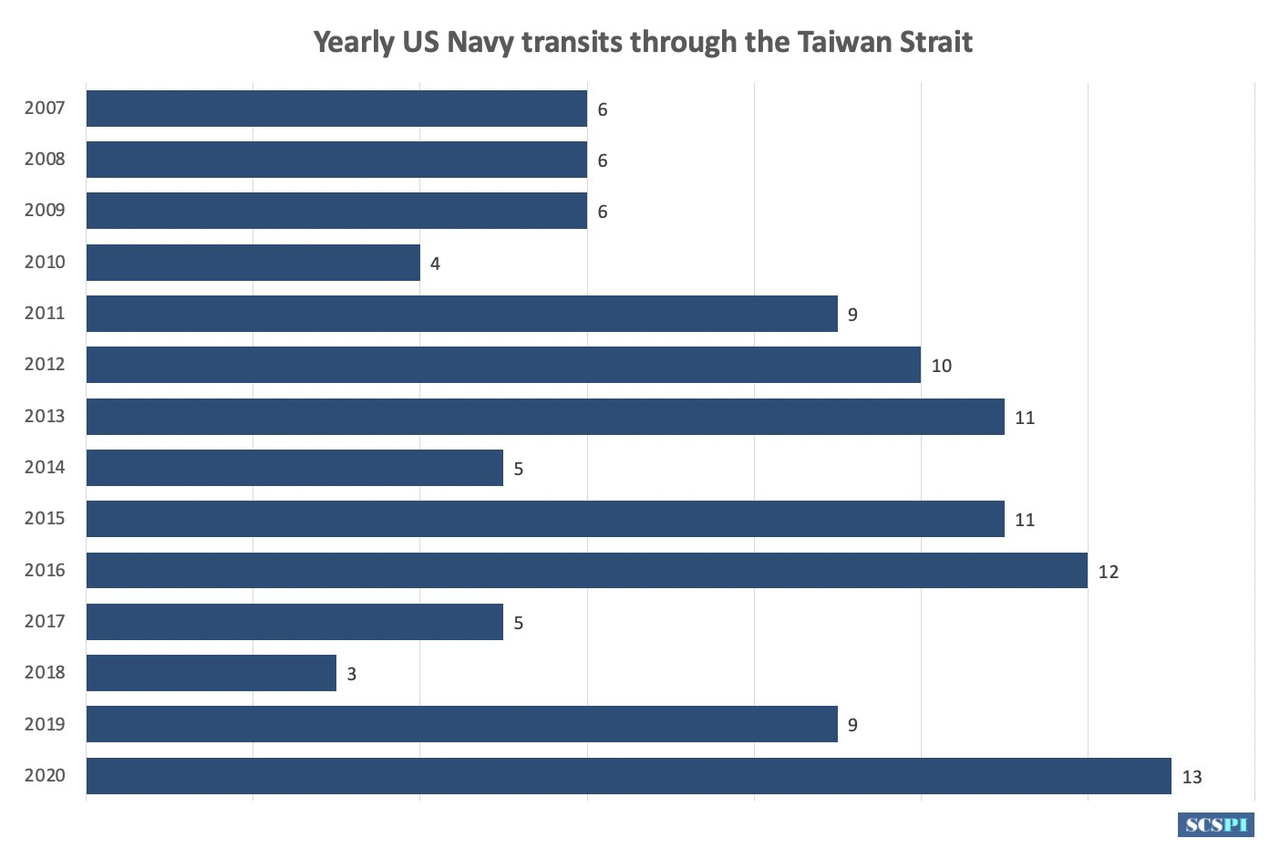
The Navy's Seventh Fleet had identified that the guided-missile destroyer USS Milius conducted the "routine" transit as part of the US "commitment to a free and open Indo-Pacific". This year the White House appears to have ordered such pass throughs of the strait on a monthly basis, given Tuesday's event marked the 11th US warship transit of the Taiwan Strait this year, which is just under the record - in 2020 there were a total of 13.
USS Milius, UN Navy image
Chinese Foreign Ministry spokesman Zhao Lijian subsequently said, "The Chinese side was closely following and fully aware of the US military vessel’s passage through the Taiwan Strait." He disputed the standard Pentagon description of maintaining freedom and openness of international navigation.
"The US warships have repeatedly flexed muscles, made provocations, and stirred up trouble in the Taiwan Strait in the name of 'freedom of navigation.' This is by no means commitment to freedom and openness, but rather a deliberate disruption and sabotage of regional peace and stability," Zhao said.
"China is firmly resolved in upholding national sovereignty and territorial integrity," Zhao continued. "The US side should immediately correct its mistakes, stop making provocations, challenging the bottom line and playing with fire, and play a more constructive role in regional peace and stability."
Additionally the Chinese military's Eastern Theater Command had revealed later on Tuesday that it had sent PLA naval and air forces to "conduct close-in tracking and monitoring" of the warship.
During the past decade, the US Naval presence in the strait has steadily grown...
US-China tensions have only continued despite last week's virtual meeting between Chinese leader Xi Jinping and President Biden wherein Biden reaffirmed his commitment to the 'one China' policy as Xi reportedly laid out that Beijing sees Washington support to Taiwan - including weapons transfers - as "playing with fire". State media reported Xi during the Nov.15 virtual meeting: "Such moves are extremely dangerous, just like playing with fire. Whoever plays with fire will get burnt."
Biden had said according to the White House summery of the virtual summit that his administration "strongly opposes unilateral efforts to change the status quo or undermine peace and stability across the Taiwan Strait".

WSJ : AT&T, Verizon Propose 5G Limits to Break Air-Safety Standoff

AT&T, Verizon Propose 5G Limits to Break Air-Safety Standoff
Wireless operators said they will limit the strength of service while regulators review the impact on planes and helicopters

AT&T Inc. T -1.17% and Verizon VZ -0.17% Communications Inc. said they would limit some of their fifth-generation wireless services for six months while federal regulators review the signals’ effect on aircraft sensors, an effort to defuse a conflict that has roiled both industries.

The cellphone carriers detailed the proposed limits Wednesday in a letter to the Federal Communications Commission. The companies said they would lower the signals’ cell-tower power levels nationwide and impose stricter power caps near airports and helipads, according to a copy reviewed by The Wall Street Journal.

“While we remain confident that 5G poses no risk to air safety, we are also sensitive to the Federal Aviation Administration’s desire for additional analysis of this issue,” the companies said in the letter to FCC Chairwoman Jessica Rosenworcel. Wireless industry officials have held frequent talks with FCC and FAA experts to discuss the interference claims and potential fixes, according to people familiar with the matter.

An FCC spokesman said the agreed-upon limits “represent one of the most comprehensive efforts in the world to safeguard aviation technologies” and the agency will work with the FAA “so that 5G networks deploy both safely and swiftly.”

A spokesman for the FAA called the proposal “an important and encouraging step, and we are committed to continued constructive dialogue with all of the stakeholders.” The FAA believes that aviation and 5G service in the band telecom companies have planned to use can safely coexist, he said.

Wireless industry executives don’t expect the temporary limits to seriously impair the bandwidth they provide customers because networks already direct signals away from planes and airport tarmacs, according to another person familiar with the matter.

Still, the voluntary limits are a rare step for wireless companies that place a high value on the spectrum licenses they hold. U.S. carriers spent $81 billion to buy licenses for the 5G airwaves in question, known as the C-band, and spent $15 billion more to prepare them for service this winter.

The carriers earlier this month delayed their rollout plans until early January after FAA leaders raised concerns about the planned 5G service. Air-safety officials worried the new transmissions could confuse some radar altimeters, which aircraft use to measure their distance from the ground.

At an industry event last week, FAA Administrator Steve Dickson said conducting flights in a safe manner and tapping spectrum for 5G services can both occur. He said the question was how to “tailor both what we’re doing in aviation so that it dovetails with the use of this particular spectrum.”

Mr. Dickson said another focus is the use of the spectrum in other parts of the world and how it differs compared with the U.S. “That’s what the discussions are that we’re having with the telecoms right now.”

U.S. wireless companies send 5G signals over lower frequencies than the altimeters, but air-safety officials worried that some especially sensitive sensors could still pick up cell-tower transmissions. Regulators in Canada and France have also imposed some temporary 5G limits.

The carriers’ letter said the mitigation measures would provide more time for technical analysis “without waiver of our legal rights associated with our substantial investments in these licenses.”

C-band limits are most relevant to AT&T and Verizon, which paid premiums to grab licenses for the new signals ready for use in December 2021. The companies still plan to launch their service, subject to the new limits, in January 2022. The proposed limits would extend to July 6, 2022.

Rival carrier T-Mobile US Inc. is less vulnerable to delay because it spent a smaller amount for licenses that are eligible for use in December 2023. It also controls a swath of licenses suitable for 5G that aren’t subject to air-safety claims.

WSJ : Chinese Property Developer Kaisa Proposes $400 Million Debt Swap

Chinese Property Developer Kaisa Proposes $400 Million Debt Swap
Shenzhen-based group warns it may pursue an alternative restructuring if it can’t exchange debt to push out repayment deadline

Kaisa Group Holdings Ltd., which in 2015 became one of the first Chinese developers to default abroad, warned it risked reneging on its international debts again unless creditors agreed to a $400 million bond swap.

The Shenzhen-based company is one of the sector’s biggest offshore borrowers after China Evergrande Group, EGRNF -3.82% with about $10.9 billion of dollar bonds outstanding as of end-June.

Government efforts to control developers’ mounting debts, falling home sales and the crisis at Evergrande have shaken investor confidence. That has pushed down bond prices and effectively shut the market for new offshore debt issuance, making it even harder for property companies to raise the cash they need to repay coming debts.

“Persistent tightening governmental policy, multiple credit events and deteriorating consumer sentiment have resulted in temporary shut-down of various refinancing venues for the sector and put enormous pressure on our short-term liquidity,” Kaisa said Thursday.

Kaisa is seeking to swap $400 million of notes due Dec. 7 for new bonds paying the same annual 6.5% coupon, which will mature in June 2023. Investors will get $25 in cash for every $1,000 in face value of notes they exchange.

If it can’t conclude the exchange, Kaisa warned it may not be able to repay the bonds at maturity on Dec. 7, and said it could consider an “alternative debt restructuring exercise.”

The Hong Kong-listed developer said it was already in a 30-day grace period for more than $88 million of coupon payments due earlier this month, which it hadn’t paid on time. It didn’t specify whether there was any such grace period for repayment of principal on its maturing bonds.

In a separate filing late Wednesday, Kaisa said it had implemented a repayment plan for about 1.1 billion yuan, the equivalent of about $172 million, of wealth products “issued for and on behalf” of the company and its subsidiaries. Principal repayments will be staggered over the next 2 ½ years. It is still negotiating with holders of other wealth products, it added.

Kaisa’s shares, which had been halted since Nov. 5, resumed trading and jumped 19% by late morning Thursday in Hong Kong. A Kaisa bond due 2024 was bid at 33 cents on the dollar, according to Tradeweb.