Morgan Stanley Warns The Fed's Turbo Taper Will Trigger Market Chaos Over "The Next 3-4 Months"
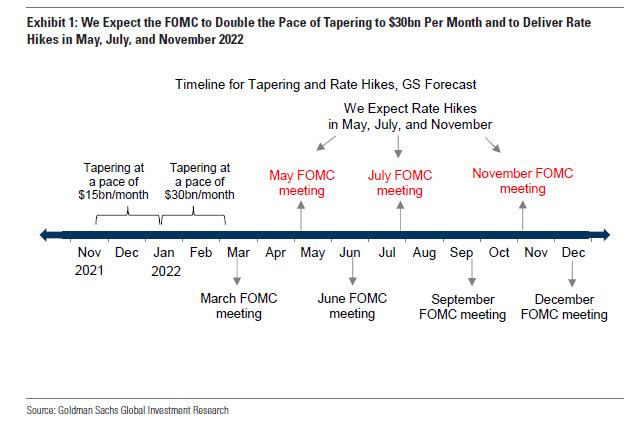
Until last week, the economic and market views of Goldman Sachs and Morgan Stanley couldn't be more opposite: the former, delightfully optimistic, expects the US economy to grow on all cylinders in 2022 and despite the Fed's tightening - two months ago Goldman flipped its Fed views by pulling forward its first rate hike forecast by one year to July, and followed it up over the weekend by predicting that liftoff will begin in May with two more rate hikes to follow in 2022...
... said in its year-ahead market forecast last month that it expects the S&P to hit 5,100 by the end of 2022 even as the economy slows down modestly from its current feverish pace.
Meanwhile, far less optimistic than their Goldman peers, Morgan Stanley's economists expected - until late last week - the Fed to stand pat without hiking even once in 2022. That changed over the weekend, however, when the bank admitted "defeat" and now expects two rate hikes in 2022, even as the bank's chief market economist Michael Wilson sees the S&P closing 2022 at 4,400, some 5% below current levels.
So while there has been some convergence on the economy and Fed front, a gaping divergence remains when it comes to what the two most influential US banks think the market will do, a schism which only became more acute in the past 24 hours, when on one hand Goldman predicted that a massive year-end Santa Rally is imminent (as we discussed last night), while Morgan Stanley doubled down on its bearish view this morning when in Michael Wilson's latest strategy outlook piece (available to professional subscribers), he warns that "the Fed's pivot to a more aggressive tapering schedule poses a larger risk for asset prices than most investors believe."
Confirming what we have been saying since 2010 when we first explained that it is not the stock but the flow that matters, and that tapering is tightening, Wilson echoes our decade-old conclusion and writes that "tapering is tightening for markets, if not the economy." And due to the much greater than expected rise in inflation - now that even Powell has killed and buried "team transitory" - the Fed is pivoting to a more aggressive removal of monetary accommodation.
Wilson believes this is warranted and supported by an administration that appears less focused on the stock market as a barometer of
its success (actually since this administration has zero success to "barometer" besides flooding money into the economy and watching inflation skyrocket of course, it simply hasn't even considered the level of the S&P; it will soon... after the crash).
its success (actually since this administration has zero success to "barometer" besides flooding money into the economy and watching inflation skyrocket of course, it simply hasn't even considered the level of the S&P; it will soon... after the crash).
Furthermore, the Morgan Stanley strategist believes that tapering is different than in 2014 for 3 reasons:
- the Fed is exiting QE twice as fast this time,
- asset prices are much richer today and
- growth is decelerating rather than accelerating.
And as we joked earlier (but not really) with the Fed tapering and soon hiking, the outcome will be a recession and a market crash...

... Wilson again agrees and says that such an adverse market reaction "could be important for the economy, too, given how levered consumers are to stock prices today."
Taking a more nuanced look at Morgan Stanley's forecast, Wilson explains that when he was writing his (decidedly bearish) year ahead outlook, he was faced with "a wider than normal range of potential economic and policy outcomes." This higher " uncertainty" was one of the key inputs to the bank's conclusion that valuations for US equity markets were likely to come down over the next 3-6 months, and as further notes explains "in our discussions with hundreds of clients since publishing our outlook, the conversations have centered around how to handicap these various outcomes." Wilson lists the three scenarios as follows:
- Goldilocks: When we published on November 15, this was the prevailing view by most clients. In this outcome, supply picks up in 1Q to meet the excess demand companies are having a hard time fulfilling. Inflation falls back toward 2-3%, allowing the Fed to move gradually with its taper and hike maybe 1-2 times in 2022, a modest amount of tightening that most believe the economy and markets can handle. Under this scenario, earnings growth is solid (10-15%), interest rates stay well behaved and valuations remain elevated (20-21x Forward EPS). This yields 5-10% upside to the S&P 500 over the next year or roughly 5000. For us, this was the Bull case outcome in our outlook with a 20% probability.
- Inflation remains hot and the Fed responds more aggressively: Under this outcome, inflation proves to be stickier as supply chains and labor shortages remain difficult to fix in the short term. The Fed is forced to taper faster and even raise rates on a more aggressive path than investors expect. This was our base case as it essentially lined up with our hotter but shorter cycle view we first wrote about back in March. Under this outcome, interest rates continue to rise next year to 2-2.25% by year end. At the same time, operating leverage starts to fade as costs increase more in line with revenues, leaving limited margin upside. This leaves breadth narrow in the near term as valuations come down and P/Es finally normalize in line with the traditional mid cycle transition. While there is some debate around how much P/Es need to fall, we believe 18x is the right number to use for year end 2022 and when combined with 10% revenue growth that gives us slight downside to the index from current prices, or 4400. We put a 60% probability on this outcome.
- Supply picks up just as demand fades: Under this outcome, supply does improve but it's too late to meet what has been an unsustainable level of demand and consumption for many goods. It's also too expensive for customers who have become more wary of high prices, which leads to discounting and a whiff of deflation for many areas of the goods economy. While services should fare better and keep the economy growing, goods producing companies suffer and make up a much larger part of the consumer discretionary part of the stock market. Under this scenario, the Fed may decide to back off on their more aggressive tightening path. Rates fall but not enough to offset the negative impact on margins and earnings which end up disappointing. This is essentially the "Ice" part of our narrative turning out be colder than expected. Equity risk premiums soar and multiples fall even more than under our base case. This was our bear case with a 20% probability.
Before we drill down into these, a quick detour to Wilson who says that since publishing his year-ahead forecast one month ago, he feels "more confident about our base case being the most likely outcome. Inflation data continues to come in hotter and based on commentary from our analysts, companies seem to be having no problem passing it along to customers, keeping inflation sticky on the upside. While this will likely lead to another good quarter of earnings overall, we suspect there will be more casualties, too, as execution risk is increasing leaving dispersion high and leadership inconsistent — two more conclusions in our outlook." This means that stock picking, while difficult, will be a necessary condition to generate meaningful returns in 2022 as the market separates the winners and losers and index basically goes nowhere over the next 12 months.
Meanwhile, and far more ominously, Wilson also warns that "the likelihood of our bear case is growing relative to our bull case. As it stands, we would say Bear case is now 30%, Base case is still 60% while goldilocks looks like a distance 3rd at just 10%."
In other words, the odds that the Fed will short circuit its tightening plans are rising.
* * *
With that in mind, let's focus some more on Wilson's core assumptions, at the top of which is that...
The change in the Fed's reaction function is a big deal because Tapering is Tightening
While Morgan Stanley's base case has always assumed the Fed would respond appropriately to the higher inflation, "the pivot by Chair Powell at his recent Congressional testimony was more aggressive than what we expected, especially in light of the new Covid variant, which at the time was a known unknown." We discussed this over the weekend in depth. Here, Wilson concedes that with Omicron now looking like a lower risk to growth than 2 weeks ago, this only raises the probability that the Fed will indeed taper its asset purchases much faster than the last tapering episode in 2014, and Morgan Stanley "economists point out that the Fed is now suggesting stable prices is important to achieving its primary goal of full employment which means inflation has taken center stage, until it's under control." In terms of speed, the bank's forecast is now for the Fed to end its asset purchase program by the end of March, the same as Goldman. However, if the Fed executes on that path, "it will leave a mark on asset prices in our view."
Wilson also thinks Jay Powell and the Fed will be under much less pressure from the White House versus the last time they tried to take the punch bowl away in late 2018. Part of this is due to the fact that inflation is a much bigger problem today than it was in 2018 and part of it is due to the observation that this White House is not as preoccupied with the stock market. Wilson's bottom line: "the Fed put still exists but the strike price is much lower now, in our view. If we had to guess, it's down 20% rather than down 10% unless credit markets or economic data really start to wobble."
Here Wilson encounters the same challenge we have observed over the years, namely that most disagree with the conclusion that tapering is tightening (for markets, if not the economy). As evidence, those who still don't understand that only the Flow (and not the Stock) matters, point to the tapering in 2014 as an example of how markets traded well as the Fed let the air out of the balloon back then. On that score, Wilson has makes several points to argue "it could be different this time."
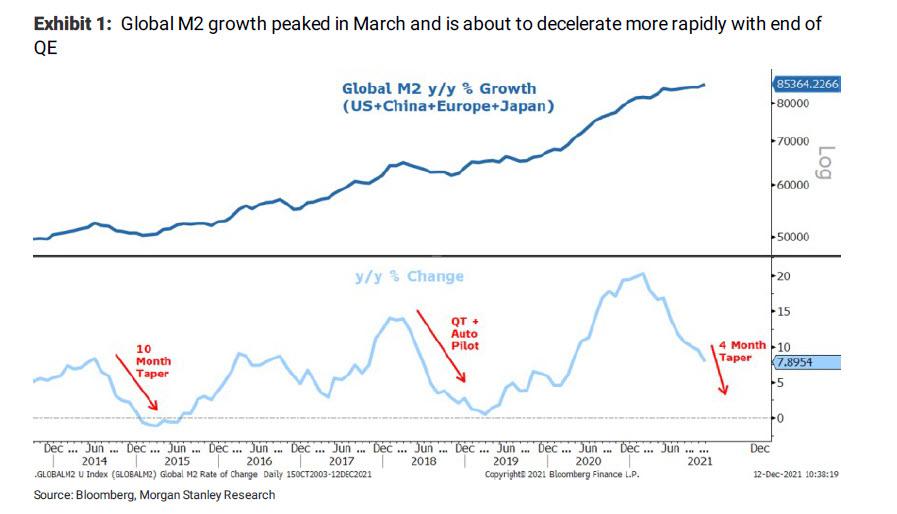
First, in 2014, it took the Fed 10 months to taper its QE program. This time they will do it in just 4 ½ months, or twice as fast. While M2 has been decelerating this year on a global basis, it's still running almost 8% y/y (Exhibit 1). In the US, M2 growth is running 13% and explains a lot of why nominal GDP growth is also running about 13% in the fourth quarter. After all, MV=PQ. If the Fed takes QE down to zero, its global M2 growth will slow severely and likely fall below 5% by the end of 1Q. This looks a lot like 2014 and 2018, but at a faster pace. Wilson's guess is that growth will take a hit at a time when it's already decelerating and increase the odds of our bear case playing out.
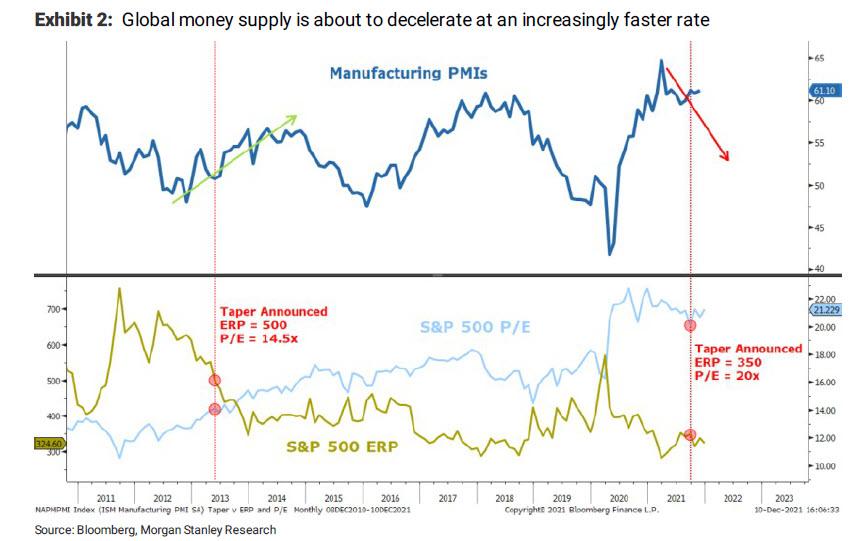
Second, US Equity markets are much richer today and therefore more vulnerable to a swift reduction of liquidity. Specifically, the equity risk premium is 350bps today and was close to 500bps when they started the taper talk in 2013. P/Es were 14.5x versus 20x today. To be sure, rates were higher then but that is why multiples had room to rise from there as rates reflected the more hawkish Fed and inflation that was much lower then. As a result, valuations were able to hold in and even increase during that tapering episode.
Third, growth is decelerating now while in 2013-14 it was accelerating. In addition to the PMI shown in the exhibit, earnings and economic growth were accelerating whereas both are likely to decelerate in 2021 and even outright decline for many companies, particularly in the first half of the year when the comparisons are most difficult. This, Wilson says, is what will really separate the winners from the losers and why he is so focused on earnings stability/achievability and valuation "because small beats will likely not be enough to drive stocks higher if they have a premium P/E."
Morgan Stanley's bottom line: given that much of the market is expensive relative to history, rather than just a few sectors or names, it suggests to this tapering episode will be different than the last one and is likely to leave the overall market lower than where we are trading today by the end of the first quarter if the Fed goes through with an expedited tapering schedule.
In short, Powell - who was wrong about inflation being transitory for the past year and only two weeks ago admitted he was dead wrong - is about to trigger a nightmare scenario for market, and will scramble to snuff inflation just as it has already peaked, and just as the global economy is sliding into a fast slowdown.
* * *
But wait, there's more because as Wilson also correctly observes, asset markets have never been more important to consumer health. That's right: a market crash here and we spiral right into a deep recession, perhaps even worse than the Global Financial Crisis.
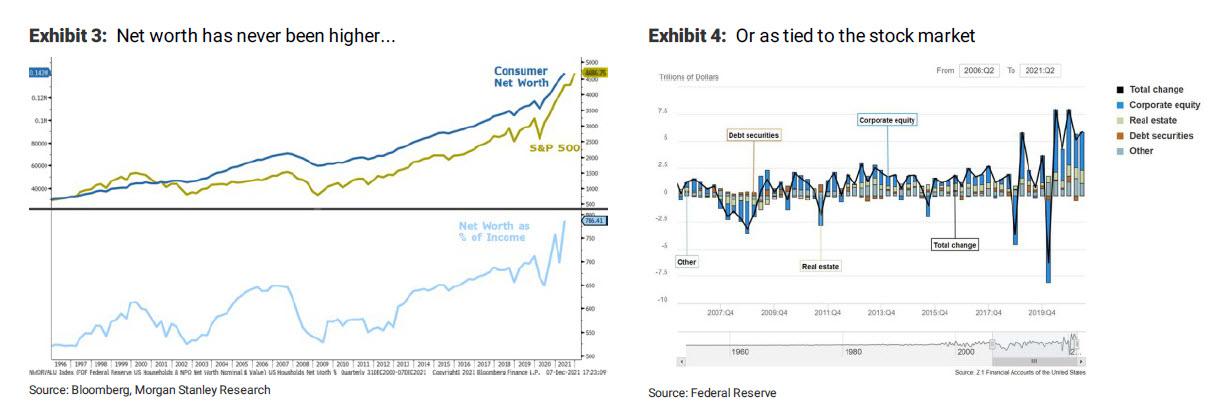
While Morgan Stanley's base case is that the economy should be able to handle the ending of QE and even some rate hikes next year, the big risk has always been that if asset markets correct more significantly it could have a greater than normal effect on the economy too given how levered the consumer is to the stock market and other asset prices like housing and crypto currencies. When just considering the stock market, it's easy to see that consumer net worth has increased dramatically as many key assets have risen inexorably over the past 18 months. And while this is a good thing for consumer demand if prices remain elevated, it also dramatically increases the odds that the inverse will be just as painful, and tapering will quickly become tightening for the economy, too, if it leads to a significant asset price deflation.
Here, Morgan Stanley thinks that "the risk of that is greatest over the next 3-4 months as the Fed exits QE on this faster time table."
The market has, naturally, been ignoring these risks and one place where this is especially obvious is the collapse in market breadth. Since September, breadth has rarely been this weak relative to the Index level price
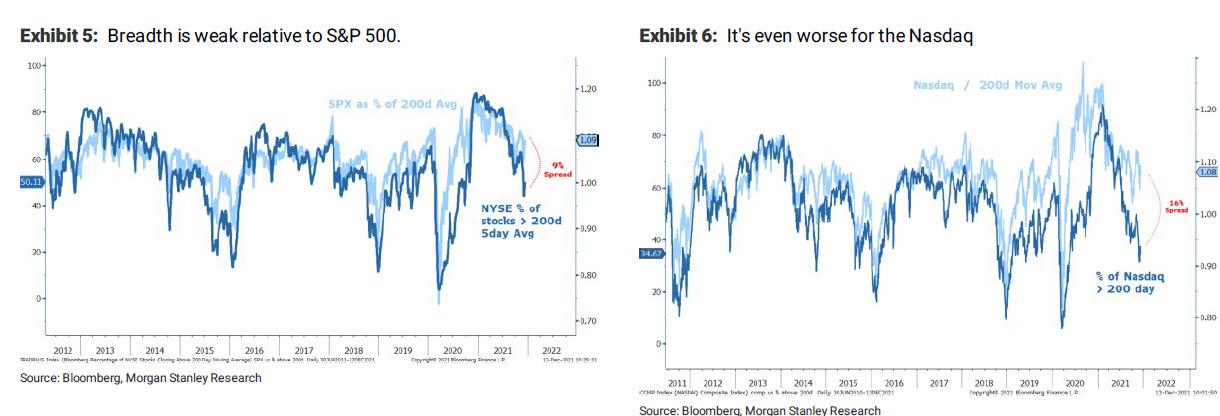
As Wilson concludes, "the rolling correction that began last spring continues under the surface, making the index a very bad gauge of the overall health of the stock market, or the economy, in our view." The good news here is that the average stock has already discounted a good chunk of the risks Morgan Stanley is forecasting "even if the index has not."
In this regard, the bank continues to stress that watching the S&P 500 is a bad idea for measuring what the market is really telling us about the fundamentals. It also explains why it's been so difficult for many active managers to keep up with the benchmark. And while the average stock may begin to outperform as the index catches down, Wilson warns that the absolute direction for most stocks will remain lower until the index has taken its turn on the de-rating process that began over 6 months ago. It's also why Wilson remains overweight large cap defensive quality for now.
One final point from the MS strategist: if there is one chart that depicts the risk off nature of the markets under the surface, it's the MSCI large/mid cap quality index versus the Russell 2000 small cap index.
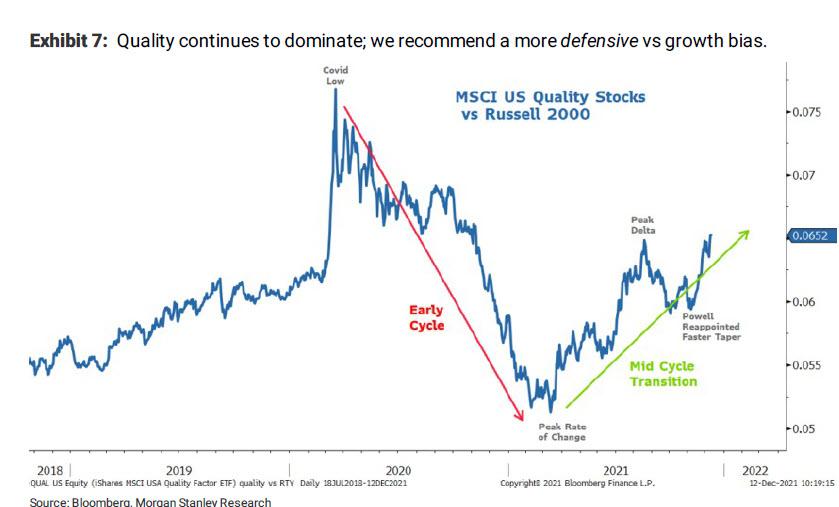
As Wilson concludes, "making this very simple pivot in March as the rate of change on growth and policy peaked was the more important thing to do this year for performance... We continue to recommend this pair but with a more defensive bias on the quality side rather than growth due to valuation constraints as the Fed accelerates its taper this week."
High hopes for private credit
How does private credit beat the bond market?
Often I write headlines or section headings that end with question marks, even though I know the answer. This is not one of those times. I do not know how private credit beats the bond market, or even if it does, in risk-adjusted terms. It is pretty evident, though, that a lot of other people believe that it does, and that it will continue to do so.
We can see this belief in the fact that money is absolutely pouring into the asset class, with the explicit expectation that it will beat the dreary performance of the public debt market. Stories about this appear with thudding regularity in the Financial Times and elsewhere. The most recent was in Monday’s Wall Street Journal, which described how Ares Management has raised $8bn for a new private debt fund that will invest primarily in loans that back leveraged buyouts. It had set out to raise just $4.5bn, but what the hell. Where does all the demand come from? It ain’t complicated:
“More than anything, it’s about low interest rates,” said Kipp deVeer, head of Ares Credit Group. “A lot of investors are frustrated by the low yield in fixed income they’ve traditionally allocated to, whether it’s loans or government bonds or high-grade corporates.”
The frustrated investors include California Public Employees’ Retirement System, which announced last month it was so frustrated it was adding 5 per cent more leverage to its portfolio and changing its asset allocations as follows:

Calpers’ return target is 6.8 per cent. Junk bond indices are yielding 4.5 per cent. Triple-C bond indices (featuring bonds that are “currently vulnerable and dependent on favourable . . . conditions to meet financial commitments” in S&P Ratings’ words) yield only 115 basis points more than Calpers target. Frustrating! So here we come private markets, with a big chunk going to private credit. The Ontario Teachers’ Pension Plan is doing the same thing, for the same reason.
With private equity, we have a pretty good idea where the returns in excess of public markets once came from. They came from high leverage and from managing that leverage skilfully so it did not cause a meltdown during recessions. I used the past tense here because private equity as an industry has not outperformed public markets in the past decade (something of an achievement while using high leverage during a stonking, continuous bull market, but with the right fee structure the sky’s the limit).
Both private equity and private debt funds say that part of their excess return comes from an illiquidity discount. I’m not certain, but I suspect this is false. The primary customers for the private equity and debt funds — pension managers — actually prefer the illiquidity, because it comes with apparently stable returns uncorrelated with other asset classes, which is flattering to the pension managers’ portfolios. In other words, I believe managers pay more than they otherwise would for private markets’ illiquidity, because it brings with it returns that are not marked to market. My work has made me cynical.
If not illiquidity, then what is the source of extra returns? Executives at Apollo Global Management have something to say about this. Here is Marc Rowan, Apollo’s chief executive, on the company’s credit business, talking during an investor call:
“This is a fixed income replacement business. This is not an opportunistic credit business. Our goal in our [private debt] segment is to produce 150 to 200 basis points of excess return over the equivalent [publicly traded bonds] across the capital structure. We want to get paid . . . for illiquidity and complexity and origination, not for taking additional credit risk or assuming other risks.”
So higher return, less risk, because finding high quality private loans to make or buy is tricky, and Apollo is very good at it. Here is another Apollo executive, Christopher Edson, at a conference:
“There is no excess spread left in liquid [public] markets, so we believe that we need to originate [these loans] directly. This is basically manufacturing and creating the factory to generate these assets on an ongoing and recurring basis to drive excess spread and to effectively create these assets at wholesale prices . . . What are these origination platforms? They’re living and breathing companies. They have management teams. They have dozens or hundreds of employees.”
These Apollo-owned companies lend money to small companies, and lend against planes or rental car companies, houses and other assets. Apollo can earn 200 basis points more off these loans for the same risk level because, apparently, it’s just too hard for anyone else to supply the same customers with credit at the lower rates available in the bond market.
There are plenty of examples of tricky, niche markets rewarding enterprising investors with excess returns, but it is often argued that this is a reward for risk, not brains. The idea that there is a market inefficiency big enough to stuff hundreds of billions of dollars into is not naturally appealing to me, but at this point I’m not sure if I buy the private credit story or not. I’d be very interested to hear from readers with experience in the industry, or investing in it.
Surge in Omicron cases in Denmark and UK sends warning to rest of Europe
Two countries show how the coronavirus variant is driving rates of infection and hospital admission
Omicron will become the dominant coronavirus variant in Denmark this week, epidemiologists say, driving a rise in cases to record levels and offering a warning to the rest of Europe about the more transmissible mutation.
Cases in Denmark have surged, contributing to a record daily tally of Covid-19 infections, with some statisticians expecting Omicron to represent a majority of cases in the Scandinavian country by Tuesday or Wednesday.
The Omicron variant is now having a clear impact on case numbers in Denmark and the UK, the first evidence outside southern Africa of its ability to change the course of the pandemic. Epidemiologists say the two countries offer an early warning of how infections and hospital admission rates could spike across Europe this winter and show the need for effective booster programmes to be in place.
“Denmark is a frontrunner here. We were one of the first countries to have initial spreading domestically, but other countries in Europe will see the same,” said Soren Riis Paludan, professor of biomedicine at Aarhus University.
Omicron is also expected to become the dominant strain in the UK by mid-December, the UK Health Security Agency has said, while it will represent a majority of cases in Norway just before Christmas.

Both Denmark and Norway are expecting Covid cases to far exceed previous peaks. Denmark’s health authority, which said it expected Omicron to become dominant this week, said daily cases could soon exceed 10,000. It reported 7,799 new cases on Monday, its highest daily figure of the pandemic, with cases doubling from the same day last week.
In Norway, health authorities warned that if no countermeasures were taken Omicron could infect up to 300,000 people a day compared with the previous peak of about 1,000 cases. Frode Forland, Norway’s state epidemiologist, told the Financial Times that about 500 hospital admissions a day was a more realistic prediction, almost double the previous peak.
“It’s impossible to stop it. The strategy in Norway is to try to prolong the time period until it takes over. The situation is very serious now so we have to take urgent measures. There is an exponential increase in these cases,” he added. Norway’s centre-left government on Monday evening introduced a range of new restrictions including a ban on serving alcohol in bars and restaurants as well as asking the military to help with booster jabs.
Denmark and the UK both have sophisticated genetic sequencing operations, which have enabled them to detect Omicron and other variants before many other countries. Both countries are seeing rapid increases in Omicron infections unlike some other countries with high caseloads such as Germany.
Denmark has recorded 3,437 Omicron cases, authorities said on Monday, close to a doubling in the past two days. About 9 per cent of those infected with Omicron had received three doses of a Covid-19 vaccine, 75 per cent two doses, while 14 per cent were unvaccinated.
Thirty-seven people have been admitted to hospital with the variant in Denmark, with 28 of those testing positive before hospital admission or immediately afterwards and eight who were admitted for other reasons and then tested positive some days later. This is in stark contrast to admissions with other variants, where the vast majority of patients tested positive before admission, suggesting that a significant number of patients in the Omicron wave may test positive for Covid even if they are not being treated for it.

The UK recorded its first death of a patient with Omicron on Monday. Daily Covid case numbers have now surpassed their summer peak but are still below the record high from January. Health minister Sajid Javid told MPs on Monday there were now 4,713 confirmed cases of Omicron in the UK and he expected it to become the dominant variant in London in the next 48 hours.
Paul Hunter, professor in medicine at the University of East Anglia, said UK cases of the Delta variant were rising at a slower rate than Omicron, meaning the latter was “going to take over, probably not this coming week, but almost certainly the following week”.
He emphasised that in the week ending December 6 most of the growth in cases had been seen in under-60s in London. The UK capital reported 11,791 new cases on Monday, its highest figure since January. Infection rates are now doubling every week, the fastest rate of increase since July.
“I suspect that most of the growth that we’ve seen in the early part of this Omicron epidemic has been in low-vaccinated younger people in London,” said Hunter, suggesting that growth in infection rates may slow. “Once it starts spreading in older people, and in other parts of the country where they’ve got better booster vaccine rollout, I suspect that we’ll see a fairly marked decline in the reproduction rate,” he added.
Other European countries are still waiting to feel the full impact of Omicron. In France, there are signs that the pace of increase in the country’s current fifth wave of infections is starting to slow but some health officials are warning that Omicron will drive an imminent sixth wave.
Cases in Switzerland, which has the worst vaccination rate in western Europe, have been rocketing since mid-November. But the latest publicly disclosed sequencing of tests, from December 3, showed Omicron accounting for only 2.7 per cent of positive results.
Closing Stock Market SummaryThe S&P 500 fell 0.9% on Monday in a defensive session, as investors digested the latest Omicron news and waited for the Fed's policy decision this week. The Dow Jones Industrial Average also declined 0.9%, while the Nasdaq Composite (-1.4%) and Russell 2000 (-1.4%) both declined 1.4%.
Risk sentiment was pressured by lingering growth concerns after UK Prime Minister Johnson warned of an impending "tidal wave" of new coronavirus cases and the British government upped its COVID-19 alert level. Cyclical stocks, including travel names, were among the weakest performers today.
The cyclical S&P 500 energy (-2.8%), consumer discretionary (-2.4%), and financials (-1.2%) sectors underperformed alongside the information technology sector (-1.6%). Accordingly, investors leaned defensively into the real estate (+1.3%), utilities (+1.2%), consumer staples (+1.2%), and health care (+0.9%) sectors.
After a record-setting rally last week, it's also plausible that investors saw the news as a convenient excuse to take profits and withhold buying conviction until the FOMC concludes its policy meeting on Wednesday. That's loosely based on the underperformance of the tech sector and growth stocks.
Apple (AAPL 175.74, -3.71, -2.1%) nearly reached a $3.0 trillion market capitalization after JP Morgan raised its price target on AAPL to a Street-high of $210. The firm also reiterated the stock with an Overweight rating and a "top pick into 2022." AAPL shares closed lower alongside the other mega-caps, even though long-term interest rates declined in their favor.
The Vanguard Mega Cap Growth ETF (MGK 258.09, -3.65, -1.4%) fell 1.4%, which was twice the decline of the Invesco S&P 500 Equal Weight ETF (RSP 158.58, -1.16, -0.7%).
Specifying the moves in the Treasury market, the 10-yr yield declined seven basis points to 1.42% while the 2-yr yield declined two basis points to 0.64% -- flattening the curve and corroborating growth concerns. The U.S. Dollar Index rose 0.3% to 96.36. WTI crude futures decreased 0.6%, or $0.46, to $71.24/bbl.
Pfizer (PFE 55.22, +2.44, +4.6%) was an individual standout with a 4.6% gain after agreeing to acquire Arena Pharma (ARNA 90.08, +40.14, +80.4%) for $6.7 billion, or $100 per share, in cash. The deal represented a 100% premium over ARNA's closing price from last Friday.
Investors did not receive any economic data on Monday. Looking ahead, investors will receive the Producer Price Index for November and the NFIB Small Business Optimism Index for November on Tuesday.
- S&P 500 +24.3% YTD
- Nasdaq Composite +19.6% YTD
- Dow Jones Industrial Average +16.5% YTD
- Russell 2000 +10.4% YTD
After Hours Summary: PRPL -8.3% falls on news its CEO is stepping down, weak guidance; AA +4.9% jumps on news it will join S&P MidCap 400After Hours Gainers:
Companies trading higher in after hours in reaction to earnings/guidance: None
Companies trading higher in after hours in reaction to news: GAMB +7.3% (to acquire RotoWire), SNSE +5.3% (to be added to the NASDAQ Biotech Index), AA +4.9% (to join S&P MidCap 400; also announces closure of aluminum smelting capacity at Wenatchee), ELY +3.4% (approves $50 mln share repurchase program), EQT +2.1% (approves $1 bln share repurchase program, also to reinstate its dividend), NGD +2.1% (to sell Blackwater Project gold stream for upfront cash consideration US$300 mln), BLU +1.2% (commences $175 mln stock offering), SEEL +1.2% (stock offering), NOG +1.1% (names new COO), FNA +1% (received supplemental approval order from FDA for Patient Specific Talus Spacer), KMPH +0.8% (to be added to the NASDAQ Biotech Index), FTNT +0.8% (to join Nasdaq 100 Index), RKLB +0.7% (to acquire SolAero, a supplier of space solar power products, for $80 mln), PGEN +0.3% (positive interim phase 1 data for PRGN-3006 UltraCAR-T), AVNS +0.1% (to acquire OrthogenRx for $160 mln), ALSN +0.1% (selected by Israeli Ministry of Defense for infantry fighting vehicle), MKL +0.1% (to acquire minority interest in Metromont)
After Hours Losers:
Companies trading lower in after hours in reaction to earnings/guidance: PL -12.7%
Companies trading lower in after hours in reaction to news: PRPL -8.3% (CEO stepping down, names new CEO; expects rev, adj. EBITDA at low end of previous guidance), APTO -8.2% (HM43239 demonstrates durable clinical benefit), MX -1.7% (MX and Wise Road Capital mutually terminate acquisition agreement), HARP -0.2% (provides drug pipeline update), AMK -0.2% (reports Nov operating metrics), BMY -0.2% (files mixed securities shelf offering), CLVT -0.1% (discloses separation agreement with CFO), GILD -0.1% (GILD and Merck to stop all dosing of participants in a Phase 2 study for people living with HIV)
Vox Media, Group Nine Media in Advanced Talks to Merge
Stock deal would unite two of the biggest digital-media companies; Vox Media would get 75% ownership
Vox Media is in advanced talks to merge with Group Nine Media Inc., according to people familiar with the situation, a deal that would unite two of the biggest players in digital media.
The companies are discussing an all-stock transaction that would give Vox Media 75% ownership of the combined company, with the remaining 25% going to Group Nine Media, the people said. Vox Media Chief Executive Jim Bankoff would helm the company, the people said.
Vox Media, owner of media properties including tech-focused website the Verge, current-events site Vox.com and sports-focused SB Nation, has been expanding. In August, it agreed to acquire cocktail website Punch to deepen its coverage of food and drinks. Vox has explored ways to raise cash for further growth, including the possibility of going public, people familiar with the matter have said.
Group Nine Media, whose brands include news outlet NowThis, lifestyle site Thrillist and animal-focused the Dodo, has also been an active consolidator in the media space. It earlier explored a deal with BuzzFeed and in 2019 purchased female-skewing digital-media company PopSugar.
The combined company is expected to generate more than $700 million in revenue in 2022 and more than $100 million in profit, according to people familiar with the matter. On a pro forma basis, the combined company grew revenue by about 30% this year compared with last year, the people said.
France goes unicorn hunting
Plus, UK spy chief tells the FT of concerns over Chinese central bank digital currency
Liberte, Egalite, Fintech
When French president Emmanuel Macron said his country should have 25 unicorns by 2025, the nation counted nine and wasn’t exactly known as a tech hub. Two years later, nine of France’s 22 private companies valued over $1bn are fintechs. Banking app Lydia joined the ranks last week after closing a $100m round.
“France is a great place to build European start-ups,” said David Sainteff, partner at Global Founders Capital. Because of its “challenging” regulatory environment and competitive scene, start-ups that “reach a market-product fit despite those constraints” are often mature enough to compete on a European scale, added the backer of French digital accountancy firm Penny Lane.
Ten years ago, France suffered from chronic bureaucratic syndrome. Administrative hurdles stifled innovation and entrepreneurship. Homegrown talents, despite strong maths and finance credentials, would start companies elsewhere. Eventbrite and Datadog are among the billion-dollar companies that French entrepreneurs founded in the US.
The sheer perspective of “building champions” able to scale up beyond national borders “didn’t use to exist in France” said Lydia’s chief executive officer Cyril Chiche. “In fact, it existed very little in Europe outside of the UK,” he added. Chiche saw a shift take place in the last three years, as France started to attract foreign capital “in very large proportion”. China’s Tencent and US-based venture capital firm Accel are among Lydia’s investors.

Capital concentration in the UK’s fintech scene meant European start-ups were slightly undervalued in comparison, making them attractive to investors. “Once they realise there are companies of this calibre, which already have users, revenues streams, and a maturity they hadn’t imagined . . . they realise valuations are attractive and it’s a good place to invest,” said Chiche.
This year, France raised $2.8bn in fundraising rounds fin fintech, overtaking Sweden as the third-hottest European destination for venture capital in the sector, after UK and the Germany.
Lydia plans to add an investing arm to its banking and payments app, in a bid to become a European “super-app”. If scaling beyond borders is the next frontier for most French fintechs, the UK is not on their horizon, said Sainteff. As a “very competitive” environment, it has “well-established local players” and is seen by American companies as the “easiest gateway to Europe”. Like N26, Lydia closed its UK operation citing “local constraints”, and has instead focused on expanding in Portugal and Spain.
Though Emmanuel Macron has tried to nurture the French tech spirit — his government unveiled a pandemic stimulus plan for the digital sector worth €7bn — most fintech players say the trend predates him and expect it to transcend his presidency. “You’d have to be crazy to hit the brakes now,” said Chiche. According to BPI France, French fintechs have created over 25,000 jobs and most are actively hiring.
Chiche says the “tens and tens of concrete measures” implemented in the last decade helped the ecosystem flourish. He cites fiscal reforms, the creation of a public investment bank and the “bettering of relations between the tech scene and national administrations”.
“Crazy puzzles” used to penalise start-ups, says Chiche, such as the now-reformed Banque de France’s solvency scoring system. Previously, it was based on profitability and size, meaning lossmaking start-ups struggled to borrow cash.
“We believe that by 2025, two or three scale-ups will be on the CAC40, with probably one fintech among them,” said Paul-François Fournier, Innovation director at BPI France.
But challenges remain, such as fierce global competition for talents, said Sainteff.
When asked about the challenges of competing in a crowded pan-European market, Chiche said: “If we look at potential future big actors in digital banking . . . there are maybe 10 at most . . . Do you know how many banks there are in Europe? 5,073. So actually, well there is room, you know.” (Akila Quinio)