Closing Stock Market SummaryThe S&P 500 declined 0.5% on Thursday, as risk sentiment remained pressured by underlying growth concerns in this downwards-trending market. The Nasdaq Composite (-0.3%) and Dow Jones Industrial Average (-0.8%) also closed lower, while the Russell 2000 (+0.1%) closed slightly higher.
Eight of the 11 S&P 500 sectors closed lower in a choppy, back-and-forth session. The consumer staples (-2.0%), information technology (-1.1%), and industrials (-0.9%) sectors were the weakest performers, while the materials (+0.7%), consumer discretionary (+0.1%), and health care (+0.2%) sectors eked out gains.
Growth concerns were reinforced by another batch of disappointing corporate updates and economic data in addition to elevated oil prices ($109.91, +0.56, +0.5%), which hovered near $110 per barrel.
In the corporate space, Cisco (CSCO 41.72, -6.64, -13.7%) dropped 14% after missing revenue estimates and issuing downside quarterly guidance amid persisting supply chain issues. Bath & Body Works (BBWI 40.03, -2.92, -6.8%), Kohl's (KSS 45.04, +1.91, +4.4%), and The Children's Place (PLCE 47.74, +4.52, +10.5%) were the latest retailers that issued disappointing guidance.
Continued bleeding in Walmart (WMT 119.07, -3.41, -2.8%) and Target (TGT 153.43, -8.18, -5.1%), both of whom stoked profit-margin concerns this week, was another drag on sentiment that discouraged dip-buying efforts. On top of that, Citigroup downgraded Union Pacific (UNP 216.42, -8.57, -3.8%), CSX (CSX 30.94, -1.38, -4.3%), and Norfolk Southern (NSC 228.03, -9.54, -4.0%) to Neutral from Buy.
Specifying the data, weekly initial claims were higher than expected at 218,000 ( consensus 200,000), the Philadelphia Fed Index dropped to 2.6 in May (Briefing.com consensus 16.5), the Conference Board's Leading Economic Index (LEI) decreased 0.3% m/m in April (consensus 0.0%), and existing home sales fell 2.4% m/m in April to a seasonally adjusted annual rate of 5.61 million (consensus 5.65 million).
The Treasury market, meanwhile, was a strong indicator for these underlying growth concerns, as demand drove yields lower across the curve. The 2-yr yield declined seven basis points to 2.61%, and the 10-yr yield declined three basis points to 2.86% after touching 2.78% in the wake of the weekly claims and Philadelphia Fed Index releases.
Reviewing Thursday's economic data:
- Initial claims for the week ending May 14 increased by 21,000 to 218,000 (consensus 200,000). That remains a low number historically, but relative to expectations it was a disappointment. Continuing claims for the week ending May 7, however, decreased by 25,000 to 1.317 million.
- The key takeaway from the report is that it covers the week in which the survey for the May employment report was conducted. The relatively low number of initial claims will support an outlook for another strong month of nonfarm payroll gains.
- Existing home sales decreased 2.4% month-over-month in April to a seasonally adjusted annual rate of 5.61 million (Briefing.com consensus 5.65 million) versus a downwardly revised 5.75 million (from 5.77 million) in March.
- The key takeaway from the report is that the supply of available homes for sale remains extremely tight, yet higher mortgage rates and home price inflation are contributing to a slowdown in buyer demand rooted in affordability pressures that are expected to persist.
- The Philadelphia Fed Index for May decreased to 2.6 (consensus 16.5) from 17.6 in April.
- The Conference Board's Leading Economic Index (LEI) decreased 0.3% m/m in April (consensus 0.0%) following a revised 0.1% increase (from 0.3%) in March.
There is no economic data scheduled for Friday.
- Dow Jones Industrial Average -14.0% YTD
- S&P 500 -18.2% YTD
- Russell 2000 -20.9% YTD
- Nasdaq Composite -27.2% YTD
THG rejects £2bn bid as Candy weighs up online retailer
Approaches from Belerion and King Street rebuffed amid interest from property tycoon
THG has rejected a £2.07bn bid from two investment companies, as a venture capital firm controlled by property tycoon Nick Candy also said it was exploring an offer for the beauty and nutrition online retailer.
THG has been hit by a string of setbacks since its initial public offering in 2020, with its share price tumbling from a peak of almost 800p to 116p.
The company, which sells nutrition and beauty products online and markets its technology and logistics expertise to consumer goods groups and other retailers, has been the subject of persistent bid speculation over the past year.
THG said it had received an unsolicited offer of 170p per share from Belerion Capital and King Street Capital Management.
It said the offer “significantly undervalued the company and its future prospects” and rejected the approach. The price represents a 48 per cent premium to its closing price of 116p on Thursday.
Belerion and King Street must state by June 16 whether they intend to make an offer or walk away. Iain McDonald, Belerion’s co-founder and chief investment officer, is a THG non-executive director.
Separately, Candy Ventures said it was “in the early stages” of considering a bid and that there was no guarantee that a formal approach would be made.
At the time of its full-year results in April, THG said that it had received several “unacceptable” proposals from undisclosed entities but was not currently in talks with any bidder.
Any bid would have to secure the backing of founder and chief executive Matthew Moulding, who owns a special share that allows him to veto any hostile offer.
As part of efforts to enhance its appeal to investors, many of whom had grown concerned about its valuation and strategy, THG has pledged to unwind the special share arrangement by the end of this year.
Candy declined to comment on his interest. The property tycoon branched out into investments in the tech sector after making his name as the designer and developer of apartments for the super wealthy, including at One Hyde Park in Kensington which he helped build with his brother Christian more than a decade ago.
His Luxembourg-based investment group is a big shareholder in podcast maker AudioBoom and augmented reality group Blippar, and was one of the backers of the collapsed high-end fashion label Ralph & Russo.
He was also part of a consortium that was interested in acquiring Chelsea football club, although most of his investments are in Aim-listed or privately held groups.
Odey urges Shell to drop appeal against order to slash emissions
Asset manager calls on oil major to seek creation of climate auditor for all companies
Odey Asset Management has called on Shell to drop its appeal against a landmark Dutch court ruling targeting its climate strategy and instead to fund an independent body to audit the emissions of every oil and gas company.
The call from the London-based hedge fund, which has acquired about $70mn of Shell shares since the start of 2021, comes as Europe’s biggest oil company prepares for shareholders to vote on its energy transition strategy at its annual general meeting next week.
In a letter to chief executive Ben van Beurden, Odey said it would vote for Shell’s strategy even though it had “some sympathy with those questioning its transparency and apparent ambiguity”.
Fund manager Henry Steel, who wrote the letter, told the Financial Times that Shell was “sending the wrong signals” by appealing against last year’s Dutch ruling ordering the oil major to cut its emissions by 45 per cent by 2030.
Shell has since pledged to reduce emissions from its own operations, known as scope 1 and scope 2, by 50 per cent by 2030 but it has appealed against the court decision. The UK-headquartered company argues it cannot be bound to targets for scope 3 emissions from the fuel it sells, which it says are beyond its control, particularly while governments are doing little to reduce demand.
Odey has proposed that Shell drop its opposition and instead start its own European litigation to impose the same ruling on all oil and gas companies to create a level playing field.
Shell should also fund the creation of an independent auditor to review emissions data published by each oil and gas company in the same way that financial results are audited, Odey said in the letter.
Companies currently publish their own figures and often use different methodologies, which makes them difficult to compare, Steel said.
“If you’re going to have credibility and the trust of the society then the whole industry needs to have a clearly independent auditor of emissions, who other stakeholders can hold accountable,” he said.
Shell said it would review Odey’s recommendations. “Meaningful dialogue with investors is central to how we determine our approach and we have engaged with Odey as part of our programme of regular investor engagements,” it said.
Odey’s $70mn in Shell shares represent about 0.03 per cent of the company’s stock.
Shell, which simplified its Anglo-Dutch structure in December by relocating its headquarters to London, was one of the first oil majors to put its net zero emissions strategy to a vote last May. Nearly 89 per cent of shareholders backed the proposal, though that fell short of the 95 per cent that is usual for resolutions put forward by management.
At the same meeting 30 per cent of shareholders voted in favour of a rival resolution from Dutch shareholder activist group Follow This, which called for the oil company to set more “inspirational” targets.
Follow This, which submits the same resolution at other oil companies, has so far been less successful this voting season with fewer shareholders backing its resolution at BP than had done in 2021.
BlackRock, the world’s largest money manager, has already said it will support fewer shareholder resolutions on climate change this year, some of which it said had become too extreme or too prescriptive.
Nomura: The 'Calmest Selloff Ever' Is Over, Brace For Turbulence Ahead
Yesterday was different.
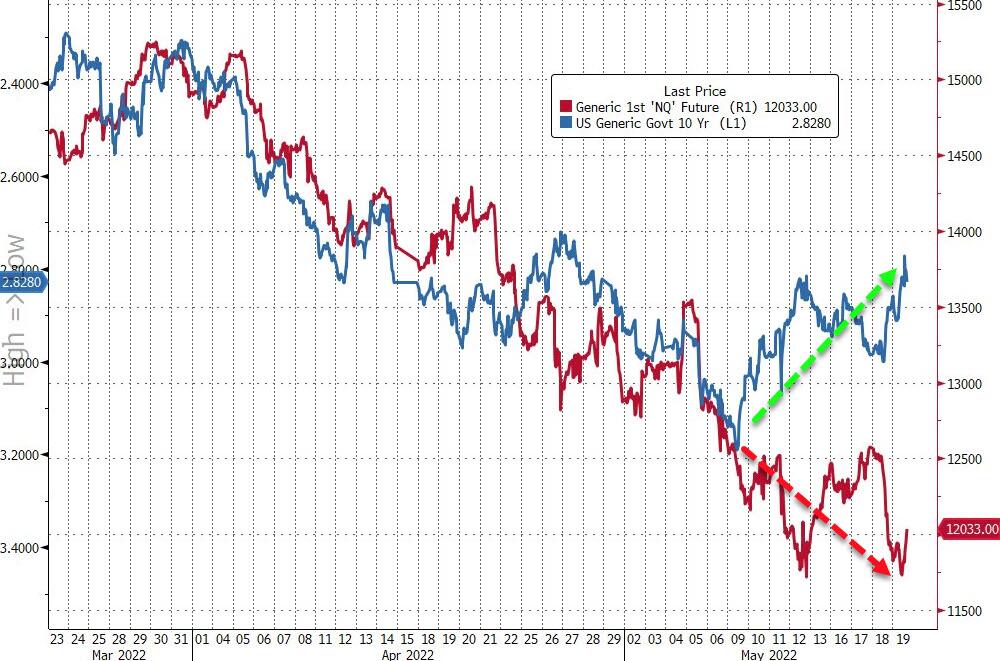
Bond yields tumbled with stocks (they have tended to rise recently as stocks tanked)...
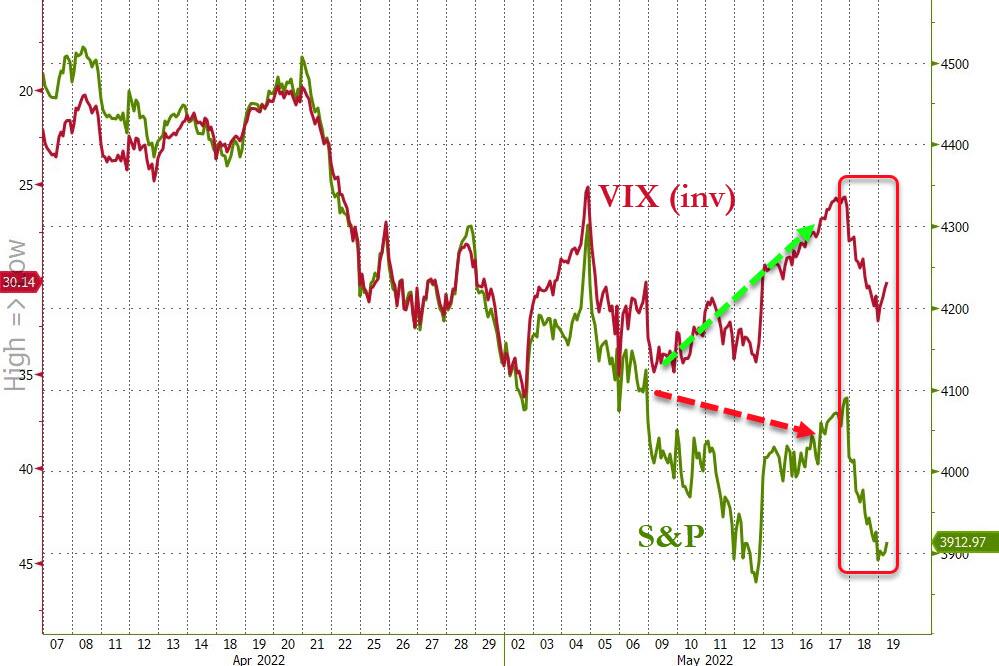
...and VIX spiked as stocks were spanked (it has been decoupling, exuding calmness for a few days until then)...
The change was catalysed by two factors:
1) "Hard-Landing" / "Recession" narrative keeps gaining-steam, so bonds are beginning to "work" as a risk-asset hedge, and2) Yesterday's VIX-piry (and tomorrow's Op-Ex) removed much of the overhang suppressing vol, crushing hopes for some form of 'stabilization'
So given the 'change', what happens next?
As Charlie McElligott warns, the bond short covering is only just beginning.
Today's ugly Philly Fed miss and significant trend rise in jobless claims is leading to another wave of spastic short-covering / upside-buying in USTs (and USD weakness), as "Growth Scare >> Recession" meme-check builds further steam.
In fact, while unwinds have begun, CTA Trend legacy “Short” positioning remains a significant source of “covering” risk instability

And notably, McElligott points to Credit / Spread-Product / Long Duration demand from “asset allocators” and real money:
"I just get the sense that as the market crystalizes on this (pre-emptive) move towards 'Contraction / Recession / Hard-Landing' that the market is gonna 'come hard' for this stuff."
Shifting back to equity-land, the 'calmest selloff ever' is over following VIX-piration yesterday.
As SpotGamma notes, yesterday's VIX expiration likely pulled forward expiration “rally fuel” but looked for more support around the 4000 level. However, terrible retail reports from the likes of WMT (-15%) & TGT (-20%) and now CSCO (-10% premarket) signal “recession”, and that comes into an environment with increasing interest rates. This likely triggered both natural & forced liquidations. As markets declined it was quite likely that options hedging flows sold, too, as large short dated put positions went from 2% out-of-the-money, to 2% in-the-money.
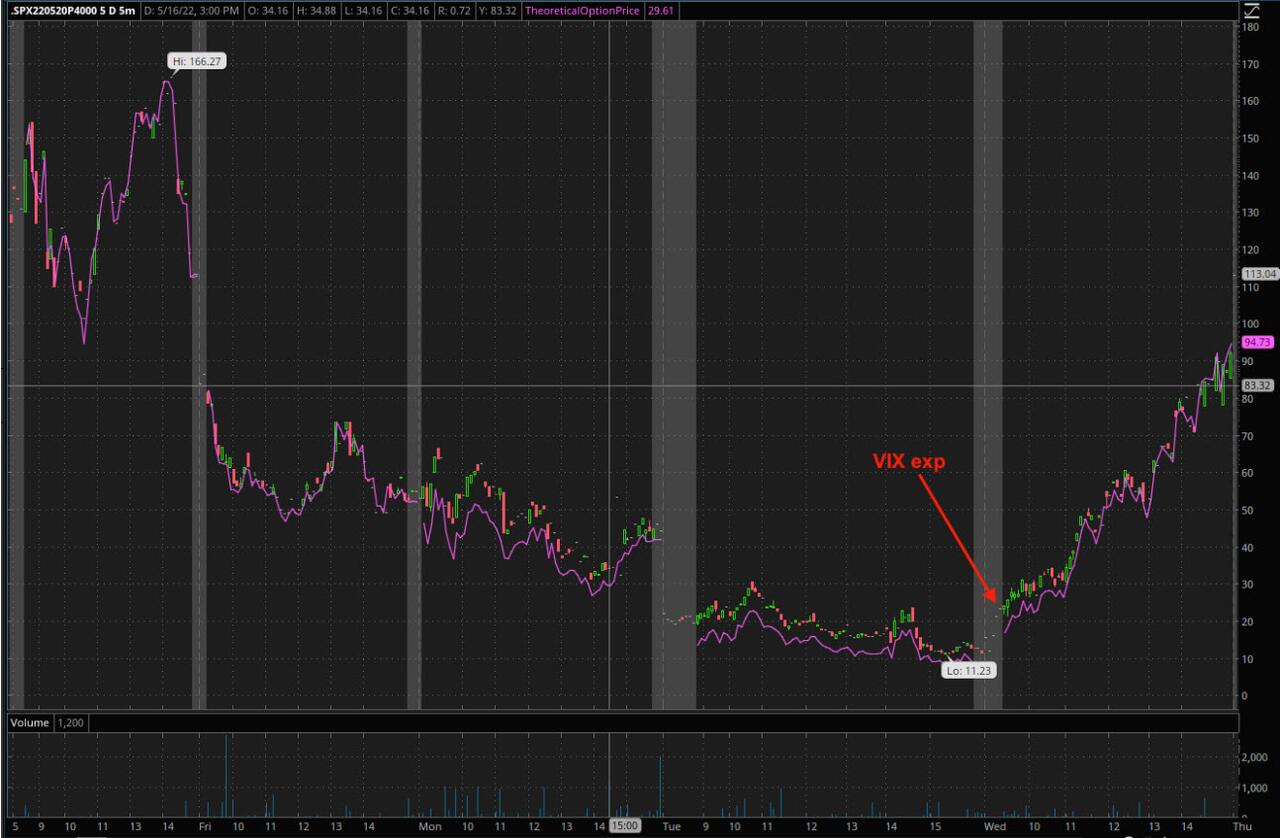
The concentrated puts positions near 400SPY/4000SPX/300QQQ invoked “jump risk” as options rip higher in value.
Shown below is the price of the 5/20exp 4000 strike put – note how its price shot higher as 9AM VIX settlement passed...
Negative Gamma is dominating the market's intraday moves...
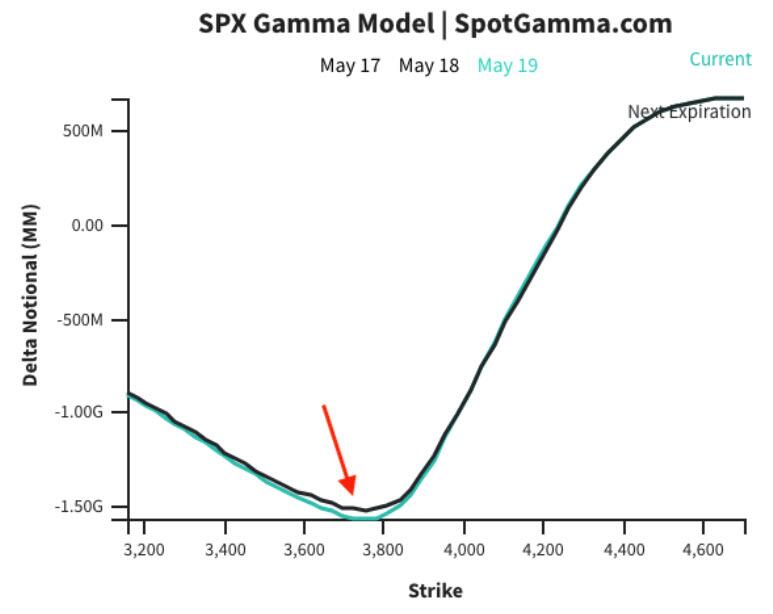
...which are at near record levels of turbulence. As Nomura's McElligott notes, this is the longest extended period of dealer "short gamma" seen for years, which implicitly has led to the most persistently violent intraday-day range period in recent history...
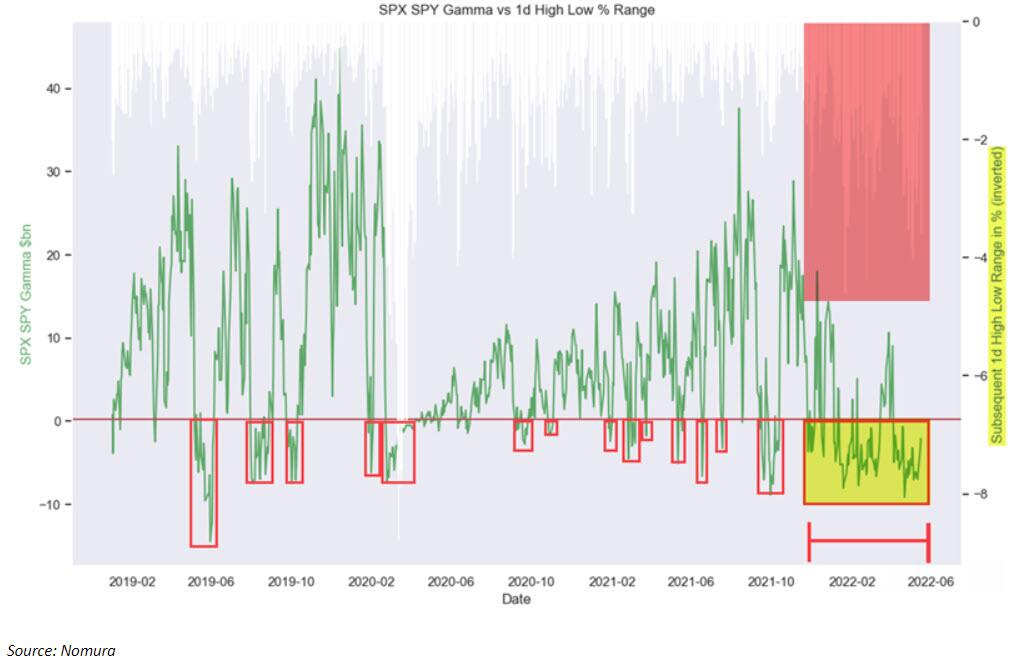
The Nomura strategist offers one more inisght of note, that is that one of the challenges for Stocks now with regards to hopes of some form of stabilization and “finding friends” - at least from within the leveraged community (Equities L/S and M/N space) - is “tight-stops” in this type of VaR environment, where risk-allowances are punitively low due to so many sample days where both longs- and shorts- are consistently blowing through of risk-limits.
Still room for more pain as traders are still not 'grabbing for crash-hedges', and tomorrow's OpEx has huge levels of Delta and Gamma set to come off:
- SPX / SPY will see 35% of the total $Gamma expire Friday ($16.7B of $48.3B), with -$74.5B (!!!) of associated front-week (Short) $Delta set to come-off
- QQQ will see 41% of the total $Gamma expire Friday ($1.15B of the $2.8B), with -$9.6B of associated front-week $Delta set to come-off
- IWM will see 42% of the total $Gamma expire Friday, with -$2.9B of associated front-week $Delta set to come-off
- HYG will see 55% (!!!) of the total $Gamma expire Friday, with -$3.8B of associated front-week $Delta set to come-off
The current expiration period has been tracking April's expiration.
VIX expiration seemed to lead to a decline in volatility that was released post-expiration. Here we have a relatively large stock OPEX which may provide a bounce into an overall trend lower.
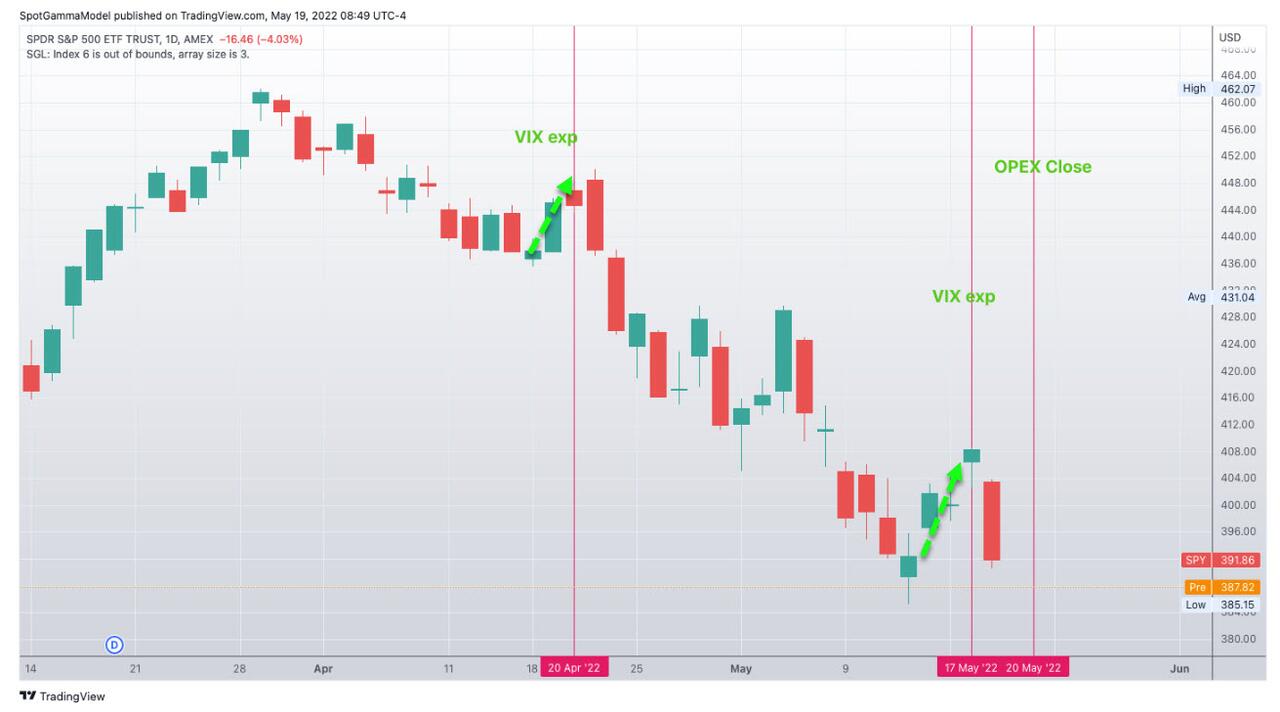
Finally, SpotGamma reiterates its recent point that rallies should be framed as short covering and subject to quick and violent reversals. We very strongly believe that a major market low will come with a quarterly OPEX+FOMC combo.a
Massive Momo Shuffle May Mean More Tech-Wrecks & Bank-Beatdowns To Come
As if the market didn't need more sand kicked in its eye, a rebalance of a major quant strategy could put more technical selling pressure on tech and financial names as they suffer.
BlackRock’s iShares MSCI USA Momentum Factor ETF (ticker MTUM) is facing its latest semi-annual rebalance, with the fund’s underlying index due to start the process next week.
Momentum names have been under pressure in the last few days as Value caught a bid...

Wells Fargo's Chris Harvey estimates that a whopping 75% of the smart-beta product’s holdings will be turned over in favor of sectors that gain from elevated inflation like value and energy, at the expense of technology names.
At the same economically sensitive companies like banks will likely be slashed in favor of defensives like health care.
“Our preliminary estimates indicate a wholesale renovation,” Harvey wrote in a note.“Momentum holdings are expected to re-align with value and take on old-school defensive traits: lower price volatility, more stable earnings, larger size, and steadier dividends.”

This sector shuffle will likely lower the overall volatility of the ETF. As the following chart of sector vols shows, while an increase in Energy's allocation will raise overall vol, a reduction in Tech and Financials will cut it and adding more 'low vol' Staples and Utes will significantly lower the overall volatility in the fund.

A look at the S&P's implied correlation offers some more insight. A rising implied correlation suggests the index vol is rising considerably more than the individual names in the index.

But given that VIX has not been rising dramatically, this suggests a notable dispersion among the individual names (or sectors) is already occurring.
Finally, we consider what happens next? Last year's rebalance followed a similar path into the shuffle, then ramped after...

We could see a similar reaction as traders reach for something more 'stable'.
“Post-rebalance MTUM will have a lot in common with low-volatility funds, based on our analysis, with an expected 56% of MTUM’s projected weighting falling into the lowest-volatility quintile of the Russell 1000,” Christopher Cainand Athanasios Psarofagis wrote in research last week.
Is this the turning point in Energy vs Tech... just like at the DotCom Bust?

But, given the relatively strong correlation with the broad market, it is likely more a relative, than absolute, bet to buy the momo dip.
How Saint Laurent Became a $3 Billion Powerhouse
Chief executive Francesca Bellettini breaks down how she worked with designer Anthony Vaccarello to double sales in 5 years, leaning into an amped-up take on Parisian glamour, seasonless merchandising and a rapid expansion in leather goods.
KEY INSIGHTS
- Under CEO Francesca Bellettini and designer Anthony Vaccarello, Saint Laurent has more than doubled sales in 5 years and is on track to surpass $3 billion in 2022.
- A seasonless strategy favouring evolution over revolution has hammered home the brand's message to consumers.
- Quilted leather bags like Lou crossbodies and Niki envelope totes are driving growth.
PARIS — Saint Laurent’s Fall/Winter show this March was the eighth time designer Anthony Vaccarello had shown in front of the Eiffel Tower, with each outing hammering home his message of amped-up, yet relatable Parisian glamour.
The collection — featuring luxurious faux furs, tuxedo coats and wispy dresses in a silent-movie palette of deep sepia, ivory and black — dug deep into founder Yves’s archive, invoking a 1970s French take on Old Hollywood style that was famously documented by photographer Helmut Newton.
Rather than being interpreted as redundant, the show won rave reviews for its tense, cinematic presentation as well as the way Vaccarello had sublimated his iconic inspirations into something modern — adding his own subversive, Belgian spin.
Vaccarello is “finally discovering more of the provocative allure of Saint Laurent — and conveying it in his own way,” fashion critic Cathy Horyn wrote. “Vaccarello has got himself in charge of the Yves Saint Laurent aesthetic,” deploying the brand’s playbook “in his own accent, with his own taste,” added Vogue’s Sarah Mower.
The show followed months of magazine covers dominated by Saint Laurent, as almost six years into Vaccarello’s tenure fashion media seemed to be embracing his slow-burning transformation of the brand more than ever.
Since his arrival at Saint Laurent in 2016, Vaccarello has transitioned the brand from the retro, rock-and-roll-inflected positioning cultivated by his Los Angeles-based predecessor Hedi Slimane to a heightened, more squarely Parisian narrative.
While maintaining the brand’s seasonless approach — favouring evolution over revolution each season — Vaccarello has nonetheless managed to shift the brand’s focus from glitzy party dresses to daywear and tailoring and back again, perpetually twisting the bourgeois signatures of Yves Saint Laurent into something more sporty and youthful: true to the brand’s French DNA but with global, contemporary appeal.
At the same time, chief executive Francesca Bellettini’s precise approach to merchandising and distribution has helped the brand boost its commercial impact dramatically: Saint Laurent’s sales have grown by roughly 5-fold to €2.52 billion ($2.66 billion) since Bellettini joined the brand in 2013, and more than doubled since Vaccarello came aboard as creative director in 2016. Saint Laurent has grown its profits by a factor of 10 during Bellettini’s reign, with EBIT rising from €77 million in 2013 to €715 million last year.
With retail sales up by 49 percent last quarter, the brand is on track to surpass €3 billion in sales this year even as the brand works to clamp down on its exposure to wholesale, according to HSBC.
Evolution, Not Revolution
“The success lies in the consistency of our strategy,” Bellettini said during a recent interview at the brand’s headquarters in a renovated hotel particulier on Paris’ tony Rue de Bellechasse. “Everything we do aims to elevate and amplify the brand.”
An appetite for repetition (as with the Eiffel Tower background) and the more gradual stylistic evolutions on Vaccarello’s runway has helped to reinforce a consistent brand identity with consumers, as well as helping it to phase out markdowns.
“Saint Laurent has really gained with consistency,” HSBC analyst Erwan Rambourg said. “Consumers are looking for references, they’re looking for iconic products, and this is one of the most iconic French brands. They don’t need to make noise every other minute to draw you in.”
“They’ve really harnessed that Parisian chic, that luxury cool girl and wrapped it up in a way that appeals broadly,” Sam Lobban, Nordstrom’s vice president of luxury and special projects, said.
That consistency is also helping boost Saint Laurent’s bottom line, as the consistency of collections has made it easier to avoid markdowns.
“The vision of Anthony that builds on, that reinterprets constantly — as well as adding to — the icons allows us to really build a business that is profitable. Because almost nothing is obsolete,” Bellettini said.
No items are marked down before less than one whole year, and no discounting has been done through the brand’s mainline boutiques since 2017, the brand said.
Appreciation for what Bellettini and Vaccarello have built at Saint Laurent has been hard-won, however, as the brand’s evolution was gradual enough (by fashion standards) that it was sometimes easy to miss.
Saint Laurent’s success has at times been attributed to the bold-faced, monochromatic brand image and store concept put in place by previous creative director Hedi Slimane. The perception that the brand had simply been riding the wave of Slimane’s turnaround was hard to shake.
It is true that Vaccarello has often favoured the same short hemlines and sauntering, rail-thin brand of models his predecessor employed at the brand. And the sexed-up, shimmery party dresses that marked his first seasons at the brand blended seamlessly with his predecessor’s trademark skinny jeans, low-top sneakers, and Sac du Jour handbags in stores.
But the product assortment changed rapidly following Vaccarello’s arrival. While Saint Laurent doesn’t disclose sales about particular products, retail sources say hit items featuring Vaccarello’s revival of the YSL monogram were driving growth within a few seasons: such as Lou camera bags, Niki envelope totes and Opyum stilettos.
By the time Slimane returned to fashion at the helm of LVMH’s Celine in 2019, YSL’s business had moved on from his signature styles far more than the market realised. The Celine revamp (which has featured many similar ingredients in branding, ad campaigns and even collections as Slimane’s work for Saint Laurent) has had “no impact,” on YSL’s trajectory, Bellettini says.
Saint Laurent’s fashion week storytelling has been in constant evolution too, even amid the Eiffel tower backdrop’s frequent returns: Vaccarello’s fantasy of the Saint Laurent client as a perpetual party girl gradually morphed into a sportier daywear shopper, notably with an Autumn/Winter 2020 collection that paired checked blazers in bright hues with skintight latex trousers.
That time, fashion’s gatekeepers took notice, with the collection gracing the covers of Vogue Paris and Korea, Elle and L’Officiel.
“That show was a breakthrough,” Bellettini said, as it boosted daywear and tailoring themes that Vaccarello had already been developing in stores. Spotlighting those categories has helped make ready-to-wear the brand’s fastest-growing category, she added.
Vogue Paris and Vogue Korea featuring Saint Laurent looks on the cover.
Vogue Paris and Vogue Korea featuring Saint Laurent looks on the cover. (Courtesy)
Rapid Expansion in Leather Goods
Still, it’s the quilted-leather handbags championed by Saint Laurent that are driving volumes at Saint Laurent, pushing both sales and the brand’s profitability to new heights. Bags now make up 72 percent of sales, Bellettini says.
Hit accessories like the €1,950 Niki flap tote and €1,250 Lou crossbody have been aligned with several market trends: the brand offers hands-free, crossbody versions for smart-phone wielding women; there is a robust offer of logo-driven styles at prices within reach for aspirational consumers; and their “goes with everything” black or black-and-chrome shades hit the mark for ladies on the move, who increasingly favour day-to-night looks.
And while top-end rival Chanel has opted for dramatic price hikes on its own quilted-leather bags — raising prices for its classic flap styles to $10,000 — Saint Laurent seems committed to growing through volume.
“You have to keep in mind the role of each category. The accessories are what help clients entering the brand, while the ready-to-wear is about growing in the brand,” Bellettini said. “We can raise prices, but at the same time we need to protect the entry-point.”
Recent months have seen Saint Laurent push a top-end release in its quilted-leather line, the €3,500 Icare shopper, as well as a monogrammed canvas offer including items starting at €695.
“What is relevant is to always offer the right balance of the price of the product and the value. That way when you launch a high-priced product, people are willing to pay,” Bellettini said. “It’s not that there’s no price resistance, there’s no brand resistance. They believe that what they’re paying for is worthwhile.”
Saint Laurent’s more conservative pricing relative to rivals has created “white space, a bit of breathing room,” HSBC’s Rambourg said.
Still, competing with Chanel on core styles like quilted crossbodies (and tweed jackets) won Saint Laurent a rare public swipe from Chanel’s fashion president Bruno Pavlovsky, who told WWD it was “sad to see a brand like that parasite another brand.” (The companies later made peace in a cryptic joint statement about their shared commitment to support creativity.)
“We all compete for the same customers, but when you talk about a quilted bag, who doesn’t have a quilted bag?” Bellettini said about the dust-up, pointing out that YSL’s envelope styles had been around since the days of Tom Ford.
“What we need to stand for is who creates, where an idea comes from,” she said. “The problem is when customers know where an idea comes from, because there are players in the fast fashion who can copy it so quickly.”
Building on Success
A long-term focus on clienteling and nourishing its local clients has also been key to Saint Laurent’s success.
In 2020, when stores reopened after months of strict coronavirus lockdown, sales associates sent bouquets of white roses to long time customers who, in an act of self-indulgence and optimism often showed up to buy €2,100 evening gowns and €1,050 stilettos despite having little visibility on when galas and weddings might actually resume.
Those clients helped Saint Laurent’s sales get back in line 2019′s pre-pandemic levels by late 2020. Then, in 2021, as first-time luxury buyers flooded the market, the brand’s appeal with local customers in the buoyant US market pushed sales to new heights. Despite the prolonged downturn in international travel, Saint Laurent’s retail revenues grew as much as 35 percent above 2019′s pre-pandemic levels last year.
Now the brand is leaning into its acceleration in the US by expanding its stores or relocating to larger locations in San Francisco, Los Angeles, Dallas and Atlanta. In Europe, a store set to open in 2023 on Paris’ famed Avenue Champs Élysées is set to be its biggest in the world.
As sales surge, Saint Laurent is already close to hitting its mid-term target of €3 billion, it announced at an investor day for parent company Kering in 2018. It stands to reason that renewed ambitions for the brand could be announced soon, as the group plans to hold a new investor day spotlighting several of its brands in mid-June.
The luxury industry “has a very select group of megabrands, meaning at €5 billion [in sales] and beyond … Saint Laurent has the potential to join that group,” Rambourg said.
Luxury Is the Future Says Burberry as It Preps for Mega China Rebound
Burberry foresees a rebound in China, and is "investing ahead of the curve," said Julie Brown, chief operating and chief financial officer.
LONDON — The only way is luxury, said Burberry as it reported record revenue and higher-than-expected profits in fiscal 2021-22 despite the lockdowns in China, war in Ukraine and rocketing inflation in the U.K., its home market.
Although Burberry’s new chief executive officer Jonathan Akeroyd didn’t reveal much about his strategy, it’s clear the future will be about gaining traction in the luxury market, focusing on the full-price business and wooing younger customers with fresh ideas and further strides in the environmental and social space.
Akeroyd, who assumed the helm eight weeks ago, won’t be laying out his plan publicly until the November interim results, but on Wednesday, during the year-end presentation to analysts, he took center stage, along with Julie Brown, Burberry’s chief operating and chief financial officer.
It was the first time in two years that the company staged a live presentation at its London headquarters, and Akeroyd and Brown were in a bullish mood, optimistic about the future and the prospect that China will rebound mightily once local lockdowns lift.
Revenue in the 53 weeks ended April 2 rose 21 percent to 2.83 billion pounds.
Same-store sales grew 18 percent in the year, while full-price same-store sales were up 24 percent compared with the prior year, the result of the company’s push to eliminate discounting, bolster margins and behave more like a luxury brand.
Adjusted operating profit was ahead of guidance, rising 32 percent to 523 million pounds. Reported operating profit edged up 4.2 percent to 543 million pounds. Profit after tax rose 5.6 percent to 397 million pounds.
The company unveiled a 400 million-pound share buyback to be completed within the current fiscal year, and a final dividend per share of 0.354 pounds for the 2021-22 year.
Akeroyd said “true luxury” was the direction of travel for Burberry; it creates desire for customers and value for the brand. He said he wants to build on the “already strong platform” inherited from his predecessor Marco Gobbetti and from Burberry’s talented teams.
He said brand activations like Burberry’s Rodeo Drive experience; collaborations such as the recent sell-out one with Supreme, and “retail excellence” would help to burnish Burberry’s image and keep tills humming.
Akeroyd added that he has confidence in Riccardo Tisci, the chief creative officer, and described the designer as “consistent” in his vision for the brand, with a “strong eye and pulse for what the market needs.”
Akeroyd added that the two “feel comfortable with each other and we have a good dialogue going, too. He’s equally as proud as I am to be working for the brand.”
The new CEO said he is “very aware” that Burberry has transitioned into the luxury space and now “the expectation is growth. It was a very brave and impressive decision to exit markdown and now there’s an opportunity to play on newness.”
He added that in the Americas region there is “a much stronger appetite for the brand,” and great potential.
Burberry described the Americas as “the standout region” in fiscal 2021-22, with full-price sales almost doubling compared with two years ago, driven by new and younger consumers to the brand. Comparable-store sales in the region grew by 28 percent year-over-year.
The consumer is embracing the new, more luxe Burberry: Brown noted there was zero pushback from customers following two recent price hikes, in May 2021 and in January 2022. Burberry’s overarching strategy has been to nudge handbag prices from the 600- to 1,000-pound price range to the 1,000- to 2,000-pound one.
“We made the transfer successfully. There was no adverse response to the prices and we are seeing robust demand for products,” Brown said.
In fiscal 2021-22, full-price sales of outerwear and leather goods grew 39 percent and 28 percent, respectively, compared with two years ago when the company was still discounting.
Brown said the newly refurbished stores have been an ace marketing tool for leather accessories, in particular.
She said Burberry was originally targeting a 25 percent return on the new-format stores, and the majority of the units are already ahead of expectations due largely to sales of leather goods and outerwear.
Burberry now has 47 stores showcasing the new concept, including its Paris flagship on Rue Saint-Honoré. The company has a further 65 stores planned for refurbishment in the current fiscal year, with capital expenditure to range between 170 million pounds and 180 million pounds.
A year from now, around a quarter of Burberry’s directly operated stores will carry the new design.
Akeroyd said the Lola bag, which has a tactile, quilted finish, a TB monogram clasp and comes in a variety of shapes and sizes, has been performing “beyond expectations” in Burberry’s stores, and the brand will continue to roll out pop-ups for the Lola and other styles throughout the summer and the rest of the year.
The new CEO added that, on his watch Burberry would also go “the extra mile” for the environment. To wit, the brand said it would no longer be using exotic skins in future collections.
Asked about the decision, Akeroyd said the company made very few products with exotic skins, but it was important “to put down a marker” and make a statement about not using the material. Burberry stopped using fur in 2019.
Burberry said it would continue to keep select discount outlets open so that it can liquidate inventory in an ethical — and profitable — way.
The company said it has “substantially met” all targets it set as part of its 2017 to 2022 responsibility strategy. It is now carbon neutral across its own operations globally; all the electricity it uses is from renewable sources, and almost all of its products have “a positive attribute, meaning they carry a social or environmental benefit.”
The brand’s goal is to become climate positive by 2040 by further reducing emissions across its extended supply chain. Last fall, it set out a new biodiversity strategy, focused on protecting and restoring nature, expanding support for farming communities and developing regenerative supply chains.
There are still many question marks around China, but despite the uncertainty — and the drop in sales once lockdowns hit — Burberry is upbeat about its future.
Same-store sales grew 7 percent in the fourth quarter, compared with 5 percent in the previous quarter, with lockdowns weighing on performance in March.
Business in China fell 13 percent in the fourth quarter, although the decline was offset by 20 percent growth in other regions. Demand in the fourth quarter was particularly robust in the U.S., while business also picked up in Europe and the EMEIA region, Burberry said.
Overall, Asia Pacific comparable-store sales grew by 13 percent in the year, while mainland China comparable-store sales were up 37 percent.
The company added that its outlook for the current year is dependent on the impact of COVID-19 and the rate of recovery in consumer spending in mainland China.
Before the pandemic, around 40 percent of Burberry’s sales were from China, or Chinese tourists buying abroad. The region and its tourists now represent around one-third of Burberry’s business.
Brown said 40 percent of Burberry’s Chinese retail network, including e-commerce, is inactive due to local lockdowns, while trading in Hong Kong is “very challenging” because there are few Chinese tourists in the region.
Burberry said it plans to invest further in China and position the brand for a strong sales rebound when the lockdowns lift.
“We’re anticipating a rebound, and we’re prepared for it. We have bought inventory: we are investing ahead of the curve,” said Brown, adding that past experience has taught Burberry that when China recovers, it does so in a major way.
Akeroyd said there is still a “big appetite” for luxury goods in China. The full-price business in China was up 54 percent in the full fiscal year compared with two years ago.
Akeroyd said he hopes to resume opening pop-ups in China in the second half and he’s confident about the brand’s “retail and product mix” in the region. He added that Burberry’s new store is located in “the best location” in Shanghai.
Looking ahead, Burberry has maintained its guidance of high-single-digit revenue growth and “meaningful margin accretion” at constant exchange rates in the medium term.
The company said it is “actively managing” the headwinds from inflation which, at 9 percent in the month of April, is the highest the U.K. has seen in 40 years.
The company said for fiscal 2022-23, it is expecting a currency tailwind of 159 million pounds on revenue and 92 million pounds on adjusted operating profit.
Burberry also addressed queries about the war in Ukraine and confirmed that its three Russian stores remain shut, although it’s still paying its teams in the region. Brown said Russia represented less than 1 percent of sales.
Brown said she was encouraged by the performance in the EMEIA region. It wasn’t exactly stellar, but it’s getting better.
For the full fiscal year, comparable-store sales fell by 18 percent, which Burberry described as a “resilient performance given the ongoing drag from lack of tourists, who accounted for around 50 percent of annual pre-pandemic revenues in the region.”
The U.K. remained “challenged,” with London performance weak, given the high tourist exposure, while the Middle East continues to grow, driven by strong local demand and improved tourist flows.
Burberry’s share price closed generally flat at 15.84 pounds on Wednesday, and analysts were broadly positive about the yearly, and quarterly, performance.
The results were in line with analysts’ expectations.
Bernstein noted that Burberry is more exposed to China “and should therefore have a more material rebound potential if the country’s zero COVID-19 policy is amended, or phased out, before the second half of the year.”
Barclays noted that Burberry, “alongside the rest of the sector, is unlikely to recover some momentum until we get more visibility around the Chinese lockdown and around concerns over recession and macro sentiment.”
RBC Capital Markets said it awaits “further clarity on the strategic direction of Burberry, and evidence that it can close the growth gap with luxury peers.”
Tag Heuer Adds Cryptocurrency Payment to U.S. E-commerce
The luxury watchmaker accepts 12 cryptocurrencies including Bitcoin and Ethereum through specialized payment service BitPay.
CASH, CREDIT OR CRYPTO: Tag Heuer’s U.S.-based clients can now purchase their timepieces online using cryptocurrencies, the Swiss watchmaker said Thursday.
At checkout, they’ll be able to pay with one of 12 cryptocurrencies, including Bitcoin, Dogecoin and Ethereum, through a solution provided by BitPay, which connects to most crypto wallets and exchanges currently used.
“We knew Tag Heuer would adopt what promises to be a globally integrated technology in the near future, despite the fluctuations, one that will deeply transform our industry and beyond,” said chief executive officer Frédéric Arnault in a statement.
The executive teased the option at a keynote at this year’s edition of Watches & Wonders, saying Web 3 and, in particular, NFT-related projects were in the works as he believed the brand has a voice in “new technology and new asset class.”
Tag Heuer joins a number of brands, luxury or edgy, who have tapped into the crypto craze. In recent weeks, Gucci launched a pilot program in select U.S. stores, and German designer Philipp Plein opened a pop-up store in London with prices displayed in alternative digital currencies. Earlier this year, Off-White said its Paris, Milan and London stores would now accept digital currencies.
Given the recent crypto crash that saw a number of major digital currencies lose a quarter or more of their value in a month, don’t snooze at checkout.
Prices are fixed in dollars, regardless of payment method, and the exchange rate offered by BitPay will only be guaranteed for 15 minutes, the company explained in a separate statement. The risk of fluctuation is “inherent to the cryptocurrency market at this time,” it added.