(ZH) China Will Struggle To Reach Positive GDP This Quarter Premier Says, Warnin

China Will Struggle To Reach Positive GDP This Quarter Premier Says, Warning Economy "To Some Degree" Worse Than 2020

Over the weekend, we quoted Goldman's head of hedge fund sales Tony Pasquariello who had some very choice words for China, saying its economy was so bad, "it’s simply eye-popping (witness the worst IP print on record)", and prompted Goldman's sellside research desk to cut its expectation for 2022 Chinese GDP growth to just 4%, which ex-2020 would be the slowest growth rate since 1990! For the sake of balance, Pasquariello noted that Shanghai was set to reopen on June 1st which could be a potential upside catalyst at a time when foreign investors have largely written away Chinese equities.
Fast forward to today when we find that Pasquariello's hedging was not necessary, because on Wednesday, China's Premier Li Keqiang held a teleconference this afternoon under the topic of "stabilizing economic growth" with provincial, city-level and county-level local government officials across the country in which he had some very dismal comments about the current state of China's economy.
As Goldman notes, "while there are not many new measures being announced from this conference, the nature and scale of this conference is quite unusual. Chinese policymakers are in greater urgency to support the economy after the very weak activity growth in April, anemic recovery month-to-date in May, and continued increases in unemployment rates."
Specifically, premier Li said China’s economy is worse off to a “certain extent” than 2020 when the pandemic first emerged, urging efforts to reduce the unemployment rate which as we noted recently has soared to the highest level since the covid crash.
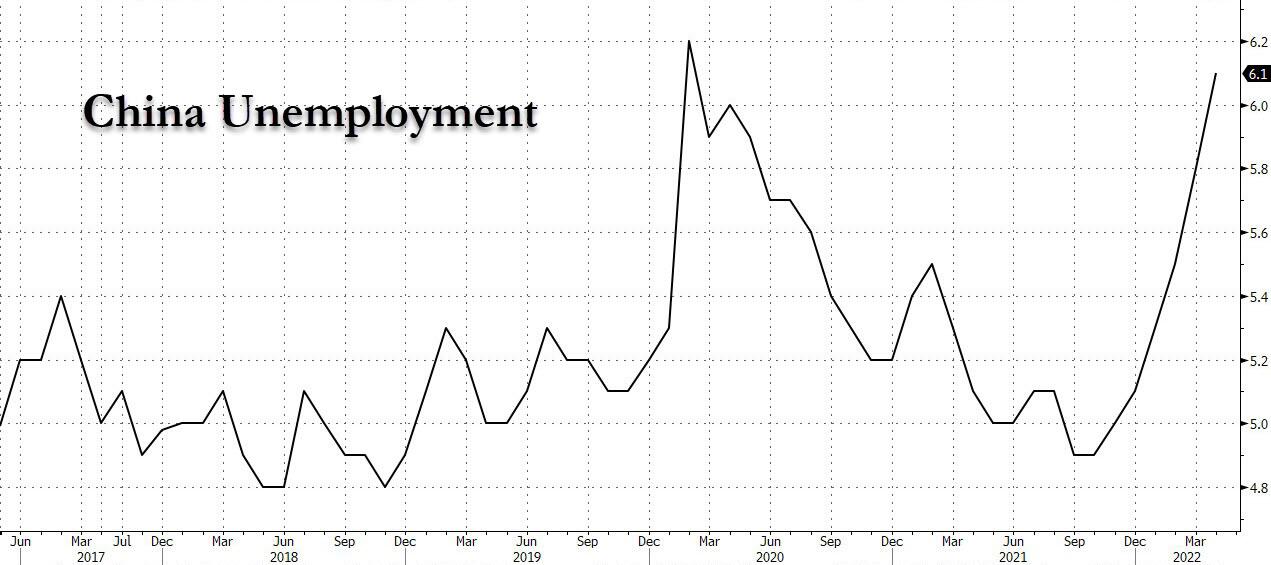
“Economic indicators in China have fallen significantly, and difficulties in some aspects and to a certain extent are greater than when the epidemic hit us severely in 2020,” Li said Wednesday following a meeting with local authorities, state-owned companies and financial firms to discuss how to stabilize the economy, Bloomberg reported.
China’s premier also said the world’s second-largest economy would struggle to record positive growth in the current quarter, urging officials to help companies resume production after Covid-19 lockdowns, according to the FT.
“We will try to make sure the economy grows in the second quarter,” Li said, according to a transcript that the Financial Times verified with three people briefed on the premier’s remarks. “This is not a high target and a far cry from our 5.5 per cent goal. But we have to do so.”
The last time China’s growth entered negative territory was when output plunged 6.9 per cent year on year in the first quarter of 2020 after the coronavirus pandemic ended an era of uninterrupted growth dating back more than 30 years.
The comments by Li Keqiang, to tens of thousands of officials on an internal videocast on Wednesday, underscore the difficulties President Xi Jinping’s administration will have in reaching its annual growth target of 5.5% while also battling Omicron outbreaks.
Concerned that the unemployment rate is approaching levels where the dreaded "social unrest" becomes a possibility, the premier urged officials to make sure the unemployment rate falls and the economy “operates in a reasonable range” in the second quarter of this year, state media cited him as saying. Earlier in May, Li warned of a “complicated and grave” employment situation after the nation’s surveyed jobless rate climbed to 6.1% in April, the highest since February 2020, and sent the yuan plunging to the lowest level since late 2020.
Today's meeting was the latest in a series of urgent calls by Li (who is quitting his job next March) to shore up the economy, which has come under enormous pressure from Covid outbreaks and lockdowns in recent months, threatening the government's growth target of about 5.5%. President Xi's stubborn commitment to Covid Zero means China is guaranteed to miss that goal this year: Economists now forecast gross domestic product growth will hit just 4.5%, according to a new Bloomberg survey, with Goldman predicting GDP will rise just 4.0% as noted above.
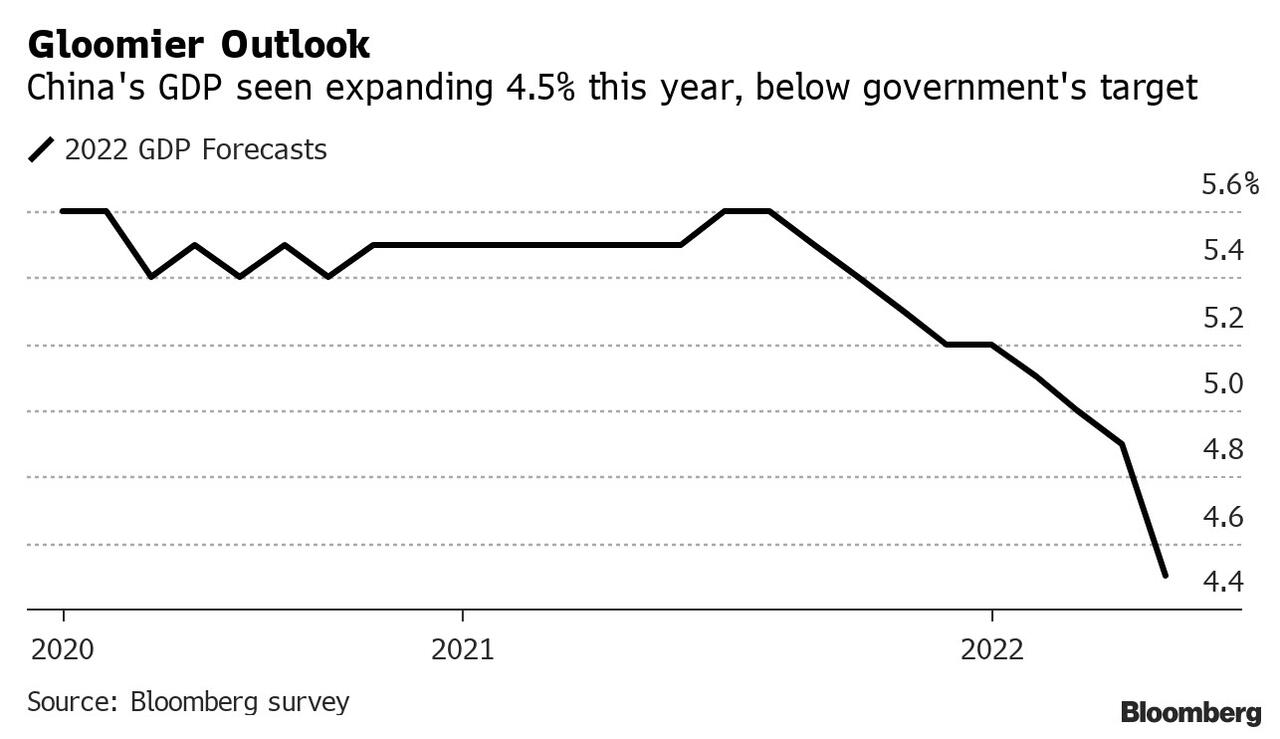
In hopes of offsetting some of the gloom and doom unleashed by Beijing's flawed covid policies, Li indicated that China will try to reduce the impact of its strict Zero-Covid policy on the economy. “At the same time as controlling the epidemic, we must complete the task of economic development,” he said.
Li also stressed implementation of current support policies, and said more detailed implementation measures would be issued by the end of this month. Somewhat bizarrely, he said that economic data for the second quarter would be released “accurately”, hinting that prior Chinese data was - gasp - inaccurate? Perish the thought.
As Bloomberg reported earlier this week, China's State Council outlined 33 support measures on Monday to help businesses struggling to cope with the lockdowns, including extra tax rebates, relief on social insurance payments and loans, and additional funding for aviation and rail construction. Local governments were told to spend most of the proceeds from special bonds -- used mainly for infrastructure -- by the end of August. Judging by the lack of market reaction, investors saw right through this latest mostly verbal attempt to prop up confidence in the country ahead of the 20th Party Congress later this year, where Xi's fate will be determine (amid some rumors that his political career may be cut short if China's economy does not stabilize).
The central bank and banking regulator also held a meeting with major financial institutions on Monday to urge them to boost loans.
Li met with local authorities in April, when Shanghai was in the middle of a lockdown, telling them to “add a sense of urgency” as they rolled out policy. During a trip to Yunnan province last week, he said they should “act decisively” to support growth. Of course, when banks artificially inject loans into an economy where there is no loan demand, what you end up getting is just another bubble.

>>> What to look at today - 25th of May 2022

Stocks in Asia and futures climbed Wednesday and Treasury yields stabilized after a sharp retreat as markets assessed the outlook for Federal Reserve monetary tightening. The dollar gained.  An MSCI Inc. gauge of Asia-Pacific shares rose with most markets modestly in the green. US futures were higher after stocks fell overnight, with the Nasdaq 100 down more than 2% as Snap Inc.’s profit warning pummeled companies that rely on digital advertising.  In China, the country’s strict Covid policy is outweighing broad measures to support growth and keeping investors wary. The nation’s central bank and banking regulator urged lenders to boost loans in the latest effort to shore up the battered economy.  Treasuries steadied after a flight to havens sent yields lower, while traders dialed back the expected pace of Federal Reserve hikes. Money-market traders priced in about 135 basis points of rate increases over the central bank’s next three policy meetings, down from about 141 basis points at Monday’s close. Investors are fretting growth will slow dramatically amid tighter monetary conditions to taper surging inflation, the war in Ukraine and China’s lockdowns that are chocking supply chains. Sales of new US homes fell more than expected in April, and the Richmond Fed’s measure of business activity fell to a two-year low. The Fed minutes from its last meeting out Wednesday may provide some clarity. US After Hours WEN +19.9% jumps as Trian Fund to explore potential transactions; CAL +12.2%, JWN +11.2%, TOL +5%, A +3.4%, INTU +2.8% higher on earnings

Nikkei -0,03% Hang Seng +0,64% CSI +0,17% Shanghai +0,58% Shenzen +0,47%

Eur$ 1,0708 CNH 6,6735 CNY 6,6689 JPY 126,98 GBP 1,2541 CHF 0,9622 RUB 55,3573 TRY 16,1517 WTI$ 111,09 Gold 1862,20 XBT 30,050 +2% ETH 20021,7%

S&P +0,57% Nasdaq +0,87% EuroStoxx +0,99% FTSE +0,90% Dax +0,96% SMI


Macro :
- Hedge Funds Brace for $20 Billion of Redemptions, Citco Says
- Air France-KLM Sees Customers Switching From Private Jets (1)
- Bill Ackman Doubles Down on Call for Aggressive Fed Rate Hikes

Keep an eye on :
- AF FP : Air France-KLM Leads Charge in State Aid Refund Wave: ECM Watch
- AT1 GY : Aroundtown Maintains FY FFO I Forecast
- ASR IM : AS Roma Bid Put on Hold by Consob Amid Request for Information
- BON FP : Bonduelle in Talks to Sell 65% of Americas Long Life Unit
- BOO LN : Boohoo to Settle U.S. Fraud Case Over Deceptive Pricing Claims
- CAI AV : CA Immo 1Q Net Income EU136.9M Vs. EU41.4M Y/y
- CCL LN : Carnival in Talks to Sell Seabourn Brand, CNBC Says
- CNA LN : Centrica Seen Storming Into FTSE 100 With UK in Energy Crisis
- COFB BB : Cofinimmo Offices to Divest 3 Brussels Offices for About EU52M
- GLEN LN : Glencore Pleads Guilty to Decade of Bribery and Manipulation
- HEI GY : Heidelberg's Disruptive Green Targets to Set Prime Margin: React
- HOLN SW : Holcim Takes $5b Currency Hedge For Adani Deal, ET Says
- MAP SM : Mapfre Says Unicaja Ends Alliance; to Get ~EU130m by Stake Sale
- NDX1 GY : Nordex Cuts FY Revenue Forecast
- NRS NO : Norway Royal Salmon Sees FY Harvest 42,600 Metric Tons
- SGO FP : Saint-Gobain in Talks to Buy Fibroplac, Falper in Portugal
- P4F GY : Seadrill Sees 2022 Adjusted Ebitda $240-280m
- STLA IM : Stellantis, Samsung to Build $2.5 Billion Indiana Battery Plant
- TTE FP : TotalEnergies to Buy Stake in US Renewables Firm Clearway Energy
- UBI FP : Electronic Arts Extends Gains, Among Top S&P 500 Performers
- VLA FP : Valneva’s Chikungunya Vaccine Met Phase 3 Primary Endpoint
- VIE FP : Veolia Sells Part of French Industrial Water Treatment to Seche
- YPSN SW : Ypsomed FY Sales CHF464.8M Vs. CHF403.7M Y/y

>>> Europe : Brokers Upgrades & Downgrades - 25th of May 2022

>>> Up
* Credito Emiliano Raised to Hold at Jefferies; PT 5.90 euros
* Hays Raised to Buy at Liberum; PT 155 pence
* Imperial Brands Raised to Buy at Goldman; PT 2,150 pence
* Mondi Raised to Buy at Berenberg; PT 2,000 pence
* Morgan Advanced PT Raised to 490 pence at Peel Hunt
* Next Fifteen Raised to Buy at Peel Hunt
* Residential Secure Income Raised to Buy at Berenberg

>>> Down
* ACS Cut to Neutral at Goldman
* EQT Rated New Overweight at Barclays; PT 315 kronor
* Hikma Cut to Neutral at JPMorgan; PT 1,900 pence
* Philips Cut to Underweight at JPMorgan; PT 21.30 euros
* Scor Cut to Add at AlphaValue/Baader
* Siemens Gamesa Cut to Hold at Deutsche Bank; PT 18.05 euros
* Snap PT Cut to $17 from $40 at Cowen

>>> Initiation
* CTS Eventim Reinstated Underperform at Exane; PT 50 euros
* Partners Group Rated New Equal-Weight at Barclays

>>> Call
* Recruiters Have Structural Opportunity, Hays Upgraded: Liberum
* Vestas Investment Case Keeps Growing Stronger, Redburn Says

WSJ : Starbucks to Sell Juice Brand as Coffee Chain Focuses On Its Stores

Starbucks to Sell Juice Brand as Coffee Chain Focuses On Its Stores
Interim CEO Howard Schultz directs investment to company’s cafes, baristas as Bolthouse agrees to acquire Evolution Fresh line of juices

Starbucks Corp. SBUX -0.95% is selling its cold-pressed juice brand, as the company focuses on its coffee-drink business and improving its stores and relations with its cafe workers under interim Chief Executive Howard Schultz.

Fresh-food maker Bolthouse Farms Inc. said it agreed to acquire Starbucks’s Evolution Fresh line of juices, which currently are sold in Starbucks cafes and supermarkets. Terms of the deal, which Bolthouse said is expected to close later this year, weren’t disclosed. Starbucks said the financial impacts of the deal weren’t expected to be material.

For Starbucks, the deal comes as Mr. Schultz directs more investment toward the coffee giant’s cafes and baristas. Mr. Schultz, the longtime Starbucks leader who returned in April for his third stint leading the chain, said the company needs to better handle increased demand, improve the cafe experience for customers and baristas, and increase communication between workers and executives.

Starbucks said it believes Bolthouse Farms has the beverage-industry experience to help Evolution Fresh grow, and shares Starbucks’s priorities for developing the brand and its employees.

The coffee chain in 2011 paid $30 million to acquire Evolution Fresh, when Mr. Schultz was at Starbucks’s helm for the second time. Mr. Schultz said at the time that the deal would give Starbucks a position in the $1.6 billion premium juice category, and products targeting the health and wellness sector.

Starbucks opened a handful of Evolution Fresh-branded juice bars, but later wound down that effort after Kevin Johnson was named Starbucks’s CEO in 2017. The company continued selling bottles of Evolution Fresh organic, cold-pressed juices in all of Starbucks’s U.S. stores.

Mr. Schultz told Starbucks investors earlier this month that since returning, he has pushed the company to focus squarely on improving its core U.S. business. In April he canceled billions of dollars in previously planned stock buybacks, saying Starbucks needed to invest more in its stores, including $200 million in additional compensation and training for workers.

Starbucks on Monday said it would permanently leave the Russia market, closing 130 stores after the country’s invasion of Ukraine.

The Evolution Fresh deal will add the brand to California-based Bolthouse’s portfolio of juices, which include vegetable, fruit and protein products. Bolthouse’s current brands represented about one-quarter of the U.S. sales of refrigerated beverages as of last month, according to data from market-research firm IRI.

“This is what we do. We grow stuff and turn it into juice,” said Bolthouse CEO Jeff Dunn. “They got a great supplier and we got a great brand.”

Bolthouse said it would keep the juice brand’s nearly 300 employees, who currently are employed directly by Starbucks in California. Over the roughly six-month sales process, Starbucks was focused on how Bolthouse would treat its employees and keep up juice supply to its stores, Mr. Dunn said.

Evolution Fresh, which is sold at Whole Foods Market and some other retailers in addition to Starbucks, had roughly 2% of the U.S. refrigerated-beverage market as of last month, according to IRI figures. Bolthouse intends to increase marketing of Evolution Fresh and get the products onto the shelves of other retailers, said Mr. Dunn, a former executive at Campbell Soup Co. CPB 3.47% and Coca-Cola Co. KO 1.85%

“People have awareness of it, but they don’t see it in a lot of other places other than Starbucks, or maybe Whole Foods,” he said. “We’ll expand the brand and really bring it to a lot more people.”

Bolthouse Farms, backed by private-equity firm Butterfly Equity, bought back its namesake brands from Campbell in 2019. It has looked to acquire other fresh-food brands since, Mr. Dunn said.

WSJ : Wendy’s Largest Shareholder Trian Explores Burger-Chain Deal

Wendy’s Largest Shareholder Trian Explores Burger-Chain Deal
Nelson Peltz’s Trian Fund Management says it seeks a potential transaction; Shares jump in after-hours trading

Trian Fund Management LP, Wendy’s Co. WEN -2.34% ’s largest shareholder, said it is exploring an acquisition or another potential deal for the fast-food restaurant, as it works to improve sales and deals with rising costs.

The activist hedge fund said it advised the fast-food restaurant chain’s board that it intends to explore and evaluate a potential transaction, alone or with third parties, to enhance shareholder value, according to a securities filing late Tuesday. A potential transaction could include an acquisition, merger or other deal that would result in control of Wendy’s, according to the filing.

Wendy’s shares jumped 17% to $19.08 in after-hours trading Tuesday.

Trian owns about 19.4% of the company, and is the company’s largest shareholder, according to the filing. Trian is led by billionaire founders Nelson Peltz, Peter May and Ed Garden. Mr. Peltz is chairman of Wendy’s board and Mr. May is vice chairman.

Wendy’s said its board will carefully review any proposal by Trian.

The company has been fighting to win more consumers by increasing the number of its locations and menu offerings, including through new chicken sandwiches. The chain started a new breakfast business just as the pandemic first hit, and has spent millions of dollars promoting and running it.

Wendy’s shares were down 32% this year, trailing rivals McDonald’s Corp. and Burger King owner Restaurant Brands International Inc.

The company told investors earlier this month that its traffic slowed in the three months ended April 3, and that lower-income consumers accounted for part of the drop-off. Sales among households earning less than $75,000 were weaker, Wendy’s executives said in an earnings call. The chain raised prices in its first quarter and intends to do so again in its current period, executives said.

Wendy’s, like other fast-food chains, is grappling with rising costs. The company has told investors that its commodity costs were increasing faster than expected, driven by higher beef prices. Restaurant-level profits decreased in its first quarter, primarily due to commodity increases, the chain said.

Trian, founded in 2005, first invested in Wendy’s predecessor company that year. Mr. Peltz had served as a director of Triarc Cos., Wendy’s previous business entity, starting in 1993, and has been a Wendy’s director since 2008.

FT : Stellantis and Samsung to build $2.5bn battery factory in Indiana

Stellantis and Samsung to build $2.5bn battery factory in Indiana
Carmaker and tech company team up to accelerate shift to electrical vehicles

Stellantis and Samsung will build a $2.5bn battery plant in Indiana, as the parent group of Chrysler and Fiat accelerates its electric vehicles shift in the US after lagging behind its peers.

The facility is set to open in 2025 and would be Samsung’s first battery manufacturing site in the US. The investment follows recent deals by the company’s South Korean rivals, including LG Energy Solution and SK On, to open US joint ventures with global automakers.

Stellantis, the world’s fourth-largest automaker, which was formed last year through the merger of Fiat Chrysler and France’s PSA Peugeot, wants to sell 5mn EVs annually by 2030. The company hopes fully electric vehicles will represent half of its North American car and light truck sales and to sell only electric passenger cars in Europe by that date.

The new plant was announced after Stellantis and LG Energy Solution announced a $4.1bn joint venture in March to build an EV battery plant in Canada.

“Stellantis has been late in its shift to EVs, compared with GM and Ford, while Samsung has also fallen behind its domestic rivals in the EV battery business expansion. Both of them are now trying to catch up,” said Lee Hang-koo, an adviser at the Korea Automotive Technology Institute.

Carlos Tavares, Stellantis chief executive, warned this month that carmakers would struggle to obtain enough batteries in the next three to four years as they raced to roll out EVs. He also cautioned about the industry’s heavy dependence on Asia for the battery supply chain.

Lee estimated that nearly 2mn EVs were sold globally in the first quarter, accounting for more than 10 per cent of new vehicle sales. “The sharp increase in EV sales is sparking concern that EV material supply could fall short of demand, which could lead to EV battery shortages,” he said.

South Korean battery makers have increased investment in the chemicals and materials used in EV batteries to reduce their dependence on China, the world’s largest processor of most of the minerals needed for battery production.

US states and municipalities have worked hard to lure investment, granting companies considerable financial incentives to develop facilities. Chipmaker Intel has said it will spend more than $20bn on a manufacturing “mega-site” in Ohio.

General Motors announced a plan days later to invest $7bn in its home state of Michigan to convert a factory to EV production and establish a battery plant.

Ford will focus its EV buildout in the southern US, saying late last year that it would spend $11bn on assembly and battery plants in Tennessee and Kentucky. The company wants to produce 600,000 electric vehicles per year by the end of 2023 and decided in March to split its EV division and traditional auto businesses.

Stellanits and Samsung’s facility will initially have an annual production capacity of 23 gigawatt hours, which will be increased to 33GWh. The investment will create 1,400 jobs in Kokomo, home to Stellantis’s engine and transmission plants, and could increase to $3.1bn.

FT : Quant hedge funds reap windfall during 2022 market ructions

Quant hedge funds reap windfall during 2022 market ructions
Computer-driven managers post biggest gains since financial crisis after ‘dead decade’

Hedge funds that use powerful computers to run their portfolios are making huge profits in this year’s market turmoil, marking a resurgence for a sector trying to recover from a long stretch of weak performance.

Trend-following hedge funds, which use mathematical models to try to predict market movements, had struggled for years in an era dominated by central bank bond-buying — a stimulus tool that suppressed much of the volatility on which they thrive. But the $337bn industry is now making its biggest gains since the 2008 financial crisis, according to data provider HFR.

These quantitative funds have profited in particular from bets against government bonds, which have been shaken by expectations that the Federal Reserve will keep raising interest rates aggressively to fight high inflation.

They have also capitalised on a surge in energy and commodity prices, fuelled by supply chain bottlenecks and Russia’s invasion of Ukraine.

“Now is one of those 2008 moments where everyone [in trend-following] is doing well again. The trends are clearer”, said Leda Braga, founder of Systematica Investments and former head of systematic trading at BlueCrest.

“The one underlying theme has been the end of the benign decade we’ve experienced”, added Braga, whose BlueTrend fund is up 26 per cent so far in 2022, its best performance in 14 years. “Now there’s more volatility.”

Among the winners lies BH-DG Systematic, a joint venture between David Gorton and hedge fund Brevan Howard. It has gained 32 per cent so far this year. Aspect Capital, co-founded by Martin Lueck, one of the three original founders of Man Group’s AHL unit, has gained 29.2 per cent in its Diversified fund, its second-best calendar year since launch in 1999.

Such quantitative funds on average gained 15.1 per cent in the first four months of the year, according to HFR data, ranking them as the best-performing category of hedge fund during a period in which many big-name managers posted double digit losses and the S&P 500 dropped 13 per cent. The hedge fund industry overall is down 1.9 per cent for four months to end of April.

These quant funds — also known as managed futures funds — can make money from latching on to persistent price trends in both rising and falling markets, which has often allowed them to profit during periods of market stress. In 2008, for instance, they profited from both a steep rise and then a subsequent collapse in oil prices, and from a rapid sell-off in equities as the financial crisis reached its nadir.

This year’s sharp upturn in performance comes after years of often-lacklustre returns, with trend followers losing money in the six of the eight calendar years between 2011 and 2018, according to HFR. The period after 2010 “was a dead decade” for trend-followers, said one senior industry executive.

The wait for a comeback proved too long for some funds. Billionaire David Harding, another former co-founder of AHL who set up quant firm Winton in the 1990s, caused controversy in the sector several years ago when he moved his main fund away from trend-following, arguing that the strategy did not make enough to justify running a big hedge fund.

“It was impossible to raise money then” after Harding’s move, said one fund manager who continued to back trend-following. GSA Capital last year shut its Trend fund after finding that meeting the fund’s investors had become a distraction for its researchers.

However, a steep acceleration in US inflation last year, initially underestimated by central bankers, has catalysed interest rates rises and the withdrawal of quantitative easing. That has removed a support for asset prices in traditional markets, sending bonds and equities tumbling.

“Central banks have to focus on fighting inflation despite the cost to asset prices,” said Philippe Jordan, president of Paris-based quant hedge fund firm CFM, whose IST trend fund is up 16.5 per cent this year. “This is a positive backdrop for trend because it creates momentum”.

The 10-year US Treasury yield has risen from 1.51 per cent to a peak of 3.2 per cent this year, while the Bund yield, which turned negative in 2019, has jumped from minus 0.18 per cent to as high as 1.19 per cent. Yields move in the opposite direction of prices.

“If you look at the German 10-year, there’s been a staggering move for something that’s been doing absolutely nothing for a long time,” said Kenneth Tropin, chair of Connecticut-based Graham Capital, whose K415 fund is up 41.7 per cent this year, while the Tactical Trend fund has gained 33.4 per cent.

“Given what’s happened in rates, commodities and currencies, managed futures funds are like pigs in mud,” said Andrew Beer, managing member at US investment firm Dynamic Beta Investments, whose DBMF fund is up 22.4 per cent this year.

After a relatively lean period for the sector, managers now think the change in market regime means trends could last for some time.

“The change in inflationary expectations feels like a large barge and is going to take time to turn around,” said Systematica’s Braga, pointing to decarbonisation and changes in supply chains as inflationary forces. “It seems to be a longer cycle ahead and I suspect trends will persist for a while.”

FT : We’re asking the wrong questions about stablecoins

We’re asking the wrong questions about stablecoins
Real issue is whether these crypto assets should be allowed to exist at all

In the wake of the collapse of one of the world’s biggest so-called stablecoins, people are asking the wrong questions.

Stablecoins are touted as the safer part of the crypto market, designed to hold a constant value per coin of $1. But it did not work out that way for the recently stricken terraUSD.

Its dramatic failure has raised questions about which kinds of stablecoins are the most stable, and about what guardrails are needed to protect users. These are not the questions we should be asking, though. The real question is: “Should stablecoins even exist?” 

Yes, terraUSD had a more fragile structure than some other stablecoins. It was a so-called “algorithmic” stablecoin that sought to maintain a $1 value through a complex relationship with a paired cryptocurrency, luna. Last week, terraUSD plunged in value to under 10 cents as demand for both nosedived.

However, terraUSD’s idiosyncrasies do not mean that other forms of stablecoins are actually stable, nor that there is a place for stablecoins in our financial system.

We often hear that stablecoins are the future of payments, but they aren’t really used to pay for real-world goods and services. We are told by supporters that “it’s early days”, but what could stablecoins ever do that non-blockchain-based payments solutions couldn’t do better?

Blockchain technology needs to involve wasteful computations in order to discourage attacks, so it does not scale well. In addition, blockchains can have data added but not deleted from them, which prevents the reversal of mistaken or fraudulent transactions. It’s hard to see how blockchain payments could ever be faster or more efficient than more centralised alternatives.

Crypto lobbyists may say that these technological limitations are worth it because they get rid of centralised intermediaries. In reality, though, crypto is rife with intermediaries. The biggest stablecoins, tether and USDC, are both issued by centralised intermediaries. TerraUSD claimed to be decentralised, but when things started to unravel, holders looked to the Twitter feed of co-founder Do Kwon — who was clearly calling the shots.

And let’s not forget that to buy stablecoins or convert them back into fiat currency, most users will rely on an exchange, such as the Bitfinex and Coinbase exchanges that are affiliated with tether and USDC, respectively. (The biggest stablecoins are affiliated with the biggest exchanges, which profit from the associated transaction fees).

In sum, stablecoins start with a convoluted and inefficient base technology in order to avoid intermediaries, and then add intermediaries (often with apparent conflicts of interest) back in.

And then there are the negative impacts on those of us who don’t even use stablecoins: the environmental costs of blockchain transactions; ransomware attacks; and the risk of future financial instability caused by stablecoin runs if the sector continues to grow.

Given these fundamental flaws, asking “what guardrails should we put around stablecoins?” is the wrong question. As we’ve learned from experience with bank deposits and money market mutual funds, the only truly effective way to prevent runs and make stablecoins stable is to put a government guarantee behind them. It seems like a truly terrible idea to guarantee something that has no real use case other than facilitating crypto speculation.

One option that should be on the table is banning stablecoins. This is something we already do with other dangerous products, but hasn’t really been part of this debate so far. Maybe that’s because people believe the decentralisation hype, and think that there’s no way to do it. But given how intermediated stablecoins actually are, there are many points through which a ban could be enforced.

Centralised intermediaries could be banned from issuing stablecoins, and centralised exchanges could be banned from trading them. As for the more decentralised stablecoins and exchanges out there, these are typically operated by “decentralised autonomous organisations” or “DAOs” that act based on votes cast by those who hold governance tokens in them.

Authorities could prohibit anyone from holding governance tokens in any DAO that issues or provides services in connection with a stablecoin. Right now, these governance tokens tend to be concentrated in the hands of founders and venture capital firms. Without VC funding, there’s a good chance that stablecoins would disappear — and that we’d all be a lot better off.