(ZH) China Quietly Boost Oil Imports In Preparation For Reopening

China Quietly Boost Oil Imports In Preparation For Reopening

Alongside the neverending charade over when/if the Fed will pivot (it will, it just needs to really break the market and the economy first, at which point it will be too late to do anything), a similarly heated - and some would say even more important - discussion surrounds China's decision to drop its doomed covid zero policy. Here, there has certainly been movement in recent days, with Chinese stocks soaring over the past week amid rampant speculation that Beijing is contemplating easing or rolling back its draconian covid zero restrictions.
And even though both the local government and skeptical China watchers have repeatedly tried to shoot down any unfounded rumors (based on spurious screengrabs) that China is set to ease its anti-covid measures, a new report from Goldman's commodity team published late on Monday (and available to pro subscribers), concludes that China has quietly if aggressively ramped up crude imports by more than 2.5m b/d in recent weeks in preparation for an eventual reopening, whose timing Goldman still views as most likely to take place some time in 2Q 2023.
Here are some more details from the Goldman report tiled appropriately enough "China signals the beginning of the end for lockdowns":
  • The oil market remains depleted of its main buffers: inventories and spare capacity. Concurrently, the risk of meaningful supply disruptions in Libya, Russia, Iraq, and Iran is currently elevated. As such, the risk distributions around our current oil forecasts are skewed squarely higher given spot demand continues to realize robustly.
  • Nevertheless, positioning in oil and broader commodities are barely above their 2Q20 lows, in part due to concerns on China oil demand - the final significant fundamental downside risk. We believe current lockdowns are subtracting as much as 0.9 mb/d from our Jan-22 expectations.
  • Our China economists believe recent headlines simply mark the start of an multi-month preparation period for reopening, and so have maintained their current base case of 2Q23 reopening, once the winter flu season has passed.
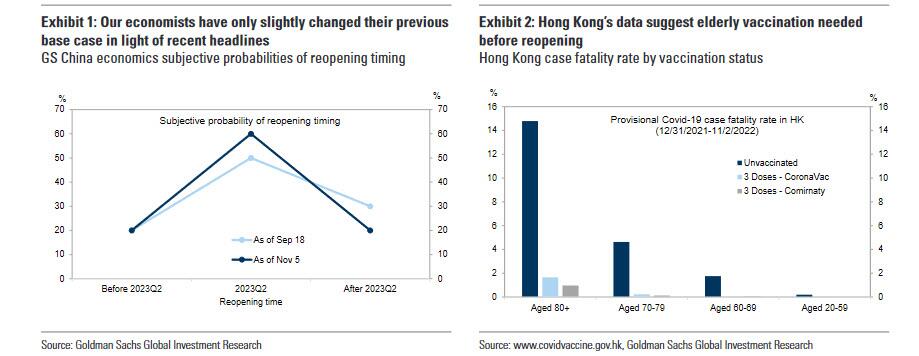
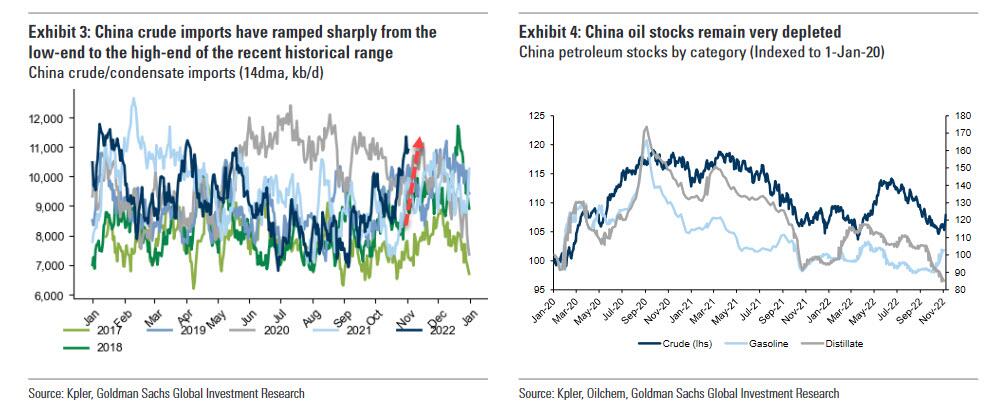
  • Nevertheless, any news around China reopening can drive rallies in oil, even if only muting uncertainty. To this end, China has already ramped up crude oil imports by more than 2.5 mb/d in recent weeks, in preparation for this event, as well as to replenish depleted inventory.
Goldman also conducts an "Effective Lockdown Index"-based exercise for contextualizing what a more rapid reopening may mean for demand and prices.
Not surprisingly, it finds that each 5% increase in the China ELI is worth c.0.2 mb/d of oil demand...
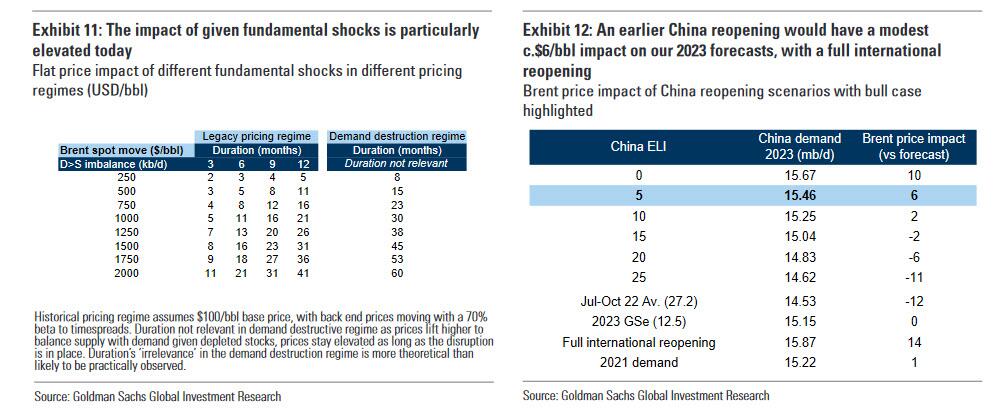
... and that a bull-case early reopening would pose $6/bbl upside risk to the bank's current $110 Brent 2023 forecasts, while a less-likely full international reopening would amount to almost $15/bbl.
On the other hand, maintenance of the current status quo for restrictions would instead amount to c.$12/bbl of downside to next year’s forecasts. Consistent with this, the bank also finds the oil market-implied increase in the probability of reopening next year increased by 25% last week.
Lastly, an additional macro risk to commodity prices this year has been the dollar, which has endured one of the sharpest appreciations in history.
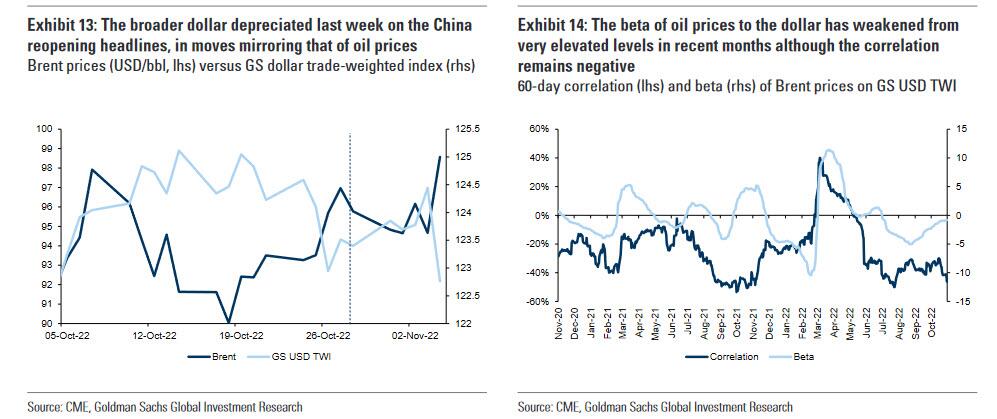
Goldman expects the USD TWI to depreciate by up to 3% as China reopens, as Asian economies benefit, and broader markets trade more ‘risk-on’. This could support oil prices an additional $3/bbl.
WSJ : Tensions Between Crypto Giants FTX, Binance Spill Into Public View

Tensions Between Crypto Giants FTX, Binance Spill Into Public View
Spat between Sam Bankman-Fried of FTX and Changpeng Zhao of Binance erupts on Twitter

Tensions between two of the richest men in cryptocurrencies erupted into open warfare on Twitter over the weekend, transfixing much of the digital-currency world.

On one side is Sam Bankman-Fried, the founder of crypto trading firm Alameda Research and FTX, a crypto exchange that has been growing in size and recognition the past two years. On the other side is Changpeng Zhao, the founder of Binance, the largest crypto exchange by volume.

The two digital asset entrepreneurs, known by their initials SBF and CZ, are both celebrities in the crypto industry, amassing hundreds of thousands of followers on Twitter.

In the past, their relationship has remained largely civil, at least in public. That changed Sunday after Binance said it was poised to sell a chunk of FTX’s own cryptocurrency and the CEOs exchanged pointed barbs on social media.

The catalyst: A CoinDesk report from last week that indicated that much of Alameda’s balance sheet was made up of FTX’s token, known as FTT. FTT is a relatively illiquid token with a market capitalization of about $3 billion as of Monday, according to crypto data provider CoinGecko. Investors are concerned that any large selling orders of FTT could cause the token’s price to plummet, potentially harming the financial health of FTX as well.

Mr. Zhao said via Twitter that his exchange would liquidate its FTT holdings for “risk management” purposes. Binance is a former equity investor in FTX and received roughly $2.1 billion worth of FTT and stablecoins when it exited that position last year, Mr. Zhao said. Binance had about $580 million worth of FTT tokens on its books as of Sunday, he said.

“We gave support before, but we won’t pretend to make love after divorce. We are not against anyone. But we won’t support people who lobby against other industry players behind their backs,” Mr. Zhao tweeted Sunday.

Mr. Bankman-Fried shot back Monday, saying Binance was trying to go after its rival “with false rumors.”

The 30-year-old billionaire was hailed as a savior of the crypto industry this summer after he stepped in to buy large stakes in troubled crypto lenders BlockFi and Voyager Digital at a discount during the recent months of market carnage.

He has also welcomed greater regulation of crypto, traveled repeatedly to Washington to meet officials and donated more than $39 million to federal campaigns in the current election cycle, according to OpenSecrets.org.

Meanwhile, Binance has been the subject of U.S. regulatory inquiries, including by the Securities and Exchange Commission and the Justice Department, The Wall Street Journal has previously reported. It was hit with a series of warnings from governments around the world last year over offering unregistered crypto products, prompting the firm to expand its compliance team.

Some of Mr. Bankman-Fried’s past remarks about Binance have irritated Mr. Zhao, a person close to Binance said. In a July 2021 interview with a crypto publication, Mr. Bankman-Fried responded to a question about Binance’s regulatory difficulties by stressing FTX’s cooperation with regulators and saying: “When you don’t do that, and when you sort of appear less flexible or responsive, I think that’s more likely to lead to cases where regulators might feel like they have no choice but to start bringing the hammer.”

In October, Mr. Bankman-Fried posted a tweet questioning whether Mr. Zhao was allowed to go to Washington, D.C. Mr. Bankman-Fried deleted that tweet Monday.

Binance has previously declined to comment on the regulatory probes but has said that it works with regulators around the globe and takes compliance seriously.

FTX experienced an increase in withdrawals after Binance announced the plan Sunday to offload its FTT holdings. Mr. Bankman-Fried said on Twitter his crypto exchange had processed billions of dollars of transactions. FTX’s Twitter account said it was “churning through” bitcoin withdrawals. The exchange has also had more than $450 million in stablecoin outflows over the past seven days, according to crypto research firm Nansen.

On the surface, the spat had little effect on the value of FTX’s token, which traded near $22 apiece on Monday. It’s possible that Alameda, as one of the largest market makers for FTT, helped support the price, said Clara Medalie, the head of research at crypto data provider Kaiko.

Financial documents released last year show that Binance Capital Management Ltd. held a 19.7% stake in FTX’s parent company, FTX Trading Ltd. The documents were released as part of a review of FTX’s plan to acquire the naming rights to the arena where the NBA’s Miami Heat play.

Later in 2021, Binance divested its equity stake in FTX after Mr. Bankman-Fried’s company opened itself up to venture-capital investors such as Sequoia Capital and SoftBank Group Corp. Binance took part of the proceeds of the sale in the form of FTT tokens, a cryptocurrency issued by FTX that is designed to give its investors a stocklike stake in the exchange.

FTX periodically supports the price of FTT by spending a portion of its trading-fee revenue to repurchase and “burn”—or permanently destroy—FTT tokens.

“They’re probably doing cost-benefit analysis right now as to what issues that may cause [if the token falls] and what level they should maintain,” said Ms. Medalie.

But it caused ripples under the market’s surface. The dollar amount dedicated to perpetual futures tied to FTT, called open interest, rose to about $226 million, more than double its level Sunday, according to data provider Coinglass. A sharp rise in open interest likely means that the cost of holding a short position has risen, though that data typically lags, Ms. Medalie said. Both could be a sign that investors are ramping up bets against the token.

On Twitter, Mr. Zhao seemed to compare potential risks associated with Alameda and FTX to that of the collapsed cryptocurrency Luna earlier this year. The coin’s plummet not only burned individual investors but blew holes in the balance sheet of Three Arrows Capital and other crypto companies.

WSJ : Last Total Lunar Eclipse ‘Blood Moon’ of 2022: When and How to Watch

Last Total Lunar Eclipse ‘Blood Moon’ of 2022: When and How to Watch
The moon, sun and Earth will align for a short time on Tuesday, Election Day; those events won’t coincide again until 2394

For the first time, a total lunar eclipse will be visible in the U.S. on Election Day.

In the early hours of Nov. 8, poll workers making their way to sites across the East Coast for the midterm elections and others in the U.S. will be able to watch the total lunar eclipse—what some call a blood moon because of its reddish color.

It is the first time the two events have coincided, according to calculations by the science blog EarthSky.org, which first reported the historic occurrence. A total lunar eclipse won’t fall on Election Day again until Nov. 8, 2394, which is in 372 years.

EarthSky determined that date by comparing Election Day rules with data on future eclipses compiled by a retired astrophysicist from the National Aeronautics and Space Administration’s Goddard Space Flight Center. General federal elections in the U.S. take place on even-numbered years. The government has designated the Tuesday after the first Monday in November as Election Day, which can fall on Nov. 2- 8.

A personal, guided tour to the best scoops and stories every day in The Wall Street Journal.

In a total lunar eclipse, the entire moon passes through the Earth’s shadow. When the moon is in the Earth’s shadow, it appears to turn a reddish hue. During a partial eclipse, the Earth’s shadow only covers a portion of the moon, while a penumbral eclipse sees the moon orbit through the outer part of the Earth’s shadow.

On Tuesday, a partial eclipse will begin at 4:09 a.m. ET, moving into totality at 5:17 a.m. ET, NASA said. Totality will last nearly 1.5 hours. The eclipse will be interrupted by sunrise for some, but the event will be visible from start to finish on the West Coast and in Alaska and Hawaii.

“As long as you’re on the night side of the Earth when it’s happening, you will be able to see it—assuming you don’t have any clouds where you are,” said Shannon Schmoll, director of the Abrams Planetarium at Michigan State University.

People in North and Central America and in Ecuador, Colombia and western portions of Venezuela and Peru will all be able to see the latest total eclipse. A partial eclipse will be visible in Asia, Australia, and New Zealand.

Unlike solar eclipses, which can cause damage if viewed with the naked eye, no special devices are needed to observe a lunar eclipse safely. But binoculars and telescopes can reveal extra levels of detail in the moon and can give viewers a more vivid look at its reddish hue. Solar eclipses should only be viewed using eclipse glasses or other indirect methods.

For those living in cities, Dr. Schmoll said that light pollution shouldn’t be much of a factor. “The moon is so bright that you don’t really need to get away. It’ll be a gorgeous sky if you can, but you don’ t need to get away from the light pollution to see the lunar eclipse well. You just need a clear sky,” Dr. Schmoll said.

The lunar eclipse will be streamed on multiple websites. Dr. Schmoll said TimeandDate.com provides users with the exact times the segments of the eclipse will occur in any location.

While the next Election Day total lunar eclipse won’t happen for hundreds of years, sky gazers won’t have to wait as long for another blood moon. The next total lunar eclipse, which will be visible in much of North and South America, is projected to occur on March 14, 2025, according to NASA.

FT : Lars Windhorst’s bank reported to regulator by Hertha Berlin

Lars Windhorst’s bank reported to regulator by Hertha Berlin
Vienna-based Euram Bank confirmed payments to football club that took weeks to arrive

A Vienna-based private bank that provided confirmations of wire transfers supposedly made by German financier Lars Windhorst was reported to Austria’s financial regulator after the money failed to turn up on time.

In July 2020, Windhorst agreed to pay €150mn to raise his stake in football club Hertha Berlin from 49.9 per cent to 66.6 per cent.

A senior banker at European American Investment Bank repeatedly told the Bundesliga club in October and November 2020 that an expected payment of €25mn from Windhorst’s personal account was imminent, people familiar with the matter told the FT. However, despite the bank’s repeated assurances, only €5mn was paid at the end of October; the remaining €20mn was transferred in mid-December.

In late October 2020, the Euram banker informed the club that the payment “has now been entered into our systems after a delay” and would “certainly” arrive in Hertha’s account in the following week, according to people familiar with the matter. When this did not happen, the banker informed the club in early November that the payment had now been “irrevocably accepted” by the bank. One week later, the banker then blamed IT issues at its correspondent bank but stressed that he was able to “execute the transfer immediately” and offered to send a “money confirmation via screenshot”.

Hertha was so incensed at the communications around the delays that it raised a complaint with Euram’s top management and reported the conduct to Austria’s FMA financial regulator. The club argued that the behaviour raised “serious questions” about “proper business conduct”.

The flamboyant 45-year-old Windhorst made his name in the mid-1990s as a teenage entrepreneur and was hailed as a wunderkind by then German chancellor Helmut Kohl. By the time he was 34, he had weathered the collapse of two companies, personal bankruptcy and a suspended jail sentence for “breach of trust”. In 2017, Deloitte resigned as the auditor of Windhorst’s now-defunct investment vehicle Sapinda Invest after saying it received letters that contained “deliberately false” information about a fund’s financial position from a custodian bank. The custodian back then denied the allegations.

Windhorst, who also owns a German shipyard, an Italian lingerie brand and a shopping centre in Hannover, paid €374mn for a majority stake in Hertha between 2019 and 2021. After falling out with the football club, he now wants to sell.

A lawyer for Euram told the Financial Times that Hertha’s complaint to the banking regulator was “completely without merit” and said that the club “even apologised to our client Euram Bank” in writing for the “potential irritation”. In the letter, seen by the FT, Hertha in January 2021 told Euram it regretted any “potential irritation”.

Windhorst last month announced that he wants to terminate his involvement with Hertha, following revelations that he allegedly hired corporate spies who set up an undercover operation to force out the club’s president.

Founded in 1999, Euram Bank says it offers private and investment banking services for Austrian and international individuals, companies and institutional investors.

Hertha and the FMA declined to comment. Windhorst declined to comment.

FT : Big hedge funds shop for bargains in corporate debt markets

Big hedge funds shop for bargains in corporate debt markets
Some managers say bond prices have fallen too far relative to the risk of default

Big-name hedge funds are snapping up bargains in junk bonds and other corners of the corporate debt market, as they bet a sell-off sparked by the darkening global economic outlook has gone too far.

Corporate debt has been hard hit this year by fears that steep increases in borrowing costs will lead to a wave of defaults at groups that have grown accustomed to years of easy money. Interest rates for risky borrowers have soared.

But several managers, including Third Point’s Daniel Loeb, Elliott Management’s Paul Singer and CQS’s Sir Michael Hintze, say parts of the credit market have fallen too far relative to the risks of default, and some are starting to build up their holdings.

“We find the current opportunity set in high-yield credit attractive,” wrote billionaire trader Loeb in a recent letter to investors, referring to companies with lower credit ratings. He has raised his bets on corporate debt and plans to increase exposure as volatility accelerates, even though he does “not anticipate a quick rebound”.

Loeb added: “We are seeing some of the most lucrative investing opportunities in structured credit since the Covid-19 crisis.”

Elliott, which recently warned that the world could be heading for its worst financial crisis since the second world war, told investors that previously absent opportunities in corporate debt and distressed investing are rapidly increasing, according to investor documents seen by the Financial Times.


And Hintze, one of the most experienced names in hedge fund credit trading, said he had used recent falls in debt prices to buy credit positions and to cut his fund’s hedges against falling prices in the sector.

After large price falls across major asset classes, “we especially favour the opportunities in credit and structured credit markets”, he wrote in a letter seen by the FT.

Yields on junk debt, which rise as prices fall, have soared from 2.8 per cent at the start of 2022 to 7.8 per cent, according to the Ice Data Services euro high yield index.

Naruhisa Nakagawa, founder of hedge fund Caygan Capital, which is betting on rising corporate bond prices, said the recent widening of spreads, a measure of the perceived risk of holding corporate debt versus ultra low risk government bonds, “was hardly justified by the fundamentals, so I think there was some kind of forced selling”.

In Europe, high-yield funds have suffered €12.7bn of net outflows this year to late October, equal to more than 15 per cent of their assets, according to JPMorgan data, while investment-grade funds lost €25.2bn in outflows.

Many of the redemptions have come in passive ETFs, which track broad indices of bonds and which have therefore had to sell a wide array of credits when investors sell out.

Assets in the iShares iBoxx $ High Yield Corporate Bond ETF, for instance, have dropped by more than $10bn since the end of 2020, mostly as a result of outflows.

Overall, US high-yield ETFs suffered $17.1bn of net outflows in the first nine months of this year, according to data group ETFGI.

“Redemptions are leading to forced selling, which is leading to price declines. It’s self-fulfilling,” said the head of one European hedge fund that has been picking up bonds recently. “It’s already attractive and it’s probably going to get even more attractive.”

Lee Robinson’s Altana Wealth wrote to investors in recent days to declare that “bonds are back”. He highlighted a number of “very attractive” opportunities including Carnival Corp and Jaguar Land Rover.

A BNP Paribas survey of investors, managing more than $380bn in total hedge fund assets, found that they planned to increase allocations to credit funds in all regions, with US funds being the most popular.

Some industry insiders also argue that while defaults, which are close to historical lows, are expected to rise, they are unlikely to reach levels seen in some previous crises.

In European high-yield, rating agency S&P expects defaults to rise from current levels of 1.4 per cent to 3 per cent by mid next year, or 5 per cent in a more pessimistic scenario, compared with the 9 per cent reached in 2008. Fitch expects 2.5 per cent next year.

And in the US, Fitch thinks defaults will reach 2.5 to 3.5 per cent by the end of next year and 3 to 4 per cent in 2024. This compares with a 21-year historical average of 3.8 per cent and 5.2 per cent during 2020s coronavirus pandemic. S&P expects 3.5 per cent mid next year.

“Markets are pricing in a 40 per cent default rate in European high yield over the next five years. It’s all in the price,” said Tatjana Greil-Castro, co-head of public markets at Muzinich & Co.

Third Point’s Loeb wrote that, even if credit spreads rose above levels seen in 2011 or 2015, investors buying the index would still make money over a year because of the yields on offer and the effect of bond prices moving back towards par.

“We do expect an increase in defaults as the economy slows but not one that would justify those spreads,” he said.

>>> US After Hours Summary: NSTG -18.7%, TTWO -16.3%, TRIP -16%, LYFT -14%, VECO -13.1%, FIVN -12.8%, UIS -8.5% lower on earnings; SEDG +9.8%, SANM +8.3%, QGEN +5.9% higher on earnings


After Hours Summary: NSTG -18.7%, TTWO -16.3%, TRIP -16%, LYFT -14%, VECO -13.1%, FIVN -12.8%, UIS -8.5% lower on earnings; SEDG +9.8%, SANM +8.3%, QGEN +5.9% higher on earnings

After Hours Gainers:

Companies trading higher in after hours in reaction to earnings/guidance: ROVR +14.1%, HIMS +12.5%, EHTH +11.3%, SEDG +9.8%, SANM +8.3%, LPSN +7.2%, TASK +6.1%, QGEN +5.9%, AMWL +5.8%, YMAB +4.5%, OSH +3.9%, PTVE +3.3%, ME +3.1%, XNCR +2.7%, PRIM +1.7%, DHT +1.6%, FN +1.6%, ADTN +1.3%, BNFT +1.1%, MOS +0.7%, TWOU +0.6%, ATVI +0.3%, GRPN +0.3%, PWSC +0.3%, ASH +0.2%, BWXT +0.2%, NFE +0.2%, FSK +0.2%, AEL +0.1%, CBT +0.1%, TDC +0.1%, WELL +0.1% (also to effectuate the sale and transition of 147 skilled nursing facilities currently operated by ProMedica)

Companies trading higher in after hours in reaction to news: NYT +3.3% (ValueAct Capital Master Fund increases its stake in NYT to 7.8%), XNCR +2.7% (topline clinical data from Phase 1a study of XmAb564), ARWR +2% (presents new phase 2 data on cardiometabolic pipeline), BRBS +0.9% (files $100 mln mixed securities shelf offering), ZM +0.9% (AMC and ZM partner to bring Zoom Rooms to AMC Movie Theatres in 2023), AMC +0.5% (AMC and ZM partner to bring Zoom Rooms to AMC Movie Theatres in 2023), ENVA +0.1% (authorizes new $150 mln share repurchase program)

After Hours Losers:

Companies trading lower in after hours in reaction to earnings/guidance: NSTG -18.7%, TTWO -16.3%, TRIP -16%, LYFT -14%, VECO -13.1%, FIVN -12.8%, UIS -8.5% (also to delay 10-Q filing), PACB -7.2%, FLGT -7.1%, QTWO -5.7%, MWA -4.7%, MTW -4.4%, SWAV -3.8%, CERT -2.6%, IFF -2.3%, DOCN -2.2%, VNOM -2%, FANG -0.2%

Companies trading lower in after hours in reaction to news: ATHX -44.2% (commences common stock offering), MRNS -15.2% (commences common stock offering), ROIV -7.6% (commences $150 mln stock offering), MDT -5.5% (SPYRAL HTN-ON MED study demonstrates meaningful clinical benefits), ABC -4.3% (ABC announces secondary offering of 10 mln shares held by WBA), VZLA -3.4% (bought deal financing of 13.8 mln shares at $1.45 per unit), ARCC -3.2% (commences 8 mln share offering), BRMK -2.9% (CEO resigns; names new CFO), ENSG -2.9% (ENSG to acquire 20 skilled nursing operations from SBRA), BMRN -2.1% (progress update on its BLA for valoctocogene roxaparvovec AAV gene therapy), NVS -2% (new long-term Leqvio data show sustained efficacy and safety), SBRA -1.7% (ENSG to acquire 20 skilled nursing operations from SBRA), SWX -1.6% (names new CFO), DCO -0.3% (files $300 mln mixed securities shelf offering), AMGN -0.2% (presents new analysis from Phase 3 FOURIER and FOURIER studies of Repatha), CNX -0.1% (partners with New Frontier to leverage abated methane emissions), WBA -0.1% (ABC announces secondary offering of 10 mln shares held by WBA)

FT : Tiger Global losses mount after whipsawing tech valuations

Tiger Global losses mount after whipsawing tech valuations
Flagship fund is down 54.7% so far this year while ‘crossover’ vehicle has fallen 44%

Losses at Tiger Global Management continued to mount in October after the New York-based hedge fund was buffeted by the whipsawing value of technology stocks in the US and a sell-off in China.

The firm’s flagship hedge fund lost 5.4 per cent in October, taking losses so far this year to a new low of 54.7 per cent, according to a person with knowledge of the figures.

A “crossover” fund that mixes publicly traded technology holdings without any hedges and Tiger’s private equity investments fell 4 per cent in October, putting year-to-date losses at 44 per cent, another fresh low, according to a document seen by the Financial Times.

At the mid-year point, Tiger’s flagship fund had fallen about 50 per cent, while the crossover fund had fallen by nearly 36 per cent, according to documents.

The technology-heavy Nasdaq Composite gained 4 per cent last month. Tiger declined to comment.

The new losses underscore continued pressure on Tiger’s sprawling portfolio of public and privately held technology companies as founder Chase Coleman and top executive Scott Shleifer work to better manage the firm’s risks and adapt to volatile markets.

Tiger has halted new investment in China as it awaits further clarity on how President Xi Jinping will manage the world’s second-largest economy, according to a person familiar with the situation.

Tiger had been reducing its exposure to the country ahead of the Chinese Communist party meeting in October, in which Xi secured a new five-year term and consolidated power, the person added.

The Wall Street Journal reported earlier this month on the halt in new Chinese equity investments.

Tiger Global managed about $17bn of hedge fund assets at the mid-year point in addition to over $40bn of private equity investments in groups such as TikTok parent company ByteDance, financial technology group Stripe and software provider Databricks.

The hedge fund’s public holdings have plunged in value this year amid a sharp reset in public technology stock valuations. The firm’s private equity holdings have also been marked down every month this year.

In its mid-year letter to investors, Tiger blamed its losses on the negative impact of high inflation and rising interest rates on technology stocks. It also said hedges on its public stock portfolio did not fully protect the fund against rising market volatility.

China, a source of some of Tiger’s biggest investment coups such as its investments in JD.com, has now become one of its foremost problems.

Schleifer, head of the Tiger’s private equity business, helped lead an investment in the ecommerce company when it was a small private start-up, leading to one of the group’s most profitable investments.

However, Tiger has been stung by a sharp sell off in Chinese stocks. JD.com, Tiger’s largest public holding as of mid-year, has fallen 35 per cent this year.

The Financial Times previously reported that the New York-based hedge fund had boosted exposure to some Chinese investments in its portfolio this year. It added jobs website Kanzhun and electric carmaker Li Auto to the 10 biggest holdings in its public equities portfolio at mid-year.

Stocks in both companies slid sharply in October before rebounding this month.

FT : Ukraine seizes control of five ‘strategic’ companies from oligarchs

Ukraine seizes control of five ‘strategic’ companies from oligarchs
Assets taken over by state as part of ‘wartime effort’ include oil producer Ukrnafta

Ukraine’s president Volodymyr Zelenskyy on Monday said Kyiv had transferred five strategic enterprises to state control from previous oligarch ownership as part of the country’s wartime effort.

The Ukrainian government seized ownership of top national oil producer Ukrnafta and Ukrntatnafta, the country’s largest refinery that halted operations after being hit by Russian missile strikes in the first months of Moscow’s full-scale invasion Ukraine.

Both companies were controlled by Igor Kolomoisky, an oligarch who backed Zelenskyy’s presidential bid in 2019 and who is now facing probes into the insolvency of PrivatBank, another of his previous businesses.

Kyiv also took over manufacturer MotorSich, an aeroplane turbine and helicopter engine maker based in Zaporizhzhia, a city close to the front lines in the south.

“Such steps, which are necessary for our country in condition of war . . . will help to provide the urgent needs of our defence sector,” Zelenskyy said in a Telegram channel statement. “In these difficult times, we must direct all our forces to liberate our land and people and support the Ukrainian army.”

The state seizures — which other officials described as temporary — come after weeks-long Russian missile and kamikaze drone strikes on electricity infrastructure across Ukraine have triggered hours-long daily power blackouts and electricity rationing across the country.

They also come a year after the president pushed through parliament so-called “de-oligarchisation” reforms aimed to curb the influence of the nation’s wealthiest businessmen.

Kolomoisky is facing domestic and international investigations for the insolvency of PrivatBank. The commercial lender was nationalised in 2016 after authorities uncovered losses of more than $5bn unaccounted for in its balance sheet.

Vyacheslav Boguslaev, MotorSich’s former owner and president, was arrested last month on treason charges. Local prosecutors allege he funnelled through sanctioned export operations helicopter engines that Moscow needed.

Boguslaev sold his controlling stake in MotorSich to Chinese company Skyrizon many years ago, but Ukrainian trust and security authorities blocked the move by freezing the shares. Both Kolomoisky and Boguslaev have denied wrongdoing.

AvtoKraz, a truck manufacturer which produces vehicles for domestic military transport as well as rocket systems, was also among the groups taken under state control. It was previously owned by Ukrainian oligarch Kostyantyn Zhevago, who has lived in exile in the past years as Ukrainian authorities pursued cases against him related to the insolvency of a bank he previously owned.

Zaporizhtransformator, an electricity grid parts producer located in Zaporizhzhia, was also seized by the state. Previously owned by businessmen including Kostyantyn Grigorishin, its seizure is designed to secure stable supply of parts needed to repair Ukraine’s electricity infrastructure.

At a joint press briefing on Monday with Zelenskyy’s national security chief Oleksiy Danilov and prime minister Denys Shmyhal, Ukraine’s defence minister Oleksii Reznikov insisted the takeovers of these enterprises by the state legally did not amount to “nationalisations”.

“This is a direct taking over of assets during wartime. These are totally different legal forms,” Reznikov was quoted as saying by Reuters.

>>> US Close Dow +1.31% S&P +0.96% Nasdaq +0.85% Russell +0.55%

Closing Stock Market Summary

Today's trade shaped up to be decidedly positive, but it wasn't always that way. The major indices experienced choppy action most of the session, pressured by rising Treasury yields and price action in Apple (AAPL 138.92, +0.54, +0.4%). The stock market shifted into rally mode in the afternoon, however, which brought the S&P 500 above the 3,800 level. The shift in momentum coincided with the U.S. Dollar Index, which had been on a steady decline, taking another leg lower.

The U.S. Dollar Index fell 1.8% on Friday and was down another 0.7% to 110.16 today.  

The stock market showed impressive resilience to selling today, which acted as its own positive catalyst. Other supporting factors included speculation that China could relax its zero-COVID policy in coming months and an expectation that the midterm election results will lead to legislative gridlock that will make it near impossible to pass any new tax hikes or big spending plans.

Apple, which was able to squeeze out a slim gain, suffered losses and weighed on index level performance earlier today. This comes after the company cut its iPhone 14 Pro and iPhone 14 Pro Max production expectations. The reaction was not outsized given that the specter of such a warning loomed large over Apple last week, which declined nearly 11% from its high on Tuesday to its close on Friday.

Market breadth reflected broad buying interest. Advancers led decliners by a roughly 2-to-1 margin at the NYSE and a 4-to-3 margin at the Nasdaq.

Most of the S&P 500 sectors closed in positive territory. Communication services (+1.8%) sat atop the leaderboard, boosted by gains in Meta Platforms (META 96.72, +5.93, +6.5%) after The Wall Street Journal reported the company is planning large layoffs that will help Meta cut costs.

The energy sector (+1.7%), which will presumably face less regulatory pressure in a gridlock environment, was another winning standout today. Energy complex futures settled the session in mixed fashion. WTI crude oil futures fell 0.7% to $91.99/bbl while natural gas futures rose 8.1% to $7.27/mmbtu.

On the flip side, the utilities (-1.9%) sector suffered the steepest loss. 

Buyers in the equity market were not deterred when the 10-yr Treasury note yield settled at 4.21% and the 2-yr note yield rose six basis points to 4.73%.  

Norwegian Cruise Line (NCLH), Perrigo (PRGO), Expeditors Intl (EXPD), Constellation Energy (CEG), DuPont (DD), GlobalFoundries (GFS), Squarespace (SQSP), and Coty (COTY) are among the notable earnings reporters ahead of Tuesday's open.

Economic data on Tuesday is limited to the October NFIB Small Business Optimism Index (prior 92.1) at 6:00 a.m. ET.

Today's economic data was limited to the consumer credit report for September, which showed an increased of $25.0 bln following an upwardly revised $30.1 billion (from $23.8 billion) in August.

Dow Jones Industrial Average: -9.7% YTD
S&P Midcap 400: -14.6% YTD
S&P 500: -20.1% YTD
Russell 2000: -19.4% YTD
Nasdaq Composite: -32.5% YTD 

(ZH) Equity Investors Are Betting Heavily On A 'Soft Landing' For The Economy

Equity Investors Are Betting Heavily On A 'Soft Landing' For The Economy

The following is an excerpt from a recent report featured on The Felder Report PREMIUM.
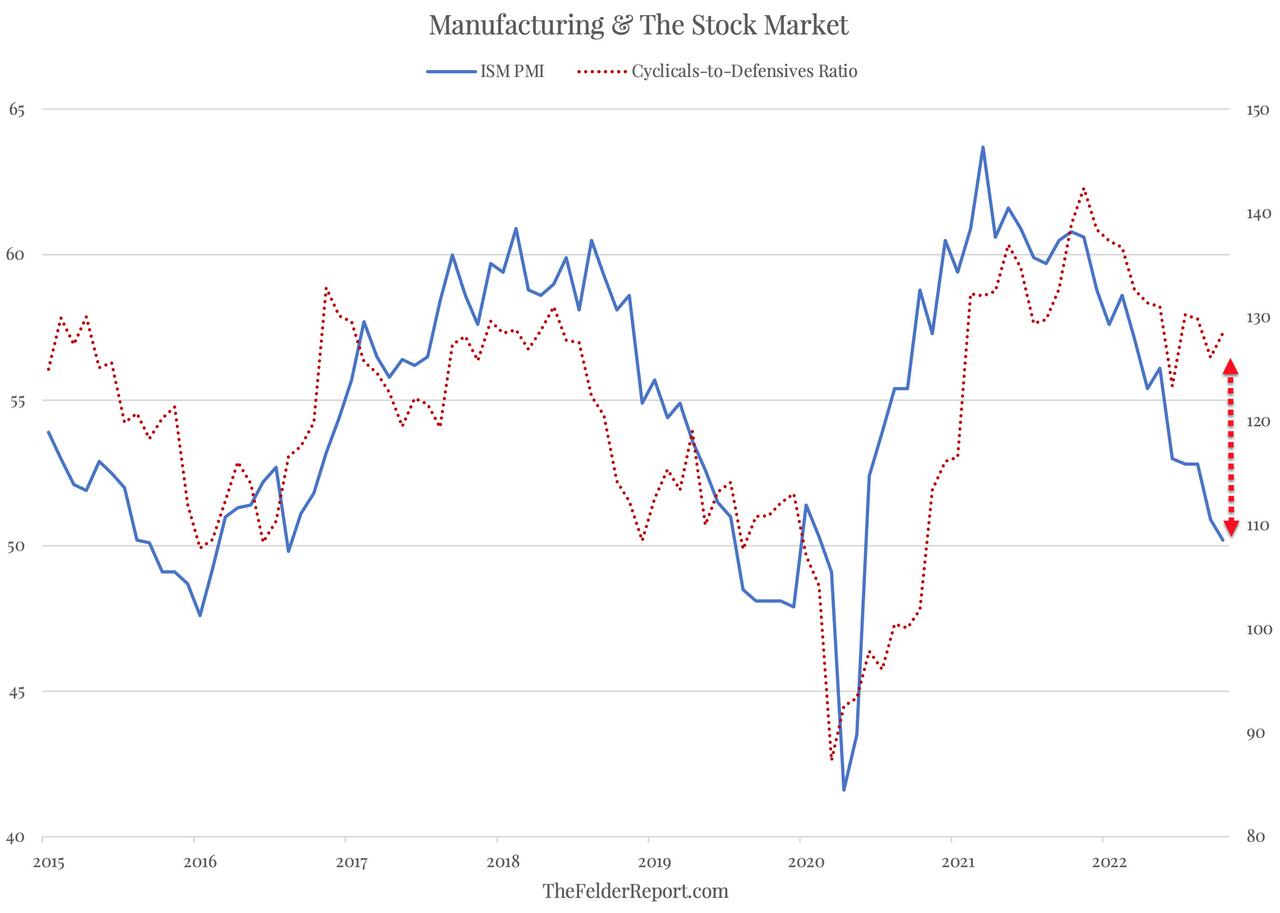
Despite all the worries over the possibility of a recession in the quarters ahead, the stock market seems to have priced in a “soft landing” for the economy.
The cyclicals-to-defensives ratio has yet to really react even to the slowdown in the economy we have already seen over the past year or so as indicated by the reversal in the ISM Manufacturing PMI. If the latter continues to deteriorate in the months ahead, cyclicals (like the tech and consumer discretionary sectors) could have a great deal of pain still in front of them.
So it’s interesting to note that the rapid rise in the dollar, interest rates and oil prices we have seen over the past two years points to a rapidly deteriorating economy in the months ahead.
In fact, as the chart above suggests, the composite of these three major economic inputs suggests that the decline in ISM Manufacturing PMI is going to accelerate over the next nine months or so, a development that would fly in the face of the soft landing narrative and likely play catalyst for the next phase of the bear market in equities.