FT : Nervous auditors turn up the heat on crypto clients

Nervous auditors turn up the heat on crypto clients
FTX collapse highlights risks in industry where accounting rules are only half-formed

Cryptocurrency businesses that need their financial statements audited are probably going to have to pay more for it, and they have Sam Bankman-Fried to thank.

The collapse of Bankman-Fried’s crypto empire, and the spotlight it put on the auditors that signed off on his books, has prompted small audit firms to re-examine their work for businesses in the nascent industry.

Several US firms told the Financial Times that they had elevated some or all of their crypto-related clients to the status of “high risk”, triggering a more thorough audit that will take longer and lead to higher bills. Some clients could ultimately be dropped altogether.

The re-examination comes just weeks ahead of the financial year-end in the US, where auditors are struggling to apply accounting rules for digital assets that are still only half formed and regulators are watching closely for slip-ups.

“Your antennas have to be up at this point,” said Jeffrey Weiner, chief executive of Marcum, whose audit clients include bitcoin miners and digital asset investment groups. The firm has designated crypto clients across the board as high risk in the wake of FTX’s collapse and the fallout in cryptocurrency markets.

“When a client is high risk, you significantly expand the scope of the audit, and that translates into needing more resources and more time,” Weiner said. Extra work will be required to check a company’s “systems, controls, the existence of assets, segregation of funds and, of course given FTX, there will be extra scrutiny of related-party transactions”.

FTX bankruptcy filings described a chaotic operation where the crypto exchange was deeply intertwined with Bankman-Fried’s personal trading business, and billions of dollars of customer money is unaccounted for. John Ray III, the insolvency expert newly installed as chief executive, said he had never seen “such a complete failure of corporate controls and such a complete absence of trustworthy financial information”.

The filings raised the question of how Prager Metis — a US firm with just $139mn in annual revenue — was able to issue an unqualified audit opinion for the 2021 financial statements from FTX’s sprawling international operations. Industry standards require auditors to understand a private company’s internal controls and design an audit accordingly, even though they are not required to attest that the controls are strong.

Armanino, a California-based firm with $458mn in annual revenue, issued a similarly unqualified opinion for financial statements from FTX’s US exchange business.

The two firms have put out statements standing by their work for FTX, which both said did not continue beyond last year’s audit.

Given the breadth of businesses with exposure to FTX and crashing markets for digital assets, “we are checking in with our clients and we have had some where we have had to adjust risk ratings”, said a partner at another firm that audits crypto businesses. “We are closing in on the end of the year, so if we are going to continue and finish up the audit, we have to ask if we have all the procedures we need, or new resources we need to bring to bear.”

The partner added that smaller audit firms are likely to become pickier about taking on crypto clients. “We aren’t in the business of working for people that might fail. When a company fails there is a lot of work: you are going to get subpoenaed, deposed, people are going to want to look at your work papers to see if you missed anything. It’s involved.”

Two weeks before the FTX collapse, the Big Four audit firm EY parted company with Core Scientific, a Texas bitcoin miner that warned it could run out of cash by the end of this year. EY said it found insufficient record-keeping and poor internal controls, according to a regulatory filing. Core Scientific said it would instead use Marcum as its auditor.

The Big Four — PwC, Deloitte and KPMG, along with EY — argue they can bring more resources to bear on work for crypto clients than smaller auditors. The large auditors typically charge more than smaller firms.

The PCAOB, which regulates audits of US public companies, issued a bulletin in August telling companies they should check whether their auditors had the right skills.

“What is the auditor’s understanding of the financial reporting implications of the company’s activities related to digital assets?” it asked. “What policies and procedures does the audit firm have regarding conducting and monitoring audit engagements involving digital assets, including considering the risks associated with performing such audits?”

Answering the first question is no easy matter, auditors say, as innovations in digital assets have come faster than accounting standards can be set. The AICPA, a professional body which sets standards for audits of private companies, has written only some chapters of a guide for audit practices, with more still in the works.

“Our guidance is always informed by current events and real-world scenarios and any additional potential risks they may surface,” said Susan Coffey, AICPA chief executive of public accounting.

Armanino, the auditor of FTX US, said it had “invested significant time and intellectual capital as an active participant in multiple accounting industry groups” to help develop standards.

Other audit firms are just pleased not have become embroiled in crypto.

“Like I would hope every audit firm, after the FTX collapse we went back to look through our portfolio of clients,” said Charly Weinstein, chief executive of EisnerAmper. For those that have digital assets or cryptocurrency exposure, it amounted to only a small fraction of the business, he said.

“We haven’t done [audit] work around cryptocurrency,” he said. “Out of an abundance of caution.”

WSJ : Adidas Top Executives Discussed Risk of Staff’s ‘Direct Exposure’ to Kanye

WSJ : Adidas Top Executives Discussed Risk of Staff’s ‘Direct Exposure’ to Kanye West Years Ago
Sneaker giant said it would investigate workplace complaints, years after employees and business-unit leaders raised concerns to top executives in Germany, people familiar say

Adidas AG’s ADDYY -0.51% chief executive and senior leaders in Germany discussed as far back as four years ago the risk of continuing a relationship with Kanye West that they feared could blow up at any moment, according to people familiar with the matter and documents reviewed by The Wall Street Journal.

A 2018 presentation to members of the Adidas executive board, a group that included CEO Kasper Rorsted and the head of human resources, highlighted the risks for employees interacting with Mr. West and detailed mitigation strategies for the relationship with the Yeezy creator, including cutting ties with the rapper-turned-designer, documents show.

Instead of parting ways when concerns were raised, these people said, the senior executives had business-unit leaders share various proposals with Mr. West so Adidas could hang onto the Yeezy partnership, which analysts estimate accounted for 8% of annual sales.

These efforts to keep the Yeezy partnership occurred again in September when the Adidas executive board met to discuss Mr. West’s latest public outbursts, the people said.

Mr. West, who legally changed his name to Ye, met with Adidas executives in mid-September and asked for more money and control over the Yeezy brand, according to people familiar with the meeting. During the meeting, he showed the Adidas executives a clip from an adult video and accused them of stealing his designs, these people said.

Soon after the meeting, the people said, Adidas agreed to some of Mr. West’s demands: The company offered Mr. West the ability to sell Yeezy footwear directly to consumers and ownership of future designs as well as a cut of the sales from Yeezy look-alike products. The proposal offered to continue the partnership through at least 2026, the people said.

Mr. West wasn’t satisfied and wanted as much as $3 billion, the people said. Weeks later, after Mr. West wore a “White Lives Matter” T-shirt at his fashion show and posted anti-Semitic comments on social media, Adidas said it would end its Yeezy partnership.

In a statement, Adidas said the company doesn’t tolerate hate speech and offensive behavior and that it continues to have conversations with employees. “They have our full support,” the company said. It declined to comment further. Mr. Rorsted, who stepped aside earlier this month, didn’t respond to requests for comment.

Mr. West didn’t respond to requests for comment and has previously declined to comment on what happened with the company.

Adidas said last week it was launching an investigation into the situation after the company received an anonymous letter that alleged years of misconduct toward Adidas staff by Mr. West and that Adidas management turned a blind eye to his conduct. Rolling Stone earlier reported on the letter and employees’ complaints.

Such alleged behavior—some of which Mr. West acknowledged on social media—and the company’s efforts to hang onto Yeezy despite it weren’t new, according to former and current Adidas and Yeezy employees. Some of the employees said they raised concerns about Mr. West’s conduct over the years to senior Adidas leaders and human-resources managers, including in 2018.

Adidas, one of the biggest global brands with more than $20 billion in annual sales, initially saw landing Mr. West as a coup. Nearly a decade ago, he was a popular hip-hop star who had left Nike Inc., its biggest rival in the sneaker world, and was gaining credibility in fashion circles. The German company hoped the designer could help lift the brand’s cachet and take it beyond sports into the booming streetwear market.

Yeezy was a commercial success soon after the first products with Adidas made their debut in 2015. Its sneakers often sold out quickly and commanded premium prices. Mr. West licensed his Yeezy trademark to Adidas in exchange for a 15% cut of sales, people familiar with the matter said. Adidas was responsible for manufacturing products and getting them to consumers, and it retained ownership of the designs.

The two sides extended their partnership, adding staff and items to the Yeezy product line, which became central to Adidas’ sales growth. There were tensions behind the scenes. Current and former employees said Mr. West berated staff in front of colleagues and sometimes watched pornography at work, which was escalated to human resources in 2018. He also occasionally made anti-Semitic comments in front of Adidas staff, including in 2018 when he suggested naming an album after Hitler, they said. CNN earlier reported on his pro-Nazi comments. Mr. West didn’t respond to requests for comment on the allegations.

Employees raised concerns to executives about Mr. West’s behavior after the artist appeared on TMZ in early 2018 saying that slavery “sounds like a choice,” former employees said. At a meeting with Adidas executives, including a member of the executive board, the focus shifted from concerns about Mr. West’s comments to complaints about how the company handled the controversy internally, the employees said.

In October 2018, Adidas executives conducted a deep dive of the Yeezy partnership that was presented to leaders based in Germany, including Mr. Rorsted. The presentation reviewed options for dealing with Mr. West, who was asking to be named creative director of Adidas, according to documents.

One of the risks identified was Adidas employees having “direct exposure” to Mr. West and leaders evaluated rotating key staff to mitigate the risk, the documents show.

One proposal was running Yeezy as a stand-alone brand like Nike’s Jordan brand, which would limit Mr. West’s exposure to the rest of the company. Another option was buying the Yeezy trademark from Mr. West and running the brand without him, according to the documents. The documents say Mr. West wanted to be paid out to focus on philanthropy.

Another proposal called “immediate mitigation” was to separate from Mr. West, sell off remaining Yeezy products and replace them with other revenue streams, including products from other celebrities, the documents show. The executive board opted to continue its arrangement with Mr. West.

Mr. West requested Adidas’s support with his philanthropic ideas, according to people familiar with the matter. Adidas offered him a $100 million annual marketing payment in 2019 to promote the brand and fund his activities, the people said. Adidas executives decided that any spending beyond Adidas-related activities could help sell more sneakers as long as Mr. West kept himself in the headlines, the people said.

Tensions resurfaced this spring. Mr. West called out Adidas executives in Instagram posts, accusing them of stealing his designs and later of trying to get him to hand over the Yeezy trademark for $1 billion. He wanted to break free from the sneaker company where he felt executives had been exploiting him, people familiar with his thinking said. In August, Mr. West accused the company of putting on Yeezy Day, an annual marketing event, without his consent.

Internally, Adidas executives tried to contain the fallout. An Adidas executive reassured some employees in August that Mr. West had approved the event and that the company would get the situation under control. “When you have a partner that behaves poorly like this it doesn’t feel good,” the executive told employees.

Mr. West’s lawyers sent letters to Adidas and Gap, which had a smaller fashion partnership with him, saying the companies were in breach of their contracts. In early September, the artist again took to Instagram to air out his discontent with Adidas and Gap. He also posted a fake newspaper headline declaring Mr. Rorsted dead.

On Sept. 15, Gap announced it was severing ties with the artist. That same week Mr. West met with Adidas executives and showed them part of a pornographic video and commented on how the actor’s voice sounded like one of the Adidas executive’s. He wanted to make the point that Adidas was cheating on him by selling copycat designs, the people said.

After the meeting, the people said Adidas made an offer conceding to many of Mr. West’s demands, including ownership of new designs, paying royalties for copycats and offering to increase the royalty payment to 20% on existing Yeezy designs after 2026. But the company wanted him to give up the annual marketing payment.

Mr. West wasn’t satisfied. He wanted Adidas to give him ownership of existing designs, and wanted the company to sell the designs without Yeezy branding—and pay him a 20% royalty for them, according to the people. He also wanted $1 billion worth of Adidas stock once sales of existing products hit $5 billion, and an additional $2 billion in stock if higher sales targets were reached, the people said.

Adidas said on Oct. 6 that it put the partnership under review a few days after Mr. West wore a T-shirt reading “White Lives Matter” at a fashion show in Paris. Days later, he tweeted anti-Semitic remarks and published a video on YouTube showing himself playing the pornography at the Adidas meeting.

Adidas executives discussed how Mr. West’s escalating behavior could work in the company’s favor as grounds to invoke a morals clause and help terminate the deal, according to people familiar with the matter.

On Oct. 25, Adidas said it was terminating the partnership. The company walked away without the Yeezy brand, and Mr. West didn’t get the payout he sought.

FT : Chinese takeovers become a geopolitical frontline

Chinese takeovers become a geopolitical frontline
Semiconductors blur the line between national security and the national interest

Newport in south Wales finds itself on an unlikely geopolitical faultline. The UK government cited national security concerns to retrospectively block the sale of one of Britain’s biggest semiconductor plants, Newport Wafer Fab, to a Dutch company owned by China’s Wingtech. The UK is not alone: Germany has blocked two similar deals, with its vice-chancellor, Robert Habeck, accusing China of pursuing a “deliberate strategy” of “trying to acquire knowledge” in the sector.

The decisions risk being perceived as China-bashing. The west must try to balance legitimate concerns about strategic assets falling into potential adversaries’ hands with actions that could stoke the idea it is trying to hold back China — or that it is pursuing industrial strategy through the back door.

The pandemic and Russia’s war in Ukraine underscored the need to secure supply chains, as well as the folly of over-reliance on a hostile regime. The UK and German decisions follow sweeping US controls on high-tech chips. US congressmen raised concerns over Newport Wafer’s sale, leading critics to allege pressure from Washington — though that is to ignore the number of China hawks in the UK government.

Wrapping industrial strategy and protectionism in the mantle of national security is wrong. But the role of Chinese companies’ in these deals, and the fact they involve semiconductors, makes the line hard to draw. That is particularly true in the context of a more assertive China and concerns that it could invade Taiwan, which dominates advanced semiconductor manufacturing.

Under a 2017 law, Chinese companies are required to co-operate with Beijing’s intelligence apparatus. That means a mooted Chinese acquisition in another country’s strategic sectors becomes a more loaded proposition. This is not limited to semiconductors: concern has been expressed over Cosco’s stakes in the ports of Piraeus and Hamburg. Beijing can theoretically require the shipping giant to provide support to the Chinese navy wherever Cosco operates.

Semiconductors also blur the definition of a security threat. They power everything from smartphones to cars but they also have military applications. This is why Joe Biden’s export controls — although ostensibly to stop military technology falling into the hands of Beijing — are so far-reaching. Securing even a small role in this global supply chain can itself be a national security concern.

The UK decision has nevertheless baffled many. Newport Wafer’s technology is not cutting edge — though the plant sits within a cluster specialising in compounds that can have advanced uses. The government’s reasoning, beyond a one-page document, is not clear. It does not help that there is no definition of national security in the legislation under which the deal was blocked. The company can mount a legal challenge but much of the government’s deliberations would be classified, making it hard for judges to consider underlying principles. Such murkiness reduces predictability for the foreign investment on which Britain relies.

If a country decides to choke off investment streams for a capital-intensive sector such as semiconductors, it is vital that it then nurture that industry. The US and EU have announced support packages worth $52bn and €43bn respectively to grow domestic semiconductor industries. UK investment, meanwhile, is negligible. An overarching strategy is long overdue.

Trying to differentiate between the national interest and national security is hard when it comes to semiconductors. But a little transparency goes a long way, as would remembering that undue protectionism will inflate costs and exacerbate cross-border tensions.

FT : Global inflation likely to have peaked, key data indicators suggest

Global inflation likely to have peaked, key data indicators suggest
Factory gate prices, shipping rates and expectations suggest headline price growth will slow

Key data indicators suggest that this year’s rampant global inflation has peaked and that the pace of headline price growth is set to slow in the coming months.

Factory gate prices, shipping rates, commodity prices and inflation expectations have all begun to subside from their recent record levels. These data series are widely watched by economists and policymakers as they provide an early indication of the trends that will shape the headline inflation calculation.

According to economists, the figures suggest that price pressures on global supply chains are easing, making it likely that headline inflation will fall from the historically high rates that hit household finances and business activity in recent months.

That would be welcome news for leading central banks, which have been raising interest rates rapidly in a co-ordinated effort to tame inflation, risking plunging major economies into recession by doing so.

“Inflation is likely at its apex,” said Mark Zandi, chief economist at Moody’s Analytics. The easing of price pressures and supply delivery bottlenecks “presage the coming moderation in consumer prices”, he said.

Global inflation hit a record 12.1 per cent in October according to Moody’s estimates; that will be the “high water mark” for consumer prices, Zandi said.


Inflation has already peaked across emerging markets, according to Capital Economics, with consumer prices falling in Brazil, Thailand and Chile, while recent data shows a weakening of some price pressures in developed economies.

In Germany, factory gate prices fell 4.2 per cent in October compared with the previous month — the largest monthly fall since 1948. In the US and the UK, annual producer price inflation has been slowing since the summer.

Nearly all the G20 group of leading economies that have released their October producer price indices reported a slower pace of annual growth than in the previous month, including Spain, Mexico, Portugal and Poland.

Jennifer McKeown, chief global economist at Capital Economics, expects global headline inflation to begin to fall next year on the back of lower prices for most commodities as demand weakens. High energy prices this year would flatten out in 2023, she said.

“Our estimate is that food and energy effects together will knock about 3 percentage points off headline consumer price inflation in the advanced economies on average over the next six months,” she said.


However some economists cautioned that continued high energy costs could slow the decline. Susannah Streeter, senior investment and markets analyst at Hargreaves Lansdown, said that “oil [is] set to stay highly sensitive to supply constraints, and the looming EU ban on Russian crude” would continue to fuel headline inflation in the UK and the eurozone.

Prices for energy and other commodities could jump again if the Chinese economy makes a strong recovery, or if Russia makes further export cuts in retaliation for western price caps on its oil and gas.

Commodity prices and other indicators which feed into the overall headline inflation figure are falling.

The FAO food price index slowed to an annual rise of 1.9 per cent in October, way down from a peak of 40 per cent in May 2021. The TTF benchmark European gas price is below €130 per MWh, down from a peak of €311 in August and most commodity prices are well below their peaks.

Global shipping rates have returned largely to pre-pandemic levels after increasing by more than five times during the lockdowns.

In the US, manufacturing and services costs rose at the slowest pace since December 2020 in November, while selling price growth fell to its slowest rate in over two years, according to the S&P Global purchasing managers monthly survey. In the eurozone, inflation in factory sales reached a 20-month low, the survey found.

Investors’ expectations of where inflation will be five years from now have stopped increasing, reflecting the recent aggressive monetary policy tightening by many central banks.

US inflation fell by more than expected in October and most economists forecast the pace of price growth will peak this quarter in the UK, the eurozone and Australia. Economists polled by Reuters expect eurozone inflation to hit 10.4 per cent in November when the data is published in Wednesday, a decline from 10.6 per cent for the previous month.

However, while it is likely to fall from its peak, global inflation is set to remain above central banks’ long-term targets, economists said.

“Don’t expect inflation to drop down to 2 per cent [the target rate in most advanced economies] very quickly,” said Katharine Neiss, chief European economist for PGIM Fixed Income.

Core inflation, which excludes energy and food, is expected to peak later for many countries, as the impact of high energy prices on the wider supply chain will be “drawn out”, she warned.

Nathan Sheets, global head of international economics at Citi, said that while many indicators point to “a sharp decline in inflation for many types of goods”, high inflation “is likely for some time to come [and] much of the coming year at least”.

(ZH) US Nuclear Reactors Among The Oldest In The World

US Nuclear Reactors Among The Oldest In The World

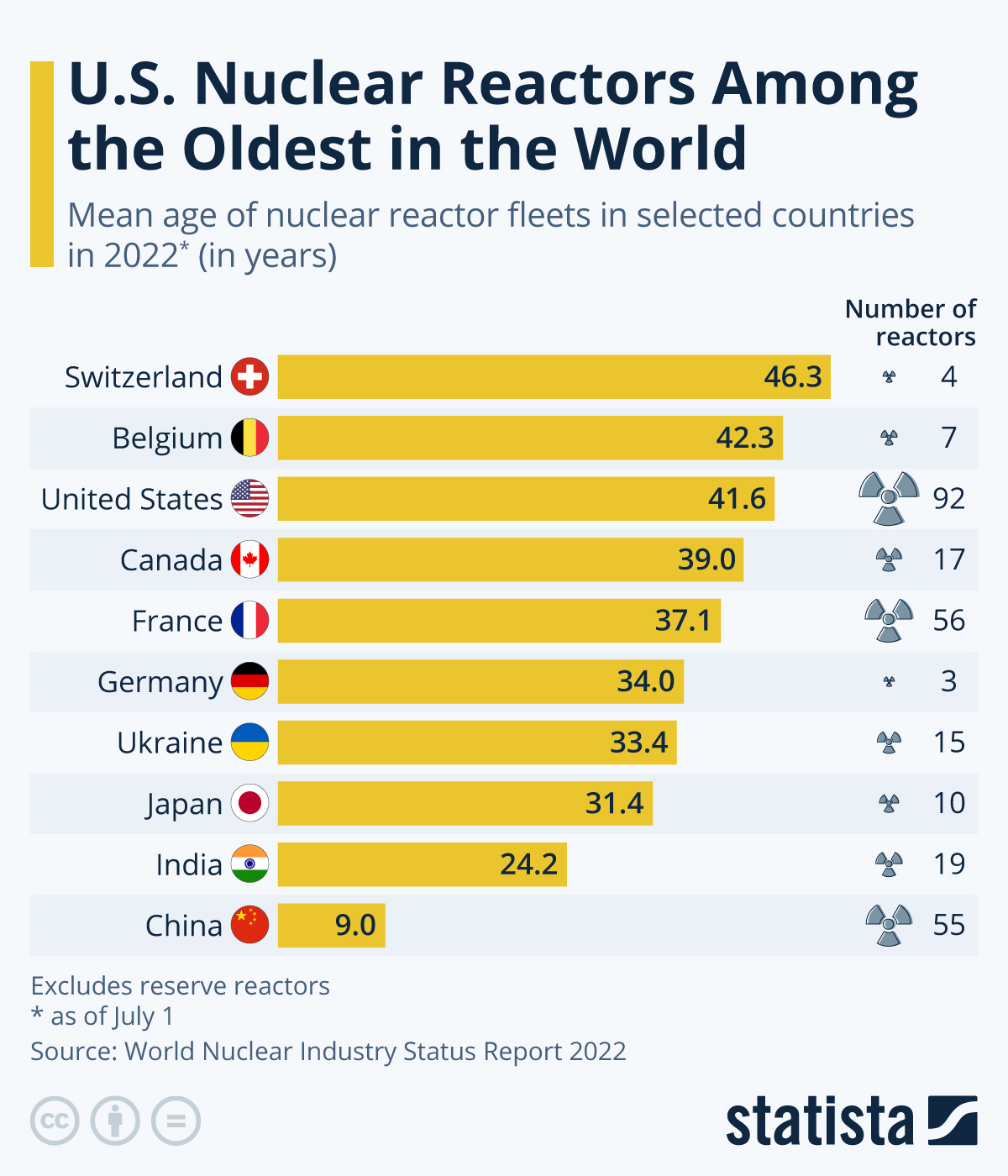
The United States' 92 nuclear reactors currently in operation have a mean age of 41.6 years, the third oldest in the world.
As Statista's Katharina Buchholz reports, the only nuclear fleets that are older are those of Switzerland (46.3 years) and Belgium (42.3 years). Also older are the singular reactors in use in Armenia and the Netherlands.
You will find more infographics at Statista
The U.S. was among the first commercial adopters of nuclear energy in the 1950s, explaining the number of aging reactors today. A building boom between the 1960s and 1970s created today’s nuclear power plants in the United States. The five reactors completed in the 1990s and the one finished in 2016 were all holdovers of delayed construction projects from the 1970s experiencing roadblocks due to regulatory problems and mounting opposition to nuclear energy. The most recent construction start date of a completed U.S. reactor today is 1978 - one year before the nuclear accident at Three Mile Island, which further cemented the public's rejection of nuclear energy and the challenges of updating nuclear reactor infrastructure today. However, two reactors started at Vogtle power plant in Georgia in 2013 will join the grid soon as the newest additions to the U.S. fleet. They too experienced many regulatory and other delays, culminating in the bankruptcy of the reactor construction company. The U.S. government stepped in with a loan so that the project can now be finished almost 17 years after its initial proposal.
The U.S. today is one of only 15 countries which the World Nuclear Industry Status Report lists as actively pursuing nuclear energy. This includes new nuclear programs in the United Arab Emirates, Belarus and Iran that were started in the past decade only, as well as a younger program in China that started producing power in 1991 and today has a mean reactor fleet age of just nine years. India, running a nuclear energy program since 1969, nevertheless saw much more recent construction than the U.S., achieving a current mean reactor age of 24.2 years. Many European countries which were early adopters of the technology are meanwhile phasing out their programs, at times before the end of reactors' expected lifespans.
Following the Russian invasion of Ukraine and the ensuing energy crisis, interest in nuclear energy has been renewed in many countries, but challenges for nuclear reactors construction persist today. One solution could be a pivot to small reactors like the ones company NuScale is expected to build in Idaho by 2030 using a new modular technology.

(ZH) EV Charging Stations By 2035 Will Need More Power Than A Small Town

EV Charging Stations By 2035 Will Need More Power Than A Small Town

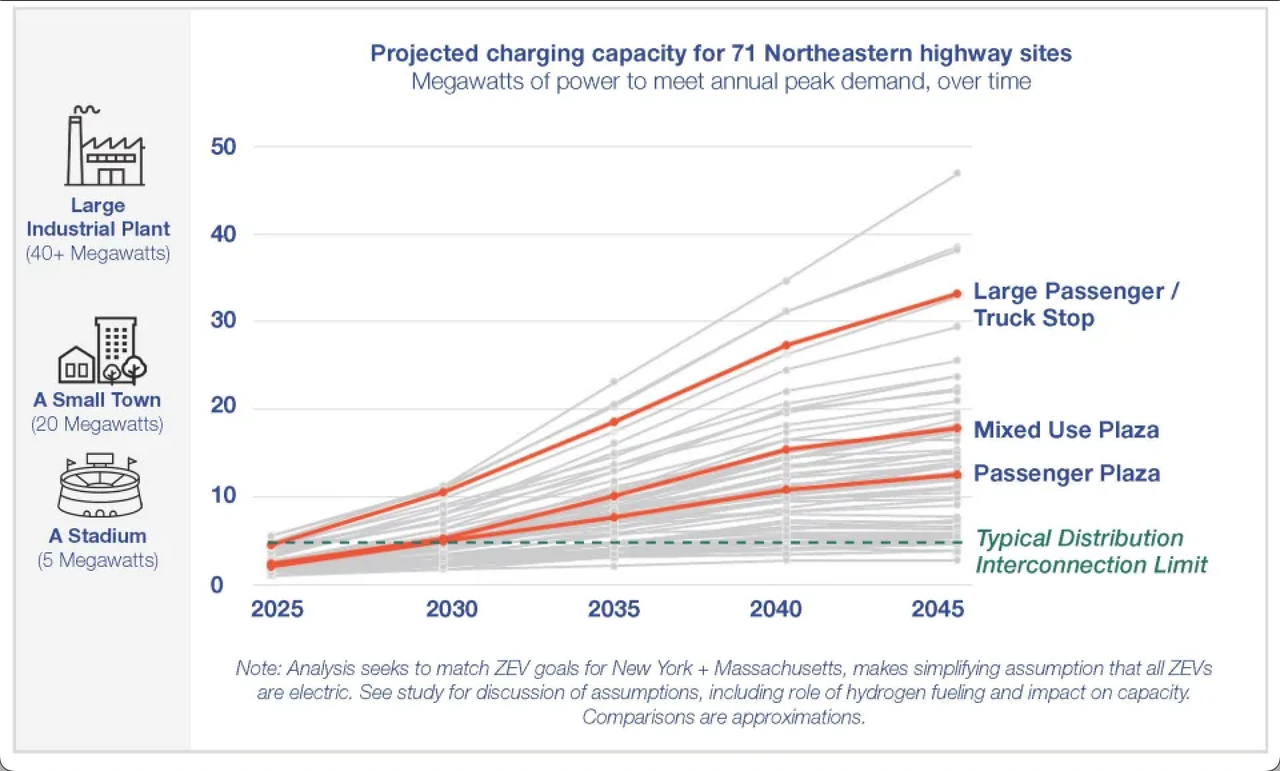
A new report from the electricity and gas utility National Grid (which serves parts of New York and Massachusetts) found a rapid increase in electric vehicles on the city streets and highways will require upgraded power grids to handle all the new demand. By 2035, a charging station could demand as much power as a sports arena or small town.
National Grid expects by 2035, large charging stations serving EVs, from SUVs and pickup trucks to delivery vans and semi-trucks, would require 19 megawatts of peak power -- that's approximately what a small town uses. In 2045, those large charging stations could demand upwards of 30 megawatts of capacity, with peak usage of a large manufacturing plant.
National Grid said current charging stations couldn't serve the EV demand of the future, indicating significant power-grid improvements would be needed. It said expanding the charging infrastructure would take time:
"Building these high-voltage interconnections and upgrades can take years, which is why it's important to take action right now.
"By making 'no-regrets' upgrades at 'no-regrets' sites, we can make sure fast-charging is there when drivers need it—and not a moment too late," the report said.
Today, the impact of EV charging on the grid is small, and there is enough excess capacity to handle the current fleet of cars, SUVs, vans, and pickup trucks.
As EV adoption expands, so will the electricity demand, and as we've noted, nuclear power generation will be the best form of on-demand clean energy. The White House understands nuclear is the future for a sustainable clean grid, as they rush to secure a "large amount" of funding for a domestic uranium strategy.
Unreliable solar and wind won't be enough to power the Biden administration's ambitious plan for half of all new vehicles sold in 2030 to be electric. Meanwhile, California set a target of 2035 to phase out the sale of new gasoline-powered light-duty vehicles.
Momentum is certainly building to electrifying vehicle fleets. In doing so, increasing investments in zero-emission nuclear power production and sourcing uranium domestically will be the key to sustainably powering future EV demand.

TechCrunch : Binance launches proof-of-reserves system for BTC holdings

Binance launches proof-of-reserves system for BTC holdings

Cryptocurrency exchange company Binance has released a new site that explains its proof-of-reserves system. The company is starting with BTC reserves. Right now, Binance has a reserve ratio of 101%. It means that the company has enough bitcoins to cover all users’ balances.

This move comes a couple of weeks after the collapse of FTX, another popular crypto exchange. In FTX’s case, the company faced a liquidity crisis. It stopped processing withdrawals because it couldn’t meet demand from investors and end users.

Crypto companies — and crypto exchanges in particular — have been trying to be more transparent about user funds since then. It means sharing more information about hot and cold wallets. But there’s still a lot of work ahead before you can completely trust crypto exchanges and how they handle funds.

A few weeks ago, Binance started by sharing wallet addresses with billions of dollars worth of crypto assets. With this move, the company proved that it does indeed hold a lot of assets and it can process a ton of withdrawals. But the company didn’t state clearly whether those are user assets, or Binance’s own balance sheet, or a mix of both.

With today’s new proof-of-reserves site, Binance clarified that point by saying that BTC wallets included in the proof-of-reserves system don’t include Binance’s own funds.

“It is important to note that this does not include Binance’s corporate holdings, which are kept on a completely separate ledger,” the company says. You will have to trust Binance’s word as you can’t verify that with a blockchain explorer.

Binance is starting with BTC holdings. Adding up the amounts in each of Binance’s wallet is easy. When it comes to user assets, the company is using a Merkle tree to include all individual user accounts and generate a cryptographic seal.

As of November 22nd at 23:59 UTC, Binance users collectively held 575742.4228 BTC — that’s around $9.5 billion at today’s exchange rate. And Binance had enough bitcoins in its own wallets to cover 101% of these funds. In other words, if everybody withdraws their BTC at the same time, Binance would have enough BTC to process all withdrawals.

Thanks to the Merkle tree, individual users can use the root hash to check whether their accounts are included in the snapshot of user balances. Binance says it includes user balances across various products — Spot, Funding, Margin, Futures, Earn and Options Wallet. The company also provides a short Python script so that you can check yourself.

“Given recent events, it is understandable that the community will demand more from crypto exchanges, far more than what is currently required of traditional financial institutions. That’s why we’re pleased to provide this latest feature for our users to verify their funds,” Binance founder and CEO Changpeng Zhao ‘CZ’ said in a statement. “As Binance’s user community is exponentially larger than the next largest exchange, this is a massive under-taking and will take a few weeks to develop the data for the majority of our assets in custody. We are working to get the next update out as quickly as possible to meet the community’s expectations.”

The company already plans to release similar proof-of-reserves information for ETH, USDT, USDC, BUSD and BNB in the future. Binance offers hundreds of different crypto assets so let’s hope that they can also cover withdrawals for lesser known cryptocurrencies.

Similarly, the company should work with independent financial and security auditing firms so that you don’t just have to blindly trust the company. There is still a long way to go, but at least today’s new proof-of-reserves system is a step in the right direction.

Barrons : German Consumers Are Boosting the Economy. These Stocks Stand to Gain.

German Consumers Are Boosting the Economy. These Stocks Stand to Gain.

It hasn’t received a lot of attention that the outlook for Germany’s economy, Europe’s largest, is considerably better than it was just a few months ago.

Prospects looked dire earlier in the year. Russia’s invasion of Ukraine cut off a significant portion of the country’s national gas supplies. Energy prices spiked, and inflation shot up. That prompted the European Central Bank to start raising interest rates for the first time in a decade.

As the roadblocks piled up, the forecasts for a painful recession in Germany, which accounts for a third of the euro zone, came rolling in.

And yet, the economy unexpectedly grew in the third quarter. Consumers lifted spending after saving through the pandemic, accounting for most of the strength in the period. Gas prices retreated, alleviating the crunch on industry, and the country scrambled to maximize gas storage for the winter.

That is an impressive feat, especially as Germany was already under considerable pressure to adjust to a new world order. Not only is it facing energy shortages, but its trade prowess also relies heavily on China, which has been hit hard by Covid lockdowns in 2022.

Its legendary car industry, led by powerhouses Volkswagen (ticker: VOW.Germany), BMW (BMW.Germany), and Porsche (P911.Germany), are facing new competition from electric vehicles. Its famous Mittelstand, or small to medium-size companies that make up a majority of output, was just starting to recover from the pandemic when the energy crisis hit.

To be sure, economists still expect a downturn. It just won’t be as bad as feared. “Despite the eased gas situation, the overall uncertainty shock is still in the bones of industry and households,” said Stefan Schneider, chief Germany economist at Deutsche Bank in Frankfurt. “The outlook compared with two months ago has improved. But it’s still pretty poor, and there will almost certainly be a recession.”

German gross domestic product increased 0.3% from July to September. That was mainly driven by pent-up consumer demand for restaurants and leisure as lockdowns eased. But industrial output also increased.

A mild winter might yet mean that the country’s gas supplies don’t need to be rationed, and the government has promised considerable support for households with higher energy bills. Slowing inflation could help consumers maintain their strength.

If so, some beaten-down consumer-goods stocks might be worth a look. Adidas (ADS.Germany), the Bavarian maker of shoes with the three-stripe logo, has fallen about 51% this year. It trades at 26 times this year’s expected earnings and is valued in line with peers.

Puma (PUM.Germany), its rival maker of sports gear, has done even worse, down about 54% since Jan. 1. It fetches 20 times earnings and is valued at a 20% discount to its peers.

While German companies face immense challenges, the German model of capitalism—characterized by the Mittelstand, close cooperation between employers and unions, and an emphasis on trade and manufacturing—is capable of coping, according to Deutsche Bank’s Schneider.

After all, the Russian gas crisis is only the latest to hit the country, and it may not be as big as some that have come before. Reunification after the fall of the Berlin Wall and the sovereign-debt crisis a decade ago were arguably tougher obstacles.

“Over the past 30 years, the German model has, according to the international press, been at the brink of extinction several times, and somehow recklessly survived,” said Schneider. “I wouldn’t underestimate the German flexibility to adjust.”

Barrons : Where to Get Yields of 10% and Up, if You Can Stomach a Little Risk

Where to Get Yields of 10% and Up, if You Can Stomach a Little Risk

The $280 billion convertibles sector is replete with 10%-plus yields on many issues. There is a risk in these high-yielders, but they can offer nice appreciation potential and a good alternative to the issuer’s common stock.

Converts are bond/stock hybrids that can offer a combination of the downside protection of bonds and the upside potential of stocks. The ICE BofA U.S. Convertibles index is off 17% so far in 2022.

Convertible issuance boomed in 2020 and 2021 as growth companies and those hit hard by the pandemic took advantage of high demand to issue converts with rates as low as zero and high equity-conversion premiums. A high premium meant the issuer’s stock would have to rise 50% or so before it made sense for the holder to convert the bond to stock.

Issuers included Coinbase Global COIN –2.83% (COIN), MicroStrategy MSTR +3.75% (MSTR), Beyond Meat (BYND), Peloton Interactive PTON +0.30% (PTON), Wayfair (W), Redfin (RDFN), RealReal (REAL), DraftKings (DKNG), Carnival (CCL), and Affirm Holdings (AFRM). Many converts are down 40% or more and are “busted,” meaning the stock prices have fallen so much that the issues act like pure bonds.

Investors can play the sector through exchange-traded funds such as SPDR Bloomberg Convertible Securities ( CWB ), yielding 2.5%; mutual funds such as Columbia Convertible Securities (PACIX); and individual issues.

Many convert issuers are barely profitable—or are losing money—but BofA Securities convertible strategist Michael Youngworth sees some positives. “While this might appear challenging from a credit perspective, fundamentals don’t look so dire,” he says. Youngworth says issuers of about half of all busted converts have no other debt on their balance sheets, “meaning total debt, leverage, and interest costs remain relatively low.”

MicroStrategy’s zero-coupon convertible due in 2027 now trades at 33 cents on the dollar and carries a 28% yield to maturity. It is an intriguing Bitcoin play. The convertibles look covered by the company’s Bitcoin holdings, now worth about $2.1 billion, and a software business possibly worth $500 million. There is about $2.4 billion of debt.

Booker Smith, an analyst at Imperial Capital, says the converts are a much better play than MicroStrategy’s stock.

Coinbase’s 0.5% issue maturing in 2026 trades around 54 (face value is 100) and yields 16% to maturity. Wayfair’s 0.625% issue due in 2026 trades at 65 and yields 16%; DraftKings’ zero-percent issue maturing in 2028 trades at 63 and yields 8.5%; Redfin’s zero-percent bonds due in 2025 trade at 54 and yield 22%; and Beyond Meat’s zero due in 2027 trades at 25 and yields 36%.

The bar is lower for a convert in these companies than the equity. If the company merely survives, investors should win.

Buying converts can be tricky, as they trade over the counter and most were originally issued to institutions under Rule 144A. But many get registered Cusips, or identification numbers, a year after issuance and can be purchased by individual investors.

Barrons : Quantum Computing Will Change the World. How to Play the Stocks.

Quantum Computing Will Change the World. How to Play the Stocks.
Investors finally have ways to play the first radical shift in computing since the 1950s, but you're better off waiting before jumping in.

Last month, the Royal Swedish Academy of Sciences awarded the Nobel Prize in physics to three scientists for their research on quantum information science, one of the most surprising and—as it turns out—most commercially alluring scientific discoveries of the past 100 years.

Yes, the quantum computing revolution is coming. But it will take time, probably longer than is comfortable for investors in the handful of quantum start-ups that have managed to reach the public market. This is a textbook case of Amara’s Law, coined by the futurist and engineer Roy Amara: “We tend to overestimate the effect of a technology in the short run and underestimate the effect in the long run.”

The new crop of small, public companies devoted to quantum—such as Rigetti Computing, D-Wave Quantum, and IonQ—will be challenged to generate significant revenue for years to come.

“We want to solve problems that are intractable for today’s—or even next century’s—supercomputers,” says Krysta Svore, vice president of quantum software at Microsoft (ticker: MSFT). With conventional supercomputers, she says, there are unsolvable problems—like sorting through potential drug candidates—that would require compute times longer than the current lifespan of the universe. “We want to bring this technology forward and see how we can use it in conjunction with classical technology.”

The nature of quantum computing makes it useful for solving computationally intensive problems with huge numbers of variables. Quantum computing will potentially speed up drug development, improve financial modeling, and boost the efficiency of electric batteries.

The Nobelists’ work demonstrated a mind-bending concept crucial to quantum computing called “quantum entanglement.” The three prizewinning physicists—Alain Aspect, John Clauser, and Anton Zeilinger—all contributed to the discovery that particles in an entangled state can affect other particles, even when vast distances apart.

The new research undermines the thinking of none other than Albert Einstein. Einstein was skeptical of the ability of quantum mechanics to describe the universe in full; in particular, he was uncomfortable with quantum theory’s reliance on what he called “spukhafte fernwirkungen”—“spooky action at a distance.” It turns out that Einstein’s doubts were misplaced.

Though the exact mechanism remains uncertain—“nobody understands quantum mechanics,” the physicist Richard Feynman once said—experiments from the new Nobelists prove that quantum theory really does describe the natural world and that entanglement exists. That discovery has set the stage for an entirely new branch of computing, and there’s a race under way to develop the first commercial quantum computers, with potentially vast riches at stake.

The combatants include some of the biggest players in “classical” computing: Microsoft, Intel (INTC), Alphabet (GOOGL), Amazon.com (AMZN), and IBM (IBM) are all building quantum hardware, along with Japan’s Toshiba, NEC, and NTT, and China’s Baidu (BIDU), Huawei Technologies, Tencent, and Alibaba. At the other end of the scale are a handful of small firms that rode quantum hype into the public markets, mostly through special purpose acquisition company, or SPAC, mergers, including Rigetti Computing (RGTI), D-Wave Quantum (QBTS), and IonQ (IONQ). And that’s just the tip of the iceberg: According to PitchBook, 251 quantum start-ups have together raised more than $5.4 billion in venture capital since the beginning of 2017.


It’s easy to see the allure.

IDC last year estimated that the market for quantum computing services, mostly delivered by the cloud, could grow to $8.6 billion in 2027, up from $412 million in 2020, a compound annual growth rate of more than 50%.

More tantalizing is a 2021 report from Boston Consulting Group that put the potential value creation from quantum computing at $450 billion to $850 billion—with $90 billion to $170 billion of that flowing to the quantum industry players. But investors will have to be patient—Boston Consulting Group doesn’t expect the industry to reach that scale until 2040 or later.

William Zeng, head of quantum research at Goldman Sachs, is fascinated by quantum’s game-changing potential. “We are very much in research mode,” Zeng says. “We do not have systems in production yet. We’re figuring out how to get there. It starts with looking at business problems—what things now are too slow, too expensive, or can’t be solved at all. And then you try to pair those with places where quantum has a theoretical advantage.”

One early area of focus for Goldman is the potential to speed up Monte Carlo calculations, complex algorithms used to assess the value and risks of derivatives and other securities. He sees other potential applications in portfolio optimization and machine learning for anti-money-laundering, among other things. But not yet, and not particularly soon.


Tony Uttley, president and COO of Quantinuum, left. He says the technology at the heart of Quantinuum’s “trapped ion” quantum computers, right, could help the company reach the market fastest. PHOTOGRAPHS BY THEO STROOMER
But you’ll need a quantum computer to predict the long-run winners.

“We’re not at the stage where a quantum computer is improving the bottom line of any company not in the field of quantum computing,” says Ryan Babbush, head of quantum algorithm and applications at Alphabet‘s Google unit.

That said, there are real-world examples of quantum computers being used today. IBM arguably has the early lead. Big Blue has built more than 30 quantum computers since 2016, and more than 20 of them are online right now, accessible via the web. IBM’s director of research, Dario Gil, says there are more than 500,000 users for those IBM quantum systems at over 180 institutions, primarily for research. “We have more quantum computers online than the rest of the world combined,” Gil says.

“It is still super-early,” agrees Simone Severini, the director of quantum computing at Amazon Web Services. “There is still substantial scientific and engineering work to do before we get quantum computing at scale.” Like other quantum industry leaders, Severini says there is growing interest from customers that want to explore the technology, but he says that it’s too early to know which technological approaches will succeed.

IBM CEO Arvind Krishna thinks we’re still probably five years away from anyone generating material revenue from quantum computing, but he adds that “there are a lot of very smart people with a lot of capital chasing the space.” He thinks that at some point—maybe in two years, or three, or five—“you will solve problems that will just astonish people.”

His back-of-the-envelope math suggests there could be a $100 billion market for quantum computing by the end of the decade, which he thinks will be split by a handful of players.

To be clear, quantum computers are never going to replace conventional computing. You’ll never use one to check your email, play games, or run Excel, and there will be no quantum smartphones or laptops. Instead, quantum systems will work in tandem with conventional computing to solve problems that can’t be addressed with current technology.

“This is the first time that computing is branching,” says IBM’s Gil, describing the radical shift away from the computing architecture pioneered by Intel, whose co-founder Gordon Moore accurately forecast in 1965 that the power of microchips would double roughly every two years.

Advertisement: Scroll to Continue
“Some people say this is another step in Moore’s Law,” Gil says, “but it is more fundamental than that. It is not that often that we get to redefine the nature of information.”

It has now been 77 years since ENIAC, the first programmable digital computer, launched at the University of Pennsylvania. Originally intended to be used for artillery targeting, ENIAC played a role in the early development of nuclear weapons. Two years later, in 1947, Bell Labs unveiled the first transistor, the basic building block for all modern electronics.

Over the decades, every computer ever built—PCs, mainframes, supercomputers, game consoles, and mobile phones—have relied on transistor-based binary computation with “bits,” the smallest possible pieces of data, which can only exist in two states. On or off. Zero or one. True or false. Yes or no.

In quantum computing, the most basic piece of information is the qubit—a quantum bit. Like a classical computing bit, the qubit also has two potential states—on or off, zero or one. But quantum computing allows for qubits to be in a state known as “superposition,” in which they are zero and one at the same time—or more precisely some statistical probability of being either. The physicist Erwin Schrödinger whimsically illustrated this paradoxical idea by describing a hypothetical situation in which a cat could be simultaneously both alive and dead.

More important than understanding the deep weirdness of quantum mechanics is the fact that entanglement and superposition give quantum computers phenomenal computational power.

In conventional computing, computing power grows linearly with an increase in bits. But with entangled qubits, computing power grows exponentially as you add more qubits. With three entangled qubits, you can get eight simultaneous calculations—add a fourth qubit, and the system can do 16 calculations in parallel. As the number of qubits increases, eventually you get systems that can’t be matched by conventional computing. To match the computing power of a system with 100 qubits, you’d need the equivalent of 10 trillion years of classical computing time. Classical computing solves problems by considering each potential solution sequentially; quantum computing evaluates all possible solutions simultaneously.

Consulting firm McKinsey estimates that quantum computing has the potential to “revolutionize” research and development on molecular structures in biopharmaceuticals, speeding up drug discovery and development. In the chemicals industry, McKinsey says quantum should drive speedier development of new catalysts, with implications in areas like carbon capture and energy efficiency. Auto makers such as BMW and Volkswagen have begun research on the application of quantum computing to supply-chain management, traffic routing, and electric-vehicle battery design. There are implications for financial services, particularly in portfolio management, risk analysis, machine learning, and options pricing.

Advertisement: Scroll to Continue
Yet, what could prove miraculous in finance, chemistry, and drug discovery also threatens to undermine all current versions of cybersecurity. The Global Risk Institute wrote in a 2021 report that “the threat posed by quantum computers could lead to a catastrophic failure of cybersystems, both through direct attacks and by disrupting trust.”

The threat is still viewed as far out—a survey of 47 quantum experts found that a little more than half saw a better than 50% chance that quantum computers will be able to break an encryption key of 2,048 numbers in under 24 hours within 15 years.

A growing worry is that a U.S. adversary—China being the most likely—could beat the U.S. to the punch, effectively putting any information protected with traditional forms of cryptography at risk of discovery—think industrial secrets, financial information, personal data, everything. The cybersecurity industry is racing to create “quantum safe” alternatives to traditional approaches to data security.

The process of creating quantum computing is taking years longer than some people might have expected, and for good reason. It turns out that building stable and useful quantum systems is fiendishly difficult. Qubits are fragile, sensitive to changes in temperature, materials impurities, radiation, vibration, and other environmental conditions. That makes them prone to high error rates.

In one room at IBM’s research center in Yorktown Heights, N.Y., there’s a quantum system sitting alone, connected to the web for the benefit of researchers experimenting with coding quantum systems. Down the hall, more systems are under construction using chips with higher qubit counts.

Earlier this month, IBM announced a 433-qubit processor, more than triple the number of qubits in the company’s last-generation quantum chip; the company is targeting the 4,000 qubit level by 2025. A few other players have made similar promises.

On the outside, IBM’s quantum systems are just imposing boxes. Inside, they look far different than a traditional computing system, mostly because quantum computers require supercooling to keep the systems running. The cooling systems to reach the required ultralow temperatures result in the distinctive candelabra-shaped designs for systems created by IBM, Rigetti, and others.

By some estimates, it could take thousands or even millions of physical qubits to create a viable quantum computer. “You need enormous redundancy,” says Amazon’s Severini. Tim Costa, director of high-performance and quantum computing at Nvidia (NVDA), says that while there are a variety of quantum computers accessible today via the large cloud vendors, none have more than a few hundred qubits; to do useful work, he says, will require systems with millions of qubits.

Most of the larger aspirants—including IBM, Alphabet, Amazon, and Alibaba—are pursuing a similar approach, using superconducting qubits, their chips cooled to extremely low temperatures, a few microkelvin, colder than the vacuum of outer space and controlled with microwaves.

Quantinuum, a spinout from Honeywell International (HON), and newly public IonQ, rely on “trapped ion” systems, using naturally occurring atoms as qubits; trapped ion systems are considered to be more reliable, but slower, than superconducting quantum computers. Quantinuum President Tony Uttley says Honeywell decided early on that the trapped ion approach would give the company a chance to reach the market sooner. “Our thesis was that if you make really high-quality qubits, you can do more with those systems in early stages of quantum computing,” he says. “We believe in a future with multiple kinds of quantum processors.”

IonQ’s CEO, Pete Chapman, says the company has systems running on all three of the leading cloud platforms—AWS, Azure, and Google Cloud—and contends that the company will have commercial applications running for clients by the end of 2023. “We have a shot at being the first one there,” he says. “We should have the market to ourselves for the next few years.”

Other companies are taking different approaches. Start-ups PsiQuantum and Xanadu use photons controlled by mirrors and other devices. ColdQuanta and Atom Computing rely on neutral, or cold, atoms—rather than the charged atoms, or ions, used by other technologies. Intel is working on “quantum dot” technology and says that its expertise in chip production can be applied to building quantum processing units, or QPUs. Microsoft is betting on a technology called “topological qubits,” which, in theory, have fewer errors than other approaches but which remain in the early research stage, with no functioning systems to date.

Advertisement: Scroll to Continue
D-Wave, which recently went public via a merger with a SPAC, offers an approach called “quantum annealing” that is targeted specifically at solving optimization problems. D-Wave CEO Alan Baratz, a longtime tech executive who in the late 1990s built the Java software business at Sun Microsystems, contends that his company is “the only commercial quantum computing company, working with real companies on real applications.”

For all the promise, today’s quantum revenue is virtually nonexistent. D-Wave’s June-quarter revenue, for instance, was just $1.4 million. For the full year, the company sees revenue of $7 million to $9 million.


The clean room at a Rigetti Computing lab. PHOTOGRAPH BY WINNI WINTERMEYER
Despite the lack of current commercial applications, companies have begun to put timelines on major breakthroughs. IBM intends to build a 1,000 qubit system by the end of 2023—and 4,000 by 2025—and sees commercial workloads evolving before the end of 2025. PsiQuantum has vowed to develop a one-million qubit computer as soon as 2025. And it may take systems at that scale to reach quantum’s potential. James Clarke, director of quantum hardware at Intel, says it will take at least one million qubits “to do something earth shattering.”

Rigetti founder Chad Rigetti, who announced his resignation as the company’s CEO earlier this month, said in a recent interview that his company has the fastest quantum computers in the world, and next year will launch a system with 336 qubits, “opening the window where quantum advantage really becomes possible.”

The real question is when quantum computing will generate meaningful revenue. “If I were to draw a graph of probability of quantum computations really assisting businesses in making decisions—it would peak in three to four years—and then again in 10 years or so,” says Alphabet’s Babbush. He sees some potential for the earliest systems to find niche applications, including in financial services, in the next few years.

Richard Moulds, who runs Amazon Braket, an AWS-hosted quantum computing research service, says the cloud-based computing giant’s customers “expect us to be a guiding hand and to be ready with commercial quantum infrastructure.” But, he adds, so far the primary use of the online quantum services is to build better quantum computers.

“No one is using this in a production sense,” Moulds says. “We’re still discovering which applications are likely to be the most useful. We’re getting ready for quantum.”

IBM’s Gil views quantum computing as a high-stakes game that few players will survive. To build quantum hardware, he says, will take “stamina, capital, and know-how.” He suspects that there will be more pretenders than successes. “I don’t think there will be many players at the end; you’ll be able to count them on one hand. In the U.S., maybe two or three. It’s not for the faint of heart. On a scale of one to 10 for technical difficulty, it is a 10.”

After a short period of hype, investors have begun to recognize the long lead times. Small-cap quantum stocks have been terrible performers this year, particularly as investors flee high-risk assets. Rigetti is down 88%, IonQ is off 71%, and D-Wave has lost 64%. The Defiance Quantum exchange-traded fund (QTUM) is down a more modest 27%, but that’s because the portfolio includes not only pure plays like IonQ but also stocks such as Taiwan Semiconductor Manufacturing, Baidu, Microsoft, and Texas Instruments.

Meanwhile, the big tech players in quantum—Alphabet, Microsoft, and Amazon.com—are all dealing with broader business issues that have weighed on their stocks.

IBM is perhaps the only quantum player currently operating from a position of strength. Its stock is up 10% this year.

IBM’s Gil thinks that quantum will be worth the work, and the wait. “The future of computing is bits plus neurons and qubits”—a combination of conventional computing, quantum, and artificial intelligence. “That is how computing is going to run.