(ZH) 'Bad News Is Good News' Juice For Stocks Might Soon Run Out

'Bad News Is Good News' Juice For Stocks Might Soon Run Out

Authored by Simon White, Bloomberg macro strategist,

Stocks’ rally in response to bad economic news might be short lived as there is plenty of room to catch down to burgeoning recession risks, while option-market dynamics create upside resistance and more instability.
Tuesday’s weaker-than-expected JOLTS and consumer confidence data sent bond yields lower across the curve by 8-10 bps. Stocks, in time-honored fashion, took them as a reason for celebration and promptly rallied.
Two volatile data-points are not reason alone to believe a recession is a shoo-in or imminent.
However, they do fit a narrative of an economy that has several recessionary signs and is slowing. More importantly, they highlight that the gap between the likelihood the market ascribes to a recession and the probability implied by the data has become quite large, meaning a downturn would be that more impactful on asset prices.
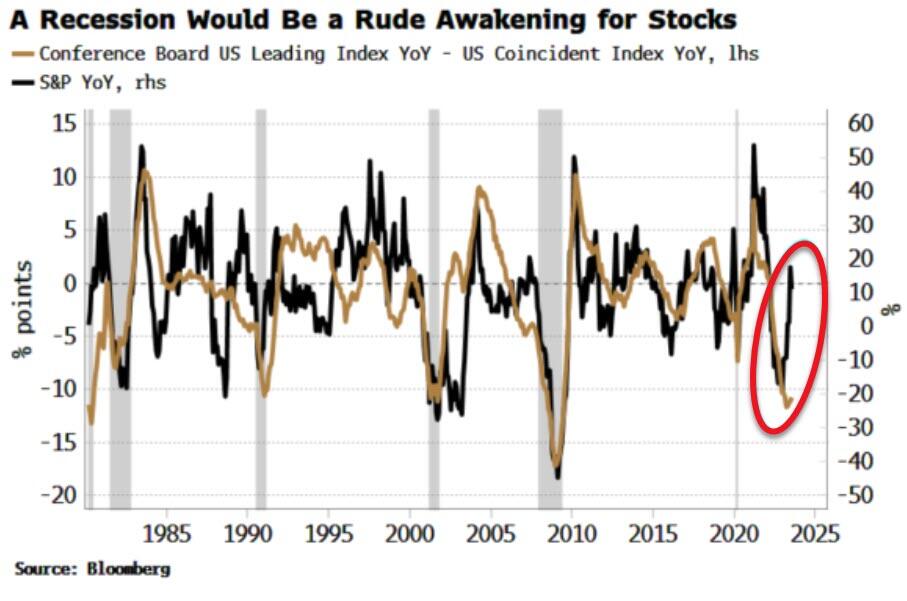
Stocks have been defying the very negative message from leading economic data for some time now.
The chart below shows the large divergence between the S&P and the ratio of the Conference Board’s Leading and Coincident Indexes. This also demonstrates that stocks have not insignificant potential downside if a recession suddenly looks more likely. (And when they happen, they tend to happen quickly.)
Stocks are also likely to run up against resistance from volatility trading.
The S&P rallied Tuesday but hit resistance at 4,500.
This is not uncoincidentally where there is a “call wall,” i.e. the strike where there is there is the most amount of calls outstanding. Option dealers have to sell at the strike to dynamically hedge.
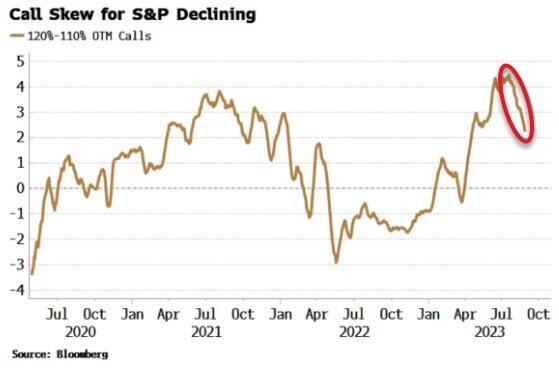
We could break through the wall, but the more fevered option trading we have seen in recent months – fueling the market’s rally – is dying down. Call skew became elevated, but is now clearly rolling over.
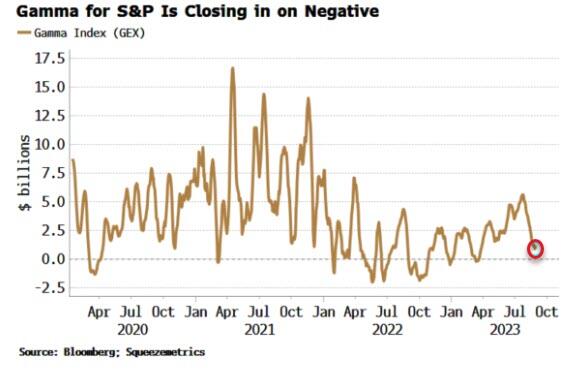
As a result gamma has been falling fast. On some banks’ estimates it is already negative, while Squeezemetrics’ Gamma Index has fallen quite rapidly and is now close to negative territory.
Negative gamma results in a more unstable market, with downside bias as option dealers’ short put-inventory becomes closer to the money.
With low volatility, more instability, and pricing that is not expectant of a near-term recession, risks are mounting for equities.

The Information : The Secret Sauce Morgan Stanley’s CEO Is Leaving for His Succe

The Secret Sauce Morgan Stanley’s CEO Is Leaving for His Successor

Over the past five years, Morgan Stanley CEO James Gorman spent $14 billion buying the pieces of what is now the world’s second-biggest provider of corporate stock plans. It was a bold bet to get an inside track to people sitting on valuable company equity who one day will be rich.

The business now oversees plans with 12 million individual participants at 2,100 public companies and 1,000 private companies, bank executives told The Information. Clients include Stripe, Uber and Dropbox. Now the open question is whether Morgan Stanley can convince those individuals to let it manage their wealth whenever they’re able to cash in on the equity.

THE TAKEAWAY
• Bank has 1,000 private companies as stock-plan clients
• Workplace business key to CEO’s goal of $10 trillion in client assets
• Gorman quietly built the No. 2 provider of stock-plan services

Gorman, who is stepping down within the coming year, envisions workplace stock plans as the main way Morgan Stanley will keep growing its wealth business, already one of the world’s largest with nearly $5 trillion in client money under management.

That’s a big departure from how the bank traditionally nabbed wealthy clients, who usually came through its financial advisers, and part of Gorman’s lofty goal of growing Morgan Stanley’s wealth and asset management businesses to $10 trillion in assets over the next five to 10 years. Wealth represents about $8 trillion of that goal.

Part of the appeal is that workers with equity in corporate stock plans tend to be younger—their average age is 40, the executives said, while typical clients of Morgan Stanley financial advisers have an average age of 60. If Morgan Stanley can hold onto the workers once their stock converts to cash, those customers will prove valuable for years to come. That could help boost profit margins in the wealth business to at least 30%—another goal Gorman set—up from around 25% now.

“If we get it right, if the formula works, we get the chance to be their wealth manager—from someone who just has $5,000 starting out, to the founders,” said Brian McDonald, who heads Morgan Stanley at Work.

Gorman’s grand plan dates back more than a decade, to when Morgan Stanley acquired brokerage firm Smith Barney, inheriting a small stock plan administrator as part of the deal. It would take years for Morgan Stanley to take full control of Smith Barney. In 2018, Gorman was ready to expand further. The bank started by buying Canadian stock-plan administrator Solium for $900 million. Two years later, in 2020, it added Barclays’ stock-plan business and another more sizable one through its $13 billion acquisition of E-Trade, better known as a low-cost online trading company. Last year Morgan Stanley also bought American Financial Systems for around $117 million.

Morgan Stanley has not ruled out another acquisition in the workspace realm, people familiar with the strategy said.

Morgan Stanley oversees $402 billion in unvested employee stock, as of June 30, and ranks No. 1 in stock-plan services and No. 2 among workplace providers, according to its own analysis. It competes against money managers like Fidelity, banks like UBS and Bank of America, benefits firms like Voya Financial and startups like Carta, which is popular with venture-backed private companies.

The bank earns fees for overseeing stock plans and advising companies on cap-table management, retirement plans, benefits and tax strategies. But the bigger play is when workers’ stock awards vest and they can sell, giving them money for other investments.

One customer using Morgan Stanley at Work is StockTwits, a stock and crypto trading platform and social network. While smaller than the typical Morgan Stanley customer, with around 60 employees, it uses Morgan Stanley because rival providers do not offer the same breadth of services and switching can be an expensive hassle, said StockTwits CEO Rishi Khanna. “You get all these other services from Morgan Stanley,” he said. “You get the wealth management; you get all the banking services."

Other companies that have used its services include Stripe, Uber, Dropbox, Shopify, Atlassian, Grammarly and Hootsuite. More than 260 companies that are now part of Morgan Stanley at Work went public between 2017 and 2021, before the IPO boom went bust.

Morgan Stanley faces a challenge in convincing people to keep money at the bank once their stock awards vest. E-Trade historically struggled to hold onto most of its workplace customers’ money, though that situation started to improve once Morgan Stanley bought it. The rate has so far doubled from 15% of client assets managed under E-Trade to 30% at Morgan Stanley.

“It’s a good strategy because they’re getting a first look at converting those people into clients,” said David Donovan, a consultant with Publicis Sapient who focuses on financial services. “It’ll still be incumbent upon them to create a service that resonates with the employees.”

Morgan Stanley has had some success in retaining those clients. It moved $150 billion from workplace customers into accounts with advisers over the past few years, Chief Financial Officer Sharon Yeshaya told analysts last month. Another $350 billion in vested shares shifted into Morgan Stanley brokerage accounts, teeing clients up for a pitch on the bank’s wealth services.

And the bank is working on different ways of keeping people. As soon as September it will be providing a single login for stock-plan customers and later do so across the Morgan Stanley wealth platform. That one sign-in is important because it can help customers see all available options without having to follow prompts that take them to new websites—the kind of friction that leads people to bounce rather than want to talk to an adviser or open a trading account.

Another important effort underway, Project Genome, uses machine-learning tools to analyze workplace customers, determine what products or services they may need and refer them to the appropriate adviser when it makes sense to do so.

However, the process is complex: The bank needs to make sure employers contractually allow Morgan Stanley to perform such an analysis, identify which employees are relevant and then convince them they should work with an adviser. From there it can figure out what wealth products they might want and find the best adviser for them to work with.

Once all of that occurs, Morgan Stanley can share data and analytics with the adviser for a sales pitch. But it has to do so in a way that doesn’t run afoul of data-privacy rules as well as fiduciary and suitability standards for how advisers can pitch clients. Genome is now deployed through the workplace business, but is not yet running at full capacity. The process requires a tremendous amount of work, sources said, and Morgan Stanley is still ironing out some of the kinks.

TechCrunch : OpenAI-backed language learning app Speak raises $16M to expand to

OpenAI-backed language learning app Speak raises $16M to expand to the U.S.

Speak, an English language learning platform backed by OpenAI’s startup investment fund, the OpenAI Startup Fund, today announced that it raised $16 million in a Series B-2 funding round led by angel investor Lachy Groom.

The co-founders of Dropbox, Drew Houston and Arash Ferdowsi, also participated in Speak’s tranche, which brings the startup’s total raised to $54 million. CEO Connor Zwick says that it’ll be used to support Speak’s launch in more markets, including in the U.S. by the end of the year. (Speak is currently live in around 20 countries including Japan, Taiwan, Germany, France, Brazil and Mexico.)

“It’s been incredible to see that the learning experience we spent years honing in a single market, South Korea, has proven to resonate with almost no modifications needed in markets and cultures across the globe,” Zwick said in a press release. “Looking ahead, we plan on bringing our AI-powered tutor to most major markets around the world by the end of this year, and are gearing up for a launch in the U.S., offering English speakers the ability to learn other languages.”

Speak was founded in 2016 by Zwick and Andrew Hsu. Zwick came from edtech — he sold his first startup, the flashcard app Flashcards+, to Chegg in 2013 — while Hsu has a background in neuroscience.

Zwick and Hsu met through The Thiel Fellowship originally. Prior to starting Speak, the pair spent a year studying and researching machine learning and developing accent detection algorithms using YouTube videos as training data.

With Speak’s app for Android and iOS, users can practice conversing in English through a collection of interactive speaking experiences. The app can hold open-ended conversations guided by an “AI tutor” on a range of topics while giving feedback on things like pronunciation, grammar and vocabulary.

The premise might sound like Duolingo and some of the other AI-driven language learning apps out there, such as Yanadoo, ELSA and Loora. But Speak has managed to hold its own despite the competition, becoming one of the top-downloaded education apps in South Korea, where it first launched, with well over 100,000 subscribers.

Speak claims that it’s helped nearly 6% of Korea’s population — ~3 million people — learn English.

After the investment from OpenAI, which gave Speak not only financing but early access to OpenAI systems and Azure resources from Microsoft, OpenAI’s close collaborator, Speak began tapping OpenAI’s AI technology for new capabilities and features.

In March, Speak upgraded its AI Tutor with OpenAI’s GPT-4 text-generating model, which Zwick said enabled “highly personalized and contextual” feedback for learners. “GPT-4 is able to generate text with a higher degree of accuracy and coherence, which allows for more natural, instructive interactions for learners,” Zwick wrote in a blog post. “This in turn translates to increased user engagement and better learning outcomes.”

Also in March, Speak adopted OpenAI’s Whisper API for multilingual speech recognition and collaborated with OpenAI on new plugins for ChatGPT, OpenAI’s viral AI chatbot. Speak’s plugin enables ChatGPT users to access a version of the startup’s language tutoring experience through ChatGPT and marked Speak’s first foray into teaching beyond English.

Speak isn’t the only language-tutoring app that’s been afforded early access to OpenAI tech — Duolingo was a launch partner for GPT-4. But according to Groom, Speak’s real differentiator is its commitment to low-cost language education.

“Education will continue to be a sector most profoundly transformed by AI,” Groom said in a statement. “Speak’s mission and approach to create a human-level, AI-powered tutor gives learners around the world access to conversational practice without paying a premium for a live tutor on the other end.”

WSJ : Saudi Arabia Is Dangling Billions for Research on Aging. Scientists Are Li

Saudi Arabia Is Dangling Billions for Research on Aging. Scientists Are Lining Up to Take It.
The kingdom’s plans to put more than $1 billion a year into global efforts on longevity stir anticipation—and hesitation around the country’s politics

RIYADH, Saudi Arabia—Vast oil wealth has enabled Saudi Arabia to establish dominant roles in global sports, electric cars and tech startups. The kingdom’s next target may be its most ambitious yet: extending the human lifespan.

Crown Prince Mohammed bin Salman, the de facto Saudi ruler, has allocated more than a billion dollars a year to an effort called Hevolution Foundation to develop new treatments for aging. That could dramatically expand the available global funding for research on longevity biology, which now comes mainly from the U.S. National Institute on Aging.

The prospect of a huge surge of funding into the area, whose budgets pale in comparison to research on diseases like cancer, is causing a stir among scientists who study aging.

“People in the field are kind of holding their breath to see how the money is going to be spent,” says Steven Austad, a researcher on aging at the University of Alabama at Birmingham and senior scientific director at the American Federation for Aging Research, or AFAR, a U.S. nonprofit that has received $7.76 million in funding from Hevolution.

The Saudi foundation’s chief executive, Dr. Mehmood Khan, says much of the initial grant money is likely to end up at universities and startups in the U.S., where scientists are trying to develop treatments that slow, prevent or even reverse the aging process for humans.

“It’s creating a more idealized funding situation,” says Martin Borch Jensen, chief scientific officer of San Francisco-based Gordian Biotechnology and president of Norn Group, a U.S. nonprofit with a grant program to which Hevolution has contributed $7 million.

For now, Hevolution’s biggest challenge is how to spend its money in a field that is still relatively small and in a world where many view anything Saudi Arabia does with suspicion.

Some institutions and individual researchers have been hesitant to establish ties with an absolute monarchy that brooks no dissent domestically and was spurned by the West after the killing and dismemberment of Saudi journalist Jamal Khashoggi in 2018. Recent injections of Saudi cash into U.S. golf and global soccer have sparked accusations that the kingdom is deploying its wealth to paper over human-rights abuses and boost its global image. Hevolution could face similar criticism but, still in its early stages, the project hasn’t attracted broad attention.

AFAR’s board had repeated discussions before accepting Saudi funding last year for 18 research projects in aging biology or geroscience but has since renewed its partnership for a second round of grants, according to officials there.

“In the beginning, people were skeptical, but I think a lot of that has kind of gone away because they see that we’re giving out the money,” says Stephanie Lederman, AFAR’s executive director. “We want to fund this science, it’s really important for the human race.”

Dr. Aditi Gurkar, an assistant professor of medicine at the Aging Institute, University of Pittsburgh, says she paused before applying for an AFAR grant funded by Hevolution but ultimately went ahead because of the Saudi organization’s collaborative and global approach to aging science. In April, she received a $375,000 grant to study with a physicist how nanoparticles could help detect cell senescence, a process in which cells stop dividing. It’s an innovative idea that she says would be difficult to secure funding for from traditional sources in the U.S.

When Norn Group announced Hevolution funding, some people objected to the Saudi ties, Jensen says, but he pushed past it because the organizations share a common goal.

“Our focus is on achieving that mission and improving human health and flourishing, which we’re committed to whatever the state of public opinion,” he says.

There is also some concern that the Middle East’s turbulent politics or a sharp change in the Saudi crown prince’s personal predilections could cut off funding unexpectedly.

Hevolution—whose name is a combo of “health” and “evolution”—aims to have a global impact, as Saudi Arabia looks to expand its influence around the world under its 37-year-old leader. Its mission could also resonate at home, where Mohammed has staked his credibility on boosting quality of life for a now overwhelmingly young population and building new industries away from oil.

The Saudi media ministry didn’t respond to requests for comment from the prince.

Established as a nonprofit in 2018 by Saudi royal decree, Hevolution doesn’t conduct its own research but instead aims to work with established institutions to pump money into underfunded areas of study. Its chief scientific officer, Dr. Felipe Sierra, ran the aging biology division at the NIA for more than a decade, and its scientific advisory board includes Dr. Thomas Rando, who directs the stem-cell research center at University of California, Los Angeles.

“We’re sort of doing the nontraditional approach. Who else might be able to solve the problem?” says Khan, the chief executive. “One of our goals is to actually attract new scientists—in terms of entering science—and scientists from adjacent fields that may not have data but their technologies could be relevant to solving.”

Since starting operations in July 2022, the Saudi foundation has focused mostly on establishing itself, dispersing less than $20 million. Khan expects that to ramp up toward $1 billion within the next two to four years. Initially, more of that money will go to research, but eventually the goal is for a roughly even split with investments into antiaging startups, he says.

Khan, who was chief scientific officer at PepsiCo, where he worked for more than a decade, says he wants to expand the field globally and pursue as many promising opportunities as possible. “We’re not saying epigenetic reprogramming is our first priority or autophagy is our first priority or senescence is our first priority,” he says, referring to three cellular processes that many scientists link to aging. “We’re looking at all of them.”

He would like to see Hevolution help identify biomarkers to track aging and also fund early large-scale human trials for existing repurposed drugs to treat aging. Those are two crucial areas that require substantial funding and are unlikely to generate quick profits.

Khan was born in Pakistan and grew up in England before moving to the U.S. He spent 1987 in Saudi Arabia and helped set up a medical residency program at the kingdom’s leading hospital, where Saudi rulers receive treatment. He later worked at the Mayo Clinic in Rochester, Minn.

“There’s a lot of snake oil” in the field, says Khan, 65, who also ran Boston-based biotech startup Life Biosciences for two years before joining Hevolution. “There’s loads of claims, and one of the things we always have to ask ourselves is ‘What is this based on, and is it legitimate? Is it anchored in real science?’”

Hevolution recently hired two investment partners and plans to announce its first direct investment before the end of the year after reviewing over 100 potential opportunities. It has registered a nonprofit entity in the U.S. and a limited liability corporation with an office planned for Boston and others to follow in Europe and Asia.
FT : What happens when AI passes through the ‘uncanny valley’?

What happens when AI passes through the ‘uncanny valley’?
Robots are close to being so convincing that we can’t tell them apart from humans — and that could be a problem

Back in 1970, a Japanese engineering professor called Masahiro Mori wrote an intriguing paper suggesting that a person’s response to a robot would shift from affinity to revulsion the more lifelike it became. He called this phenomenon the “uncanny valley”.

Children may love toy robots, which are hard to confuse with a living creature. But we feel much more uneasy when we see physical robots — or nowadays digital avatars — that closely resemble humans and realise they are not human. 

What happens, though, when our artificial creations become so convincing that they pass through the uncanny valley to the other side? For better or worse, we may soon find out, in the digital world at least. 

The release of powerful generative artificial intelligence image-creation tools, such as Dall-E 2 and Runway, has enabled the creation of some striking synthetic videos starring counterfeit humans, even if they are not yet good enough to be mistaken for the living thing.

Take The Frost, an experimental 12-minute film produced by the Detroit-based video company Waymark about environmental catastrophe. A human writer fed a script into Dall-E 2, which then generated every shot in the film. The result is an entertaining, if jarring, movie about stranded explorers in Antarctica that still looks more like an animated film than reality TV.

So unnerved are scriptwriters and actors by the growing use of AI that in the US they have gone on strike. They are calling for restrictions on the use of the technology by Hollywood studios and streaming services. But some independent film-makers at the Runway AI film festival in New York earlier this year raved about the possibilities of using generative AI models to accelerate the speed, reduce the costs and extend the creative possibilities of making films. “This is an incredibly exciting time. We have not seen anything like it,” said the film-maker Paul Trillo. 

In spite of recent advances in the technology, we are still a long way from generative AI being able to make entire films such as this summer’s hits Barbie and Oppenheimer. But these models are already being used to help create quirky music videos and commercial advertisements for the likes of Bud Light, Uber, Nike and Terry’s chocolate.

Some, such as Synthetic Summer, a surreal beer commercial produced by the London company Private Island that became an internet meme earlier this year, played up the weird imperfections of the technology as drinkers’ faces fused with their beer bottles. Exploring the uncanny valley can be an amusing experience, especially when drunk. 

More disturbingly, some politicians are also using generative AI to synthesise images. In June, the campaign team of the Florida governor Ron DeSantis released a video with apparently fake photos of Donald Trump embracing Anthony Fauci, the former chief medical adviser demonised by many Republicans for championing Covid lockdowns.

The costs of rapidly producing targeted videos at mass scale have plummeted. And the likelihood that such images will proliferate during the US presidential campaign has increased following the decision this week by X, formerly known as Twitter, to scrap its four-year-old ban on political advertising. 

Wasim Khaled, co-founder of Blackbird AI, a New York state-based start-up that helps counter misinformation, tells me we have already blown through the uncanny valley when it comes to still images. A survey by the Syzygy Group media company in Germany this year found that only 8 per cent of respondents correctly identified the photograph of a real human face when lined up against three other AI-generated images. It is only a matter of time before moving images pass through the uncanny valley, too.

But Khaled suggests that the internet has long warped our perceptions of reality anyway. The images of people we see most often are probably Photoshopped Instagram photos or touched-up covers of film stars in magazines and these are used to train AI. “AI is not a representation of humanity. It is a representation of the digital version of humanity, which is an aberration or an exaggeration of what we are,” he says.

That raises the possibility that we may be entering a world in which artificial versions of reality appear more real than reality itself. Alarming though that sounds, it would not strike some artists as odd. As Pablo Picasso once said: “Everything you can imagine is real.” And machines are inexorably extending the boundaries of our imaginations. 

FT : Turkish spending boom fuels strong expansion of economy

Turkish spending boom fuels strong expansion of economy
GDP growth of 3.8% beats forecasts on back of post-earthquake reconstruction and credit-fuelled consumption

Turkey’s economy grew more than expected in the second quarter, powered by higher consumer demand and government spending ahead of a May election, but analysts warned that tighter monetary policies would probably slow growth over the rest of the year.

Gross domestic product rose 3.8 per cent between April and June on an annual basis, according to the state statistics agency, outpacing analysts’ projections of 3.1 per cent in a Bloomberg survey.

Ahead of the May vote, President Recep Tayyip Erdoğan boosted stimulus spending, including lowering the retirement age and distributing free gas supplies, to shore up voter support. He also kept interest rates in the single digits to encourage spending but has since allowed rates to rise in an effort to tame soaring inflation.

Household consumption leapt 15.6 per cent in the second quarter, while public spending grew 5.1 per cent, Thursday’s data showed. Construction expanded 6.2 per cent as Turkey began a huge rebuilding effort in the wake of a devastating earthquake in February that killed more than 50,000 people and destroyed hundreds of thousands of buildings. 

“Our economy continued its strong growth performance in the second quarter when we tried to compensate for the economic effects of the earthquake,” said Mehmet Şimşek, who became finance minister after the election. “Our goal is for growth to be strong, but also balanced, sustainable and inclusive.”

After his re-election victory, Erdoğan appointed Şimşek and another former Wall Street banker, Hafize Gaye Erkan, as central bank governor, signalling a return to mainstream economic policies. He has permitted Erkan to raise interest rates by 16.5 percentage points to 25 per cent to tame runaway inflation that has unleashed a painful cost of living crisis.

However, Turkish inflation ended an eight-month decline in July as annual inflation rose to almost 50 per cent, illustrating the difficulties for Turkish monetary policymakers seeking to slow price growth in an overheating economy. 

Several economists expect the central bank to continue increasing the cost of borrowing this year, a move that is likely to slow, or even halt, economic growth. Goldman Sachs said last week it expected Turkey to slip into a recession this year.

Weaker global demand led to Turkish exports falling 9 per cent in the second quarter, the data showed. Declines in manufacturing output and consumer confidence suggested domestic activity might also be slowing, Haluk Bürümcekçi, economist at Bürümcekçi Research & Consulting, said in a note to clients. 

“The initial signals indicate a weakening of GDP growth in the third quarter,” he said. “The impact of tax hikes, macroprudential measures targeting consumer loans and credit cards and the slowdown in credit growth due to rising credit interest rates can all . . . curb domestic demand.”

But Erdoğan may still press his economic team to support rapid growth in the run-up to next year’s municipal elections. He has said he is determined to help the ruling party win back Istanbul, the country’s economic engine, from the opposition.