FT : Silicon Valley VCs tour Middle East in hunt for funding

Silicon Valley VCs tour Middle East in hunt for funding
Liquidity crunch leads investors such as Andreessen Horowitz to sovereign wealth funds in Saudi Arabia, Qatar and UAE

Silicon Valley investors are touring the Middle East, seeking to build long-term ties with sovereign wealth funds during the worst funding crunch for venture capital firms in almost a decade.

Top technology VCs such as Andreessen Horowitz, Tiger Global and IVP have jetted teams of executives to Saudi Arabia, the United Arab Emirates and Qatar in recent weeks, according to people with knowledge of the trips.

These visits come after their traditional North American and European backers contend with an economic downturn that has forced them to rein in private investments.

VCs are, in turn, being encouraged to come to the region, as Gulf officials and young royals seek to diversify their economy away from oil with investments into hot tech sectors such as artificial intelligence.

That has also meant that some VCs have quietly reversed earlier decisions to refuse meetings with, or cash from, Saudi Arabia over concerns about its human rights record following the 2018 murder of journalist Jamal Khashoggi.

“We came to San Francisco looking for them in 2017. Now . . . everyone is coming to [us],” said Ibrahim Ajami, head of ventures at Mubadala Capital, part of Mubadala Investment Company, a $284bn Abu Dhabi sovereign wealth fund. “The tech correction has humbled the industry.”

The Financial Times interviewed more than a dozen Silicon Valley VCs who control tens of billions of dollars between them, as well as a string of advisers and bankers. They describe a new love affair between US venture funds and Middle Eastern cash.

A group of Silicon Valley executives received a personal invite from the office of Yasir al-Rumayyan, the governor of PIF, the $620bn Saudi sovereign wealth fund, to be his guest at last month’s Formula One Saudi Arabian Grand Prix in Jeddah, according to a person with knowledge of the calls.

Among the attendees, according to the person, was Andreessen Horowitz co-founder Ben Horowitz — the veteran financier’s second trip to Saudi Arabia in less than six months. Andreessen Horowitz declined to comment.

PIF’s venture arm Sanabil recently disclosed its partnerships with nearly 40 US venture firms, including Andreessen Horowitz, Coatue Management, David Sacks’ Craft Ventures, Insight Partners and 9Yards Capital, where former UK chancellor George Osborne is a managing partner. The sums invested in the firms were not revealed.

Horowitz, whose San Francisco-based firm raised just over $14bn last year, in particular has become a vocal supporter of Saudi interest in tech innovation.

In October, he spoke at the “Davos in the desert” conference in Riyadh and had lunch with Princess Reema bint Bandar al-Saud, the Saudi ambassador to the US. At a conference organised by PIF last month in Miami, he praised the kingdom as a “start-up country” and likened its crown prince, Mohammed bin Salman, to a company founder.

A year ago, Horowitz’s trips to Saudi Arabia would have been an anomaly among VCs flush with cash and keen to avoid the moral predicament of dealing with states with poor human rights records. Now the oil-rich Gulf, which enjoyed a petrodollar windfall last year, is buzzing with US start-up investors, according to several people who have visited there this year.

“The Four Seasons in Riyadh is basically Palo Alto,” said a partner at one large Silicon Valley venture fund.

That willingness to do business in the region has led to some criticism. Founders Fund partner Keith Rabois, who said in 2018 that Silicon Valley had been hypocritical for accepting Saudi money, said, “I don’t change my values and principles because a funding environment is difficult.”

But Lead Edge founder Mitchell Green, who made venture investments in Alibaba and Uber, said he had spent the past few weeks “building long-term relationships” with people and companies in the Gulf. “We think it will become an increasingly important area of the world over the next decade. It reminds us of going to China in 2003.”

Tiger Global partner Scott Shleifer also spoke at the Riyadh conference in October, and the firm has been pursuing investment from the kingdom as part of its latest $6bn fundraising, according to people familiar with the matter. A team from IVP, one of Silicon Valley’s oldest venture firms, led by partner Somesh Dash, went on a tour of the region, according to one person with knowledge of the trip. IVP declined to comment.

US venture capital has exploded in size in recent years, in part fuelled by a boom in tech valuations during the coronavirus pandemic. Marquee funds that once prized exclusivity, such as Sequoia Capital and Andreessen Horowitz, have raised funds of as much as $5bn and sometimes as large as $9bn. That shift has been intensified by large entrants to the market, such as Japan’s SoftBank and Tiger Global, which have deployed tens of billions of dollars into start-ups.

“These guys have built their models on high-volume, high-velocity investors — now they are a prisoner to the capital cycle,” said a partner at a venture fund with more than $4bn under management.

Dealing with nations such as Saudi Arabia is the “Faustian bargain these firms have made by scaling up”, the partner added. “They went for ubiquity and market share and gave up on scarcity, and because of that they have to play the game of selling themselves. Venture capital went from being the Hermès Birkin bag of investing to Target.”

PIF, in particular, has gradually permeated US tech through its investments over the past decade. It contributed $45bn to the $100bn SoftBank Vision Fund in 2016. It has made large direct investments in US tech companies, including a $3.5bn investment in Uber in 2016 and more than $1bn in electric-car maker Lucid Motors in 2018. That same year, Elon Musk said he was in talks with PIF to help him fund a $72bn deal to take Tesla private, although a deal did not materialise.

In the wake of the murder of journalist Jamal Khashoggi by Saudi operatives in late 2018, a number of high-profile western businesses, including many tech investors, stopped publicly working with the country.

That continued until the recent economic downturn, which has meant pools of capital available for venture funds at large western institutions have dried up. Fundraising by venture capital firms hit a nine-year low at the end of 2022, according to research firm Preqin.

VCs are sitting on a record $300bn of “dry powder” — money raised that has not yet been deployed. But many are struggling to find lucrative investments in start-ups and will be unable to raise a new venture fund.

Cash that VCs put into start-ups has plunged more than 50 per cent over the past 12 months, according to data provider Crunchbase.


As a result, many have been lured back to the Gulf, which “is the most liquid place on the planet right now”, according to the head of a $1bn venture fund.

“This is a unique opportunity for funds like Mubadala to really take a leading role in the development of technology over the next 20 years,” Ajami said. Mubadala has invested in or alongside a number of big Silicon Valley firms, including private equity group Silver Lake and Sequoia Capital. It recently invested in fintech group Klarna alongside Sequoia.

Meanwhile, the Qatar Investment Authority said in 2019 it would raise investments in the US from $30bn to $45bn, including in technology.

For some investors, there remains a tricky moral debate. “The US is buying oil from Saudi, we’re selling them drones, where do you draw the line?” said one venture capitalist, who admitted they had shifted from a stance of never accepting Saudi money to being more open to it as fundraising had dried up.

For others, particularly those who control smaller funds and therefore have still been able to tap up western pension and endowment funds, the issue is more black and white.

“I’ve been in the Valley for 20 years and I’m increasingly disappointed with the way we behave,” said one senior banker who handles deals for venture firms. “If you’re really good at what you do, go to Norway [to raise money].”
FT : Tiger Global looks to cash in part of $40bn portfolio of private companies

Tiger Global looks to cash in part of $40bn portfolio of private companies
Technology-focused hedge fund aims to return money to investors by tapping secondary market

Technology-focused hedge fund Tiger Global is exploring options to cash in a piece of its more than $40bn portfolio of privately held companies, according to people familiar with the matter.

The New York-based investment group is working with an adviser to tap the so-called secondary market to help return money to some of its investors, the people said.

Talks are at an early stage and potential buyers have said that any deal would probably be complicated by difficulties valuing Tiger’s private holdings, which include stakes in companies such as payments business Stripe, US software group Databricks and China’s ByteDance, some of the people said.

Tiger declined to comment.

The decision to try and tap the private equity secondary market to generate cash highlights a growing problem private investment firms are facing: how to return money to their backers. Sources told the Financial Times that other large venture capital firms have also been studying similar sales of parts of their private portfolios.

Over the past few years, investors in fast-growing companies such as Tiger have been able to realise gains by taking companies public. However, initial public offerings have slowed over the past 18 months as investors grapple with wider inflationary pressures and stock market volatility.

Globally, the amount of money raised through IPOs in the first quarter of this year fell 61 per cent to $21.5bn against the same time period last year.

In a recent quarterly letter to investors, Tiger expressed optimism that some of its large private holdings such as Databricks would be able to list when equity markets reopened for public offerings.

“Our largest private holdings are generally capital-efficient or profitable market leaders awaiting an opportune window to complete public listings,” it told clients in a fourth-quarter letter obtained by the FT.*

The secondary market has become an increasingly popular tool to help firms return cash to their investors while public markets have been shut. It can also enable firms to hold on to private companies they own for longer periods than a typical fund structure usually allows.

Secondary deals have surged in recent years. Deals worth $105bn were struck last year, nearly five times the value of transactions in the space a decade before, according to a report published by Raymond James.

Founded in 2001 as a long-short hedge fund by Chase Coleman, Tiger expanded aggressively into private markets, particularly in China, in its early years. It eventually backed hundreds of fast-growing start-ups including Alibaba and JD.com, among others.

Over the past decade, the firm’s portfolio of stakes in privately held businesses grew to make up the bulk of its more than $60bn in assets, the FT reported in February.

Rising inflation and higher interest rates brought the firm’s push into early-stage investing to a juddering halt as shares in high-growth, speculative companies sold off sharply.

This prompted investors in private markets to also write down investments in unlisted technology groups.

In 2022, Tiger’s flagship fund suffered its worst annual loss, losing more than 50 per cent of its value as Tiger marked down its unlisted holdings by nearly 20 per cent. Some of its funds have recorded small gains for unlisted assets this year, however.

WSJ : TikTok Feeds Teens a Diet of Darkness

TikTok Feeds Teens a Diet of Darkness
Self-harm, sad-posting and disordered-eating videos abound on the popular app

Calls to ban TikTok in the U.S. are growing louder. Government leaders are trying to keep the popular China-owned social video platform away from schools, public workers, even entire states, on the grounds that users’ data could wind up in the wrong hands.

Data privacy, though, might be less worrisome than the power of TikTok’s algorithm. Especially if you’re a parent.

A recent study found that when researchers created accounts belonging to fictitious 13-year-olds, they were quickly inundated with videos about eating disorders, body image, self-harm and suicide.

If that sounds familiar, a Wall Street Journal investigation in 2021 found that TikTok steers viewers to dangerous content. TikTok has since strengthened parental controls and promised a more even-keeled algorithm, but the new study suggests the app experience for young teens has changed little.

What teens see on social media can negatively affect them psychologically. Plenty of research backs this up. The simplest evidence may be found in my earlier column about teens who developed physical tics after watching repeated TikTok videos of people exhibiting Tourette Syndrome-like behavior.

A TikTok spokeswoman said the company has a team of more than 40,000 people moderating content. In the last three months of 2022, TikTok said it removed about 85 million posts deemed in violation of its community guidelines, of which 2.8% were suicide, self-harm and eating-disorder content. It also considers the removal of content flagged by users. “We are open to feedback and scrutiny, and we seek to engage constructively with partners,” the spokeswoman added.

After the researchers published their findings, many of the videos they flagged disappeared from TikTok. Many of the accounts that posted the material remain. Those accounts include other videos that promote restrictive diets and discuss self-harm and suicide.

TikTok does take down content that clearly violates its guidelines by, for instance, referring directly to suicide. Videos where people describe their own suicidal feelings, however, might not be considered a violation—and wouldn’t fall under moderator scrutiny. They could even be helpful to some people. Yet child psychologists say these too can have a harmful effect.

TikTok executives have said the platform can be a place for sharing feelings about tough experiences, and cite experts who support the idea that actively coping with difficult emotions can be helpful for viewers and posters alike. They said TikTok aims to remove videos that promote or glorify self-harm while allowing educational or recovery content.

The company said it continually adjusts its algorithm to avoid repeatedly recommending a narrow range of content to viewers.

‘Sad and lonely’
The Center for Countering Digital Hate shared its full research with me, including links to 595 videos that TikTok recommended to the fake teen accounts. It also provided reels containing all of the videos, some of which are no longer on the site. I also looked at other content on the accounts with flagged videos.

After a few hours, I had to stop. If the rapid string of sad videos made me feel bad, how would a 14-year-old feel after watching this kind of content day after day?

One account is dedicated to “sad and lonely” music. Another features a teenage girl crying in every video, with statements about suicide. One is full of videos filmed in a hospital room. Each of the hospital videos contains text expressing suicidal thoughts, including, “For my final trick I shall turn into a disappointment.”

Users have developed creative ways to skirt TikTok’s content filters. For instance, since TikTok won’t allow content referencing suicide, people use a sound-alike such as “sewerslide,” or just write “attempt” and leave the rest to the viewer’s imagination. Creators of videos about disordered eating have also evaded TikTok’s filters.

Policing all the content on a service used by more than one billion monthly users is no easy task. Yet there is a difference between stamping out harmful content and promoting it.

“If tech companies can’t eliminate this from their platforms, don’t create algorithms that will point kids to that information,” said Arthur C. Evans Jr., chief executive of the American Psychological Association.

What parents can do
Watch what your kids are watching. Ariana Hoet, a pediatric psychologist at Nationwide Children’s Hospital, recommends asking your teens to show you their For You page. If you spot harmful content, it is an indication they’re likely engaging with that type of content. That can give you an opening to start a conversation about it.

Set up Family Pairing. Parents can set up their own TikTok account and use the app’s Family Pairing to restrict age-inappropriate content and limit the time their teens spend on the app.

Filter the feed. People can filter out videos containing words or hashtags they don’t want to see. If content is still slipping through, teens can tap “not interested.”

Refresh the feed. Some teens have told me their feeds became so problematic they closed their accounts and started over. Teens can now refresh their feed without creating a new account. Once again, they must be careful what content they like or linger on, because new rabbit holes are forming all the time.

>>> Recession Odds Rise To Highest In 40 Years: Fed

Recession Odds Rise To Highest In 40 Years: Fed

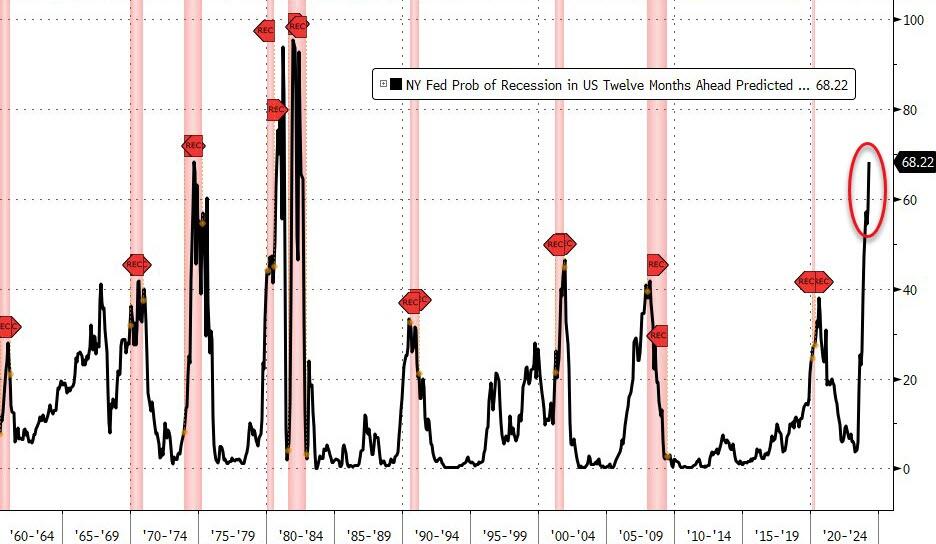
The odds that the United States will fall into a recession at some point over the next 12 months have risen to a 40-year high, according to a probability model from the New York Federal Reserve.

The probability that the country will enter a recession within the next year has risen to 68.2 percent, according to the New York Fed, which is the highest level since 1982.

The Fed’s recession risk indicator is now greater than it was in November 2007, not long before the subprime crisis, when it stood at 40 percent.
The recession model is based on the spread between the three-month and 10-year yields on U.S. Treasurys.

For months, the U.S. economy had been projected to show slowing real GDP growth and labor market softening.

Amid the banking sector turmoil sparked by the collapse of Silicon Valley Bank, economists at the Federal Reserve have projected a shallow recession.
“Given their assessment of the potential economic effects of the recent banking-sector developments, the staff’s projection at the time of the March meeting included a mild recession starting later this year, with a recovery over the subsequent two years,” stated the minutes from a March meeting of the Federal Open Market Committee (FOMC).

There has been a growing chorus of experts who believe that the odds of a recession are high.
Former Treasury Secretary Larry Summers said he thinks the chances are “probably about 70 percent.”
“The chance that a recession will have begun this year in the U.S. over the next 12 months is probably about 70 percent,” Summers said in a recent interview with Foreign Policy.
“As I put together the lags associated with monetary policy, the credit crunch risks, the need for continuing action around inflation, the risk of geopolitical or other shocks affecting commodities, 70 percent would be the range that I would be in.”

Economists at Capital Economics published their latest quarterly U.S. economic outlook report, warning that the “acute bank stress” will result in “further tightening” of credit conditions, leaving them “even more convinced that the economy will fall into recession this year.”

ING economists are also “more convinced than ever” with their prediction of a recession, citing in a research note the financial turmoil and the Fed’s monetary policy tightening.

A recent poll showed that most Americans believe that the country is headed for a recession—or has already fallen into an economic downturn.

Pessimism about the economy hit a record high amid rampant price inflation, rising interest rates, and growing recession concerns, according to the latest CNBC All-America Economic Survey.

The survey showed that 69 percent of U.S. adults have negative views about the current economic landscape, which is the highest figure since the survey began 17 years ago.

The elevated recession risk comes amid a debt ceiling standoff in Washington.

Debt Ceiling Deadlock
The Treasury Department has warned that the United States could default as soon as June 1 if no deal is reached.

The White House has put out an analysis that said even a “short” default could eliminate half a million jobs and that a “protracted” one could cost 8.3 million jobs.

When the United States reached the $31.4 trillion debt cap in January, the Treasury Department started resorting to “extraordinary measures” to keep making payments on outstanding federal debt obligations and keep the government from defaulting.

At some point, however, the scope to continue with those accounting maneuvers will run out and the government will face the prospect of being unable to meet its financial obligations—a moment known as the X-date.

When the X-date is reached and there’s no agreement in Congress to lift the cap, the Treasury Department will be unable to issue any more bills, bonds, or notes and can only make payments on the government’s debt obligations from incoming tax revenues.

After a three-month hiatus, negotiations on raising the debt cap resumed on May 9 between President Joe Biden and House Speaker Kevin McCarthy (R-Calif.), but they ended with no breakthrough.

Biden has insisted on a clean bill to raise the borrowing limit, while McCarthy and House Republicans have put forward a proposal that would pair lifting the cap by $1.5 trillion with $4.5 trillion in spending cuts over a decade. The president has rejected the GOP proposal and vowed to veto it if it reaches his desk.

WSJ : Adani Companies Plan $2.6 Billion Stock Sale in Wake of Market Rout

Adani Companies Plan $2.6 Billion Stock Sale in Wake of Market Rout
The Indian conglomerate was hit hard by a short-seller report earlier this year

Two companies in India’s Adani Group are planning to raise as much as $2.6 billion from share sales, months after a scathing short-seller report led to a sharp loss in the conglomerate’s market value.

Adani Enterprises, the group’s flagship company, wants to raise $1.6 billion through a secondary share sale while electricity generator Adani Transmission 539254 -3.49%decrease; red down pointing triangle is planning a $1 billion deal, they said through separate filings on Saturday. The two companies will need shareholder approval for the deals to go ahead.

Adani Enterprises canceled a previous plan to raise as much as $2.5 billion from investors on Feb. 1, just over a week after U.S.-based short seller Hindenburg Research published a report accusing the conglomerate of market manipulation, among other things. Adani Group 512599 -1.00%decrease; red down pointing triangle has denied the allegations.

The Hindenburg report caused the seven listed companies bearing Adani’s name to lose around half of their market value—and led to a sharp loss of wealth for Gautam Adani, the group’s 60-year founder. Mr. Adani and other executives have since taken steps to soothe investors’ nerves, including taking a series of trips to meet bond investors and announcing the early repayment of around $2.65 billion of debt backed by Adani shares.

They have also attracted a $1.9 billion investment from GQG Partners, a Fort Lauderdale, Fla.-based asset manager. The firm bought shares in various Adani companies from a trust linked to the Adani family.

The Hindenburg report led to a fallout beyond the stock market, with politicians from India’s opposition parties disrupting to put pressure on the government to investigate the accusations and the country’s Supreme Court opening a probe into the market unrest. The court is waiting for a report from the country’s market regulator, which has asked for more time, citing difficulties in obtaining the information it needs.

Hindenburg, founded by activist investor Nathan Anderson, has published several high-profile reports that have had a major impact on stock prices. On May 2, the firm targeted Icahn Enterprises, the vehicle of veteran activist investor Carl Icahn. The company’s shares lost more than a third of their value in the days after the report was published, although they have since recovered some of that loss.

Both Adani Enterprises and Adani Transmission plan on raising funds through so-called qualified institutional placements, which restrict them to selling shares to domestic investors.

Adani Green Energy, the group’s renewable-energy unit, was also considering a similar plan but is postponing the decision until May 24, the company said in a filing.

Earlier this month, Adani Enterprises reported a jump in quarterly earnings compared to last year. Adani Transmission is due to release its quarterly results next week.

Adani Group didn’t immediately respond to a request for comment.

FT : DMG Mori tracks use of its machine tool products to prevent military applic

DMG Mori tracks use of its machine tool products to prevent military application
German-Japanese company’s move comes in wake of rising geopolitical tensions

DMG Mori, one of the world’s largest manufacturers of advanced machine tools, has started tracking the use of its products to ensure they are not applied to military purposes at a time of rising geopolitical tensions.

The German-Japanese company asked clients worldwide from April to install a remote management system that would switch off equipment if it were removed or dismantled.

In a letter sent in late March and seen by the Financial Times, DMG said the installation of the system was aimed at preventing its equipment from being “illegally transferred to individuals or countries that may threaten international security”.

The letter added that the company would refuse to reactivate the equipment if its use violated “applicable export rules”. DMG makes a machine tool used to manufacture everything from passenger cars to fighter jets.

In response to a query from the FT, DMG said it had made the decision to implement the new measures “due to the global political situation — and certainly due to the outbreak of the Russian war in Ukraine”, adding that it was making sure no “misappropriation of our machines takes place”.

The move by DMG, which was created through the merger of Japanese Mori Seiki and its German rival Gildemeister, comes as tensions rise between the EU and China over the war in Ukraine. China’s foreign minister on Tuesday condemned EU proposals to impose sanctions on Chinese companies for supporting Russia’s war machine, vowing to react “strictly and firmly” to defend its businesses.

About a quarter of DMG’s sales are made in Asia. The company does not provide separate figures for its China business.

China was Germany’s top trading partner for the seventh year in a row in 2022, serving as a vital market for German car producers in particular. But western concerns about dependence on Beijing, driven by the US, have been deepened by the fallout from the Covid-19 pandemic and Russia’s war in Ukraine.

Security concerns have prompted Berlin in recent months to reconsider the use of Huawei equipment in the German telecoms network and review a decision to allow the Chinese shipping company Cosco to buy a stake in a Hamburg port terminal.

“While the requirement may apply to many countries, it will affect China the most since Chinese civil-military fusion factories had a history of buying DMG machineries,” said a former DMG China executive. “We had for years feigned ignorance of where our products were deployed in China.”

Liu Hanyu, an analyst at Daxue Consulting in Shanghai, said more western machine-tool makers would follow in DMG’s footsteps. This, according to a report last month from Guangzhou-based GF Securities, will create “a huge risk” for exporters of high-end machine tools to China.

Foreign brands accounted for 60 per cent of China’s five-axis machine-tool sales last year, while DMG took 17 per cent of the market in the same year, according to QY Research, a California-based consultancy. Chinese machine-tool users said the latest mandate from DMG might encourage them to increase purchases from local suppliers.

James Wei, an engineer at a Guangdong-based manufacturer that has worked with western machine-tool makers, said at least two local brands could serve as a substitute for DMG. “There is an urgency to reduce our reliance on foreign equipment,” said Wei.

Yet the switch to local brands could come at the expense of quality. “The design of the Chinese machines is nice and great,” said Raffaello Martini, production director at Ibarmia China, a Spanish machine-tool maker. “But you also need to have a strong body to meet the requirements of the market.”

That has put Chinese machine-tool users in a tricky position. “We need to learn to work with the second-best machine tool in the foreseeable future,” said an engineer at a Chinese aircraft maker.

FT : Cash-strapped Novavax urges governments to honour Covid jab deals

Cash-strapped Novavax urges governments to honour Covid jab deals
US biotech group is among coronavirus vaccine makers struggling with reduced demand post-pandemic

The new chief executive of Novavax has urged governments to honour Covid-19 vaccine purchase commitments as the once high-flying US biotech battles to stay afloat amid a collapse in demand for jabs.

John Jacobs told the Financial Times there was no guarantee governments would deliver on all their existing commitments with the company, which include $2.1bn in advanced purchase agreements signed with the US biotech group stretching into 2025.

“We had to invest billions . . . to deliver a vaccine that helped to stem the tide of a global pandemic that was killing millions of people,” said Jacobs, who replaced Stan Erck as Novavax’s chief executive in January.

“And then to all of a sudden say: ‘Well you spent all your money, you committed to protect our citizens. Now we don’t think we need it as much. Sorry, you’re out of luck.’ That’s probably not good for long-term relationships and that type of thing and to benefit public health,” he said.

Novavax is one of a handful of vaccine makers, along with BioNTech/Pfizer and Moderna, which are approved to supply Covid jabs in the US, EU and other western countries. All providers are facing steep falls in sales due to weak demand, which is contributing to a supply glut that has left billions of vaccine doses unused.

This has prompted governments to renegotiate billions of dollars of supply contracts with manufacturers, a move that analysts warn could pile further pressure on cash-strapped Novavax.

“The drive to renegotiate agreements is not unique to Novavax but they are more pressed against a wall because of their difficult financial situation,” said Brendan Smith, analyst at Cowen, an investment bank.

Novavax said in December it would repay the UK government $112.5mn following its decision not to exercise an option in its contract to buy additional vaccine doses. The company also faces a $700mn arbitration process linked to its cancellation of a vaccine contract with Gavi, an international body providing vaccines to poor countries.

Novavax’s market capitalisation soared above $20bn when it developed Nuvaxovid, a Covid jab made using a traditional protein-based vaccine process rather than the messenger RNA technology used by BioNTech/Pfizer and Moderna. But the 36-year-old company’s valuation has since crashed below $1bn, due to delays in launching the vaccine, tough competition from rivals and weak demand for Covid jabs.

Novavax warned in February that there was “substantial doubt” about its future and Jacobs recently detailed plans to slash costs by up to 50 per cent and reduce the company’s 2,000-strong workforce by a quarter.

Novavax’s cash reserves fell to $637mn at March 31, down from $1.3bn at the end of December. Current liabilities are almost $2bn, which include the Gavi arbitration process.

Jacobs said he was prioritising cutting costs, developing and launching an updated version of its jab in time for the autumn vaccination season and meeting revenue guidance of between $1.4bn and $1.6bn in 2023.

He said most partners were moving to protect long-term relationships with the biotech industry in the knowledge that the next pandemic could be “right around the corner”.

Jacobs said Novavax expected to deliver on the $800mn advanced purchase agreements with the EU, Australia, Canada and New Zealand, which are due for delivery this year. He added that the company was negotiating with some customers about amending 2024 and 2025 purchase agreements, which could result in changes to delivery schedules and, in some cases, accelerated upfront payments to Novavax.

Roger Song, analyst with Jefferies, said any renegotiation sought by countries due to the current vaccine supply glut posed a risk to Novavax. But it could also provide some near-term benefits in terms of cash flow, citing a $100mn payment paid this quarter in relation to a renegotiated purchase agreement.

“Countries can renegotiate but they will probably need to pay a portion of their contracts to compensate Novavax,” said Song.

The EU is renegotiating its vaccine contract with BioNTech/Pfizer, which has raised concerns among rivals that it could push them out of the lucrative market. Details of a draft deal reported by the FT suggest that BioNTech/Pfizer could supply as many as 70mn doses a year until 2026, leaving little room for Novavax, Moderna or Sanofi.

Jacobs said policymakers had a strong desire to maintain diversity in the Covid jab market by ensuring there was an alternative to the mRNA jabs provided by BioNTech/Pfizer and Moderna. Novavax was working closely with regulators to ensure market access, and so that it could update its vaccine to target new Covid strains in time for the autumn, he said.

“Imagine if we get a pathogen where that [mRNA] product somehow can’t work as well as we would expect it to. And you don’t have diversity and tools, and even enough volume to support people in countries that don’t have the money that we’re fortunate enough to have in the United States and western Europe,” he said.

Jacobs said he had no regrets about joining Novavax at a time when it was struggling. “To me it seemed like a great opportunity for a turnround.”

>>> Barron’s Weekend Summary

Barron’s Weekend Summary: SpaceX is the most valuable space company in the world—and it might offer Elon Musk the key to unlocking his empire

Cover Story:
-SpaceX is the most valuable space company in the world—and it might offer Elon Musk the key to unlocking his empire. The problem, though, it’s privately held, and therefore illiquid. When Musk needs money, his only option is to sell Tesla stock. That was the case from April to December 2022, when Musk was forced to sell some $23B in Tesla shares to keep Twitter afloat, one of the reasons the stock tumbled more than 50% during that period. What Musk really needs is another publicly traded company that would allow him to unlock some of his wealth—and take the pressure off Tesla. And that’s where SpaceX comes in. To call the company wildly successful would be an understatement. SpaceX has been sending astronauts to the International Space Station and surrounding the Earth with its Starlink satellites, and has even revived the US’s moribund space program and restored it to global launch dominance. Its businesses are starting to make money, too. Each launch could bring in from $150 million to $300 million in sales, and Starlink was sporting one million subscribers at the end of 2022. An initial public offering isn’t out of the question, and it might be just what Musk and Tesla shareholders need.

Interview:
-This week, Barron’s interviews Rayna Lesser Hannaway, a portfolio manager and analyst at Polen Capital, which oversees about $61B in mutual funds and separately managed accounts. The goal is to find high-quality companies early, she says, “and begin to enjoy their great long-term compounding.” Hannaway has been doing just that for more than 25 years, including the past six at Polen, where she runs about $400 million and manages two mutual funds, the $81 million Polen US Small Company Growth fund and Polen US SMID Company Growth, a $20M institutional fund launched in 2021. It has been a challenging few years for small-cap stocks. In the interview, Hannaway explained how she picks stocks and why she expects small-caps to rally. She also discussed three small companies poised to grow much larger in coming years.

Tech Trader:
-This past week at the Google I/O developers conference in Mountain View, Calif., Google was back with another round of demos and announcements about artificial intelligence, and this time, the company got it right. Alphabet CEO Sundar Pichai delivered the first part of the two-hour keynote, and he nailed it. Alphabet stock rallied 8% in two days following the flurry of announcements. Google has effectively erased Wall Street’s fear that Microsoft might have gained the upper hand in AI. In fact, Alphabet shares are now higher than before rollout of the new Bing. “Google just took that narrative back. We don’t believe there will be only one AI winner,” Evercore ISI analyst Mark Mahaney wrote in a research note following the Google event. “We just believe the narrative that Google would be generative AI roadkill was just plain wrong.”

The Trader:
-Many expect the stock market to crash. But what if it took a bullish turn instead? One reason that a bull market may be within the realm of possibilities is that the now slowing inflation points to the possibility of a Fed pause coming at next month’s Federal Open Market Committee meeting. Futures-market pricing implies a greater than 90% likelihood of the Fed holding the federal-funds rate steady in June at a target range of 5.00% to 5.25%. There’s still time for that to change, especially with May’s employment and inflation figures due before the meeting. Stocks have historically done well during a Fed pause, writes Jonathan Golub, chief US equity strategist at Credit Suisse, who notes that the S&P 500 has returned 16.9% on average in the 12 months following the last interest-rate hike of a cycle, while losing 1% on average in the year after the first rate cut.
-Carl Icahn’s holding company, the famed corporate raider known for high-profile activist campaigns dating back to the 1980s, is under attack by short sellers, prompted by a lengthy report published by Hindenburg Research. At first glance, Icahn Enterprises, which has dropped 36%, to $32, since Hindenburg’s short report was issued on May 2, doesn’t look all that controversial. Holdings include an energy company, the Pep Boys chain of auto parts and service stores, a pharma company, and real estate. Icahn Enterprises also owns shares in several publicly traded companies, including FirstEnergy, Xerox Holdings, and Newell Brands. It has a market capitalization of around $13B. On April 28, it was trading at $50.29, right about where it had been in September 2021. The Hindenburg report faulted Icahn’s recent investing track record and claimed Icahn Enterprises was overvaluing its stakes in private businesses. But mainly, Hindenburg’s Nathan Anderson took issue with the fact that Icahn Enterprises had been trading for around 3.2 times its net asset value, or NAV—an unusual premium.

Features:
-Fans of Topgolf Callaway Brands, one of the few pure-play golf stocks, think it can deliver the investment equivalent of a hole-in-one. But lately, the performance of its shares has resembled a poorly struck shot into the deep rough. The stock lost 13%, to $18.80, on May 10, the day after Topgolf reported first-quarter results, and closed on Friday at $17.28. While earnings, at 17 cents a share, beat the consensus 15 cents estimate, the positive news was accompanied by reduced guidance for one segment of operations, and Wall Street likes lowered guidance the way players in the PGA tournament, which starts next week, like sand traps and water hazards.
-Late on May 12, a panel of experts voted to recommend speedy approval of a gene therapy for muscular dystrophy. Stock in Sarepta Therapeutics had been halted all Friday, as the biotech company faced a reckoning. The Food and Drug Administration convened a panel of outside experts to vote on whether the agency should accelerate approval of Sarepta’s pioneering gene therapy for the fatal disease Duchenne muscular dystrophy. Despite FDA staff criticism of Sarepta’s study data, the advisers voted 8 to 6 to recommend approval. FDA leaders must decide whether to grant an “accelerated” approval by May 29, although the agency isn’t bound by Friday’s advisory vote. FDA leaders have overruled their own staff’s skepticism in the past to allow treatments for dire diseases.

European Trader:
-The Bank of England lifted its key interest rate by a quarter-point on Thursday, matching the pace of the Federal Reserve and the European Central Bank this month. Governor Andrew Bailey hinted that there could be more hikes to come. The UK is dealing with the fastest inflation among the Group of Seven nations, with annual price gains north of 10%. As Britons fret about a national cost-of-living crisis, nurses, train drivers, and teachers are going on strike for higher pay, underscoring the challenge the BoE faces in bringing inflation back down. “If there were to be evidence of persistent pressures, then further tightening in monetary policy would be required,” Bailey said at a press conference. The increase marks the 12th consecutive move after the central bank started tightening in December 2021—a few months earlier than the Fed. It puts the main BoE rate at 4.5%. That’s higher than the ECB’s main rate of 3.75%, but below the Fed’s range of 5% to 5.25%.

Emerging Markets:
No updates in this section

Commodities:
-The price of raw sugar has surged to levels not seen in more than a decade after bad weather withered harvests from some of the world’s biggest producers. At the same time, demand remains strong as refined sugar is an important ingredient for baked goods, candy and soft drinks, while sugar cane is used to produce ethanol fuel. In recent weeks, the raw sugar-cane futures contract—the international benchmark—for delivery in May, surged to more than 27 cents a pound, the highest level since October 2011. On Thursday, the futures contract for July delivery closed just above 26 cents a pound in New York. Refined sugar prices are also rising, which could feed into higher retail prices for goods in grocery stores.

Streetwise:
-This week, Jack Hough notes that Ford Motor has two anniversaries coming up, one of which is cause for celebration. The company was founded 120 years ago next month. Its $12 stock, meanwhile, first hit that level 37 years ago next January, adjusted for splits and spinoffs. Longtime Ford Motor shareholders who have been reading about rampant auto inflation must wonder when some of it will seep into their brokerage accounts. Jim Farley, Ford’s chief executive officer since 2020, spoke to Jack Hough told me this past week about shortages, pricing, robodriving, and more. Ford is still producing 10% fewer vehicles than it would like, but shortages have shifted to general parts from chips, says Farley. Dealer profit margins have started to come down, but Ford is still “at the very high end of the pricing.” Farley says he is “very encouraged that everyone’s going to keep their stocks a little lower than in the past.” Loan rates and car payments are up. Economy cars are scarce. Ford got out of sedans before the pandemic, starting in 2018.

>>> Weekend Papers Summary

Weekend Papers Summary

NEW YORK TIMES
-Ukraine’s Advances near Bakhmut Expose Rifts in Russian Forces
-Russia’s pro-war bloggers were quick to claim that Ukraine’s long-anticipated counteroffensive had begun, but Ukrainian officials downplayed the moves.
-Ukraine’s offensive could set stage for diplomacy with Russia, US Officials Say.
-Aides of President Biden have been exploring potential endgames to identify an outcome that could be acceptable to both Kyiv and Moscow if real peace talks started.
-Pandemic-era restrictions were lifted without a fresh spike in border crossings. Thousands of asylum seekers now find themselves in a holding pattern.
-Despite the relative calm, the Biden administration faces court challenges that they say may undermine efforts to deal with record levels of crossings.
-Daniel Penny arraigned on manslaughter charge in Jordan Neely’s killing. The Manhattan district attorney’s office charged Mr. Penny with second-degree manslaughter for choking Mr. Neely to death on the subway.
-Turkey’s President Amassed Power. He Could Still Lose This Election. President Recep Tayyip Erdogan has tilted the political playing field in his favor over the past two decades, but he faces a stiff challenge in Sunday’s election.
-Striking writers’ union denies waiver, imperiling Tony Awards. The Writers Guild of America indicated it would not grant a waiver to allow a live telecast of the Tonys on June 11.
-Lin-Manuel Miranda joined members of Actors’ Equity at a rally in support of the Writers Guild of America. Jay-Rey Rivera
-The FDA has approved a new drug to treat hot flashes in menopausal women. It’s the first nonhormonal treatment for the symptoms of overheating of the upper body and sweating that can be disruptive to daily life for years.
-As Mayor Eric Adams began speaking at the CUNY commencement, many of the graduates, in their caps and gowns, turned away from him in a show of protest.
-Elon Musk appoints Linda Yaccarino as Twitter’s new chief executive. Musk said Ms. Yaccarino, who had been NBCUniversal’s advertising chief, would focus on business operations and that he would work on product design.
--Behind New Indictments of El Chapo’s Sons, rivalry seethed between agencies. When charges against the Chapitos were announced last month, the Justice Department presented a unified front. It was another story behind the scenes.

THE FINANCIAL TIMES
-Russia’s defense ministry claimed a long-awaited Ukrainian counter-offensive had begun, pointing to intensifying attacks in eastern Ukraine over the past 48 hours. The ministry on Friday said Ukraine had launched 26 assaults along a 60-mile stretch of the frontline near Bakhmut and the nearby town of Soledar, involving more than a thousand troops and up to 40 tanks. It conceded that Russian troops had redeployed to “more advantageous” positions in some locations but said it had stopped Ukrainian forces from making any breakthroughs.
-While former Pakistani prim e minister Imran Khan was in confinement, some of his supporters had clashed with the police and burnt their vehicles, leaving at least five dead across Pakistan. There had even been attacks on army buildings — unprecedented in a nation where the generals sit above politics, but run the show behind the scenes.
-Elon Musk has appointed Linda
Yaccarino, as CEO of Twitter. Yaccarino is a towering figure in advertising and has deep relationships with marketers and advertising agencies, as well as ties to the traditional fixtures of global business such as the World Economic Forum, where she is an executive chair.
-The Congressional Budget Office has warned there is a “significant risk” that the US government will be unable to “pay all of its obligations” in the first two weeks of June if the debt ceiling is not raised. The intervention by the government spending watchdog reinforces US Treasury secretary Janet Yellen’s warning that the federal government could be heading towards an unprecedented default as soon as June 1.
-Clean energy analysts have warned new US rules designed to speed up a reshoring of clean energy supply chains will do little in the short term to break their dependence on imports from China. The Treasury department on Friday issued new guidance that would only allow US-based solar developers to secure tax credits offered in the Inflation Reduction Act if they made their cells domestically.
-Lawyers for the Mirror newspaper group accused Prince Harry and three other claimants of engaging in a “highly publicized smearing” of its former board at the High Court in London on Friday. The court is hearing a high-profile lawsuit brought by the prince and three others alleging that Mirror Group Newspapers unlawfully gathered information at its three titles for almost 20 years — between 1991 and 2011 — including through phone hacking and use of private investigators.
-Turkey’s big political parties are gearing up for an election mission like no other this weekend: helping a million people who fled after February’s devastating earthquake return to their ravaged hometowns, find their local school buildings, and vote. Polls suggest this number of voters could be a significant force in Turkey’s most tightly contested — and consequential — electoral race in a generation, pitting Recep Tayyip Erdogan, Turkey’s leader for two decades, against Kemal Kiliçdaroglu, who is representing an opposition alliance. The earthquake covers 11 provinces which produced sharply varying results in the previous presidential election.
-President Joe Biden on Friday officially nominated Philip Jefferson to serve as the next vice-chair of the Federal Reserve in his latest step to reshape the top ranks of the US central bank. The US president also tapped Adriana Kugler, an economist who represents the US on the board of the World Bank, to become a Fed governor. If confirmed, she would be the first Latina to become a top policymaker at the Fed.

NY POST
-Nearly two dozen struggling homeless veterans have been booted from upstate hotels to make room for migrants, says a nonprofit group that works with the vets. The ex-military — including a 24-year-old man in desperate need of help after serving in Afghanistan — were told by the hotels at the beginning of the week that their temporary housing was getting pulled out from under them at the establishments and that they’d have to move on to another spot, according to the group.
-CNN CEO Chris Licht encouraged former President Donald Trump to “have fun” in a backstage exchange moments before the start of the town hall. Before taking the stage at St. Anselm College in New Hampshire, Trump reportedly crowed to the cable news boss that he was about to boost CNN’s ratings. Licht nodded in response, then told Trump to “have a good conversation and have fun,” two people familiar with the interaction told the Guardian. The contentious town hall with the Republican front-runner for the 2024 GOP nomination turned out to be a ratings bonanza for struggling CNN. The broadcast raked in 3.3 million viewers, the cable network’s highest total in two years.