FT : Geely doubles stake in Aston Martin to 17%

Geely doubles stake in Aston Martin to 17%
Chinese group invests £234mn and becomes carmaker’s third- largest shareholder

Geely has doubled its stake in Aston Martin to 17 per cent, growing the Chinese carmaker’s influence over a company that it has long sought to own.

The group spent £234mn increasing its holding, making it the third-largest shareholder after the consortium of investors led by Aston Martin chair Lawrence Stroll, and Saudi Arabia’s Public Investment Fund, and placing it ahead of Mercedes-Benz.

Geely bought 42mn shares from Stroll’s consortium, and was issued with 28mn new shares at 335p each, a substantial premium over the current share price of 231p.

Geely will be given a seat on the board and has agreed not to increase its holding again until August 2024.

The carmaker has tried to buy Aston Martin several times in the past, including launching a rival bid to Stroll in 2020, and again last summer. It eventually bought a 7 per cent stake on the open market last September.

Geely chief executive Daniel Li told the Financial Times last week that the company “loves the brand” and wanted to “generate synergies” with its current business that includes Lotus and Polestar.

Stroll on Thursday said the deal gave Aston the chance to “access their range of technologies and components”.

>>> Europe : Brokers Upgrades & Downgrades - 18th of May 2023 V2(+)

>>> Up
* BH Macro Raised to Buy at Stifel (+)
* Freenet Raised to Neutral at Redburn (+)
* Heidelberg Materials AG Raised to Buy at Redburn (+)
* IDOX PLC Raised to Buy at Canaccord; PT 80 pence (+)
* Siemens Energy Raised to Buy at Citi; PT 29 euros
* Tecnicas Reunidas Raised to Overweight at Barclays; PT 14 euros
* YouGov Raised to Buy at Numis; PT 1,200 pence (+)

>>> Down
* A2A Cut to Hold at Intesa Sanpaolo; PT 1.87 euros (+)
* Amyris Cut to Hold at Jefferies; PT 65 cents
* BioPharma Credit Cut to Underperform at Jefferies
* Marks & Spencer Cut to Neutral at Citi; PT 170 pence
* Neste Cut to Sell at Redburn (+)
* Santander Cut to Market Perform at KBW; PT 4.26 euros
* Unicaja Cut to Underperform at KBW; PT 1.10 euros

>>> Initiation
* Advanced Medical Rated New Sector Perform at RBC; PT 285 pence

>>> Call
* ArcelorMittal, SSAB, Acerinox Are Citi’s Top EU Steel Picks
* Marks & Spencer Downgraded to Neutral at Citi on Demand Outlook
* Mitchells & Butlers Raised at Jefferies on Improving Outlook
* Santander and Unicaja Both Cut at KBW, UniCredit Still Top Pick
* Siemens Energy Margin Improvement Potential Sees Upgrade at Citi

>>> Stoxx 600 Pre-Market Indications

  • Nel (D7G TH) +1.8%
  • ASML (ASME TH) +1.4%
    • Micron to Get $1.5 Billion From Japan for Next-Gen Chips (1)
  • BAT (BMT TH) +1%
  • VW (VOW3 TH) +0.9%
    • VW Brand Plans €3 Bln in Savings, Handelsblatt Says
  • Vodafone (VODI TH) +0.7%
  • Siemens Energy (ENR TH) +0.7%
    • Siemens Energy Margin Improvement Potential Sees Upgrade at Citi
  • OMV (OMV TH) -0.5%
  • Shell (R6C0 TH) -0.6%
  • Umicore (NVJP TH) -0.8%

>>> TradeGate Pre-Market Indications

DAX:
  • Siemens Energy (ENR TH) +0.8%
    • Siemens Energy Margin Improvement Potential Sees Upgrade at Citi
  • VW (VOW3 TH) +0.8%
    • VW Brand Plans €3 Bln in Savings, Handelsblatt Says
  • Qiagen (QIA TH) +0.7%
  • Daimler Truck (DTG TH) +0.7%
  • Infineon (IFX TH) +0.7%
MDAX:
  • Thyssenkrupp (TKA TH) +0.7%
    • Vulture Cash Hits Culture Clash in Soccer World: Bloomberg Deals
  • Encavis (ECV TH) +0.5%
  • Lufthansa (LHA TH) +0.5%
SDAX:
  • Deutsche PBB (PBB TH) +1.4%
  • Deutz (DEZ TH) +0.9%
  • SFC Energy (F3C TH) +0.9%
  • Salzgitter (SZG TH) +0.8%
    • ArcelorMittal, SSAB, Acerinox Are Citi’s Top EU Steel Picks
  • Varta (VAR1 TH) -1.1%

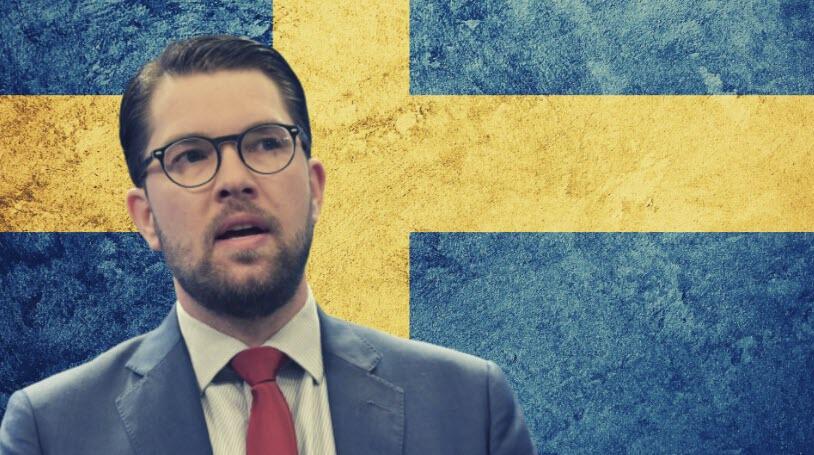
(ZH) Sweden Must Prepare To Leave The EU, Says Influential Sweden Democrats Part

Sweden Must Prepare To Leave The EU, Says Influential Sweden Democrats Party Leader

Jimmie Åkesson of the Sweden Democrats claims that only by making the necessary preparations for Swexit can the government maximize its bargaining power in Brussels...
Sweden must fully prepare to leave the European Union in order to maximize its negotiating position with the bloc, stated Jimmie Åkesson, leader of the anti-immigration Sweden Democrats party.
In an article published by Svenska Dagbladet on Monday, Åkesson and his co-author, Swedish MEP Charlie Weimers, expressed their desire for Sweden to “maximize its influence” in the European Union, outlining three measures the Swedish government must take.
First, the government should seek to make constitutional changes in order to introduce a “referendum lock,” which would enshrine into law the requirement of a public vote before any further powers can be transferred from Stockholm to Brussels.
It is a mechanism previously adopted by both Britain and Denmark, and the Sweden Democrats leader believes it will provide a necessary safeguard against any attempted power-grab by Brussels.
“Only the knowledge that every decision on the transfer of power must be submitted to the citizens would slow down the worst abuses from Brussels,” the pair wrote.
Second, the Swedish government should make the necessary preparations to leave the European Union to ensure it is ready should the decision ever be taken to do so and to legitimize any threat to withdraw in future negotiations with the bloc.
“In order for preparedness to be credible, it is necessary that we remove the writings in the constitution that state that Sweden is a member of the EU.
“In addition, we should train a cadre of civil servants with the expertise to negotiate trade agreements and other things that we have delegated to the EU and study how Brexit could have been implemented better. The better we are prepared to leave, the more we will gain in future negotiations,” Åkesson and Weimers added.
The Sweden Democrats leader also wants an investigation to be launched into how the negative aspects of Sweden’s EU membership can be mitigated.
The right-wing party is currently an informal partner of the Swedish government. While it wasn’t offered the opportunity to help form Prime Minister Ulf Kristersson’s administration, it is a signatory to the four-party coalition Tidö Agreement in which the coalition parties agreed to adopt a more restrictive immigration policy in return for Sweden Democrats’ support.
Åkesson’s party has long been in favor of Sweden’s withdrawal from the European Union, but accepts this is not a majority view among the Swedish electorate at present. The party officially dropped its support for Swexit in 2018 in a bid to garner more electoral support and subsequently achieved 20.5 percent of the vote in last year’s general election.

TechCrunch : Elon Musk used to say he put $100M in OpenAI, but now it’s $50M: He

Elon Musk used to say he put $100M in OpenAI, but now it’s $50M: Here are the receipts
Years of tax filings give the most complete picture yet of OpenAI’s early finances

It’s no secret that Elon Musk has been deeply frustrated with OpenAI since stepping down from its board in February 2018, culminating in an open letter calling for the organization to pause work on more powerful systems.

“It does seem weird that something can be a nonprofit, open source, and somehow transform itself into a for profit, closed source,” Musk said in a CNBC interview Wednesday, following a Tesla shareholder’s meeting. “This would be like, let’s say you funded an organization to save the Amazon rainforest, and instead they became a lumber company, and chopped down the forest and sold it for money.”

The power of his criticism hinges on the fact that Musk helped to launch the AI research organization. But exactly how much support he gave, even Musk seems unsure about.

“I’m still confused as to how a non-profit to which I donated ~$100M somehow became a $30B market cap for-profit. If this is legal, why doesn’t everyone do it?” he tweeted in mid-March. A week later he complained on Twitter again: “I donated the first $100M to OpenAI when it was a non-profit, but have no ownership or control.”

The $100 million figure has been widely reported as fact. But in the same CNBC interview yesterday, Musk abruptly shrank his claim. When asked how much he had donated to OpenAI, he replied: “I’m not sure the exact number but it’s some number on the order of $50 million.”

So what changed in the last eight weeks?

Following his original tweets in March, TechCrunch began an investigation into the funding behind the original OpenAI non-profit, including Musk’s contributions. Our analysis of documents filed with the IRS and a state regulator show that Musk could not have given the non-profit the $100 million he originally claimed.

In fact, while the source of much of OpenAI’s funding remains unclear, filings contain only around $15 million of donations that can be traced definitively back to Musk.

TechCrunch did not receive a response from Musk’s lawyer when presented with our analysis and asked for details of his financial support.

The tax filings also reveal previously unreported details about one of the most valuable and well-known technology ventures operating today, including the level of investment by Reid Hoffman, free Teslas for early OpenAI engineers, and the sky-rocketing computing bill that may have prompted it to take a $1 billion investment from Microsoft.

Nowhere near a billion-dollar effort
The financial side of OpenAI has been murky ever since the organization was announced by AI researchers Greg Brockman and Ilya Sutskever in December 2015. They wrote that OpenAI’s goal was to “advance digital intelligence in the way that is most likely to benefit humanity as a whole, unconstrained by a need to generate financial return.” The non-profit would be co-chaired by Musk and Sam Altman.

The blog claimed that Altman, Musk and Brockman would donate to the new 501(c)3, along with Reid Hoffman, Peter Thiel, Amazon, Infosys, Y Combinator partner Jessica Livingston and YC Research, another non-profit spun out of the startup accelerator. “In total, these funders have committed $1 billion,” they wrote. The next year, Wired duly reported OpenAI as a “billion dollar effort,” and that figure was subsequently widely shared.

But “committed” is not the same as “actually donated.” According to federal tax filings, at least one of the named donors, YC Research, never gave a single dollar, and the total amount donated to OpenAI’s non-profit from its inception through 2021 was only $133.2 million. The vast majority of those funds arrived before the launch of OpenAI’s for-profit arm in 2019, and the non-profit itself is now largely defunct. It received just $3,066 of donations in 2021.

Musk’s share
So how much of OpenAI’s $133 million did Musk donate? A good place to start is with his own 501(c)3 organization, the Musk Foundation.

In 2016, the Musk Foundation made a $10 million donation to yet another non-profit associated with Altman, called YC.org. YC.org, in turn, made a $10 million donation to OpenAI. The reason for this roundabout route, explained an OpenAI spokesperson in 2019, was a delay in establishing OpenAI’s tax-exempt status with the IRS.

That $10 million donation remains the only publicly disclosed cash contribution from Musk to OpenAI. However, an audited financial statement filed by YC.org with California charity regulators in 2020 reveals that $15 million of the organization’s 2016 revenue came from a single contributor. Given that YC’s revenue for the whole year totaled $16.6 million, Musk is very likely to have been that contributor. YC subsequently gave OpenAI another $16 million in 2017, of which at least $5 million was likely Musk’s.

The only other donation that can be tied to Musk is a previously unreported gift to OpenAI in 2017 of $248,295 worth of Tesla vehicles, and a subsequent donation in 2018 for $14,105 in vehicle upgrades. An audited financial statement notes that the vehicles were provided to employees as compensation.

However, there are also ways to give money to a non-profit anonymously. Rich individuals can cloak their gifts by funneling money through so-called donor advised funds (DAFs). The Musk Foundation donated $12.4 million in 2017, and $6.3 million in 2018, to a DAF called Fidelity Investments Charitable Gift Fund. That fund then donated $7.8 million to OpenAI between 2018 and 2020. There is no way to tell whether any of that money was Musk’s – the Fund has many donors and tens of billions of dollars in assets – but it is impossible to rule out.

Companies and individuals can donate to non-profits directly without their identities being made public. Musk likely did this with the additional $5 million gift to YC.org in 2016. Perhaps he simply topped up his OpenAI donations to $50 or $100 million the same way?

Several weeks ago, Musk’s representative was presented with TechCrunch’s reporting but did not reply to requests for comment. The only way to put a limit on Musk’s contributions was to count up the gifts to OpenAI from other donors and see how much was left over.

The other founders’ share
Sam Altman, now OpenAI’s CEO, made a contribution, the organization’s 2016 IRS filing shows. He loaned the young organization $3.75 million to get it started — and then forgave the full amount, with interest, for a total gift of $3,784,637.

Hoffman used his own foundation, Aphorism, to give $1 million to YC in 2016, which the organization seems to have passed on to OpenAI in 2017. Aphorism then followed up with a $5 million donation direct to OpenAI in 2017 and 2018.

Amazon and Microsoft donated at least $800,000 in cloud computing services, and Infosys confirmed to TechCrunch that it had made a donation. None of the companies would put a dollar amount on their contributions. There were other corporate gifts in-kind, including a $129,000 high performance computer from Nvidia, as well as software and services from over a dozen other companies.

OpenAI would not share details of contributions made by Brockman or Livingston. Likewise, there is no record of Peter Thiel providing any funds to OpenAI, nor did his VC firm reply to a request for information. However, there was a modest $100,000 donation in 2018 from Donor’s Trust, a DAF favored by conservatives and libertarians, among whom Thiel has been counted.
In 2017, Open Philanthropy announced a $30 million donation to OpenAI, which was delivered in three $10 million gifts in 2017, 2018 and 2019, through a non-profit controlled by Facebook co-founder Dustin Moskovitz. Open Philanthropy’s CEO, Holden Karnofsky, was given a seat on OpenAI’s board.

“We see some risks, both from unintended consequences of AI use, and from deliberate misuse), and believe that we — as a philanthropic organization, separate from academia, industry, and government — may be well-placed to support work to reduce those risks,” the organization wrote at the time.

The cost of computing
As OpenAI scaled, its costs began rising fast. On top of employing super-star AI researchers with multi-million dollar salaries, OpenAI’s computing bill had increased exponentially and in-kind computing donations were just a drop in the bucket. According to its tax filings, OpenAI spent $2.3 million on cloud computing in 2016, $7.9 million in 2017, and $30.6 million in 2018.

In February 2018, OpenAI switched cloud providers from Amazon to Google, signing an agreement to spend at least $63 million with the tech giant over the next two years. Musk left OpenAI’s board the same month. The events may be unconnected, although Semafor reported recently that Musk thought OpenAI was slipping behind Google, and walked away after the other founders rejected his offer to run the nonprofit.

According to insiders at OpenAI contacted by Semafor, Musk stopped making donations at that point, precipitating the spin-out of a for-profit OpenAI LP that would welcome outside investors. By the summer of 2019, OpenAI had already spent its Google computing money and was looking for another deal.

In July, Microsoft invested around $1 billion in the new for-profit entity — with about half the funds in the form of credits for its own Azure cloud computing service.

Musk has publicly decried OpenAI’s transition to a for-profit business.

Its other big donor, Moskovitz, also seems to have soured on the effort. In a conversation on a philanthropy forum in March, he posted: “My hope is we actually slowed acceleration by participating but I’m quite skeptical of the view that we added to it.”

Not every founding donor felt the same. Reid Hoffman’s Aphorism foundation invested a previously unreported $50 million in OpenAI’s for-profit venture in 2018. Aphorism justified the charitable investment by writing that the new business aimed to provide AI “technology to the public through open source licensing where appropriate to benefit the public.”

None of the recent versions of OpenAI’s Chat-GPT chatbot have been open source.

With Musk’s departure, OpenAI welcomed six new board members, each of whom also became a donor, according to the organization. Neither they nor OpenAI would share how much they gave, but the next year, OpenAI received its last major public gift: $30 million from a DAF called the Silicon Valley Community Foundation. There is no record of Musk or his foundation ever donating to that DAF.

The bottom line
Adding up all the non-Musk contributions to OpenAI (including the Silicon Valley Community Foundation money) gives a total of $75.8 million, out of $133.2 million. That means the most Musk could have donated to OpenAI would likely have been $57.4 million — a far cry from the $100 million he originally claimed, but close to the figure he mentioned Wednesday.

However, this number assumes that three founding donors (including Thiel), six newer donors, and multiple corporate supporters like Infosys, gave nothing at all.

In the bigger scheme of Musk’s finances, a discrepancy of $35 million, $50 million or even $85 million is little more than a rounding error. With Musk recently valuing Twitter at just $20 billion, the world’s second richest person has lost well over $100 million every day since buying the company last fall.
Glitz Paris : Bernard Arnault's dream shopping list (Google Translate)

Bernard Arnault's dream shopping list
Already owners of 75 brands, the founder and CEO of LVMH continues to covet a few independent houses. Detailed review of the luxury tycoon's ideal targets.

Since the takeover of the jeweler Tiffany & Co, in January 2021, sealed by the reopening of the brand's New York store last month, LVMH has not carried out any acquisitions. An eternity in a group that has mainly developed by takeover and whose flourishing cash flow could, in theory, capture a number of targets. If Bernard Arnault's buying fever is periodically the subject of rumors - a plan to raid Cartier has been mentioned in recent months - LVMH is more discreetly eyeing a handful of small houses with a prestigious history but run by families who want to keep control of their brands.

Expand the leather goods offer
This is the case of Signoles, which since 1998 has controlled the trunk maker Goyard, a house founded in 1853 and which, in the eyes of the founder of LVMH, would be a welcome addition to the group's leather goods division. The luxury giant has already attempted several discreet overtures towards the company, located at the corner of rue Saint-Honoré and rue Castiglione, in Paris - opposite the Louis Vuitton store in Place Vendôme. All have all come up against an end of inadmissibility. Worse: since 2018, Goyard has implemented a shareholder lock on its capital by instituting so-called "category A" shares, which concentrate 90% of the voting rights on the board of directors.

In the event of the disappearance of the chairman of the board of directors Jean-Michel Signoles, the 75-year-old businessman who has run Goyard with his three sons since 1998, his "category A" shares would vanish, preventing any resale to a potential buyer of these securities endowed with extensive powers.

In addition to its prestigious history, Goyard has the particularity of fully controlling its production chain: its manufacturing subsidiary, Algo, has a workshop in Drôme, near Romans-sur-Isère, the former French capital of leather and footwear. , and announced in 2022 the creation of two factories on the outskirts of Carcassonne (Aude), where the Signoles family is from. A control strategy of the value chain which is also that of the trunk maker Vuitton, flagship of LVMH, which recently bought several of its suppliers.

Expand the range of men's luxury
At the other end of Place Vendôme, again opposite an LVMH store, that of the jeweler Bulgari, operates one of the other houses that have interested LVMH for a long time: the Charvet blouse. Like Goyard, it is a nearly bicentenary house - it was founded in 1838 - and which fully controls the manufacture of its pieces. The Colban family, which bought Charvet in the 1960s, is the former textile supplier of the blouse. Like Goyard, the group is not experiencing any major financial difficulty: its latest accounts available, for the year 2019, show a turnover of nearly 10 million euros, for a net profit of 2.5 million euros. euros.

LVMH's interest in Charvet coincides with the exponential growth of high-end men's ready-to-wear, boosted by gender fluid fashion.

Diversify the great Bordeaux
Already the owner of two Bordeaux châteaux, Yquem and Cheval Blanc, Bernard Arnault has long dreamed of adding a third to his range of exceptional wines. And not least: the CEO of LVMH peeps Petrus, the most prestigious Pomerol, one of the appellations of the right bank of the Dordogne. Petrus has belonged since the late 1960s to the Videlot group, part of the Moueix family, which also controls the Bordeaux wine distribution group Duclot, as well as the K2 hotels and the catering company Experimental.

The entry, in 2018, of the Colombian millionaire Alejandro Santo Domingo, husband of the daughter of the 9th Duke of Wellington Charles Wellesley, Charlotte Wellesley, in the capital of Petrus as a minority shareholder (20%), caused some teeth to cringe at the headquarters of LVMH .

Bet on the long term
Last dream, tirelessly cherished but constantly frustrated: Patek Philippe, the Geneva watch company of the Stern family. Despite repeated approaches, the brand remains fiercely attached to its independence. The only consolation: by buying Tiffany & Co, LVMH found a partnership with Patek Philippe, whose jewelry chain has been distributing items in the United States for more than a century and co-producing limited editions.

>>> What to look at today - 18th of May 2023

Asian stocks advanced as traders bet on a breakthrough for US debt-ceiling talks, which will remove a drag on global markets. Equities in Japan continued to rally after hitting a 33-year high. A gauge of Asian stocks is headed for its biggest gain since March, with benchmarks in Australia, Hong Kong and South Korea advancing. Japan’s Topix index climbed around 1%, with rising exports and a weakening yen helping to fuel positive sentiment.  Tech stocks rallied in both Hong Kong and Japan, with Alibaba Group Holding Ltd. gaining 3% ahead of its earnings release Thursday. Chipmakers were among best performers on the Nikkei 225 after Japan Prime Minister Fumio Kishida met with global executives to boost the country’s domestic semiconductor sector.  US futures were marginally lower in Asia after the S&P 500 and Nasdaq 100 closed near highs of the day, rallying more than 1% on debt-talks optimism. The CBOE VIX index of equity market volatility fell below 17 to close at the lowest level since the start of the month. President Joe Biden expressed confidence there will be no US default, and House Speaker Kevin McCarthy said reaching an agreement this week is “doable.” JPMorgan Chase & Co. chief Jamie Dimon said the US government “probably” will not default on its debt after he and other bank leaders met in Washington to discuss the debt limit. The dollar and Treasuries were little changed in Asia. That was after the yield on the US two-year note rose seven basis points on Wednesday, while the 10-year yield climbed three basis points to 3.56%. European Central Bank Vice President Luis de Guindos said the ECB has completed most of its tightening but there is still “a way to go.” The euro was little changed.  Australia’s dollar dropped after the country reported an increase in unemployment, which reinforced the case for the central bank to stand pat at next month’s policy meeting. The yen drifted higher after falling almost 1% on Wednesday. The Japanese currency has dropped more than 3% this quarter as traders increasingly expect the central bank to maintain its ultra-loose monetary policy. Citigroup Inc. said the the officials’ lack of urgency to assess yield-curve control was received by markets as dovish. Nomura Holdings Inc. gained even after the Japanese company said it would cut its profit forecast.
US regional banks rallied after Western Alliance Bancorp reported growth in deposits boosted sentiment and eased worries about the health of the industry. All members of the KBW Regional Banking index advanced, pushing the benchmark 7.3% higher for its best day since January 2021. Walmart Inc. is due to report in the US. US After Hours
CSCO -4.2% and BOOT -15.5% lower on earnings; TTWO +8.5%, DLO +8% higher on earnings.

Nikkei +1.59% Hang Seng +0.99% CSI +0.33% Shanghai +0.81% Shenzen +0.30%

Eur$ 1.0832 CNH 7.0302 CNY 7.0134 JPY 137.53 GBP 1.2472 CHF 0.8994 RUB 80.3080 TRY 19.7704 WTI$ 72.60 -0.32% Gold 1,979 -0.15% BTC 27,270 -0.25% ETH 1,822 -0.26%

S&P -0.08% Nasdaq -0.03% EuroStoxx +0.56% FTSE +0.47% Dax +0.41% SMI

Macro :
- BofA Says an Ominous Signal From S&P 500 Is Pointing to Gains
- Investor Flows Show Some Preparing for 2H Recession, EPFR Says
- Priced-for-Perfection Luxury Goods Offset Depressed Auto Value

Keep an eye on :
- ADP FP : ADP April Passenger Traffic +26.2%
- BNP FP : Deutsche, BNP, Peers €680 Billion CRE Loan Risk Clearer After 1Q
- CSGN SW : QIA Explored Claims Against Switzerland for CS Losses: Reuters
- DLAR LN : De La Rue Investors Push for Nat Rothschild as Next Chair: Sky
- ERICB SS : Cisco Orders Slow as Customers Weigh Uncertain Economic Outlook
- ESI FP : ESI Is Said to Weigh Sale With Dassault, Buyout Firms Interested
- ETL FP : Viasat 4Q Adjusted EPS Beats Estimates
- FUTR LN : Future PLC 1H Revenue Beats Estimates
- GALP PL : Portugal’s ENSE Says Gasoline Consumption Rose 24% in April
- IDR SM : Ex Renault Spain CEO Mozos Frontrunner for Indra CEO: Expansion
- NEWR US : Software Company New Relic in Talks to Be Sold -- WSJ
- NOKIA FH : Cisco Orders Slow as Customers Weigh Uncertain Economic Outlook
- SPM IM : Saipem Wins Offshore Contracts Valued at About $850m
- SHEL LN : Shell Said to Plan Sale of French Floating Wind Power Unit Eolfi
- SON PL : Sonae 1Q Net Income EU26M Vs. EU42M Y/y
- STM FP : UK’s Sunak to Unveil Semiconductor Partnership With Japan: FT
- TRI FP : Trigano 1H Net Income EU121.7M Vs. EU141.3M Y/y
- VOW GY : VW Brand Plans €3 Bln in Savings, Handelsblatt Says

>>> Europe : Brokers Upgrades & Downgrades - 18th of May 2023

>>> Up
*
* Siemens Energy Raised to Buy at Citi; PT 29 euros
* Tecnicas Reunidas Raised to Overweight at Barclays; PT 14 euros

>>> Down
* Amyris Cut to Hold at Jefferies; PT 65 cents
* BioPharma Credit Cut to Underperform at Jefferies
* Marks & Spencer Cut to Neutral at Citi; PT 170 pence
* Santander Cut to Market Perform at KBW; PT 4.26 euros
* Unicaja Cut to Underperform at KBW; PT 1.10 euros

>>> Initiation
* Advanced Medical Rated New Sector Perform at RBC; PT 285 pence

>>> Call
* ArcelorMittal, SSAB, Acerinox Are Citi’s Top EU Steel Picks
* Marks & Spencer Downgraded to Neutral at Citi on Demand Outlook
* Mitchells & Butlers Raised at Jefferies on Improving Outlook
* Santander and Unicaja Both Cut at KBW, UniCredit Still Top Pick
* Siemens Energy Margin Improvement Potential Sees Upgrade at Citi