Landlords struggle to future-proof UK’s historic commercial properties
Retrofitting old buildings to meet modern standards is costly and complex
In London’s Mayfair, the lofty neoclassical staircase of 66 Grosvenor Street has been freshly painted a sophisticated grey. The lick of paint has more to it than just a modern colour palette.
The experimental paint job also embeds compounds designed to attract and break down pollutants in the air, explained Andy Creamer, who has overseen a recent overhaul of the building to bring the 300-year-old Georgian town house, now used as offices, up to modern energy efficiency standards.
Creamer is responsible for an ongoing £90mn environmental retrofit project across the 300-acre historic London estate of Grosvenor, the Duke of Westminster’s property company, which is due to overhaul 1mn sq ft of space by the end of the year.
The daunting scale of the project — which has involved ripping out 50 gas boilers, and installing more than 2,000 sensors to monitor temperature and air flow to make heating and ventilation more efficient — attests to the huge challenge facing UK landlords to bring Britain’s old and draughty building stock up to modern standards.
The project is a forerunner of the difficulties many other commercial landlords and homeowners will ultimately have to face if the UK is going to meet its climate goals.
“It’s very easy to convince yourself that now is not the right time,” Creamer said, a brisk, cheerful man with more than a decade’s experience at Grosvenor. “We can’t wait 10 years.”
The government recently walked back proposed 2025 deadlines for residential landlords to improve energy efficiency, but commercial property owners face tougher timelines.
Three-quarters of commercial floorspace in England is rated EPC C or lower, according to the think-tank Centre for Cities, meaning it would need to be upgraded by 2030 if the government pushes ahead with current proposed regulations.
The UK Green Building Council, an industry group, said that energy consumption from commercial property sectors such as offices would need to fall 59 per cent to achieve net zero by 2050. The group in December said the UK was “significantly” behind the progress needed on reducing building emissions.
Uncertainty over those regulations has led some landlords to delay. “We are advising clients to spend sometimes in the region of millions of pounds to upgrade their buildings,” said Ollie Morris, director of sustainability at real estate firm CBRE. “And the justified comeback is ‘do we actually need to do this?’’’
Some gains can be achieved by simply running buildings more efficiently. Mike Edwards, director at engineering firm Arup, said some owners could achieve 15 to 20 per cent energy savings by “tuning the building like you would tune a car”.
But ultimately, particularly leaky older buildings will need upgrades. Some owners are moving ahead of the government requirements to avoid being left behind.
Grosvenor’s decision to spend on big retrofits ahead of the deadlines reflects its advantages as a large, private landlord with deep pockets.
For other owners facing a huge rise in the cost of debt and a lack of demand for many older offices as people shift to working from home, financial survival is higher on the priority list than green projects.
The practical difficulties are also daunting, particularly in historic properties that make up vast swaths of UK towns and cities. “As a landlord with a single property or two properties, it’s horrendous,” Creamer said.
About 600,000 commercial properties in the UK are historic buildings dating from before 1919, according to research by Grosvenor.
High on the list of challenges to refitting these properties is finding enough skilled workers. About 100,000 people work on historical buildings in the UK, according to research by consultancy Capital Economics.
That workforce would need to double to complete necessary retrofit work by 2050, with particularly intense demand for electricians and heating and ventilation installers. The research suggests the gap in the workforce will bite as retrofit work ramps up in the 2030s unless the government and industry invest in building the workforce.
Supply chains have also been strained by the increase in demand for green technology in buildings. “Lead times are awful for air source heat pumps in particular,” said Creamer, who added that he can wait up to three months for new heat pump orders.
The UK’s planning system and heritage protections can add painful delays. Grosvenor looks after 500 Grade I and II listed buildings and structures.
Creamer said that in one row of 15 historic town houses in Buckingham Palace Road, the company applied for permission to install heat pumps, new glazing and solar roof tiles. The nearly identical applications were approved on 14 of the 15 buildings, but refused on the last one because a different planner had worked on that file.
He praised local authorities such as the City of Westminster, which has formed a retrofit task force to speed up approvals. Nearly 80 per cent of the city is covered by a conservation area. But, he said: “The retention of heritage has often taken precedence over future-proofing the properties.”
Sam Altman’s Knack for Dodging Bullets—With a Little Help From Bigshot Friends
The OpenAI CEO lost the confidence of top leaders in the three organizations he has directed, yet each time he’s rebounded to greater heights
Minutes after the board of OpenAI fired CEO Sam Altman, saying he failed to be truthful, he exchanged texts with Brian Chesky, the billionaire chief executive of Airbnb.
“So brutal,” Altman wrote to his friend. Later that day, Chesky told Microsoft’s CEO Satya Nadella, OpenAI’s biggest partner, “Sam has the support of the Valley.” It was no exaggeration.
Over the weekend, Altman rallied some of Silicon Valley’s most influential CEOs and investors to his side, including Vinod Khosla, co-founder of Sun Microsystems and the founder of Khosla Ventures, OpenAI’s first venture-capital investor; Ron Conway, an early investor in Google and Facebook; and Nadella. Days later, Altman returned as OpenAI’s chief executive.
Altman’s firing and swift reversal of fortune followed a pattern in his career, which began when he dropped out of Stanford University in 2005 and gained the reputation as a Silicon Valley visionary. Over the past two decades, Altman has lost the confidence of several top leaders in the three organizations he has directed. At every crisis point, Altman, 38 years old, not only rebounded but climbed to more powerful roles with the help of an expanding network of powerful allies.
A group of senior employees at Altman’s first startup, Loopt—a location-based social-media network started in the flip-phone era—twice urged board members to fire him as CEO over what they described as deceptive and chaotic behavior, said people familiar with the matter. But the board, with support from investors at venture-capital firm Sequoia, kept Altman until Loopt was sold in 2012.
Two years later, Altman was a surprise pick to head Y Combinator, the startup incubator that helped launch Airbnb and Dropbox, by its co-founder Paul Graham. Graham had once compared Altman with Steve Jobs and said he was one of the “few people with such force of will that they’re going to get what they want.”
Altman’s job as president of the incubator put him at the center of power in Silicon Valley. It was there he counseled Chesky through Airbnb’s spectacular ascent and helped make grand sums for tech moguls by pointing out promising startups.
In 2019, Altman was asked to resign from Y Combinator after partners alleged he had put personal projects, including OpenAI, ahead of his duties as president, said people familiar with the matter.
This fall, Altman also faced a crisis of trust at OpenAI, the company he navigated to the front of the artificial-intelligence field. In early October, OpenAI’s chief scientist approached some fellow board members to recommend Altman be fired, citing roughly 20 examples of when he believed Altman misled OpenAI executives over the years. That set off weeks of closed-door talks, ending with Altman’s surprise ouster days before Thanksgiving.
Altman’s gifts as a deal-maker, talent scout and pitchman helped turn OpenAI into a business some investors now value at $86 billion. The loyalty he engendered through his success mobilized high-profile supporters after his firing and inspired employees to threaten a mass exit.
“A big secret is that you can bend the world to your will a surprising percentage of the time,” Altman wrote in his personal blog two months before his exit from Y Combinator.
Over his career, Altman has shown skill in bending circumstances to his favor. His ability to bounce back will be tested once again. Scrutiny of his management is expected in coming months. OpenAI’s two new board members have commissioned an outside investigation into the causes of the company’s recent turmoil, conducted by Washington law firm WilmerHale, including Altman’s performance as CEO and the board’s reasons for firing him.
“The senior leadership team was unanimous in asking for Sam’s return as CEO and for the board’s resignation, actions backed by an open letter signed by over 95% of our employees. The strong support from his team underscores that he is an effective CEO,” said an OpenAI spokeswoman.
This article is based on interviews with dozens of executives, engineers, current and former employees and friend’s of Altman’s, as well as investors.
Center stage
Altman was a 19-year-old Stanford sophomore studying computer science when he stepped into the limelight at a campus entrepreneur event in 2005. He stood onstage, held up a flip phone and said he had just learned all cellphones would soon have a Global Positioning System, now commonly known as GPS.
Altman asked anyone interested to join him to figure out how best to pair the technologies. He and his co-founders decided on a flip-phone app that would let people track their friends on a map, which Altman would later pitch as a remedy for loneliness.
During a later entrepreneurship competition, Altman impressed Patrick Chung, who had just joined New Enterprise Associates, a venture-capital firm, and was one of the event’s judges. NEA teamed up with Sequoia and offered Altman and his team $5 million to pursue their idea.
Altman dropped out of school and Loopt was born. An early investor was Y Combinator, a startup incubator founded by Paul Graham and his-then girlfriend now-wife, Jessica Livingston. Altman soon became a favorite of Graham’s.
A few years after the company’s launch, some Loopt executives voiced frustration with Altman’s management. There were complaints about Altman pursuing side projects, at one point diverting engineers to work on a gay dating app, which they felt came at the expense of the company’s main work.
Senior executives approached the board with concerns that Altman at times failed to tell the truth—sometimes about matters so insignificant one person described them as paper cuts. At one point, they threatened to leave the company if he wasn’t removed as CEO, according to people familiar with the matter. The board backed Altman.
“If he imagines something to be true, it sort of becomes true in his head,” said Mark Jacobstein, co-founder of Jimini Health who served as Loopt’s chief operating officer. “That is an extraordinary trait for entrepreneurs who want to do super ambitious things. It may or may not lead one to stretch, and that can make people uncomfortable.”
Altman doesn’t recall employee complaints beyond the normal annual CEO review process, according to people familiar with his thinking.
Among the most important relationships that Altman made at Loopt was with Sequoia, whose partner, Greg McAdoo, served on Loopt’s board and led the firm’s investment in Y Combinator around that time. Altman also became a scout for Sequoia while at Loopt, and helped the firm make its first investment in the payments firm Stripe—now one of the most valuable U.S. startups.
Michael Moritz, who led Sequoia, personally advised Altman. When Loopt struggled to find buyers, Moritz helped engineer an acquisition by another Sequoia-backed company, the financial technology firm Green Dot.
“I saw in a 19-year-old Sam Altman the same thing that I see now: an intensely focused and brilliant person whom I was willing to bet big on,” said Chung, now managing general partner of Xfund, a venture-capital firm.
Man versus machine
Graham’s selection of Altman to lead Y Combinator in 2014 surprised many in Silicon Valley, given that Altman had never run a successful startup. Altman nonetheless set a high goal—to expand the family run operation into a business empire.
He made as many as 20 introductions a day, helping connect people in Y Combinator’s orbit. He helped Greg Brockman, the former chief technology officer of Stripe, make a mint selling his shares in the successful payments company to buyers including Y Combinator. Brockman co-founded OpenAI in 2015 and became its president.
Altman turned Y Combinator into an investing powerhouse. While serving as the president, he kept his own venture-capital firm, Hydrazine, which he launched in 2012. He caused tensions after barring other partners at Y Combinator from running their own funds, including the current chief executive, Garry Tan, and Reddit co-founder Alexis Ohanian. Tan and Ohanian didn’t respond to requests for comment
Altman also expanded Y Combinator through a nonprofit he created called YC Research, which served as an incubator for Altman’s own projects, including OpenAI. From its founding in 2015, YC Research operated without the involvement of the firm’s longtime partners, fueling their concern that Altman was straying too far from running the firm’s core business.
Altman believed OpenAI was primed for AI breakthroughs, including artificial general intelligence—an AI system capable of performing intellectual tasks as well as or better than humans. Altman helped recruit Ilya Sutskever from Google to OpenAI in 2015, which attracted many of the world’s best AI researchers.
By early 2018, Altman was barely present at Y Combinator’s headquarters in Mountain View, Calif., spending more time at OpenAI, at the time a small research nonprofit, according to people familiar with the matter.
The increasing amount of time Altman spent at OpenAI riled longtime partners at Y Combinator, who began losing faith in him as a leader. The firm’s leaders asked him to resign, and he left as president in March 2019.
Graham said it was his wife’s doing. “If anyone ‘fired’ Sam, it was Jessica, not me,” he said. “But it would be wrong to use the word ‘fired’ because he agreed immediately.”
Jessica Livingston said her husband was correct.
To smooth his exit, Altman proposed he move from president to chairman. He pre-emptively published a blog post on the firm’s website announcing the change. But the firm’s partnership had never agreed, and the announcement was later scrubbed from the post.
For years, even some of Altman’s closest associates—including Peter Thiel, Altman’s first backer for Hydrazine—didn’t know the circumstances behind Altman’s departure.
Resurrection
At OpenAI, Altman recruited talent, oversaw major research advances and secured $13 billion in funding from Microsoft. Sutskever, the company’s chief scientist, directed advances in large language models that helped form the technological foundation for ChatGPT—the phenomenally successful AI chatbot. Sequoia was one of OpenAI’s investors.
As the company grew, management complaints about Altman surfaced.
In early fall this year, Sutskever, also a board member, was upset because Altman had elevated another AI researcher, Jakub Pachocki, to director of research, according to people familiar with the matter.
Sutskever told his board colleagues that the episode reflected a long-running pattern of Altman’s tendency to pit employees against one another or promise resources and responsibilities to two different executives at the same time, yielding conflicts, according to people familiar with the matter.
“Ilya has taken responsibility for his participation in the Board’s actions, and has made clear that he believes Sam is the right person to lead OpenAI,” Alex Weingarten, a lawyer representing Sutskever, said in a statement. He described as inaccurate some accounts given by people familiar with Sutskever’s actions but didn’t identify any alleged inaccuracies.
Altman has said he runs OpenAI in a “dynamic” fashion, at times giving people temporary leadership roles and later hiring others for the job. He also reallocates computing resources between teams with little warning, according to people familiar with the matter.
Other board members already had concerns about Altman’s management. Tasha McCauley, an adjunct senior management scientist at Rand Corp., tried to cultivate relationships with employees as a board member. Past board members chatted regularly with OpenAI executives without informing Altman. Yet during the pandemic, Altman told McCauley he needed to be told if the board spoke to employees, a request that some on the board viewed as Altman limiting the board’s power, people familiar with the matter said.
Around the time Sutskever aired his complaints, the independent board members heard similar concerns from some senior OpenAI executives, people familiar with the discussions said. Some considered leaving the company over Altman’s leadership, the people said.
Altman also misled board members, leaving the impression with one board member that another wanted board member Helen Toner removed, even though it wasn’t true, according to people familiar with the matter, The Wall Street Journal reported.
The board also felt nervous about Altman’s ability to use his Silicon Valley influence, so when members decided to fire him, they kept it a secret until the end. They gave only minutes notice to Microsoft, OpenAI’s most important partner. The board in a statement said Altman had failed to be “consistently candid” and lost their trust without giving specific details.
Altman retreated to his 9,500 square-foot house, which overlooks San Francisco in the city’s Russian Hill neighborhood.
One of his key allies was Chesky. Shortly after Altman was fired, Chesky hopped on a video call with Altman and Brockman, who had been removed from the board that day and quit the company in solidarity with Altman. Chesky asked why it happened. Altman theorized it might have been about the dust-up with Toner or Sutskever’s complaints.
Satisfied that it wasn’t a criminal matter, Chesky phoned Nadella, the Microsoft CEO.
A small group of Silicon Valley power brokers, including Chesky and Conway, advised Altman and worked the phones, trying to negotiate with the board.
The board named Emmett Shear, an OpenAI outsider, as interim CEO, drawing threats to resign by most of the company’s employees. In another lucky turn of fortune for Altman, Shear was an ally and a mentor of Chesky’s.
Saudi-French Plan Proposes Exile For Hamas Leadership
The French newspaper Le Monde published details this week of a Saudi document containing a plan to end the war in Gaza, which stipulates the transfer of Hamas’ military and security leaders to the Algerian capital.
The newspaper stated that the document was prepared by the head of the Gulf Research Centre, Abdulaziz bin Saqr, after a meeting on November 19 in Riyadh with the head of the North Africa and Middle East Department at the French Ministry of Foreign Affairs, Anne Greux. The document was then transferred to the French Ministry of Foreign Affairs.
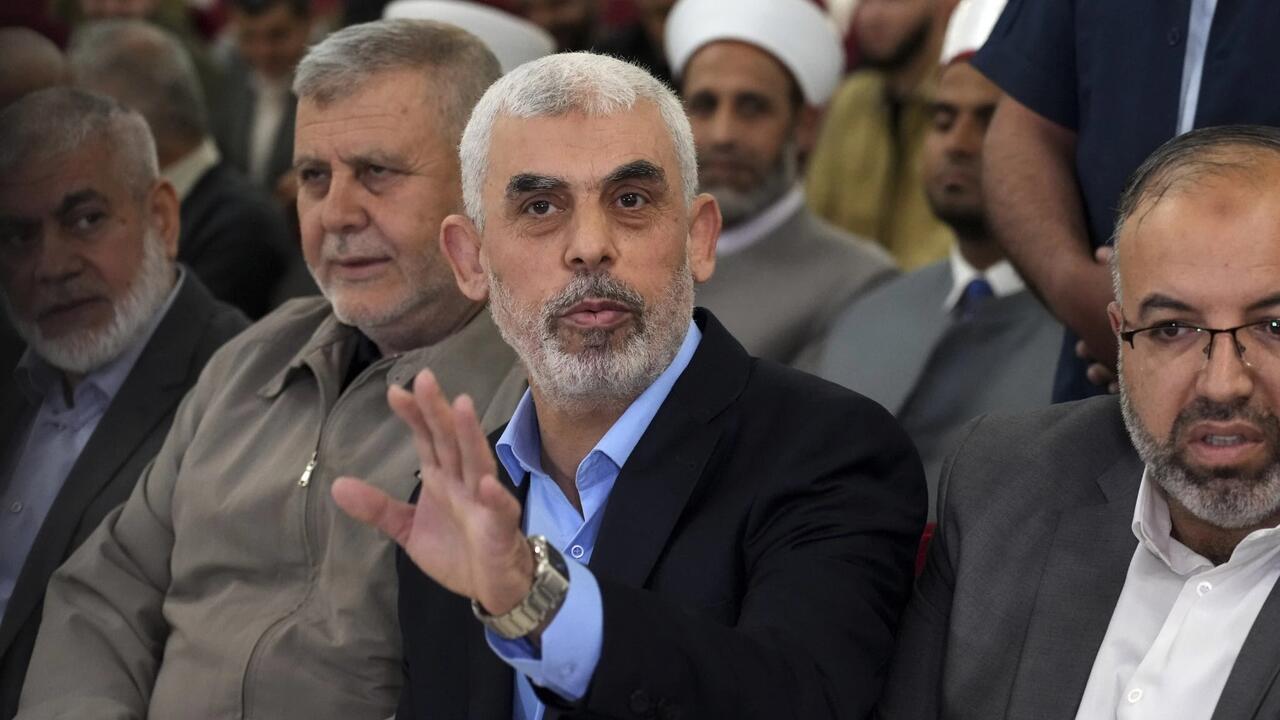
Yahya Sinwar, head of Hamas in Gaza, via AP
Le Monde pointed out that the evacuation of Hamas leaders to Algeria most likely refers to the leader of the Ezzedine al-Qassam Brigades, Muhammad Deif, and the leader of the movement in the Gaza Strip, Yahya Sinwar.
Algeria was reportedly chosen as a potential place of exile for the movement’s leaders because of the north African nation’s good relationship with Qatar and Iran, the main supporters of the Hamas movement, and because of its security capabilities that would allow it to tightly control their activities.
Le Monde contacted the Algerian ambassador in Paris, but he did not wish to comment on the matter.
The plan also calls for the deployment of an Arab peacekeeping force in Gaza under UN auspices and the establishment of a "joint transitional council," including the main factions in Gaza, Hamas, Palestinian Islamic Jihad (PIJ), and Fatah. The council would be responsible for managing the enclave for a period of four years, and for organizing presidential and parliamentary elections.
The newspaper noted it is unclear if the plan had been approved by the Saudi authorities, or whether it was a purely personal initiative of the Gulf Research Centre head.
The document stated only: "It appears that the search for a Saudi-French consensus could contribute to the crystallization of a common vision acceptable to all parties, and have an impact on the decision to end the war."
Since October 7, the Israeli army has carried out vicious campaign against Gaza that has killed almost 20,000 people, the majority women and children. Israel’s bombing campaign and ongoing siege threaten to make the enclave completely uninhabitable.
Putin Now Serious About Negotiating End To War: Diplomats
In a fresh weekend report The New York Times says that President Vladimir Putin is ready to negotiate an end to the nearly two year-long 'special operation' in Ukraine, at a moment most of the territory which forms the four 'annexed' oblasts remains firmly under Russian military control.
However, to some degree, Putin has consistently held open the chance to negotiate... it's just that "negotiate" in the Kremlin context would be on the basis of Crimea and the Donbass being fully recognized as Russian Federation territory. Until recently, the West considered this an impossibility, but US and European officials have more recently quietly admitted Moscow has more or less 'won'. The NY Times quotes Putin in the following:
Buoyed by Ukraine’s failed counteroffensive and flagging Western support, Mr. Putin says that Russia’s war goals have not changed. Addressing his generals on Tuesday, he boasted that Ukraine was so beleaguered that Russia’s invading troops were doing “what we want.”“We won’t give up what’s ours,” he pledged, adding dismissively, “If they want to negotiate, let them negotiate.” But in a recent push of back-channel diplomacy, Mr. Putin has been sending a different message: He is ready to make a deal.


Sputnik/AP
The report cites Russian diplomatic sources who say Putin has for the first time been open to ceasefire which would include a freezing of all frontline fighting. American officials say the same, per the report: "In fact, Mr. Putin also sent out feelers for a cease-fire deal a year earlier, in the fall of 2022, according to American officials."
"That quiet overture, not previously reported, came after Ukraine routed Russia’s army in the country’s northeast. Mr. Putin indicated that he was satisfied with Russia’s captured territory and ready for an armistice, they said."
Very obviously, Ukraine's leadership and society has been fracturing under the strain of the invasion and immense death toll, with Kiev officials recently admitting monumental problems with manpower and ammo supply.
But the reality is that Russian society is likely facing deep fractures and uncertainty too, though it's far less evident. Countless mothers, fathers, and families are grieving and dealing with the loss of loved ones killed in action. Conservative estimates have said at least 50,000 Russian troops have died in the war (and that is based just on data as of mid-summer). US officials have claimed a figure in the hundreds of thousands, but there are reasons to be doubtful of this.
Angry families of fallen soldiers have increasingly formed the locus of a small but increasingly visible Russian anti-war movement, suggesting broader quiet societal angst concerning the direction of the war in Ukraine. They don't want Ukraine to be Russia's "endless war". This discontent threatens to become much more out in the open, seen for example in the following:
Former TV journalist Yekaterina Duntsova was disqualified on Saturday from running against President Vladimir Putin in an election next March because of alleged flaws in her application to register as a candidate.Video from a meeting of the central electoral commission showed members voting unanimously to reject the candidacy of Duntsova, who had wanted to run on a platform to end the war in Ukraine and release political prisoners.Her disqualification was seized on by Putin’s critics as proof that no one with genuine opposition views will be allowed to stand against him in the first presidential election since the start of the 22-month war. They see it as a fake process with only one possible outcome.
According to more in the NYT report on Putin's supposed new-found readiness for serious negotiations:
Mr. Putin’s repeated interest in a cease-fire is an example of how opportunism and improvisation have defined his approach to the war behind closed doors. Dozens of interviews with Russians who have long known him and with international officials with insight into the Kremlin’s inner workings show a leader maneuvering to reduce risks and keep his options open in a war that has lasted longer than he expected. While deploying fiery public rhetoric, Mr. Putin privately telegraphs a desire to declare victory and move on.“They say, ‘We are ready to have negotiations on a cease-fire,’” said one senior international official who met with top Russian officials this fall. “They want to stay where they are on the battlefield.”
So likely, Putin could be facing increased pressure even from Kremlin senior officials to wrap up Ukraine operations, especially given the Donetsk, Luhansk, Kherson and Zaporizhia regions have already been declared part of Russia, and a firm military grip remains on them.
But it remains that Ukraine's Zelensky has shut the door every time he's so much as asked by the press about the possibility of negotiating. Simultaneously, he's admitted time and again that things aren't going well for Ukraine forces on the battlefield. Yet he still says he'll never enter ceasefire talks with Moscow so long as Putin is still in power.
Bitcoin miners splash out $600mn in race to squeeze out rivals
Firms invest in technology ahead of date next year when rewards for verifying transactions will halve
Cryptocurrency miners are spending heavily on the newest technology to earn more bitcoins, trying to gain market share and squeeze out rivals ahead of a halving of their rewards in around four months’ time.
Miners listed on the world’s stock exchanges have this month committed to spending around $600mn on buying new chips and servers that are the keystone of the digital ledger underlying bitcoin, according to The Miner Mag, an industry data provider. The December amount is nearly half of the $1.3bn total committed for the year.
The burst of spending comes despite miners having suffered heavy losses in the 2022 crypto market crash. They are now trying to profit from the soaring price of bitcoin, which has surged to an 18-month high of more than $44,000.
The splurge also comes before a scheduled plan in April to halve the incentive scheme that verifies all bitcoin deals. Optimists hope the so-called “halving” — a once every four year event to slow the circulation of bitcoins — will support further gains for the cryptocurrency next year but the move also threatens to undercut miners’ shaky profitability.
“Buying equipment is not just an action in the bull market,” said Juri Bulovic, head of mining at Foundry. Miners are “realising that refreshing the fleet is what would keep them in business post-halving.”
Miners play a crucial role in bitcoin’s operation, racing each other to verify new blocks of deals for its blockchain and taking on the role of deal guarantor. In return, the winner is rewarded with new tokens.
However, the process has been heavily criticised for the huge carbon footprint it creates. According to Cambridge university, bitcoin’s energy consumption is today roughly equivalent to that of Poland or Malaysia.
The halving is expected to reshape industry economics, which have been deeply strained in the last two years by the high cost of energy and the falling price of coins. Now companies are spending big on new equipment, hoping to leave rivals on older machines struggling.
Nevada-based CleanSpark, a bitcoin mining firm that has committed roughly $280mn to mining equipment this year, is one prepared to accept a smaller financial reward in exchange for a larger slice of the market.
“It won’t be dissimilar to when China banned mining [in 2021], everybody unplugged, and the percentage rewards skyrocketed for the miners that were still standing,” said Matthew Schultz, executive chair at CleanSpark. “The companies that have made these investments [in new equipment] are likely the ones that survive,” he added.
Bitcoin miners have already been pushed to their limits. Many invested during the bull run of 2020 and 2021, using debt and low interest rates to finance their expansion as the price of bitcoin soared to more than $69,000.
However they were hit hard when bitcoin lost three-quarters of its value and energy prices soared. Companies including Core Scientific and Computer North filed for bankruptcy while others were forced to temporarily shut down operations or were paid by some US states not to mine bitcoin, in an effort to conserve energy.
Another, Marathon Digital, became a focus for short sellers after paying its former chief executive Merrick Okamoto just under $220mn in stock and missing its earnings targets.
Bitcoin’s rebound this year as market speculation intensifies that US regulators will approve a spot bitcoin exchange traded fund.
Supporters say approval would potentially unlock billions of dollars worth of capital from major Wall Street players like BlackRock and Fidelity and send the price of bitcoin much higher.
Enthusiasts also note that the last halving, in May 2020, pushed bitcoin’s price up by roughly 460 per cent over the subsequent 12 months.
Bitcoin miners share prices have responded to bitcoin’s rising price: Riot Platforms is up 424 per cent this year and Marathon Digital is up 681 per cent. In Toronto, Bitfarms has risen 607 per cent this year and Hive Digital Technologies 232 per cent. In contrast, over the course of 2022 Riot and Marathon share prices fell by around 85 per cent and 90 per cent, respectively, while Bitfarms and Hive saw their share price decline by 91 per cent and 88 per cent.
“The enthusiasm over the potential of a bitcoin ETF all of a sudden has opened up the ability to raise capital to upgrade equipment, so you’ve seen this huge bulk buying spree,” said Frank Holmes, executive chair of Hive, which itself committed $9mn to new equipment this month.
But hopes for a resurgence are still contingent on bitcoin’s recent rally persisting. The SEC has given no indication it will approve an ETF, and end its decade-long policy of refusing all applications.
Moreover miners are still plagued by real-world costs, notably energy.
Latest figures pin the median cost to mine one bitcoin at around $17,000, but that could rise to as high as $34,000, according to The Miner Mag. It “doesn’t leave much room” for miners if bitcoin remains at its current price of roughly $42,000, said Wolfie Zhao, its head of research.
But some see it as a risk worth taking. Among them is Bitfarms, a Canadian-listed group, which this month set aside $95mn for new equipment.
“As our market share goes up, and we get more bitcoins on a daily basis, our revenues and our cash flow should work out as well [as] if not better than in the status quo,” said Geoffrey Morphy, Bitfarms chief executive.
“We’re not maintaining [our market share], we’re leapfrogging,” he added.
Jim Ratcliffe agrees to buy $1.3bn stake in Manchester United
Some board members had worried about future treatment of non-Glazer shareholders in Premier League club
Sir Jim Ratcliffe has agreed to buy a roughly $1.3bn stake in Manchester United, ending more than a year of uncertainty over the English football club’s ownership and highlighting continued investor appetite for sports assets.
The agreement came after a board meeting ended weeks of delays to football’s highest-profile transaction, and values the club at about $6.3bn including debt, one person close to the deal said.
It is the latest in a record series of sports deals, including private equity tycoon Josh Harris’s $6bn acquisition of the Washington Commanders NFL franchise.
British chemicals billionaire Ratcliffe and the Glazer family that owns Manchester United had agreed on the broad terms to buy a non-controlling stake in the English Premier League club in November, but a formal announcement had been repeatedly pushed back.
One person close to the deal said the announcement was accelerated following an FT report about some board members’ concerns for equal treatment of minority shareholders in future transaction involving Ratcliffe and the Glazers.
One of the obstacles had been how United’s public shareholders would be treated in any future transactions between Ratcliffe and the Glazers, according to people familiar with the matter.
Board members had raised concerns about potential future deals and whether they would allow the Glazers to cash out on terms that would not be extended to other shareholders.
There is no guaranteed path to control but Ratcliffe could increase his shareholding over time, the person added. The deal is subject to approval by authorities including the Premier League.
United and Ineos declined to comment.
The situation had been complicated because United has two classes of stock and the PLC is headquartered in the Cayman Islands. The New York-traded A shares have inferior voting rights to the B shares held exclusively by the Glazers.
UK fund manager Lindsell Train, Ricky Sandler’s Eminence Capital and Chicago-based Ariel Investments are among the biggest holders of the A shares, which are largely held by non-family shareholders. Hedge fund billionaire Leon Cooperman has also accumulated a stake. Sandler has previously threatened to oppose any deal that treats minority shareholders differently from the Glazers.
Ratcliffe and his Ineos group have agreed to acquire around 25 per cent of the Glazers’ super-voting B shares and 25 per cent of the New York-traded A shares. Each B share has 10 times the voting rights of a single A share.
Ordinarily the B shares would convert into A shares on sale by the Glazers. The announcement confirmed that shareholders tender their shares and approve legal changes that permit the transfer of B shares without conversion, one of the people said.
The British tycoon had previously reformulated the Ineos bid because of concerns that arose when his original proposal for majority control envisaged buying out only the Glazer family’s B shares without extending an offer to A shareholders. Ineos subsequently changed the proposal to buy 25 per cent of each share class.
The six Glazer siblings own 110mn B shares. Selling 25 per cent of the total at $33 would generate more than $900mn for the family. The deal would value United’s equity at roughly $5.4bn.
The New York-listed club’s stock exchange filings warn that the “concentration of voting power in our Class B shares may harm the value of our Class A ordinary shares” by “delaying, deferring or preventing a change in control”, “impeding a merger, consolidation, takeover or other business combination”, or “causing us to enter into transactions or agreements that are not in the best interests of all shareholders”.
Ineos’s proposal values United at about $33 a share. The A shares closed at less than $20 each on Friday. Ratcliffe is also set to inject $300mn of fresh capital into the club and take significant influence over football operations.
The Manchester United share price hit a high of more than $27 in February on expectations that the club would be bought in full by Sheikh Jassim Bin Hamad Al Thani, the son of one of Qatar’s richest men. However, his Nine Two Foundation withdrew from the bidding in October.
In May 2022, Daguzan made the jump and switched over to Jacquemus full time just as the brand was hitting a steep growth curve.
Sales more than doubled in 2021 to top 100 million euros, with more than 30 percent of that going right to the bottom line.
Shortly after Daguzan joined, Jacquemus was tapped for the WWD Honor for Best-Performing Fashion Company, Small Cap. That fall Daguzan said the company was on pace to double sales again in 2022 and was targeting 500 million euros by 2025.
The growth spurt followed along several lines as the company has both accessories and ready-to-wear sold through its own e-commerce site, wholesale accounts and, as of last year, a flagship on Avenue Montaigne in Paris.
It is a fashion machine that employs 300 people and is powered by the designer, who has cultivated an easy connection with customers via the brand’s official Instagram account, which boasts 6.2 million followers.
Daguzan stressed the importance of that digital connection last year.
“Each time we say something on Instagram, you have a queue on Avenue Montaigne,” he said. “And that is the way we work: We create surprises in order to make people dream about us.”
Bastien Daguzan Steps Down as Jacquemus President
Designer Simon Porte Jacquemus thanked Daguzan, who was officially at the brand for less than two years.
Bastien Daguzan is parting ways with Jacquemus after less than two years as president of the breakout brand.
Simon Porte Jacquemus, founder, owner and creative director of the 14-year-old designer business, thanked Daguzan in a statement Thursday and said: “Bastien has been a driving force behind the business and its leadership. We wish him well in his new endeavor.”
Likewise, Daguzan said: “I would like to thank Simon for his trust and the incredible journey we have been on together with the team. He has always been an immense source of inspiration; I am so proud to have been a part of this adventure.”
For Daguzan, the adventure began when he started consulting for Jacquemus during his five-year stint as general manager of Paco Rabanne fashion.
In May 2022, Daguzan made the jump and switched over to Jacquemus full time just as the brand was hitting a steep growth curve.
Sales more than doubled in 2021 to top 100 million euros, with more than 30 percent of that going right to the bottom line.
Shortly after Daguzan joined, Jacquemus was tapped for the WWD Honor for Best-Performing Fashion Company, Small Cap. That fall Daguzan said the company was on pace to double sales again in 2022 and was targeting 500 million euros by 2025.
The growth spurt followed along several lines as the company has both accessories and ready-to-wear sold through its own e-commerce site, wholesale accounts and, as of last year, a flagship on Avenue Montaigne in Paris.
It is a fashion machine that employs 300 people and is powered by the designer, who has cultivated an easy connection with customers via the brand’s official Instagram account, which boasts 6.2 million followers.
Daguzan stressed the importance of that digital connection last year.
“Each time we say something on Instagram, you have a queue on Avenue Montaigne,” he said. “And that is the way we work: We create surprises in order to make people dream about us.”