FT : Companies rush to bond market in record $150bn debt splurge

Companies rush to bond market in record $150bn debt splurge
Investment-grade companies tap dollar-denominated debt market at fastest year-to-date pace to lock in lower yields

US corporate bond markets are “on fire” as companies have sold a record $150bn of debt since the start of this month, the busiest opening to the year for more than three decades.

Investment-grade groups have issued $153bn worth of bonds this month, according to data from London Stock Exchange Group, the highest year-to-date figure for dollar-denominated debt in records going back to 1990.

Borrowers are rushing to lock in lower interest costs, while investors are keen to buy new bonds before policymakers start cutting US interest rates later this year.

“The market is just on fire,” said Richard Zogheb, head of global debt capital markets at Citi.

Investors “want to lock in longer-term yields now”, Zogheb said.

Corporate borrowing costs have fallen sharply since financial markets rallied strongly late last year, after the US Federal Reserve signalled that it had completed its campaign of interest rate rises.


Investment-grade yields sit at 5.34 per cent — higher than their levels at the end of last year, but well below their mid-November levels of more than 6 per cent.

The “spread” — or premium — paid by borrowers to issue bonds over the cost of US Treasury yields has shrunk to just 1.01 percentage points, according to Ice BofA index data. This is the lowest level in two years.

The first month of the year is typically busy for new issuance, but bankers and strategists said this month’s particularly strong burst of activity reflected companies rushing to take advantage of that fall in yields.

“It’s a lot cheaper for [issuers] to borrow now than it was just a few months ago,” said Matt Brill, senior portfolio manager at Invesco Fixed Income. “So in that regard, they’re thinking ‘hey, this is a good time to go ahead and do it’.”

More than two-thirds of this month’s borrowing has been by banks and other companies classified as financials by LSEG.

Zogheb pointed to concerns that banks’ regulatory capital requirements could increase. But, he said, “the biggest factor” driving issuance was “just pent-up need to issue paper”. Many companies postponed debt-raising plans last year after the collapse of Silicon Valley Bank.

Banks that have issued bonds since the start of 2024 include JPMorgan, Wells Fargo and Morgan Stanley, raising $8.5bn, $8bn and $6.75bn respectively.

Non-financial companies tapping lenders include energy group Energy Transfer with a $3bn deal, natural gas producer EQT with a $750mn deal, telecoms company T-Mobile with a $3bn transaction and Canada’s Liberty Utilities with an $850mn offering.


Borrowers may be trying to get ahead of any economic data that could threaten the positive mood, some of those involved in the market said.

“Everybody’s bought into the ‘soft landing’ narrative at this point,” said Maureen O’Connor, global head of Wells Fargo’s high-grade debt syndicate. “It just feels priced for perfection . . . And so I think there are some nerves that there are near-term catalysts for volatility.”

Many finance directors believe it is better to issue debt now rather than risk waiting for further falls in case the market turns.

“No treasurer is going to get fired because he left 10 or 15 basis points on the table,” said one senior banker. “Some treasurer is going to get fired for not financing and then seeing the market shut down for a couple of months.”

FT : The Gorman prophecy: why European banks might just bounce back

The Gorman prophecy: why European banks might just bounce back
Some analysts are arguing that a new era of capital returns to shareholders has dawned

When the Financial Times interviewed James Gorman just before Christmas, the then-Morgan Stanley chief executive was clear: the past decade had produced huge growth for Wall Street groups like his, while European competitors had been left behind. But, in an apparent gesture of festive generosity, he sounded a bullish note for the likes of UBS, Deutsche Bank and Barclays. “I don’t think [over] the next decade the gap will be as large,” he said. “I think there’s opportunities for the Europeans.”

There is no obvious fundamental driver for any such re-rating: the European economy is downbeat; net interest margins have peaked, with both the European Central Bank and the Bank of England widely expected to begin cutting interest rates at some point in 2024; and bad debts are likely to increase, as the delayed impact of higher rates over the past year or two filters through to corporate and individual borrowers alike. 

And yet there may be a valid technical trigger for higher European bank valuations: some analysts are arguing that a new era of capital returns to shareholders has dawned. After a decade during which US banks’ payout ratios — share buybacks and dividends as a percentage of earnings — trounced those of European rivals, the numbers are starting to look very similar, Autonomous Research points out. Since 2021, the ratio distributed by European banks has surpassed the historic norm of about 40 per cent and could now settle at closer to 80 per cent, it says.

Stronger earnings, combined with the willingness of European regulators to authorise a reduction in bank share counts for the first time ever helped the combined tally of dividends and buybacks by European banks to jump to €121bn for 2023 from €90bn in 2021. 

Future dividends are expected to remain broadly in line with the historic average, but overall payouts will be substantially topped up by share buybacks — long a US corporate tradition, thanks to generous tax breaks. 

For multiple reasons, buybacks have traditionally been less popular in European banking: investors in Europe have liked income stocks, so have preferred dividends; and since 2008 European regulators have been focused on the steady build-up of capital levels and have thus been unsympathetic to anything that would undermine that trend.

Over the past year, though, supervisors have become more receptive to an easing of equity demands. They were heartened by the events of early 2023, when eurozone and UK banks proved resilient in the face of the pressures that toppled regional lenders in the US and Credit Suisse in Switzerland. With existing capital levels deemed sufficient, mass buybacks have become feasible.

At the same time low share prices in many European sectors, but particularly in banking, have made buybacks a much more attractive option for banks themselves — especially given the absence of obvious opportunities to invest and grow instead.

Analysts at Berenberg point out that total returns from shareholder payouts could reach 14-19 per cent a year in 2024-2025, even before capital gains. Last year the sector clocked up a total shareholder return of 28 per cent.

Among those banks to watch this year will be UBS, where payouts should jump thanks to the vast $29bn “negative goodwill” gain made from its rescue of Credit Suisse on the cheap. Stockholm-based activist Cevian Capital recently made a €1.2bn investment in UBS in the hope that the share price will double in three to five years. UniCredit, a standout performer last year in terms of its share price recovery, is set to continue its efficiency drive to maximise returns. Analysts suggest the likes of ING, HSBC, Lloyds and the big Irish banks could also make outsized payouts.

For stock re-rating momentum to gather, though, the sector needs to attract more than a quirky Swedish hedge fund, and win over the mainstream US asset managers who have been put off by years of European bank underperformance and policymaker surprises.

We are still only a few weeks into 2024. But European banks may be tempted to think Gorman’s December prophecy is already coming true. Since January 1, all the European banks he name-checked have outperformed Morgan Stanley, not least because the group he still chairs reported disappointing fourth-quarter results. If they can maintain decent earnings and also deliver on analysts’ dividend and buyback expectations, they might just bear out Gorman’s faith.

FT : Big developer launches $1bn fund to buy distressed New York offices

Big developer launches $1bn fund to buy distressed New York offices
RXR and Ares Management are betting on a thaw in the commercial real estate market

One of New York’s biggest property developers is launching a $1bn fund to invest in the city’s distressed office buildings, potentially heralding a new phase in the commercial real estate crisis.

Scott Rechler, the chief executive of RXR, one of New York’s largest office landlords, is teaming up with Ares Management, an alternative investment manager that has $49bn in real estate assets.

The partners are convinced that a prolonged paralysis in an office market frozen by uncertainty about interest rates and the threat of remote working is now breaking, with many players ready to accept losses to unload or restructure assets.

“We have clarity as to where rates are, we have clarity about the future of offices, and which buildings are going to be competitive, and we have a capitulation, I think, to a recognition that values aren’t just bouncing back like they did in ‘08,” said Rechler. “There’s a reset and that this is more permanent.”

Leasing activity for US offices picked up in the fourth quarter of 2023, with several large deals announced, also contributing to expectations that activity was resuming in the market after an extended pause.

RXR and Ares are planning to target a sliver of office buildings around the city that they believe are still appealing but that may need fresh capital to remain competitive or a restructuring of their debts to reflect the new realities of higher interest rates and slower — or non-existent — rent growth.

In what many are now calling a trifurcated market, those buildings rank below the newest and most modern towers, which are still fetching record rents, but above a growing list of older offices that are fast becoming obsolete.

“Where we’re seeing the best opportunity is to buy the upper quartile of that middle, class-A part of the market,” Rechler said, arguing that many of those properties had been shunned by lenders and investors desperate to exit the sector altogether. “If you’re able to be almost a stockpicker, you can buy real value at these prices.”

Craig Snyder, an Ares partner, said that “the broad, indiscriminate flight of institutional capital from the office sector has resulted in many high-quality properties trading down to historic lows,” and that the partnership was “hoping to identify long-term winners”.

Other developers have also been hatching plans to buy distressed office buildings and related debt but have, until now, been frustrated by a lack of willing sellers.

Identifying good buildings is an unproven art. One essential is their proximity to public transit. The partners are also measuring mobile phone data, retail activity and other indicators to try to sift the good from the bad.

Rechler is the scion of a Long Island real estate family. He was proved prescient during the 2008 financial crisis, selling his company in 2007 and then returning to the market in 2009 to buy about $4.5bn in offices over the next two years. Those towers rebounded quickly after the crisis passed, and then soared in value.

This time is different, he believes: it is not a question of the wider financial system seizing up or a lack of liquidity. Rather, the offices themselves are the problem because remote working has reduced demand for space. The sharp rise in interest rates that began in 2022 compounded the challenge for their owners, who needed to refinance loans they took at historically low rates.

Some $117bn in commercial mortgages tied to US offices will come due this year, according to data from the Mortgage Bankers Association, part of a wall of looming maturities that is contributing to expectations of distressed sales. A broader measure by Trepp forecasts $2.2tn in commercial real estate debt maturing over the next three years. 

Banks have been keen to shed their exposure to commercial real estate, in part under pressure from regulators after several regional lenders collapsed last year. Many investors have also shied away.

As a result, office owners have been left with few options to refinance loans coming due or find new capital to pay for improvements necessary to lease their properties. Some — including RXR — have responded by simply handing the keys back to lenders for buildings whose debts may now exceed their value.

Ares has shown a willingness to step in where lenders have pulled back. Last year it bought a $3.5bn loan portfolio from PacWest Bancorp, which was then desperate to raise liquidity.

Together with RXR, it has seeded the new fund with $500mn. The partners are hoping to raise at least an additional $500mn. 

“We bring capital and operational expertise and an understanding of what’s happening in the leasing market to know where tenants are going,” said Rechler, noting that they were already in negotiations to buy $1bn in office loans from different banks at varying discounts.

Those transactions were playing out behind the scenes. “No one really wants to expose either that they have loans they have concerns about or buildings that can’t fund [improvements] because then tenants stop coming to look at the buildings,” said Rechler. “So this is very quiet.”

FT : US pension funds worth $1.5tn add risk through leverage

US pension funds worth $1.5tn add risk through leverage
Retirement systems allow more borrowing and derivatives as private holdings strain cash flows

US public pension plans that manage hundreds of billions of dollars of assets are increasingly turning to risky leverage strategies as burgeoning private market holdings create cash flow strains.

At least eight very large US public pension funds are using borrowed cash or other leverage strategies, now that the board of Calstrs, one of the largest US retirement funds, this month voted to allow the fund to borrow as much as $30bn, or 10 per cent of its portfolio.

The strategy has risen in prominence as these giant funds have tied up a larger and larger share of their assets in illiquid investments such as private equity, infrastructure and real estate. Using borrowed money and derivatives can help boost returns, rebalance portfolios and give the funds access to cash without having to resort to fire sales of illiquid assets during times of market stress.

But use of leverage can backfire, as it did during the 2022 gilt markets crisis, when forced selling by UK pension funds led to an emergency intervention by the Bank of England. Global regulators have recently stepped up scrutiny of the practice as well as broader systemic risks posed by nonbank financial institutions.

“If you are borrowing money to help avoid fire sales then this is a risky strategy because the money still needs to be paid back,” said Alasdair Macdonald, head of investment strategy with WTW, a global professional services firm.

“There is still a risk that assets will have to be sold at low prices, to repay the borrowing, locking in losses.”

California’s Calpers as well as state funds in Wisconsin and Texas are among the large funds already using leverage as part of their strategies. Virginia Retirement System said they are adding the tactic in the near future. The eight US funds known to have embraced leverage together manage $1.5tn.

Many large pension funds currently have more money allocated to private equity than their targets, in part because a slowdown in deals and new listings mean that funds are not returning money as quickly to their investors. That makes it harder to rebalance and increases the risk of missing the chance to snap up bargains if they do not have cash on hand.

The growing reliance on illiquid assets has also introduced new challenges in terms of cash flow for defined benefit style funds, such as Calstrs and others public retirement systems, which must pay regular benefits to millions of retirees. 

Calstrs, formally the California State Teachers’ Retirement System, has for six years in a row put more money into private equity than it has received back, according to filings. Its exposure to private equity has grown to 16.5 per cent of its portfolio, at the very edge of Calstrs’ targets. 

“Pension funds use leverage to manage cash flow and manage portfolios more efficiently,” said James Lewis, chief investment officer at the UK arm of Mercer, which advises pension funds.

“For example, futures can be put in place whilst an equity portfolio is being built, with the futures position unwound afterwards. The advantages of this are the avoidance of cash drag and swifter implementation. In most cases the main disadvantages are increased complexity and a need for robust operational controls.”

Steven Foresti, a senior adviser at Wilshire, an investment adviser that works with public pension funds, said some industry players were “a little bit early on that journey” to understand the risks of using leverage.

“I don’t think you can kind of pick a level of knowledge (about taking leverage) and say that applies to the industry writ large,” he said.

Calstrs has historically used some leverage within certain strategies, such as derivatives trading, but the proposal approved by the Teachers’ Retirement Board investment committee will enable the giant fund to borrow up to 10 per cent of the total portfolio.

“We are not looking to immediately borrow capital, but this an investment tool to utilise, particularly during market disruptions,” Scott Chan, deputy chief investment officer, told an investment committee meeting.

“We have 42-43 per cent [of the portfolio] in private markets and alternative assets. We need the flexibility to rebalance that, particularly with cash flow issues [we face],” he said. “We are not paving new ground in the industry”.

Calpers, the largest pension plan in the US with $452bn in assets, had total fund leverage of 8 per cent as of June 2023, which included what the fund described as “active” and “strategic” leverage. 

The $106bn Virginia Retirement System told the Financial Times it planned to increase its leverage level from zero to 1 per cent in the “near-term future” and expected the ratio to reach as high as 3 per cent of its portfolio. 

VRS said the use of leverage was part of its “long-term strategic asset allocation, which seeks to maximise return while balancing risk”. Virginia has almost half of its portfolio in private markets, including a 33 per cent stake in private equity, according to 2023 data.

The State of Wisconsin Investment Board said current target leverage approved at its December 2023 board meeting is 12 per cent.

The Texas Retirement System incorporated leverage within its individual asset allocations in 2019 to improve the “risk return profile” of the fund. By 2022, TRS said the use of leverage had added 0.63 per cent to returns over the previous three years — or more than $1bn. 

Calstrs has acknowledged that its leverage move was not without risk but believes allowing up to 10 per cent leverage, “poses minimal risk to funding over time”. The fund intends to implement tighter monitoring and governance around leverage use.

“I want the members to know we guard their money jealousy,” said William Prezant, chair of Calstrs’ investment committee.

>>> Barron’s Weekend Summary

Barron’s Weekend Summary: Stocks have regained momentum after a bleak start to the year,

Cover:
-Stocks have regained momentum after a bleak start to the year, with the tech highfliers leading the way. The S&P 500 index reached its first all-time closing high of 4839.81 on Friday, marking its first such record in over two years. The Barron's Roundtable, held on January 8 in New York, discussed 19 potential contenders and a variety of attractive bond funds. Speakers included William Priest, chairman and co-chief investment officer at TD Epoch, David Giroux, Sonal Desai, Scott Black, and John W. Rogers Jr., founder of Ariel Investments. The discussion highlighted the potential of these companies to attract value-conscious investors.

Interview:
-no interview this week

Tech Trader:
-The ad industry is facing a growing problem in 2024, with many ads and wasted money. Google, the parent company of Google, has threatened to phase out third-party cookies in Chrome, which controls 65% of the web browser market. This move is expected to disrupt the ad industry, as Apple's Safari browser already blocks third-party cookies. CEO Mark Zagorski, CEO of DoubleVerify, believes that the ad market is more upbeat this year than last year, with a sense that the market is not ready for a boom. DoubleVerify's role is to ensure advertisers get what they pay for, ensuring ads are seen and not appearing adjacent to problematic content.

The Trader:
-Legislators from both parties have agreed on a tax proposal with business-focused provisions, which could stimulate investment spending and generate a corporate windfall. The plan includes expansions of child and low-income housing tax credits and ending a Covid-era employment-support program. The Tax Relief for American Families and Workers Act of 2024, published on Tuesday, undoes provisions in the 2017 tax bill that rolled back favorable research, depreciation, and interest deductions starting in 2022. The big winners will be stocks of companies that spend the most on research, equipment, and interest payments.
-The S&P 500 index rose 1.17% in a holiday-shortened week, closing at a new record for the first time since January 2022. The Dow Jones Industrial Average added 0.72%, and the Nasdaq Composite jumped 2.26%. U.S. bank stocks generally slid after reporting fourth-quarter 2023 earnings, weighed down by billions of dollars of special charges to pay back regulators for backstopping failed regional banks' deposits last year. Semiconductor stocks had a particularly strong week after Taiwan Semiconductor Manufacturing gave a bullish forecast for the year ahead. However, investors have proved hard to impress, with 88% of the 43 S&P 500 companies reporting by Thursday morning beating the consensus earnings-per-share estimate. Wall Street's consensus calls for 11% S&P 500 EPS growth in 2024, which would help justify an index trading at about 20 times forward earnings.

Features:
-BP, the former British Petroleum, has refocused on its oil-and-gas business, particularly its U.S.-oriented operations. The company aims to boost its American oil-and-gas production by over 50% by 2030 and produce half of its projected output of two million barrels a day in the U.S. Despite its ambitious goals, the market has not yet noticed. BP's U.S-listed shares trade around $34 after hitting a 52-week low, fetching just seven times projected 2024 earnings of $5 a share, which is cheap even for big European energy companies. This shift in focus is expected to benefit BP's beaten-down stock.
-Microsoft has revealed that Russian hackers have accessed the email accounts of some of its senior leadership team, allowing them to read some messages and attached documents. The company identified the threat actor as Midnight Blizzard, also known as Nobelium. Microsoft has previously discovered attacks on its software by Midnight Blizzard, including an attack affecting small businesses in August. The attack began in late November using a password spray attack on a non-production test account, allowing access to a small percentage of Microsoft corporate email accounts.

Europe:
-Desmond Lachman, a senior fellow at the American Enterprise Institute and former deputy director in the International Monetary Fund's Policy Development and Review Department, discusses the fate of the Euro, which was launched 25 years ago with bold promises. However, despite the fanfare and bold promises of prosperity, economists like Milton Friedman and Martin Feldstein criticized the Eurozone for not meeting the basic conditions for an optimum currency area and questioning the wisdom of a monetary union before a political union. In 2024, the promise of economic growth and political integration in the euro zone has largely been unfulfilled, and the jury is still out on whether the euro will have its final day of reckoning.

Emerging Markets:
-No update this week

Commodities:
-As part pf the Barron’s Roundtable discussion, David Giroux, CIO, T. Rowe Price Investment Management, discussed his favorable expectations for some commodity investment. For the first time in a decade, Giroux is recommending an energy stock: Canadian Natural Resources, an oil-sands company with a market cap of $73 million, is a potential investment for investors. With a reserve life of 29 years, CNQ can grow production by 3% to 5% a year in a capital-friendly, low-risk way. The company is set to hit its net debt target of $10B by the end of the first quarter, and will pay back 100% of its free cash flow to shareholders. This will result in a 4.3% dividend yield and a 3%-4% reduction in share count. CNQ is one of the best capital allocators I have ever dealt with. Despite concerns about the sustainability of Russia's oil production due to Western sanctions and the Middle East, there are many reasons to be positive on energy.

Streetwise:
-Jack Hough is hungry and he feels like a Whopper. Burger King (part of is reportedly considering a franchisee fliparoo, with Oppenheimer). BK stated it's a good idea and the stock could make investors nearly 20% over the next year. The chain has a history of turnarounds, starting in the 1950s with the original California restaurant and later being bought out by franchisees and sold to Pillsbury in the 1960s. In 2014, 3G Capital of Brazil combined Burger King with Canada's Tim Hortons and took it public as Restaurant Brands International.

(ZH) Massive Deficit Spending Keeping The Economy Out Of Recession (For Now)

Massive Deficit Spending Keeping The Economy Out Of Recession (For Now)
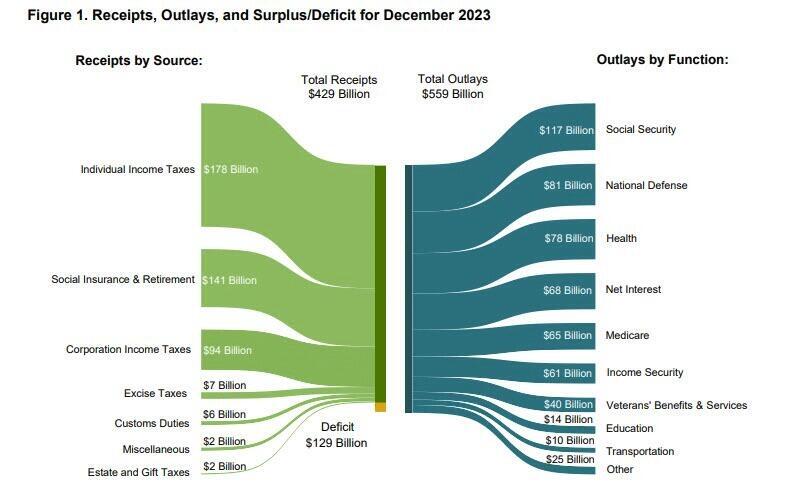
Economic growth continues to defy expectations of a slowdown and recession due to continued increases in deficit spending. In fact, the U.S. Treasury recently reported the December budget deficit, which shows the U.S. collected $429 billion through various taxes while total outlays hit $559 billion.

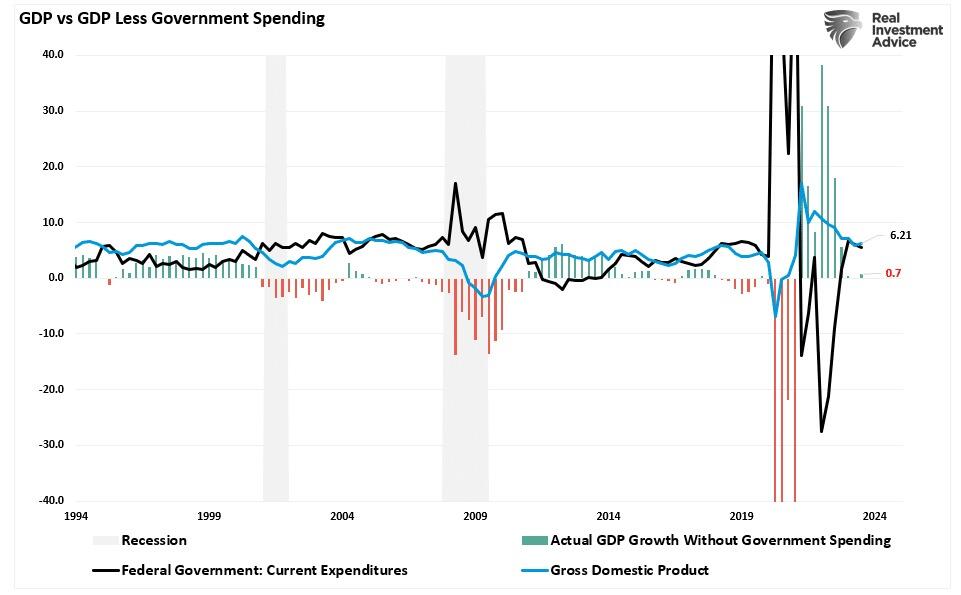
As noted, the problem remains on how the economy has avoided a recession despite the Fed’s aggressive rate hiking campaign. Numerous indicators, from the leading economic index to the yield curve, suggest a high probability of an economic recession, but one has yet to occur. One explanation for this has been the surge in Federal expenditures since the end of 2022 stemming from the Inflation Reduction and CHIPs Acts. The second reason is that GDP was so grossly elevated from the $5 Trillion in previous fiscal policies that the lag effect is taking longer than historical norms to resolve.
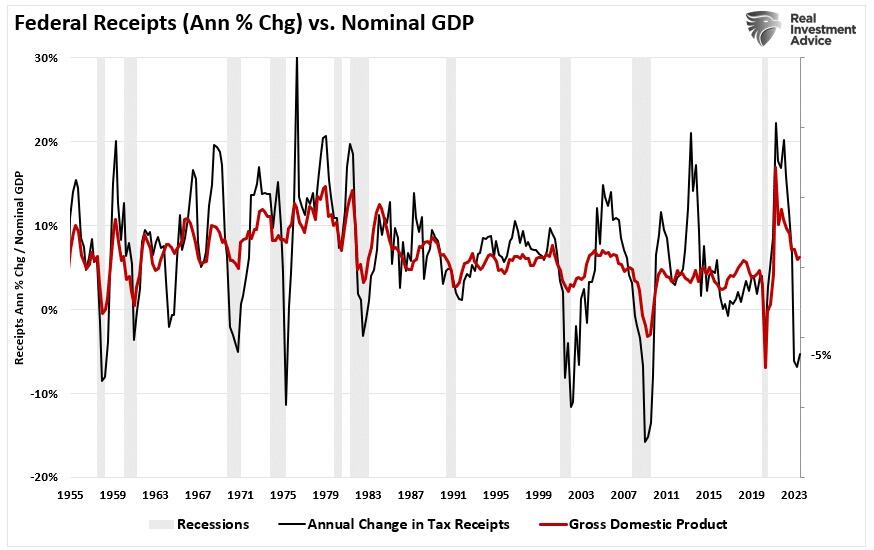
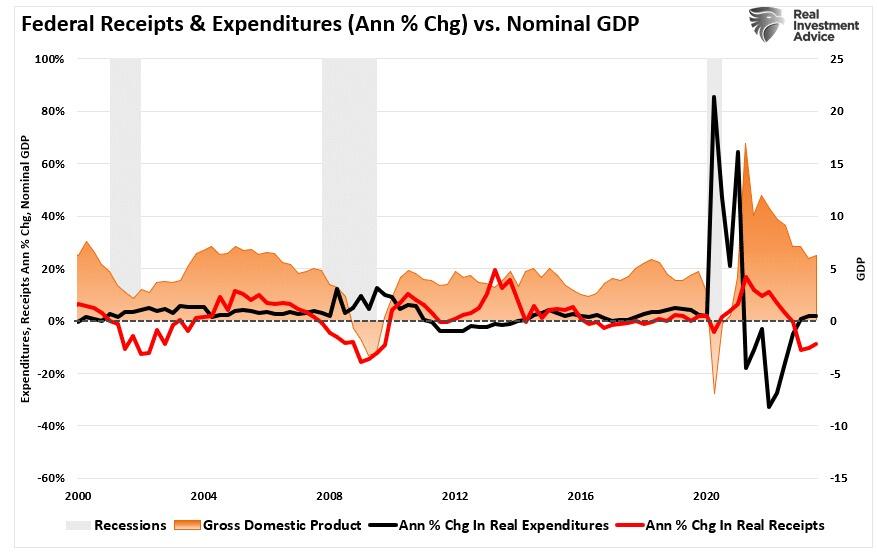
However, that red line in the chart above is the most interesting. Notice that while Federal expenditures are rising, Federal tax receipts are falling. Such is why the national deficit is increasing. When we discussed this previously, many thought the shortfall was temporary. To wit:
California’s tax payments are delayed due to the emergency declaration. However, that doesn’t account for the magnitude of the decline in filings. Secondly, given the shuttering of the entire economy in 2020, which also delayed filings nationwide, the extent of the current decrease seems more than just a single event.”
Given the length of time and the fact the collection rate fell further, it suggests there is more to the decline.
Tax Receipts Send A Warning
The change in Federal receipts is essential as the Government’s revenue is from the taxes on both corporate and individual incomes. Unsurprisingly, if revenues and incomes decline, such would reflect economic activity. As shown below, there is a very high correlation between the annual change in Federal receipts and economic growth. Historically, when the yearly change in Federal receipts falls below 2% annual growth, such has preceded economic recessions. Federal receipts’ yearly rate of change is currently a negative five percent (-5%).
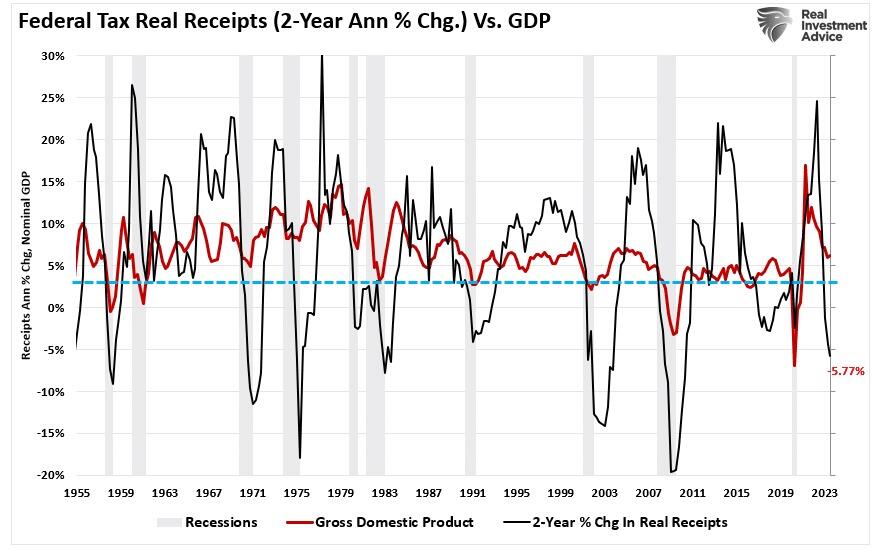
We see the exact correlation by smoothing the data and using inflation-adjusted tax receipts on a 24-month rate of change. Again, a recession follows when tax receipts fall below 2% annual growth rates. I like this measure better as it accounts for the “lag effect” in the economy. The 2-year yearly change in receipts has fallen well below the 2% warning line and is currently at -5.77%.
While tax receipts suggest economic weakness is more pervasive than headlines suggest, the deficit spending flows keep economic growth from becoming recessionary.
The Frog And Deficit Spending
If we look at the current economy, there is no noticeable collapse in the dollar, private capital, rampant Inflation, or recession. However, like bringing the water to a slow boil, the frog doesn’t realize it is in trouble until it’s too late.
The government’s serious endeavors into deficit spending began with Ronald Reagan in 1980. Since then, politicians concluded that a lot should be better if a little deficit spending is good. For politicians, there are only positive benefits of deficit spending increases. More spending provides a short-term boost in economic activity, which gets them re-elected to office.
However, the water temperature is clearly rising in the longer term.
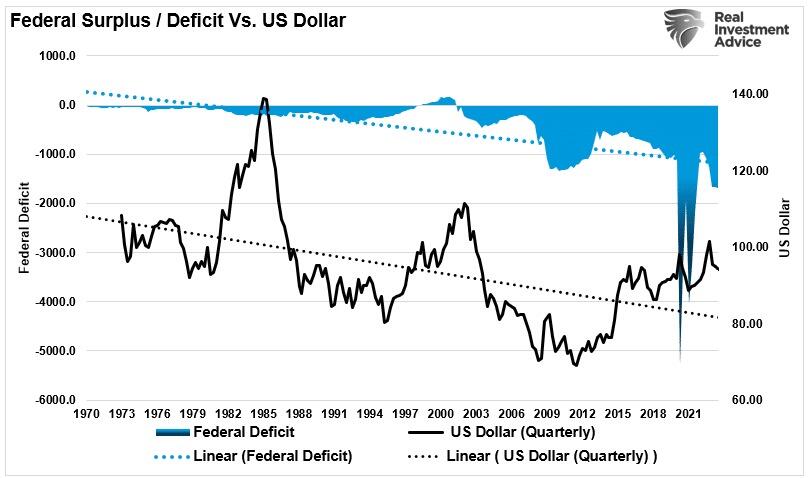
While the dollar hasn’t collapsed under the weight of deficit spending, the negative strength trend relative to other currencies is slowly rising in temperature.
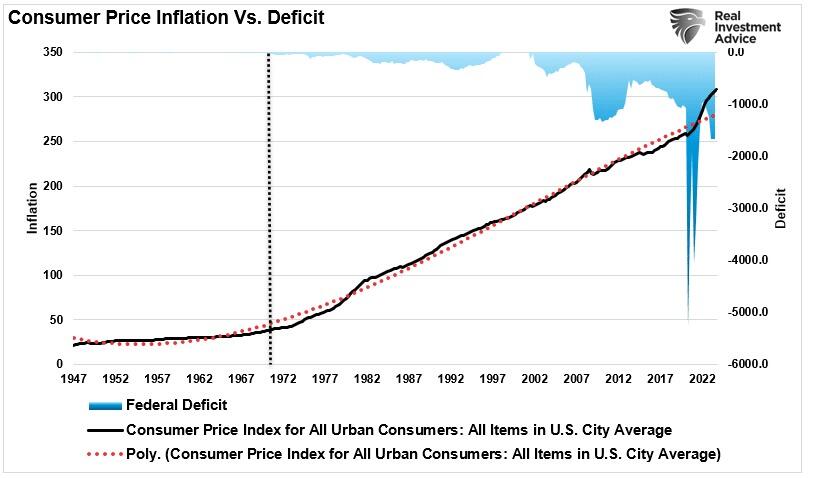
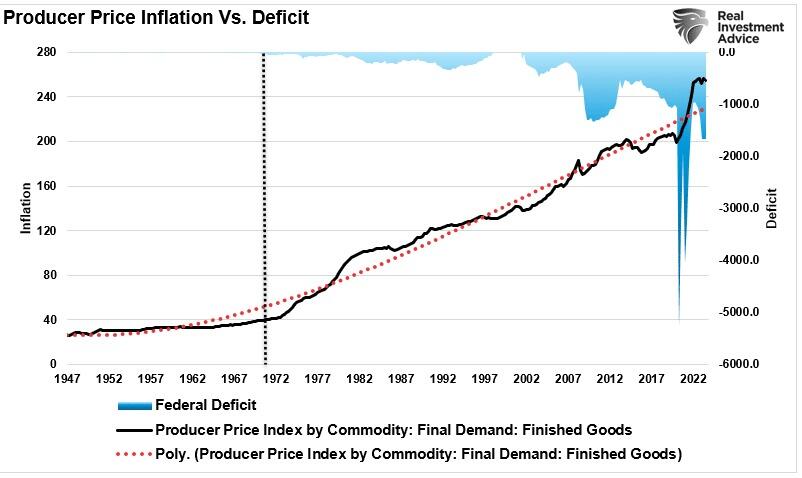
Of course, as the dollar weakened and deficits grew, Inflation, for both producers and consumers, rose.
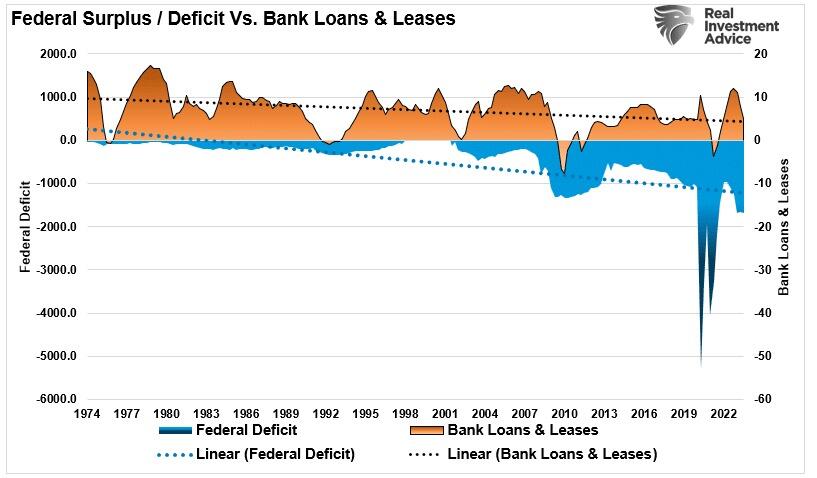
While deficits may not appear to crowd out private investment, the rise of behemoth companies like Apple, Google, and others do crowd out innovation and new company formations. Such activities require capital, and a reasonable correlation exists between the ebbs and flows of deficits and capital acquisition.
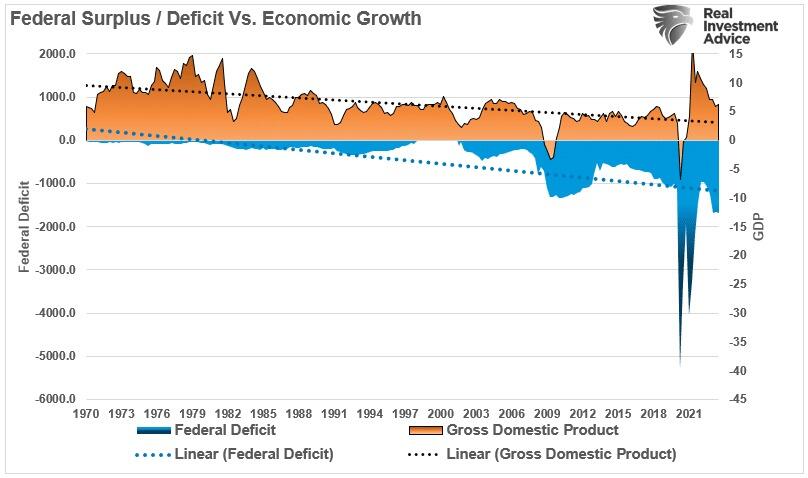
Not surprisingly, as the dollar weakens, the movement of capital slows, and Inflation rises, the economic growth rate slows. Such should not be surprising as debt used for non-productive purposes diverts money from productivity to interest service.
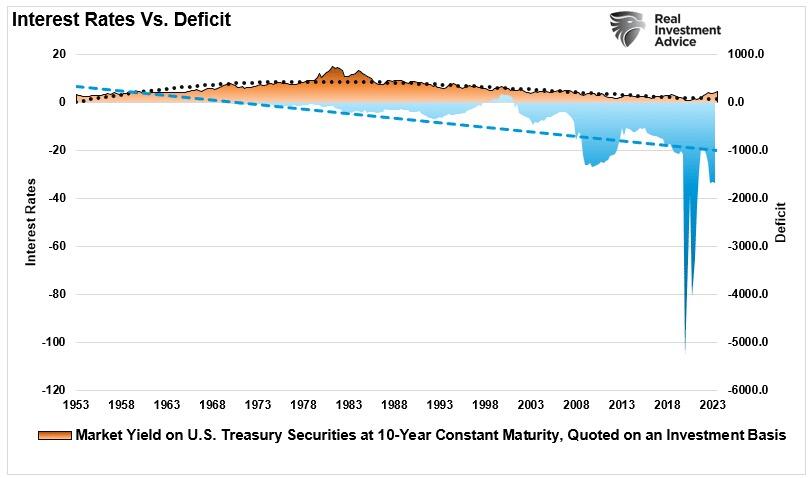
The one thing that deficits have not led to is surging interest rates and massive increases in borrowing costs.
However, that suppression of interest rates has come from two primary sources.
  1. Slower rates of economic growth
  2. Massive interventions by the Federal Government to suppress rates.
Given the sharp increases in Federal debt since 2008 to support economic growth, the economy can not sustain higher borrowing costs for long.
The Economy Is Close To Recession
While economic growth continues to defy expectations on the surface, if it weren’t for increases in deficit spending, economic growth would be flirting with recessionary levels at just 0.7% in Q3 rather than 6.21%
In GDP accounting, consumption is the most significant component. Since deficit spending doesn’t filter down into the average household, it is no wonder why Presidential approving ratings are so dismal.
Should governments use deficit spending for “productive investments” during economic downturns? That answer is clearly in the affirmative category.
However, once the economy returns to growth, the deficits should be reversed into surpluses to prepare for the next inevitable downturn. Such is the entire underlying premise of Keynesian economic theory. But, unfortunately, politicians, in their ongoing endeavor to get reelected, ignore the part about repaying debts.
While short-term deficits may have no consequences, the rising levels of corporatism, wage disparities, and wealth inequality provide ample evidence that something has gone wrong.
Are all the problems in the U.S. solely the result of rampant deficit spending? Of coursenot. The U.S. has also spent four decades making poor political and economic choices.
  1. Massive increases in consumer and corporate debt.
  2. A shift from productive to non-productive labor.
  3. Poor immigration policies.
  4. The slow erosion of the rule of law; and,
  5. An undermining of capitalism and a move to socialistic policies.
If you ignore all of the anecdotal evidence, an argument can be made for running continual economic deficits. However, suggesting “deficit spending” has no consequences is entirely wrong.
We can continue our path for quite some time, and probably longer than most imagine.
But, just because we haven’t realized it yet, it doesn’t mean we aren’t slowly being “boiled by deficits.”

>>> Weekend Papers Summary

Weekend Papers Summary

.FINANCIAL TIMES
-Electric vehicles (EVs) are increasing globally, but at slower rates than anticipated due to higher prices compared to petrol alternatives. The UK and Europe's EV sales market share fell last year, while US growth has slowed. In 2023, a record 1.2M EVs were sold in the US, making up 7.6% of the domestic car market. However, Kelley Blue Book analysts noted that the US EV market is still growing, but not as fast. Sales in the last three months of 2023 rose 40% compared to the same period a year earlier.
-Microsoft has reported that a Russian hacking group, Midnight Blizzard, gained access to a small percentage of its senior leaders' email accounts in November. The attack was detected on January 12, and Midnight Blizzard lost access to the accounts on or about January 13. Microsoft attributed the attacks to the risks posed by groups like Midnight Blizzard, which was responsible for a high-profile cyber-attack in 2020 that hijacked software from SolarWinds to breach the US Treasury, Commerce, Pentagon, and Fortune 500 companies.
-A meeting between senior figures in the far-right Alternative for Germany (AfD) party and Austrian extremist Martin Sellner has scandalized Germany's political class and sparked media attention. The meeting, which took place at the Landhaus Adlon in Berlin, saw politicians and wealthy benefactors discussing mass deportations and other incendiary ideas. Many see the meeting as a Rubicon, indicating the AfD's radicalization despite growing political support. AfD leader Alice Weidel fired her closest adviser, but rallies have been held across Germany, with calls to ban the party outright being made at the highest levels.
-New Hampshire holds an "open" primary, allowing registered Republicans and independents to participate in the vote. Nikki Haley is assured of second place, but the question remains whether she can make it close enough to call on primary night. Haley has the endorsement of New Hampshire's governor, Chris Sununu, but South Carolina senator Tim Scott is preparing to endorse Trump. The latest polls show Trump with 47% support in New Hampshire, while Haley has 34%. Florida governor Ron DeSantis has only 5% support.
-South Carolina Senator Tim Scott has endorsed Donald Trump's White House bid, a significant win for the former president and a blow to Nikki Haley's campaign. Scott, who dropped his own bid for the Republican nomination in November, emphasized the need for a president who will close the southern border and unite the country. This endorsement comes as a gut punch to Haley, who appointed him to the US Senate in 2013. Scott, the only black Republican senator, is also rumored to be Trump's vice-president pick.
-Japan has successfully landed a 2.4-metre tall lunar lander on the Moon, becoming the fifth nation to do so. However, the spacecraft's power issue is posing a threat to its ability to study the lunar surface and find clues about the Moon's origins. This comes after a series of setbacks for Japan's space exploration plans, despite increased investment and collaboration with the US to counter China's ambitions.
-Israel's war leadership has sparked a divide after former military chief Gadi Eisenkot called for elections within months and accused the government of not being truthful about its offensive against Hamas. In a blunt television interview, Eisenkot declined to trust Israeli Prime Minister Benjamin Netanyahu, highlighting the need for a return to the polls and elections to renew trust and address issues such as securing Palestinian hostages and post-war planning.
-European Central Bank president Christine Lagarde has quashed investors' hopes of a first-quarter interest rate cut in Davos, citing demands for pay rises by European workers as the main threat. Policymakers at the ECB remained concerned about high wage growth and the potential for it to trigger a surge in price pressures. Lagarde and IMF first deputy managing director Gita Gopinath pushed back on market expectations of a rate cut in the first quarter. However, wage growth remains the main hurdle for a clear shift in tone.

THE NEW YORK TIMES
-With Deal Close on Border and Ukraine, Republican rifts threaten to kill both. A divided GOP coalesced behind a bit of legislative extortion: No Ukraine aid without a border crackdown. Now they are split over how large a price to demand, imperiling both initiatives.
-Stocks climb to record, lifted by big tech and rate cut hopes. The S&P 500 crossed above its January 2022 peak. Investors have been buying stocks after signs that the Fed’s campaign of raising interest rates is over.
-A line chart showing the trajectory of the S&P 500 index from 1980 to now. The index has reached a new peak.
-Divisions have emerged in Israel over Gaza war. Protesters demanded action to free hostages, a war cabinet minister criticized the military campaign and the prime minister ruled out a two-state solution.
-President Biden pressed Prime Minister Benjamin Netanyahu of Israel on working toward the creation of a Palestinian state.
-The US is staring down a Trump-Biden repeat in disbelief and denial. As President Biden and Donald Trump stroll toward a likely fall rematch, many Americans are clinging to forlorn hopes and floating wild theories.
-Ron DeSantis is quietly starting to build his off-ramp from 2024. DeSantis praised Donald Trump’s victory in Iowa. He admitted to an early strategic error. And he’s begun casting his eyes forward to 2028.
-Inside CNN, there’s a debate going on over whether or not to air Donald Trump speeches live.
-Donald Trump, disdaining Nikki Haley, said she “probably” wouldn’t be his running mate.
-Credit card statements suggest prosecutors in Trump case traveled together. Records included in a court filing followed claims that Fani Willis had begun a relationship with Nathan Wade before hiring him to help lead the case.
-Sports Illustrated is thrown into chaos with mass layoffs. The announcement on Friday left in doubt what lies ahead for the venerable publication, with some staff members dismissed immediately.
-After Uvalde, challenges endure for the police despite clear protocols. The failures in Texas underscored a challenge that mass shootings pose to officers: Be ready to use deadly force in some cases, and try to de-escalate in others.
-Louisiana lawmakers approve map that empowers more black voters. A federal court had found that the existing map appeared to illegally undercut the power of Black voters in the state.
-Alec Baldwin is charged, again, with involuntary manslaughter. A grand jury in New Mexico indicted the actor in the death of the cinematographer on “Rust,” months after the original case against him was dismissed.
-In Solano County, Calif., a who’s who of tech money is trying to build a city from the ground up. But some of the locals don’t want to sell the land.
-Japan becomes the latest country to land on the Moon. The SLIM spacecraft made a successful landing on the lunar surface, but a problem with its solar panels means it will soon run out of power. Japan made a soft landing, but robotic spacecraft have crashed and belly flopped on the moon since 1959.
-Trump claims immunity extends even to acts that ‘cross the line.’ On social media, Donald Trump appeared to take a stance that went further than his lawyers have in court about presidential immunity from prosecution.

THE NEW YORK POST
-Donald Trump is leading White House candidate Nikki Haley in South Carolina's primary by a significant margin, according to internal polling by the super PAC backing the former president. The memo, handed to Haley's donors and supporters, includes a survey showing Trump beating Haley by 39 points in the Palmetto State. The poll shows 64% of South Carolina Republican voters favor Trump, 25% favor Haley, and only 8% support DeSantis. Haley's supporters appear to be more uncommitted than Trump's.
-JetBlue Airways and Spirit Airlines have announced they will appeal a federal judge's ruling that blocked their planned merger due to US antitrust law violations. The move follows US District Judge William Young's decision that JetBlue's $3.8B acquisition of Spirit was anti-competitive and would harm consumers. The airlines filed a notice to appeal the ruling to the 1st US Circuit Court of Appeals, stating that the appeal is consistent with the requirements of the merger agreement. Spirit shares rose 12% after the appeal notice, but are still down over 50% since the ruling.
FT : Europe’s food delivery apps are beginning to serve up a profit

Europe’s food delivery apps are beginning to serve up a profit
The companies can point to 2023 as proof that their concept works and can assume further growth in the future

In most sectors, companies lament the impact of rising interest rates. The higher cost of capital sends their wheels spinning. Not so in European food delivery, where operators have paused value-incinerating land-grabs and are starting to gain traction.

For the first time, all three of the European delivery companies are expected to report positive adjusted ebitda in 2023. This metric strips out the impact of share-based compensation, which can be considerable, but it provides a useful indication of how the underlying business is performing.

The UK’s Deliveroo reckons it will do slightly better than its guidance of £60-80mn adjusted ebitda. Earlier in the week, Just Eat pointed to above-guidance adjusted ebitda of some €320mn. Germany’s Delivery Hero, which operates brands such as Glovo, Foodora and Foodpanda, expects adjusted ebitda margins of over 0.5 per cent. 

True, this is a mere sliver of profit and is adjusted to boot. Investors burnt by years of negative cash flows are loath to give the sector much credit. With the exception of Deliveroo, whose strong balance sheet enabled it to return cash to investors, share prices have languished.


Yet the companies can point to 2023 as proof that their concept works. Even in the midst of a cost of living squeeze, they have been able to extract more from their customers without causing them to quit the apps. Gross transaction value at Deliveroo rose 3 per cent year on year to £7bn.

There is more to come, especially in markets where food delivery is less widespread. Demographics will help. Today’s delivery-prone youngsters may spend more as they grow up and their disposable income increases. Gross transaction volume growth in the high single digits should be a reasonable mid- to long-term assumption, thinks Giles Thorne at Jefferies. 

Margins rise with increased penetration. As the density of participating restaurants and diners in a small “hyperlocal” area increases, riders can make shorter trips and even bunch up deliveries. Central overheads are largely fixed, meaning operating margins after amortisation and depreciation should move from negative to some 6 per cent of transaction values, reckons William Woods at Bernstein.

That is an attractive shift, especially for a sector that trades at 6.8 times 2025 ebitda, on Capital IQ estimates. European food retailers such as Tesco and Carrefour, with a fraction of the growth potential, hover near 6 times. Beleaguered platforms may yet deliver the goods.