FT : PGIM becomes latest US asset manager to open Abu Dhabi office

PGIM becomes latest US asset manager to open Abu Dhabi office
Oil-rich emirate draws new name as it seeks to become financial hub to rival neighbouring Dubai

The $1.3tn asset manager PGIM has become one of the biggest players in its industry to open an office in Abu Dhabi, as the oil-rich emirate seeks to build itself up as a financial hub to rival neighbouring Dubai.

The arm of New York-listed insurer Prudential Financial announced on Thursday that it was opening an office in the Abu Dhabi Global Market centre, its first in the Middle East.

A number of hedge funds and billionaire family offices have set up in the city, which is home to sovereign wealth funds including the nearly $1tn Abu Dhabi Investment Authority.  

Abu Dhabi Global Market’s head of market development Arvind Ramamurthy said PGIM’s arrival would “strengthen ADGM’s position”.

PGIM’s new Middle East head Mohammed Abdulmalek said the move “emphasises our ongoing dedication to our presence in the UAE and our commitment to the Middle East”, and he described Abu Dhabi as a key market for PGIM. The asset manager said it had secured a licence to operate in ADGM.

“Middle Eastern sovereign wealth funds along with other institutional clients and evolving family offices are looking for partners who can support them as they strive to deepen the local capital markets and become more than providers of capital to the rest of the world,” said David Hunt, PGIM’s CEO. “It’s important to be close to our partners to work most effectively with them as they achieve these goals.”

For years, global money managers served Gulf clients from offices in Europe, North America or the regional financial hub of Dubai.

Abu Dhabi wants to attract some of that business as it tries to diversify its economy and lessen its dependence on oil. It has sought to convince money managers they will have a better chance of raising funds in the oil-rich state if they demonstrate their commitment there, including by opening offices in the UAE capital.

It is also aiming to draw finance professionals with low taxes, as well as private schools and healthcare.

Other major asset managers have a presence in Abu Dhabi too. ADGM said last month that 112 asset and fund managers now operate there, and that firms including Rajiv Jain’s GQG Partners and Morgan Stanley have obtained licenses.

BlackRock registered two “Middle East infrastructure” funds at ADGM last year, the centre’s registry shows, and BlackRock has an office on Abu Dhabi’s seafront promenade, according to its website. 

Billionaires have also set up shop. Ray Dalio, the founder of hedge fund Bridgewater Associates, has opened a family office in Abu Dhabi, while former Apollo Global Management chief executive Leon Black this week announced a new Abu Dhabi branch of his family office Elysium.

>>> Stoxx 600 Pre-Market Indications

  • DSV (DS81 TH) +6%
    • DSV Wins Race to Buy Deutsche Bahn’s Schenker: Reuters
  • ASML (ASME TH) +4.4%
    • Tech Surges With Nvidia’s $216 Billion Gain: S&P 500 Sector Wrap
  • STMicroelectronics (SGM TH) +2.9%
  • Infineon (IFX TH) +2.9%
  • Diageo (GUI TH) +2.5%
    • Diageo Raised to Buy at BofA
  • Novo Nordisk (NOV TH) +2.4%
  • TAG Immobilien (TEG TH) +2.2%
  • Delivery Hero (DHER TH) +2%
  • 3i (IGQ5 TH) +1.9%
  • Adyen (1N8 TH) +1.8%
  • Nokia (NOA3 TH) -0.3%
  • Unilever (UNVB TH) -0.4%
  • Danone (BSN TH) -0.6%

>>> What to look at today - 12th of September 2024

Stocks in Asia rose Thursday for the first time this week, as a tech-fueled rally on Wall Street spread across the region. Risk appetite returned as US inflation data for August supported bets for a Federal Reserve rate cut next week. Benchmarks in Japan, South Korea and Taiwan advanced, pushing the MSCI Asia-Pacific Index to the biggest gain in almost a month. “The tech rebound and increased appetite for risk-taking are enjoyed by the Asian markets as well,” said Jun Rong Yeap, market strategist at IG Asia. “Rate expectations are still split on what will come beyond September, so that may still see some caution creeping back in as the Fed meeting nears,” he said.
Traders have swung between optimism that the Fed will guide the US economy to a soft landing and fear that the central bank has left it too late to cut rates. While swaps have now priced in a 25 basis point rate reduction next week, debate over the path for further reductions continues, and some investors say markets have overpriced expectations. In Japan, the Nikkei index halted a seven-day losing streak as the US inflation print pulled the yen down from its strongest level against the dollar since December. A region-wide gauge of tech stocks rose more than 3% after Nvidia Corp. jumped 8.2% overnight, while Taiwan Semiconductor Manufacturing Co. was among top gainers on the regional index. Chinese stocks were mixed. The so-called core consumer price index — which excludes food and energy costs — increased 0.3% from July, the most in four months, and 3.2% from a year ago, Bureau of Labor Statistics figures showed Wednesday. The three-month annualized rate advanced 2.1%, picking up from 1.6% in July, according to Bloomberg calculations. An index of the dollar was steady after falling Wednesday. Oil held gains from Wednesday as Hurricane Francine ripped through key oil-producing zones in the Gulf of Mexico, prompting traders to cover bearish bets. Bank of Japan policy board member Naoki Tamura sent the yen slightly upward with comments about lifting its benchmark rate to at least 1% by the end of its projection period. On Wednesday, another board member, Junko Nakagawa, said the central bank will continue to adjust policy provided the economy performs in line with projections in comments that sent the yen higher. Japan’s producer price index rose less than expected in August. Other data set for release in Asia includes producer prices for Hong Kong, inflation and industrial production in India and a rate decision in Pakistan. Investors are also showing new interest in Southeast Asian equities, which have emerged as a favored trade among fund managers for the Fed’s policy pivot. Whether the economy is entering a soft landing that only requires a series of modest rate cuts, or heading for a harder landing at some stage in the next year is the biggest conundrum for investors. Currently, Fed swaps are pricing in over 140 basis points of rate cuts by the Jan. 29 rate decision, equivalent to roughly two half-point moves over the next four gatherings barring no intra-meeting event. Guha noted that if the Fed doesn’t cut rates by 50 basis points next week, it will possibly do that in November. Treasuries were steady. Australian and New Zealand yields were slightly higher. In corporate news, OpenAI is in talks to raise $6.5 billion from investors at a valuation of $150 billion, according to people familiar with the situation. Nvidia Corp. Chief Executive Officer Jensen Huang said the limited supply of their products has frustrated some customers and raised tensions. Alimentation Couche-Tard Inc. is discussing improving its takeover proposal for Seven & i Holdings Co. with the goal of convincing the Japanese convenience store operator to start engaging in discussions, people with knowledge of the matter said.  US After Hours NTGR +23.4% roaring higher on settlement agreement and raised guidance; OXM -9.1% slides on lackluster earnings.

Nikkei +3.42% Hang Seng +1.11% CSI -0.08% Shanghai +0.14% Shenzen +0.02%

Eur$ 1.1019 CNH 7.1242 CNY 7.1187 JPY 142.78 GBP 1.3050 CHF 0.8524 RUB 91.5426 TRY 34.0078 WTI$ 67.95 +0.95% Gold 2,520 +0.33% BTC 58,030 +0.93% ETH 2,359 +0.46%

S&P +0.18% Nasdaq +0.26% EuroStoxx +1.53% FTSE +1.17% Dax +1.16% SMI +0.62%

Macro :
- BEL 20 Index Unchanged in September Quarterly Review
- Oil Jumps as US Gulf Hurricane Spurs Short Covering by Traders
- As EVs Ebb, The Gas-Guzzling, Huge Engine Supercar Rises Again
- Biden Drug Pricing Law Threatens New Products, J&J’s Duato Says
- Oil Groups Appeal Ruling They Say Threatens Gulf Drilling
- Watch European Miners as Aluminum, Copper and Iron Ore Climb
- European Stocks Set to Gain Ahead of ECB Interest Rate Decision

Keep an eye on :
- ABN NA : Dutch State Ends ABN Share Sale After Its Stake Drops to 40.5%
- AIR FP : China Development Bank Leasing Unit Buys 80 Airbus A320neo Jets
- AKELD SS : Akelius Residential Sells Castellum Shares to Akelius Apartments
- BALN SW : Baloise 1H Profit CHF219.8M Vs. CHF205.7M Y/y; Refocus Strategy
- BA US : Boeing CEO Warns Workers Strike Would Jeopardize Its Recovery
- BOL SS : Boliden Says Odda Smelter Cost Raised by €100M Due to Delays
- CWG LN : Canary Wharf credit rating cut deeper into junk by Fitch - FT
- CCO CN : Asset Managers Are Now Investing in Once-Shunned Nuclear Stocks
- ATD CN : Couche-Tard Is Said to Discuss Higher Price for 7-Eleven Owner
- DSV DC : DSV Said In Advanced Talks to Buy €14 Billion Deutsche Bahn Unit
- DND CN : Activist Shareholder Blasts Dye & Durham M&A, Calls for Meeting
- EQT SS : EQT Explores Sale of Banking Circle: Reuters
- PRT IM : Esprinet Sees FY Adjusted Ebitda EU66M to EU71M, Est. EU70.4M
- HOLN SW : Holcim Argentina Sees Biggest Rise Since November on New CEO
- JNJ US : Biden Drug Pricing Law Threatens New Products, J&J’s Duato Says
- NOVOB DC : *NOVO ADRS RISE TO SESSION HIGH, UP 3%; LILLY SHARES GAIN 1.6% *ROCHE ADRS DROP 3.6% ON OBESITY PILL DATA
- MSFT US : OpenAI Fundraising Set to Vault Startup’s Value to $150 Billion
- LUN CN : Lundin CEO Says Potential Buyers Are Eyeing Its European Mines
- NOVOB DC : *NOVO'S AMYCRETIN SAFETY ISSUES `A LITTLE HIGH': DEUTSCHE BANK
- NVDA US : US Closer to Allowing Nvidia Chips for Saudi Arabia: Semafor
- PGHN SW : BlackRock, Partners Give Retail Investors Private Markets Access
- ROG SW : Roche Tumbles on Obesity Pill’s Side Effects; Rivals Climb
- RCL US : 12-year-old Dies in Fall From Balcony on Royal Caribbean Cruise Ship
- SAN FP : Sanofi, RadioMedix, Orano Med Sign Deal for Rare Cancer Therapy
- 3382 JT : Seven & i Appoints Nomura to Advise on Couche-Tard Offer: FT
- STLAM IM : Stellantis May Be Next Carmaker Warning on Profit, MS Says
- STLAM IM : Stellantis’ US Dealers Call Out CEO Tavares for Damaging Brands
- TLGO SM : Spain Vetoed Hungarian Train Group Bid on Ukraine Concerns: FT
- UBI FP : Grand Theft Auto VI Competition Fears See Ubisoft Bull Backtrack
- X US : Biden Is Urged to Reconsider $14 Billion US Steel Takeover (2)

>>> TradeGate Pre-Market Indications

DAX:
  • Infineon (IFX TH) +2.9%
  • SAP (SAP TH) +1.7%
  • Deutsche Bank (DBK TH) +1.7%
    • Watch European Rate Sensitive Sectors as ECB Expected to Cut
  • BMW (BMW TH) +1.5%
  • Mercedes (MBG TH) +1.5%
MDAX:
  • TeamViewer (TMV TH) +4%
    • TeamViewer Raised to Neutral at BNPP Exane; PT 13 euros
  • Delivery Hero (DHER TH) +2.6%
  • Thyssenkrupp (TKA TH) +2.2%
  • TAG Immobilien (TEG TH) +2.2%
    • TAG Immobilien Raised to Outperform at Bernstein
  • Nordex (NDX1 TH) +1.8%
SDAX:
  • Kontron (KTN TH) +3.9%
  • BayWa (BYW6 TH) +3.5%
  • RENK Group AG (R3NK TH) +3.2%
  • PNE AG (PNE3 TH) +2.9%
  • Salzgitter (SZG TH) +2.3%
  • flatexDEGIRO (FTK TH) +1.3%
  • Schaeffler (SHA TH) +1.1%
    • Schaeffler Cut to Neutral at JPMorgan; PT 4.20 euros
  • Ionos (IOS TH) -1.5%
    • Ionos Cut to Neutral at BNPP Exane; PT 27 euros

FT : Christie’s chief says Europe struggling to remain art-market centre

Christie’s chief says Europe struggling to remain art-market centre
Marlborough’s Mayfair building for sale; Charles Saatchi offers 500 works for charity; Frieze slower in Seoul

Guillaume Cerutti, chief executive of Christie’s, kicked off London’s new season with some sobering statistics at this year’s Art Business Conference on September 10. He disclosed that, between 2010 and 2023, the value of sales at his auction house grew 32 per cent in the Americas and 22 per cent in Asia Pacific but fell 6 per cent in Europe (including the UK). Across a similar period (2012-23), he reported that buyers from the Americas and Asia Pacific grew 27 per cent and 33 per cent respectively, while falling 37 per cent in Europe.

The real challenge now, Cerutti said, is not about the post-Brexit “rivalry” between London and Paris, but more “how can we pull together . . . the commercial field and the museum world . . . to keep Europe at the centre?” Because of Brexit, he conceded, London has lost being a “fabulous entry point” to the rest of Europe.

Other speakers voiced concerns about the more recent news that London’s wealthy, including donors to the arts, could leave the country in expectation of higher taxes under the UK’s new Labour government. Charlotte Appleyard, director of development and business innovation at London’s Royal Academy of Arts, cited a recent report by advisers Henley & Partners that expects 9,500 millionaires to leave the UK this year.

Cerutti said that, for the art market at least, this was unlikely to be a big problem and assured the audience that “we will continue to fight for London”, including by supporting events such as the 1-54 contemporary African art fair.

‘Balloon Monkey (Blue)’ (2006-13) by Jeff Koons, which will be sold at Christie’s © Christie’s Images

One highlight that Christie’s has already secured for the city’s October auctions is Jeff Koons’s “Balloon Monkey (Blue)” (2006-13). The guaranteed work comes with a £6.5mn-£10mn estimate and is sold by fellow artist Damien Hirst, who showed it in his gallery in 2016. (Christie’s would not confirm that Hirst was the seller.) It goes on show in London’s St James’s Square from September 30 to October 10.

The London building belonging to Marlborough Gallery, which closed this summer after 78 years of business, is on the market, priced in excess of £25mn. The 10,300 sq ft, 10-floor freehold building on Mayfair’s Albemarle Street, called Scandia House, is “a rarity” on the property market, says David Rosen of Pilcher London, which is offering the space.

In June, Marlborough trustee Franz Plutschow said that closing the gallery, which also operated in New York, Madrid and Barcelona, came “after long and careful consideration”. Representatives from the gallery did not respond to requests to comment on plans for its other buildings or the dispersal of the gallery’s stock, rumoured by parties close to the business to be worth about $250mn.

Meanwhile, the gallery’s artists are gradually finding new ways to market. The New York-based British painter Bill Jacklin, who first showed with Marlborough Gallery in the 1970s, is now collaborating with Portland Gallery, which will bring three of his paintings to this month’s British Art Fair, priced between £24,000 and £36,000 (September 26-29).

‘Ana’ (2007) by Tanyth Berkeley © Saatchi Collection

British collector Charles Saatchi is having a collection clear-out, starting this week with the first part of an online sale of about 500 works, to benefit London’s Great Ormond Street Hospital. The first tranche of 150 works, on offer through Artsy until September 25, have estimates that range from £300 to £60,000. These include photographs by John Stezaker (est £2,000-£3,000), Hannah Starkey (est £1,000-£1,600) and Tanyth Berkeley (est £400-£600), plus a taxidermied horse on a “Jesmonite blob” by the Iranian-born Soheila Sokhanvari (“Moje Sabz”, 2011, est £2,600-£3,600). The September works have a low estimate of £200,000, with further sales on Artsy in October and December.

Separately, Bonhams will auction the Saatchi Collection’s vast coal-sack installation by Ghanaian artist Ibrahim Mahama for between £30,000 and £50,000 at its Modern and Contemporary African art sale on October 16. The 2013 work was first shown in Saatchi Gallery’s Pangaea: New Art from Africa to Latin America exhibition in 2014.

‘The Wind Blows-240506’ (2024) by Lee Kang-So was sold by Thaddaeus Ropac at Frieze Seoul © Lee Kang-So/Zagupsil

Reported sales from fairs in Seoul and New York have come in slower and lower than in more economically healthy times. Gallerist Thaddaeus Ropac said the pace of sales was “somewhat slower than last year” at Frieze Seoul (September 4-7), but it did sell work by the gallery’s latest charge, 81-year-old Korean artist Lee Kang-So (“The Wind Blows”, 2024, $180,000). 

More sales were reported from The Armory Show, now owned by the Frieze franchise, though with 235 exhibitors, this fair is twice as big as its Seoul event. Anne-Claudie Coric, executive director of Galerie Templon, found the fair “a remarkable concentration of New York energy” and reported sales by gallery artists Jim Dine, Alioune Diagne, Chiharu Shiota and Omar Ba (€50,000-€150,000). Oliver Durey, director of Larkin Durey, described the fair as “sustainable and well-tempered”, reporting sales between $18,000 and $110,000.

‘Les gardiens de la prairie’ (2024) by Marc Padeu at Larkin Durey © Courtesy Larkin Durey
Some galleries sold across both fairs, albeit at different price levels: Korea’s Johyun Gallery reported 10 works by its charcoal artist Lee Bae were sold at Frieze Seoul for $56,000 each, while three works by the same artist sold at The Armory Show for between $90,000 and $300,000.

FT : Valentino’s Jacopo Venturini: ‘We are selling dreams, emotions and entertai

Valentino’s Jacopo Venturini: ‘We are selling dreams, emotions and entertainment’
The chief executive on his strategy for the Italian luxury house — and the new creative direction under Alessandro Michele

Jacopo Venturini, chief executive of Valentino, has a message that he wants to get across: “There is no magic formula. To me, it doesn’t exist.”

The company is in the midst of a transformation that includes a new creative direction led by former Gucci star designer Alessandro Michele. Venturini and Michele are a tried-and-tested team, having worked together at the Kering-owned brand for four years. At the time, Venturini led Gucci’s merchandising. (Kering also bought a stake in Valentino from Qatar’s Mayhoola in July 2023, and has the option to take full control of the house by 2028.)

For some, that raises the question of whether Venturini is attempting to recreate the sparkle from his time at Gucci, when the brand took a more fashion-forward approach, with buzzy accessories and gender-fluid styling that proved a hit. Its sales more than doubled from €3.9bn in 2015 to more than €10bn in 2022. Operating profits more than tripled.

Much hinges on Michele’s official debut at Valentino, taking place via a show at Paris Fashion Week this month, to lift the fortunes of the Italian couture house, which saw a 3 per cent year-on-year dip in 2023 profits, at constant exchange rate, to €1.35bn (a slump that Venturini attributes to the broader luxury slowdown).

“What I can tell you is that in my experience, at any company I’ve been at, I did my job in a different way,” he says, from Valentino’s headquarters in Milan. “The DNA of a company is much stronger than any formula.”

The idea of harmony is a crucial part of Venturini’s thinking. When we meet in his circular office, filled with vases and handicrafts (curated to feel less corporate and more like a living room), Venturini is wearing a white tee under a blue striped shirt, its cuffs jutting out from under the sleeve of his jacket, and trousers in a shade of dark rose taupe. Layers of jewellery hang from his neck and adorn his wrists and fingers. His style and overall demeanour is less that of a typical CEO and more akin to a film director.

Born and raised in Milan (where his family has been based for generations), Venturini’s interest in clothes developed from a young age — but there was more to it than figuring out how to dress. “I’ve always been fascinated by the identity of different brands,” he says. Familial expectations led him to study economics and business at the city’s Bocconi university. His first job was as a buyer for Italian department store La Rinascente, from 1995 to 1999.

His first encounter with Valentino was in 2000, when founder Valentino Garavani was still at the company; Venturini worked on the merchandising of men’s and womenswear as brand manager, until 2004. He then moved to Prada before returning to Valentino in 2008 as ready-to-wear collection and retail image director. In 2015 he left for Gucci.

“They called me at Gucci when Alessandro was named creative director,” Venturini recalls. “[It] was a great opportunity, but I decided to sign after I saw the [designs] of Alessandro. After I saw his first show, I wrote to [former Gucci CEO Marco] Bizzarri: ‘I’m coming, he’s a genius.’ I was excited by the way he was looking at Gucci in what I thought was the real essence of [the brand] in the ’70s, the period in which they started going towards [ready-to-wear] clothes and lifestyle.”

Now at Valentino for the third time, Venturini, who was appointed CEO in 2020, wants to do things differently, starting with a repositioning of the brand. “I would like Valentino to be positioned in the world of the maison de couture where it was born, in 1960, and where it still deserves to be.” He also emphasises creating “a sustainable culture of the irresistible”.

What that looks like, in practice, is a departure from the traditional show cycle in favour of “seasonless” collections that are “really meaningful”, says Venturini. Instead of staging four separate men’s and women’s ready-to-wear shows a year, and a couture collection twice yearly, the brand will present co-ed shows twice a year, in which the women’s and men’s collections will be presented together. There will also only be one couture show a year.

“The luxury system became too mechanical over the last 15 years and it’s probably due to the immense growth it has had,” reflects Venturini. “We don’t give the time to breathe between one expression of creativity and another. I talked about that with Alessandro and the ways to give more space. So we made this decision, because it’s much better to do one great show.”

Going co-ed is a shift that Michele also engineered when he was at Gucci. When it was put in motion in 2017, the designer justified it by saying that unified collections allowed him time to be more thoughtful and reflected his gender-fluid approach to design. (In 2022, Gucci returned to showing separate collections).

Other luxury houses have slowed down their pace: Ferragamo’s runways are currently co-ed; Balenciaga presents a couture collection yearly; and Maison Margiela’s ready-to-wear and couture shows are irregular. A growing number of smaller independent fashion designers similarly stage a show once a year.

Venturini is also rethinking Valentino’s points of distribution. Direct sales currently account for 75 per cent of the business; the goal is to grow that figure to 80 per cent. He caveats that “co-operation” with selected wholesale partners remains vital because “they have a point of view that is very different to ours, and they see the entire market”.

Since November 2022, Valentino has been rolling out new store concepts globally, with the aim of putting the customer first. The brand’s boutiques, now offering more intimate and exclusive areas reserved for private appointments, have “a more cosy and home-like feeling”, according to Venturini. “At the same time, everything has to do with efficiency.”

Changes such as improved stock management and back-of-house systems aren’t discernible to the public eye but are crucial in that they allow store advisers to spend valuable time with their clients, Venturini explains. He has also overseen training to make store staff more knowledgeable about a wider breadth of products. “Clients are not interested if you are in charge of bags, or in charge of shoes. You have to know how to sell all the different categories.” He continues: “We are selling dreams, emotions and entertainment. We can’t be mechanical in the way we do things.”

Keeping Valentino’s long-standing customers happy is a priority. “We are quite resilient because we have a strong base of clients who are very loyal,” says Venturini. That requires maintaining pricing stability (there have been some price increases due to rising production costs, he admits) and expanding product categories, including costume jewellery, to “complete the wardrobe of our clients”. Elevation remains top of mind; Venturini terminated the sub-label Red Valentino at the start of the year.

To communicate Michele’s new vision, an advertising campaign will be rolled out in October when the designer’s first collection (a pre-spring 2025 lookbook with his first designs were unveiled in June) arrives in stores. But there will be no erasing of Valentino’s past, says Venturini. Signatures such as the Rockstuds (square studs applied to bags and shoes, created in 2010 by Garavani and now the brand’s most recognisable motif) will remain — even if, in recent years, they have started to feel stale, in part because of rising counterfeits and an association with aspirational shoppers.

“An iconic product should always stay,” Venturini asserts. “It’s not easy to have a product that sells for 14 years, so we should defend it.” While ready-to-wear makes up the bulk of Valentino’s business, its accessories offering could be re-energised, he acknowledges. Will Michele be able to create the next Rockstud, whatever that may be? “For sure,” says Venturini. “I am sure he will do that.”

>>> Europe : Brokers Upgrades & Downgrades - 12th of September 2024

>>> Up
* ABN Amro GDRs Raised to Neutral at JPMorgan; PT 15.30 euros
* Alten Raised to Outperform at BNPP Exane; PT 115 euros
* Commerzbank Raised to Overweight at JPMorgan; PT 17.20 euros
* Derwent London Raised to Outperform at Bernstein
* Equinor Raised to Hold at Berenberg
* HIAG Immobilien Raised to Buy at Baader Helvea
* Icade Raised to Outperform at Bernstein
* Land Sec. Raised to Outperform at Bernstein
* Sage Raised to Outperform at BNPP Exane; PT 1,200 pence
* TAG Immobilien Raised to Outperform at Bernstein
* TeamViewer Raised to Neutral at BNPP Exane; PT 13 euros
* Veolia PT Raised to 45.30 euros from 43.40 euros at Oddo BHF

>>> Down
* Air France-KLM Cut to Add at AlphaValue/Baader
* Antin Cut to Neutral at Citi; PT 14.30 euros
* Ionos Cut to Neutral at BNPP Exane; PT 27 euros
* Planisware Cut to Underperform at BNPP Exane; PT 23 euros
* WDP Cut to Underperform at Bernstein

>>> Initiation
* GlobalData Rated New Buy at Berenberg; PT 295 pence
* Kongsberg Automotive Reinstated Buy at ABG; PT 2 kroner
* Lime Technologies Rated New Buy at Nordea; PT 405 kronor
* RELX Rated New Buy at ING; PT 4,309.40 pence
* Safran Started at Outperform by RBC, Target Started at EUR240

>>> Call
* Avanza Concerns Overdone, Citi Opens Upside Catalyst Watch
* GlobalData New Buy at Berenberg, Has Multiple Growth Levers
* Safran New Outperform at RBC on Continued Aftermarket Strength
* Veolia PT Boosted to Street-High at Oddo BHF on Growth Strategy

TechCrunch : Mark Zuckerberg says he’s done apologizing

Mark Zuckerberg says he’s done apologizing

The home of the Golden State Warriors was packed on Tuesday evening this week, but it wasn’t to watch Steph Curry. Thousands of fans gathered at the Chase Center in downtown San Francisco to watch one of Silicon Valley’s biggest ballers, Meta CEO Mark Zuckerberg, sit down for a conversation with the hosts of the Acquired podcast, David Rosenthal and Ben Gilbert.

Shortly after hopping onstage, Zuckerberg joked that he might need to schedule his next appearance in order to apologize for whatever he was about to say. After a beat, he added that he was just kidding and that, in fact, his days of apologizing are over.

Zuckerberg has had something of a rebrand recently. He raises cattle in Hawaii now, has long bouncy curls and a gold chain, and commissions Roman-style statues of his wife. Onstage, the Facebook founder wore a boxy T-shirt he designed himself alongside fashion designer Mike Amiri that read “learning through suffering” in Greek letters.

The tongue-in-cheek comment about apologizing was a reference to Nvidia CEO Jensen Huang, who himself addressed a flub he’d made on the Acquired podcast earlier this year, via a pre-recorded video on a screen hanging over the crowd. Huang’s original comment — that he never would have started Nvidia if he knew what he did today — was grossly taken out of context, he said. In the video, he clarified that he absolutely would start Nvidia again, and that his comment was more about the blissful ignorance of startup founders.

While Zuckerberg’s opening comment was just a friendly jab at Huang, it set the tone for Zuckerberg’s new attitude toward life and business. The founder of Facebook has spent a lot of time apologizing for Facebook’s content moderation issues. But when reflecting on the biggest mistakes of his career, Zuckerberg said his largest one was a “political miscalculation” that he described as a “20-year mistake.” Specifically, he said, he’d taken too much ownership for problems allegedly out of Facebook’s control.

“Some of the things they were asserting that we were doing or were responsible for, I don’t actually think we were,” said Zuckerberg. “When it’s a political problem… there are people operating in good faith who are identifying a problem and want something to be fixed, and there are people who are just looking for someone to blame.”

The vague comments seemed to be about critics blaming Facebook for its part in Donald Trump’s election victory in 2016. Among other things, a firm called Cambridge Analytica took Facebook users’ data and attempted to use it to influence voters to choose Trump. Foreign actors also used the platform in an attempt to influence the election and sow political division, culminating in years of bad press for the company and in Zuckerberg testifying before Congress. (It’s unclear how effective these campaigns actually were.) In the months following the 2016 election, Zuckerberg lamented how almost no one had good things to say about Facebook.

Now, however, Zuckerberg says he’s found the right balance on political issues. He didn’t say much more than that, but his recent actions are instructive.

In August, the Meta CEO sent a letter to House Republicans effectively apologizing for censoring misinformation around COVID-19 in 2020, and bending to demands from the Biden administration. Zuckerberg said he regrets not being more outspoken about the pressure from government officials at the time. In the future, Zuckerberg said he would “push back if something like this happens again.”

Meanwhile on Meta’s platforms, Facebook and Instagram have removed all special restrictions for Trump’s social media accounts. These restrictions were originally placed on his accounts after the January 6 insurrection in 2021, but will not impact Trump’s accounts going into the 2024 election.

In July, while not going as far as to endorse a specific candidate for U.S. president, the Meta CEO also called Trump a “badass” for lifting his fist in the air after someone attempted to assassinate him.

On Tuesday night, Zuckerberg said he’s more excited about projects outside of social media these days, describing Meta as a “human connection” company at its core. The Meta CEO noted how no one gets out of bed in the morning and goes “f— yea, social media!” Instead, he wants to make more “awesome” products, seemingly referring to Meta’s AR glasses, VR goggles, and open source AI efforts.

Zuckerberg was pressed at one point about whether he regrets naming the company Meta, which signaled the company’s pivot toward the metaverse. The CEO simply replied, “Meta is a good name.”

Regardless of where Zuckerberg’s focus is, Meta’s social media platforms are still where billions of people convene every day. That means content moderation issues will arise, and the CEO will ultimately have to make consequential decisions.

Electrek : Ferrari’s first EV spotted testing ahead its debut [Video]

The all-electric Ferrari we’ve been waiting for is almost here. Ferrari’s first EV was spotted out for testing near its Maranello factory in Italy. Check out the video below to get a closer look.

Although Ferrari has not officially revealed its first electric model, CEO Benedetto Vigna has given us some clues about what to expect.
According to Vigna, one thing is guaranteed: The electric Ferrari will be “a lot of fun” to drive, as you would expect from the luxury sports car maker.
“People buy a Ferrari because when they buy a Ferrari, they have a lot of fun,” Vigna boasted earlier this summer. Ferrari’s CEO confirmed the brand’s first EV will launch in 2025, promising it will be made “the right way.”
Vigna explained that you don’t buy a Ferrari for a single purpose; “It’s a combination of things.” These Ferrari-like elements, including unique sounds, will be a staple in its upcoming EV.
In June, a Reuters report claimed that the electric Ferrari would cost over $500,000. Vigna said the report was “a surprise” but didn’t deny (or confirm) the price.
Inside Ferrari’s new e-building (Source: Ferrari)
Ferrari’s first EV spotted testing ahead of its debut
Ahead of its official debut, Ferrari’s first EV was caught testing near its Maranello plant. The video from Acriore gives us our best look yet at the luxury electric model.
The vehicle is covered in camouflage and even has a fake exhaust, but the big yellow high-voltage sticker on the front and rear indicates it is electric.
Ferrari’s first EV testing in Italy (Source: Acriore/ YouTube)
As the vehicle passes, you can hear clear exhaust noises, suggesting Ferrari is working on its own noise-generating system. It could be something like Dodge’s Fratzonic Chambered Exhaust for the electric Charger.
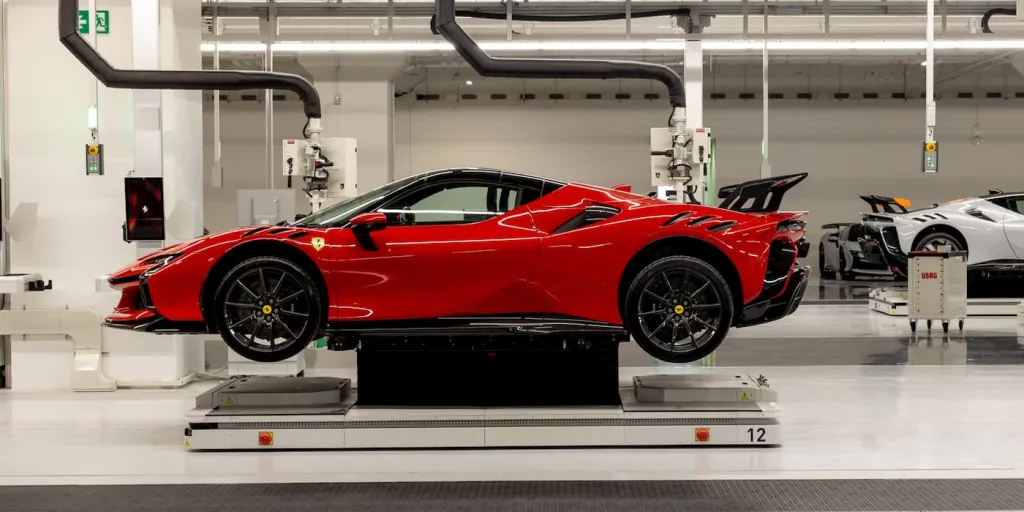
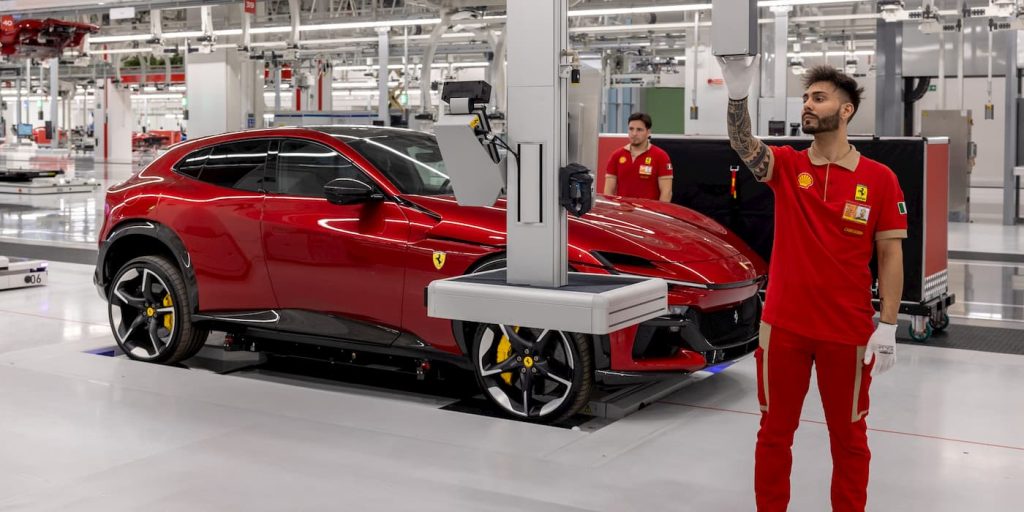
Ferrari opened its new e-building this summer, where the electric model will be built. Vigna said the new factory will “light up Ferrari’s future.”
Inside Ferrari’s new e-building (Source: Ferrari)
The electric Ferrari is expected to debut later this year ahead of sales in 2026. Ferrari launched its first plug-in hybrid last year, the SF90 Stradale. By 2026, the Italian sports car maker aims for 60% of sales to be EV or PHEV.
Ferrari will also build batteries, electric motors, and inverters at its e-building. Word on the street is that the company is already working on its second EV. Stay tuned for more.