WSJ : SpaceX to Invest $2 Billion Into Elon Musk’s xAI

SpaceX to Invest $2 Billion Into Elon Musk’s xAI
The startup is leaning on Musk’s business empire to play catch-up in the AI race

  • SpaceX has agreed to invest $2 billion in xAI, nearly half of the Grok chatbot maker’s recent equity raise.
  • The investment is one of SpaceX’s largest investments in another company.
  • Musk has used SpaceX to support his other businesses in the past.

Elon Musk’s SpaceX has agreed to invest $2 billion in his artificial-intelligence company xAI, investors close to the companies said, nearly half of the Grok chatbot maker’s recent equity raise.

Musk has repeatedly mobilized his business empire to boost the AI startup, which is racing to catch up with OpenAI. Earlier this year, he merged xAI with X, combining what was a small research lab with a social-media platform that helps amplify the reach of its Grok chatbot. The merger valued the new company at $113 billion.

The SpaceX investment is part of xAI’s $5 billion equity fundraise announced by Morgan Stanley last month. It is the rocketmaker’s first known investment into xAI and one of its largest in another company.

Since leaving his role in the Trump administration, Musk has turned his attention to training the latest version of Grok, which earned high marks from AI-benchmarking service Artificial Analysis for its performance following its release on Wednesday.

Musk called it “the smartest AI in the world,” though the chatbot it powers hasn’t gained nearly as much traction as OpenAI’s ChatGPT. It recently posted racist and controversial comments in response to users on X. “We deeply apologize for the horrific behavior that many experienced,” xAI said, adding that it investigated and took steps to resolve the issue.

Grok powers customer-support features for SpaceX’s satellite internet service, Starlink, The Wall Street Journal reported. Musk’s representatives have said more business partnerships between SpaceX and xAI are likely in the future, according to investors who spoke with them.

During Musk’s release of Grok 4 this week, he said he also aims to embed Grok into humanoid robots, like Tesla’s Optimus fleet.

Musk has long used SpaceX to support his other businesses. He personally borrowed $20 million from the company to help fund Tesla early in its history and also used SpaceX’s equipment to set up his tunneling venture, The Boring Company. More recently, he turned to SpaceX for a $1 billion loan around the time he was acquiring what was then-called Twitter, which he paid back shortly after taking it out.

SpaceX’s investment in xAI may pose risks for Musk’s space company. SpaceX’s revenue has jumped in recent years, but the company is investing billions to develop a new rocket called Starship. The experimental vehicle is behind schedule and has suffered multiple setbacks this year, including three consecutive failures in flight and a large explosion during an engine test last month.

SpaceX recently had more than $3 billion in cash on hand, the Journal has reported. The company has rarely made investments in outside ventures. A major one occurred in 2021, when it acquired a satellite-communications firm for $524 million.

At xAI, Musk is spending billions of dollars every year training AI models, an effort that mirrors the high spending levels at rival AI startups, which have similarly garnered high valuations but face almost constant pressures for cash.

The startup raised $5 billion in debt alongside its equity financing, and it is expected to raise even more money later this year, one of the investors said.
>>> Barron’s Weekend Summary

Cover:
-The Barron's Roundtable predicts a stall or sink in the stock market due to high prices, potential inflation from tariffs, and tepid economic growth. Despite these concerns, there are 55 promising stocks to buy, with many in neglected sectors or attached to companies with temporary challenges. The Roundtable's investment pros were initially skeptical about the market's prospects but are still searching for bargains. Rajiv Jain, an investment pro, expressed more anxiety due to complacency in the bond market and the fiscal setup. Jain highlighted the fiscal deficit running at 6.5% of U.S. GDP for five years, indicating the significant impact of Covid-related stimulus and deficits on corporate earnings.

Interview:
-No update

Tech Trader:
-Tech earnings later this month are expected to reveal more massive outlays for artificial intelligence, as Amazon, Google, Meta Platforms, and Microsoft remain in a costly race to build data centers and buy Nvidia chips to fill them. To slow the pace of spending, hyperscalers are sourcing chips not made by Nvidia, such as Broadcom and Marvell Technology. Both companies develop application-specific integrated circuits (ASICs), which can be designed for predictable, high-volume workloads and cost an average of several thousand dollars compared to more than $30,000 for Nvidia's latest GPUs. Morgan Stanley analysts estimate that the custom AI chip share of the market stood at 11% in 2024 and will rise to 15% in 2030. The AI accelerator market is set to grow to $390B by 2030, making Broadcom and Marvell valuable diversification in the AI trend.

The Trader:
-Oil prices have been volatile this year, with oil prices increasing by 0.5% this week. WTI Crude, the U.S. benchmark, is down 16% from its 2025 high of $80.04 in January but up 18% from its low of $57.13 in May. Despite this, oil prices have held up even after OPEC announced a larger-than-expected supply boost on July 5. This resilience suggests that concerns about oversupply are already reflected in the price, though a shift in the economic or political winds could always cause volatility to resume. In such an uncertain environment, investors should look for oil companies that are relying on more than higher prices to boost profits. Chord Energy, a $6.2 billion company, fits the bill by implementing efficiency measures that can boost its free-cash-flow margins. Resources, California Resources, and SM Energy, which currently have margins below 20%.
-President Donald Trump's tariffs are causing concern among investors, with the S&P 500 index dropping 0.9% in the first two days of the week. The iShares Expanded Tech-Software Sector exchange-traded fund has declined only 0.2%, suggesting it should be more volatile than the stock market. Software companies tend to buy fewer physical products, making them less vulnerable to rising prices. Demand isn't as economically sensitive as for other industries, so if the economy takes a light hit from increased levies, software isn't among the market's top concerns. If tariffs get slightly worse, software will trade well. The recently passed tax bill allows software companies to expense research and development spending immediately, resulting in higher near-term expenses and lower tax bills. According to Morgan Stanley analyst Keith Weiss, the three software stocks that benefit the most from the changes in the law are Okta, Autodesk, and CrowdStrike Holdings.

Features:
-Venture capital firms have been investing in gambling and gambling treatment since the opening of nationwide sports betting in 2018. New Hampshire-based alumni Ventures, part of an initial investment round for Sleeper, raised $2M in 2017, which was later valued at $400M. This past August, alumni Ventures invested $1.5M in Kindbridge Behavioral Health, a gambling addiction treatment firm. Bettor Capital, a devoted gambling VC firm, also invested in Kindbridge in March. In total, six VC firms have simultaneously invested in gambling and gambling treatment. The investment thesis is that as more people gamble, more will eventually develop a gambling problem and seek help. Venture-capital firms see the market for treatment growing in lockstep with the market for gambling. American VC firms have invested $2B in gambling businesses since a US Supreme Court ruling opened the door to nationwide sports betting in 2018.
-Luxury stocks have been a topic of discussion in recent years, with companies like Burberry Group and Chanel struggling to maintain exclusivity and avoid brand dilution during the Covid-era boom. However, the luxury sector has seen a decline in recent years due to weakness in China, hit-or-miss merchandising, and tariffs. LVMH Moët Hennessy Louis Vuitton, Gucci owner Kering, and Prada have all seen their stock drop over the past two years. However, the One Big Beautiful Bill provides a 2.3% tax cut to top earners, who are also getting richer as the stock market rises. This is good news for luxury, which has seen an uncharacteristic boom/bust cycle in recent years.

Europe:
-European equities have been the global market's surprise of 2025, with a surge in European equities and high-yield corporate bonds. In June, investors ate up EUR 23B ($27B) in subinvestment-grade corporate paper, with Europe remaining a small junk-bond fish with around $350B in total issuance compared to $1.5T in the US. The market has hit a Goldilocks range that suits both borrowers and investors, with tight spreads and attractive yields. Average gross yields below 5.5% lag behind the 7% available in U.S. high yield, but with U.S. interest rates more than two percentage points higher than in the euro area, the alchemy of hedging can make up the difference. European junk on average is safer, with two-thirds of the market rated BB, the upper limit of high yield, compared with half in the US Market exuberance has opened the door for higher risk/reward credits, with Austrian auto parts manufacturer Benteler International and UK-based Punch Pubs placing paper at more than 7% annual interest. European high-yield offerings are diverse, with no single sector accounting for more than 10% of the market. Most European issuers are domestic-facing, minimizing exposure to Donald Trump's threatened US tariffs. Auto makers represent around 10% of the European market.

Emerging Markets:
-No update

Commodities:
-Copper prices have been experiencing a surge, with President Donald Trump's recent threat of a 50% tariff on copper imports causing market shock. The consensus was for a 10%-25% levy, but Commerce Secretary Howard Lutnick has announced a 50% tariff will be implemented by August 1. Investment banks like Goldman Sachs and many traders believe the threat is credible, with Goldman analysts seeing a 60% chance of a 50% tariff priced into December 2025 contracts. Copper is considered a leading indicator for the global economy and industrial activity. Demand for copper has been healthy, with the US heavily dependent on imports for the past few years. The US has imported nearly half of its copper, mainly from Chile and Canada, with Peru and Mexico accounting for 9% and 6%, respectively. A stockpiling rush as companies try to front-run tariffs is distorting prices, with copper in the US trading nearly 30% higher than prices on the London Stock Exchange. If Trump backs off from a 50% tariff, prices could tumble back to where they were before the tariff announcement. Additionally, US buyers who bought excess inventory may exit the market as prices stay elevated.

Streetwise:
-CVS Health has introduced a new feature for weight loss patients, reducing weight loss. The company's pharmacy benefit manager, Caremark, has made Wegovy its preferred obesity-fighter and dropped coverage of Zepbound. This change has affected around 200,000 Zepbound patients, but overall, Eli Lilly has been adding 500,000 Zepbound patients per month. Investors should expect a dent to revenue growth when the company reports second-quarter financial results on Aug. 7, followed by a reacceleration in the third quarter. The stock selloff hasn't left Eli Lilly's valuation particularly lean, but earnings gains through the end of the decade could be humongous. Bulls are predicting big stock returns from here. Eli Lilly's stock has been up 174% since a follow-up column two years ago, while Novo has underperformed. The company has an even newer obesity drug called retatrutide, which appears in trials to be more effective than existing meds. The bigger development might be Eli Lilly's orforglipron, which showed promising blood sugar reduction and weight loss in a late-state diabetes trial reported in April and could hit the market next year, pending approval.

The Information : How Granola—and AI Note Taking—Grabbed Silicon Valley’s Attent

How Granola—and AI Note Taking—Grabbed Silicon Valley’s Attention
The note-taking apps have quickly changed privacy norms. No one’s unhappy about it.

At the moment, many in the tech industry have developed a rather profound addiction to Granola.

No, not to the crunchy breakfast-time oats—but to a software product made by a two-year-old startup that has come to dominate a crowded field of artificial intelligence–powered note-taking options. The tool from Granola, which was valued at nearly a half-billion dollars in May, has become something of an It App this summer among venture capitalists and startup founders.

For instance, Nikhil Basu Trivedi, a co-founder of Footwork, a San Francisco–based venture firm, no longer only fires up Granola in business settings: He’s also used it while meeting with his lawyer, his fellow board members of a nonprofit and his 3.5-year-old daughter’s preschool teacher, even though he pretty much knew what to expect from the latter. “Knock on wood—she’s doing pretty well,” he said. “A good kid.”

Meanwhile, Cat Noone, CEO of Stark, a Montreal-based software company, likes to turn on Granola while meeting with her therapist. Doing so allows her to stay more present in the conversation as it happens, she said, and she later reads the app’s auto-summaries to further reflect on what they discussed. “I don’t want to miss a thing,” she said.

Every few years, a new notes app becomes a darling of Silicon Valley, a place where digital optimization of body, mind and thought is a foremost obsession. Evernote was one, then Notion. More recently, the boom in AI has supercharged what note-taking software can do, making the apps infinitely more searchable, organizable and customizable than previous versions.

Nearly all the major meeting tools, like Google Meet and Zoom, offer an AI notes function, and older notes apps like Notion have also embraced AI. Still, Granola is the hands-down favorite among the tech elite, scooping up more than $70 million in funding from the industry’s top names, including Lightspeed Venture Partners and Nat Friedman, the investor who just became one of Meta Platforms’ AI czars.

Users prize Granola over other options for a number of reasons, including its sophisticated search function, which runs on natural language prompts—just as we might talk to ChatGPT or Claude.

More than anything else, though, people like Granola because it hides itself. After connecting Granola to an email calendar, users can join their meetings directly through Granola, and the app transcribes the conversation without ever visibly notifying the participants that it’s running. (The transcriptions happen live, and Granola doesn’t save the audio.)

The proliferation of Granola and of AI note taking has established a surreal status quo: A sizable portion of Silicon Valley’s population is recording each other all the time, often without telling the other person before doing so, upending privacy norms in a manner that would’ve been somewhat unimaginable even a few years ago.

No one seems too fussed about it. “Transparently, I kind of just assume that everyone is using a meeting note taker of some sort,” said Brett Goldstein, CEO and founder of Micro, a New York–based AI startup. And that’s apparently a universal assumption in the industry, judging by the more than half-dozen Granola devotees I spoke to.

As a result, no one expects to get a head’s up about someone using Granola to record a conversation, which makes people like Rebecca Kaden, a managing partner at Union Square Ventures, outliers. She always makes sure to ask people if they’re comfortable with Granola before she turns it on. “I’ve never had anyone say no,” she said.


4 Tips for Using Granola and AI Notes
AI has made it possible to easily record and then closely study the content of everything from a dinner conversation to a doctor’s office visit.

  • Download Granola’s mobile app and use it in settings like a dinner business meeting, where you’d like to take notes, but it would be awkward to keep scribbling them down.
  • AI note-taking apps are also helpful in situations like doctor appointments, where notes are often essential, but the conversation is laden with dense information, which can be hard to write down quickly, Pedregal said.
  • Such apps also come in handy if someone is attending a conference or seminar and wants to share the talk with people who couldn’t be there.
  • Startups such as Windsurf, which makes a popular AI coding software, have used Granola not just for external meetings—say, recording notes of a sales call—but for internal ones, too.“I use it in every meeting with my boss now,” said Rudy Garza, a salesperson at Windsurf. “And she’s doing the same thing with all of us.”
Undoubtedly, part of what’s making everyone feel comfortable—at least for now—is that there hasn’t been a public horror story of anyone using Granola or another AI note taker in some devious fashion to embarrass someone or leak information, and none of the users I spoke to recounted such an incident or had even heard about one. And as with much of AI, the audio apps exist in a legal gray area, since laws about recording another person vary across the country.

“It’s a world where the norms are changing all the time,” said Sam Stephenson, seated next to his Granola co-founder, Chris Pedregal, in their East London office. “When we started, we were more on edge”—worrying whether Granola might run into privacy concerns—“and I think norms have already shifted to a lot of this kind of thing being normal.”

Stephenson and Pedregal met in 2023 shortly after Pedregal left Google. Pedregal had previously started an AI tutoring startup, Socratic, before selling it to Google, and he found himself itching to return to artificial intelligence after fooling around with OpenAI’s GPT-3 large language model. He found Stephenson, a mobile app designer, in a thriving online group for people with a keen interest in “tools for thoughts”—note-taking apps, in other words.

For a year and a half, they labored to develop an app simple enough for users with “1% of their brain available for the tool at any given time,” Stephenson said. They launched the app in May 2024.

While Granola has a devoted coterie of loyal fans, it faces the stiff task of fending off much bigger rivals who might just copycat the startup to death. Brett Goldstein, founder of New York–based Micro, put a fine point on the problem: “Granola is more of a feature than a business product—like Snapchat stories.”

Pedregal doesn’t dismiss the size of the challenge ahead. “I don’t think the Granola product that we have today in two years would be a viable product: It needs to keep getting better—doing more and more for you. And we need to do that faster than anyone else,” he said. “That’s hard.”

SCMP : A year after China returns rocks from moon’s far side, debate rages over

A year after China returns rocks from moon’s far side, debate rages over ancient crater
Chinese scientists believe samples found by Chang’e-6 mission answer central question in lunar science, but some in the West have doubts

A year after China returned the first rock samples from the moon’s far side, scientists are debating whether the mission has answered a central question in lunar science – and whether the country’s rising scientific dominance is challenging who gets to tell the story of the moon’s past.
While a team of Chinese researchers believes they may have nailed down the age of the moon’s largest and oldest crater – a colossal impact basin that could hold clues to the early solar system – other scientists, mostly from the West, remain unconvinced.
Some say the ancient rocks may have come from a different impact and were tossed to the landing site. Others suggest the rocks may not have come from an impact at all, but from magma that cooled slowly underground.

“I don’t think the 4.25-billion-year age is 100 per cent certain, but it’s the most credible number we have so far – more reliable than model-based crater counting or meteorites with unknown origins,” said planetary scientist Yang Wei of the Institute of Geology and Geophysics in Beijing.

“It’s based on the only direct evidence we’ve ever collected and measured from the South Pole-Aitken (SPA) basin,” said Yang, who was not directly involved in the study but coordinates a nationwide research effort that gave select teams early access to samples from the Chinese lunar mission Chang’e‑6.

The findings, which he described as the most important among a collection of five papers submitted to the journal Nature for peer review last September, were rejected twice by a review panel dominated by Western scientists.

The paper was later published in National Science Review, a China-based journal. Four others, which detailed the lunar far side’s chemistry, water content and its volcanic and magnetic history, appeared in Nature’s print edition this week.

A Chinese scientist familiar with the review process, who requested anonymity due to the sensitivity of the matter, said he felt some Western scientists were not ready to accept that Chinese researchers might solve such an important scientific problem.

“They didn’t want China to be the one to pin down the age of the SPA basin. Maybe it stings a little,” the scientist said. “But it doesn’t matter. The paper is published, and time will tell.”

In the National Science Review study, researchers from the Chinese Academy of Sciences focused on norite, a type of rock made of two common lunar minerals.

Radiometric dating revealed two distinct age groups of norite particles in Chang’e-6 samples. One was about 3.87 billion years old, consistent with known impact events like Apollo or Schrödinger. The other was much older: 4.25 billion years.

The researchers argued that this older group was likely to have come from the formation of the SPA basin, since the samples were collected from within that basin and no older impact signals were detected. “Our preferred SPA impact age of [around 4.25 billion years] is broadly consistent with crater-counting age estimates from previous studies,” they wrote.

Clive Neal, a planetary geologist at the University of Notre Dame, said the rocks were likely misidentified – not true norites, but impact melts with a similar mineral make-up.

He also noted that the 4.25-billion-year age was significantly younger than what crater-counting models and radiometric data from SPA-linked meteorites had suggested. Neal said the team may have uncovered evidence of a major impact – possibly the one that created the Apollo basin, a crater believed to have formed after the SPA.

Qian Yuqi, a planetary geologist at the University of Hong Kong, said the 4.25-billion-year age was “very close to the lower limit of the SPA basin’s possible age”.

According to a paper Qian and colleagues published in early 2024, extensive intrusive magmatism – a slow, underground process where magma hardens without erupting – is common in the SPA basin. That means the rocks analysed by the Chinese team may not have come from an impact at all.

The five papers emerging from Chang’e‑6 sample analyses revealed a previously untold chapter of the moon’s history – one that, according to Yang, began more than 4.2 billion years ago when a 500km-wide (310-mile) asteroid slammed into the lunar far side.

The impact carved out a colossal basin and melted part of the moon’s deep interior, forming what the researchers call the SPA impact melt rock.

That rock told a story not just of ancient violence, but of surprising resilience. Even after the moon’s mantle was stripped of water and key elements, it somehow erupted again 2.8 billion years ago – possibly triggered by a sudden reawakening of the moon’s magnetic field. “Our work has just started,” Yang said.

Following the Chang’e‑6 mission’s return of nearly 2kg (4.4lbs) of samples from the moon’s far side, the China National Space Administration announced plans to open access to international researchers.

While it may take time to prepare the portions for global distribution, the move could allow for independent testing of one of lunar science’s biggest questions.

SCMP : What are China’s plans for deep space exploration … and beyond?

What are China’s plans for deep space exploration … and beyond?
The United States has long held the lead in the space race, but the Chinese programme is catching up fast


The US Senate has approved an extra US$10 billion for Nasa’s Artemis moon exploration programme, giving a major boost to contractors such as Boeing.
While many see it as a domestic win over newer space players including SpaceX, it also signals the Trump administration’s determination to stay ahead of China in an intensifying space race.
Here we look at how China is expanding its deep-space ambitions, from putting astronauts on the moon to returning rocks from Mars, and how it is posing the most serious challenge to US space leadership in 60 years.
Will the next words spoken on the moon be in Mandarin?
Possibly.

China aims to land two astronauts on the moon before 2030, with all major hardware now in prototype development and large-scale testing.
The Chinese programme’s Mengzhou crew capsule passed a critical safety test just last month, and the Long March-10 moon rocket could make its maiden flight as early as next year. China is also developing the Lanyue lunar lander and the Wangyu spacesuit, both undergoing trials.
Nasa still leads on paper, with Artemis III targeting a crewed landing no earlier than 2027. But the mission faces big technical hurdles. In particular, its massive lunar lander – a modified SpaceX Starship – requires in-orbit refuelling, something that has not been done before.

In congressional testimony in February, Dan Dumbacher, a former senior Nasa official, called the Artemis timeline “very suspect”.
“The probability of the United States safely landing humans on the moon by 2030, with the current plan, is remote at best,” he warned.

China’s Shenzhou-20 crew to test superconductors, install debris defences on space station
How serious is China about building a base on the moon?
Very serious.
China aims to build a permanent base called the International Lunar Research Station (ILRS) near the moon’s south pole by 2035, and the planning is already under way.
In 2023, more than 100 researchers from universities, laboratories, and space companies gathered in the central city of Wuhan for the first major planning meeting. Since then, a team has worked out how to bake lunar bricks using simulated soil and sent them to China’s Tiangong space station for testing under extreme space conditions.
China hopes to make its first real brick on the moon in 2028, during the Chang’e-8 mission. A team in the central province of Anhui has built a 3D printer that uses concentrated sunlight to melt lunar soil into bricks that are strong enough for roads and buildings. They have also developed a prototype to extract water ice, using a bundle of tiny drill needles to heat the lunar soil, release vapour and collect it.
Architects in China have proposed various concepts for the research station, including bases on the open lunar surface, at the bottom of craters, and in underground lava tubes. Each features multiple linked modules and is meant to support three to four astronauts during short-term stays.

Space race elevates Asia in new world order
Will China beat Nasa to the next big discovery beyond the moon?
Possibly – at least when it comes to bringing back rocks from Mars.
China’s Tianwen-3 mission, now in development, aims to collect and return at least 500 grams of Martian samples by 2031.
The plan involves two spacecraft. One will land on Mars to drill, scoop and deploy a drone to grab rocks nearby. The collected material will then be launched into orbit, where a second spacecraft will rendezvous, capture the container, and bring it back to Earth.

That timeline puts Nasa at a clear disadvantage. The US began collecting samples on the red planet with its Perseverance rover in 2021, but the return mission has been plagued by ballooning costs and major delays, with no final plan or launch date in sight.
There is also a real possibility that China could overtake the US in solar system exploration. Nasa’s science programme is facing deep budget cuts, putting missions to Venus, Jupiter, near-Earth asteroids, and even the distant Kuiper Belt at risk – including some that are already in space.
China, meanwhile, is forging ahead. It recently launched Tianwen-2, a mission to collect samples from a near-Earth asteroid, and is planning Tianwen-4, which will target Jupiter and Uranus for a rare leap into the outer solar system.

Private Chinese space rocket crashes and explodes after accidental launch during test
Will China take the lead in building the infrastructure that deep space depends on?
Probably.
China has already made history by deploying the first relay satellite, called Queqiao, in a special halo orbit beyond the moon. From that position, it enables continuous communication between Earth and China’s Chang’e-4 spacecraft – the first to make a soft landing on the moon’s far side.
Its successor, Queqiao-2, launched earlier this year, is even more capable. Operating in a highly elliptical lunar orbit, it is designed to support up to 10 missions operating on the lunar far side simultaneously.
Looking ahead, Chinese scientists have proposed building a BeiDou-like navigation and communication system for the moon and deep space.
The plan is for 20 to 30 satellites to be placed in various orbits around Earth, the moon, and in between, which will provide high-bandwidth communication and real-time navigation services for a moon landing, moon base construction, and even a crewed landing on Mars.
While Nasa and its partners are focused on building the Gateway lunar station, China is seizing the initiative to create the critical infrastructure that deep-space exploration will rely on in decades to come.

SCMP : US puts jet-drone teams to bigger test in race with China for air suprema

US puts jet-drone teams to bigger test in race with China for air supremacy
American air force fighters work with uncrewed Valkyries to see how well they integrate

Amber Wangin Beijing
Published: 6:00am, 12 Jul 2025Updated: 6:25am, 12 Jul 2025

The US military has raised the difficulty level with a coordination test of its crewed fighters and “loyal wingman” drones as it races against China towards the next frontier of air dominance.
Chinese military observers said the People’s Liberation Army was matching the United States in this technology.
The Air Force Research Laboratory said earlier this month that pilots operating an F-16C Fighting Falcon and an F-15E Strike Eagle each controlled two XQ-58A Valkyrie drones in an air combat training exercise.


The exercise was a test of real-time integration between crewed and semi-autonomous systems, according to the laboratory, which is the US Air Force’s main scientific research and development centre.

Taiwan agrees to buy 1,000 killer drones from US one day after PLA blockade drills
Built by defence firm Kratos, the drone first flew in 2019 as part of the air force’s push to explore the “loyal wingman” concept in which uncrewed aircraft are directed by crewed fighters.
While the Valkyrie has previously flown with different types of crewed fighters, analysts said the most recent test was more complex, with a formation that could be scaled up.
“This kind of simulated combat drill is a logical next step, given that the Valkyrie has been flying for quite a while now,” said Fu Qianshao, a Chinese military aviation analyst.
“Commanding and controlling two drones at once raises the difficulty substantially – it demands more attention from the pilot, greater tactical judgment, and the ability to maintain broader battlefield awareness.
“We are also working on similar technologies in China, although there has been little public reporting on it. China’s loyal wingman drones capabilities are on par with the United States.”
The US Air Force described the exercise as a “major leap” in human-machine teaming, referring to the Valkyries as “autonomous collaborative platforms”. The goal is to integrate such platforms into future air combat scenarios, reducing pilot workload while improving situational awareness and combat effectiveness.

The Valkyrie is a low-cost, long-range, high-speed drone designed for a variety of missions including strike, intelligence-surveillance-reconnaissance, electronic warfare, decoy operations, and communications relay, according to media reports.
As early as 2020, an F-22 Raptor and an F-35A Lightning II were seen flying in formation with a Valkyrie.
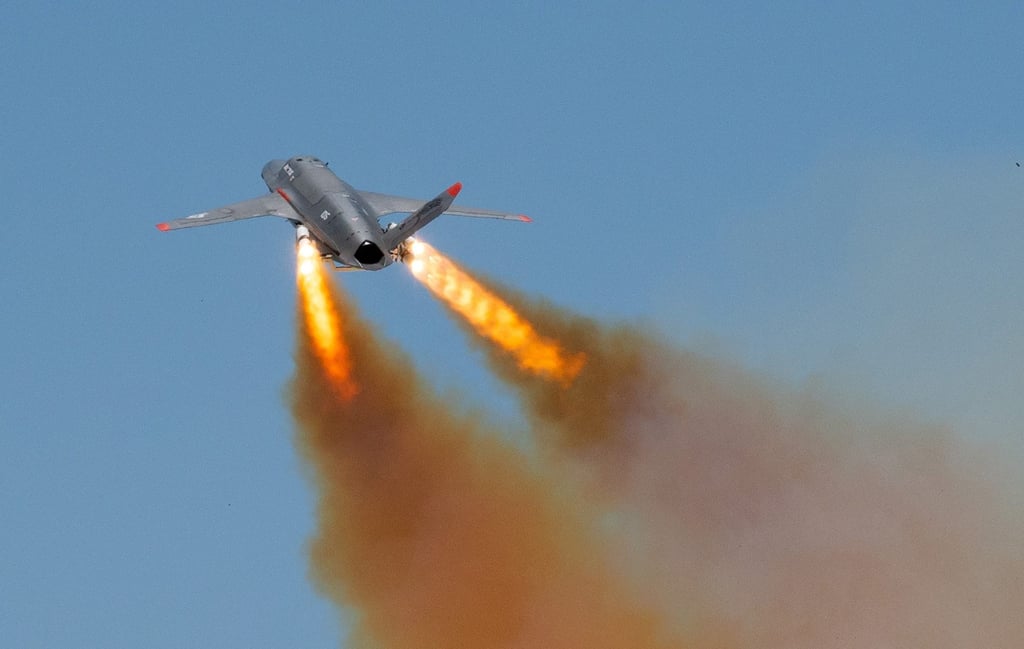
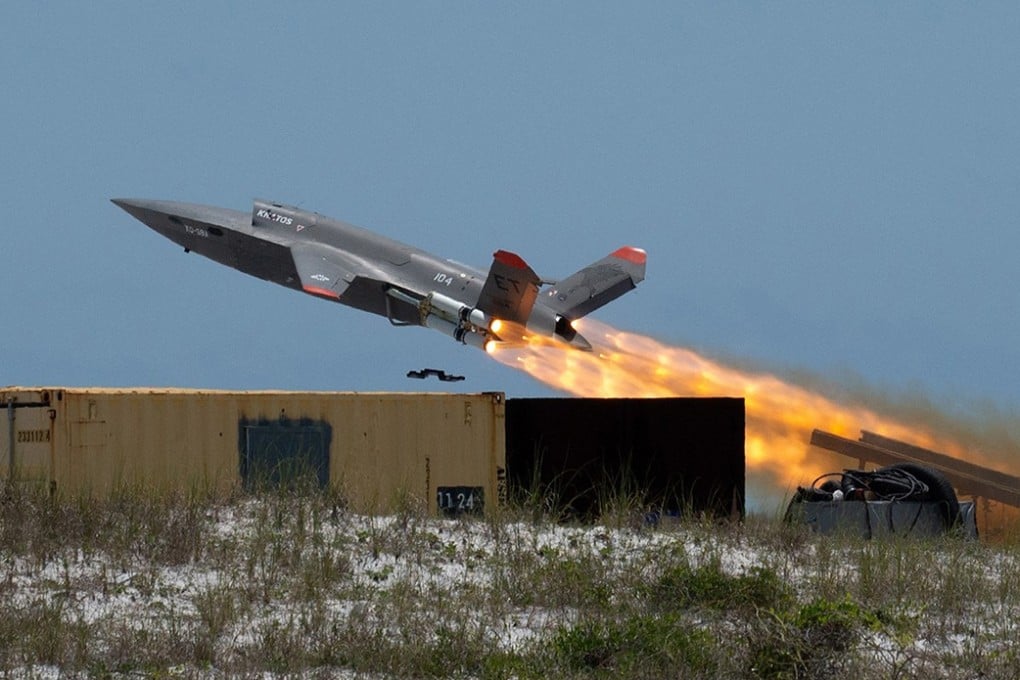
The Valkyrie is a low-cost, long-range, high-speed drone designed for a variety of missions. Photo: Air Force Research Laboratory

In 2024, the US Marine Corps tested the Valkyrie in a loyal wingman role alongside their F-35B stealth fighters. The drone also proved its ability to launch smaller uncrewed systems during another test.
The drone is 30 feet (9.1 metres) long with a 27-foot wingspan; and has a dry weight of 2,500lbs (1.13 tonnes), a Mach 0.72 cruise speed, and a maximum range of about 3,000 nautical miles, according to media reports.
Chinese military analyst Song Zhongping said such tests showed how drones, under the control of crewed fighters, could effectively extend the operational reach of crewed aircraft.
“This is essentially a method to extend the combat radius of a fighter jet by using drones under its control,” Song said.
“China’s newest fighter jets already have this ability,” he said, adding that teaming with drones was becoming standard for both fifth- and sixth-generation aircraft.
Earlier this month, new images of China’s two-seat variant of the J-20 stealth fighter emerged online. Defence watchers say the second seat is intended for a mission systems officer to control loyal wingman drones.

State broadcaster CCTV has shown footage of the J-20 flying in formation with three GJ-11 stealth drones – evidence that China is actively experimenting with crewed-uncrewed teaming.
Song added that China’s sixth-generation fighters, which reportedly made their first flights late last year and have since undergone multiple rou

WSJ : As Tesla Stumbles, SpaceX’s Finances Go From Strength to Strength

As Tesla Stumbles, SpaceX’s Finances Go From Strength to Strength
Musk’s rocket-and-satellite powerhouse uses technological edge to boost revenue and win customers

  • SpaceX has several thriving businesses, in contrast with some of Elon Musk’s other struggling ventures.
  • Starlink’s global expansion helps drive SpaceX’s revenue, and reaches millions of users.
  • Starship faces setbacks with repeated failures, pressuring SpaceX amid NASA’s reliance and financial implications.

Collapsing electric-vehicle sales, political fallout and an AI chatbot publishing antisemitic posts—much of Elon Musk’s business empire is in disarray.

But the executive’s rocket-and-satellite company remains as dominant as ever, riding high on the strength of technologies that rivals haven’t mastered and deep relationships with U.S. government officials.

Privately held SpaceX has been working on a sale of employee shares that would value it at $400 billion, up 14% from six months ago, according to people familiar with the situation. Bloomberg reported earlier on the new valuation.

Musk, who controls SpaceX with a more than 40% stake, recently projected close to $16 billion in revenue at the company this year. That would be up more than three times versus 2022. Its Starlink satellite business has stoked those gains with a rapid global expansion.

Meanwhile, SpaceX is sitting on more than $3 billion in cash, which has helped the company to expand without raising new capital, people familiar with the matter said.

SpaceX has carved out powerful positions on several fronts. Its launch division frequently handles high-stakes government and commercial missions. The company has reeled in major wins through Starshield, a national-security satellite effort. Starlink, a huge satellite-internet network, now has around 8,000 satellites speeding through low-Earth-orbit.

“I hope others can catch up. Competition is good for industries,” SpaceX President Gwynne Shotwell said at an investor event in November. “On launch, and both satellite production and deployment, we are ahead.”

One of the big questions right now at SpaceX is Starship, the vehicle Musk has said would reach Mars years ago. Engineers and technicians are wrestling with repeated failures of the experimental rocket, including an explosion last month in Texas that shook homes miles away.

The company has also been plunged into fights between President Trump and Musk, the most recent of which followed the executive’s promise to start a new political party. Trump has threatened to cut billions of dollars in contracts between the government and Musk-tied businesses, a move that would roil SpaceX.

SpaceX didn’t respond to a request for comment.

SpaceX operates a vehicle, called Crew Dragon, that is the only U.S. spacecraft flying astronauts to and from the International Space Station. That dependency generated anxiety inside the National Aeronautics and Space Administration when Musk briefly threatened to cancel the ship as he fought with the president last month.

Starlink’s new connections
A growing part of the Texas-based company’s financial power is rooted in Starlink.

The satellite network providing high-speed internet connections is used by everyone from the Ukrainian military to campers streaming television shows in the wilderness.

Earlier this month, the company said it was connecting more than six million people around the world through Starlink. A Starlink business covering the company’s international side, along with some U.S.-related sales, saw 2024 revenue nearly double to $2.7 billion from the year earlier, according to a company document viewed by The Wall Street Journal.

“In the context of a satellite industry that does not grow fast, this is amazing growth,” said Tim Farrar, an analyst who has long tracked satellite operators.

While Tesla sales have shrunk dramatically across Europe, Starlink continued to grow, with revenue shooting up to $744 million in 2024, from $367 million the previous year, according to the document viewed by the Journal. Across Africa, a nascent market, revenue topped $100 million, up from about $19 million.

Starlink is poised to continue pulling in customers overseas, at least for now.

Shotwell, who has talked about winning a 3% share of the global broadband market for Starlink, recently met with officials about starting service in India, according to posts she and an Indian government minister recently put up on X. SpaceX has long viewed India as crucial for Starlink, given its massive population and growing economy.

Starlink still faces many challenges. The company is able to charge much more for monthly service in wealthier countries than developing markets, but most of the population in places like the U.S. live in areas where traditional internet access is available at cheaper costs.

User terminals for the service are also expensive. A recent search for U.S. addresses showed costs at $349 for that equipment, and Farrar, the satellite-industry analyst, estimates the company must subsidize their costs to spur consumer access. Starlink isn’t allowed to offer service in China, one of the largest international markets.

Getting Starship on track
SpaceX’s dominant businesses provide a big cushion for the company as it grapples with one of the toughest challenges in its more than two-decade history: making Starship work.

The company eventually wants to stop producing its current fleet of rockets and vehicles entirely, switching over to Starship, current and former employees have said. Getting there is proving tougher than many at the company expected.

The complex vehicle has failed during three consecutive flight tests this year. Last month, a Starship spacecraft exploded during an engine test on the ground, leaving equipment destroyed and a test site unusable.

The setbacks ramp up pressure on SpaceX as it pours billions into the Starship program. NASA is depending on the rocket to handle planned astronaut moon-landing operations, and the company’s own plans to fly huge Starlink satellites on the vehicle are in limbo.

While Starship is on the ground, the company is limited in its ability to generate revenue from it and fully take advantage of infrastructure supporting the rocket.

That is something SpaceX is all too aware of. In a court filing last year, SpaceX fought an injunction that sought to restrict Starship launches from Texas, warning of the financial hit if it couldn’t fly the vehicle.

“Each day that SpaceX is unable to perform its Starship-Super Heavy launch operations will cost SpaceX millions of dollars,” the company said in the filing.

FT : A potential earthquake for multiclub ownership

A potential earthquake for multiclub ownership

All for nothing? Crystal Palace won the FA Cup earlier this year © PA Wire/PA Images
Yesterday Uefa issued its long-awaited ruling on whether Crystal Palace would be allowed to compete in next season’s Europa League. The decision to eject the Premier League team is a bitter blow for fans, players and shareholders, and is likely to have ramifications across European football.

The south London club qualified after winning the FA Cup, the first major trophy in its history. But celebrations were cut short when Uefa raised concerns about the club’s ownership structure.

At the time, John Textor’s Eagle Football Holdings held around 43 per cent of Palace (a stake since sold to New York Jets owner Woody Johnson). Eagle also owns Olympique Lyonnais, who qualified for the Europa League thanks to a last-minute goal on the final day of the season.

Uefa decided the two clubs breached rules on multiclub ownership as of the March 1 deadline. Then, Palace were in the FA Cup’s fifth round, long shots to win. Lyon were facing provisional relegation from Ligue 1 due to financial problems that would have barred them from Europe.

Textor and fellow shareholders — Apollo co-founder Josh Harris, Blackstone executive David Blitzer and chair Steve Parish — argued there was no conflict. Textor, they said, lacked decisive influence. Uefa disagreed.

The rules aim to stop two clubs under the same control from meeting in Uefa competitions — a moot point now that Textor has exited Palace. But the March 1 deadline for ownership changes has been upheld.

The verdict (appealable to the Court of Arbitration for Sport) follows previous rulings ejecting a Mexican club from the Club World Cup and an Irish one from the Europa Conference — both upheld by CAS.

These moves mark a tightening of the rules, with serious implications for multiclub ownership.

Owners must now decide by February which club(s) to place in a blind trust, the short-term fix for managing conflicts.

They might even start planning which team to push towards which competition — potentially compromising domestic leagues. Uefa may have protected its tournaments’ integrity, but opened a can of worms at home.

The broader question is whether this will cool interest in multiclub investment. The impact will be felt far beyond south London.

FT : Can Apple deliver on F1’s American dream?

Can Apple deliver on F1’s American dream?

Apple’s bid to show live Formula 1 races in the US is a major boost for the sport. As Scoreboard went to press, a person with knowledge of the matter said that the tech company looked increasingly likely to win the rights.

But picking the streamer — just as F1 tries to mastermind the next phase of its growth strategy in a country it is starting to crack in a meaningful way — is not without risk.

Apple, which co-produced the summer blockbuster F1 (the movie starring Brad Pitt) is challenging Disney’s ESPN, the existing broadcast partner, for the rights. The pressure is on F1 to convert its growing popularity in the US into a more lucrative media rights deal rather than just hype.

The timing is also key, with talks taking place between the release of the hit film and the arrival of US marque Cadillac on the grid in 2026.

Wall Street is watching closely. Analysts at Citi have previously estimated that F1’s next US broadcast deal could be worth $121mn a year. Two people involved in the process say it could be worth about that or up to $150mn, well above the $85mn a year currently paid by ESPN. One person cautioned that F1 is yet to make a final call.

But there’s more to factor in than just cash. F1 is still focused on growing its audience in the US — and Apple has limited reach compared to other networks and platforms. Concerns have also been raised that not many fans are watching Major League Soccer on AppleTV. Then there’s the matter of whether F1 can negotiate a deal that allows it to continue showing live races on its own streaming app, F1 TV.

Could Apple’s keen interest bring ESPN back to the table? As cord-cutting transforms the media rights market in the US, the Disney-owned network has so far adopted a tough negotiating stance.

While F1’s audiences on ESPN have doubled since 2018 to an average of 1.1mn viewers a race, the pace of growth stalled in 2024. ESPN had an exclusivity period last year to negotiate with F1 but the talks ended without a deal.

For F1 executives, the choice of broadcast partner in the US is set to be a pivotal moment in the sport’s American story. Going with Apple would be a gamble.

FT : Italian court confirms UniCredit must exit Russia to complete BPM takeover

Italian court confirms UniCredit must exit Russia to complete BPM takeover
Ruling is blow to chief executive Andrea Orcel, but Meloni’s government defeated on other conditions it demanded

An Italian court has confirmed that lender UniCredit must comply with a government demand to exit from Russia if it wishes to complete the takeover of rival Banco BPM, in a blow to chief executive Andrea Orcel.

The request by Giorgia Meloni’s government is “totally legitimate” and “there can be no doubt about the fact it is proper”, the court ruled.

But it partially upheld an appeal by UniCredit on other measures demanded by Rome as conditions of the takeover.

In the landmark ruling, published on Saturday, government prescriptions on BPM’s post-merger loan-to-deposit ratio and the maintenance of the two lenders’ project finance portfolios in Italy were struck down.

It is the first time the administrative court has ruled against any requirements imposed by the government on a strategic takeover deal, and the judges’ decision cancels the existing text of the government’s decree altogether.

Orcel had previously warned that the deal could fall apart if the government did not relax its requirements.

It was not immediately clear whether either side in the case would appeal further, or whether the government would redraft its decree to take into account the judges’ decision.

That leaves the deal in limbo. The BPM offer period, which has already been extended once due to the court case, ends on July 23. If the government does not rewrite its decree, UniCredit could ask for the deadline to be extended, or one of the parties could appeal against the court’s decision; the deadline could also be suspended by the regulator.

BPM said in a statement it was pleased with the outcome of the appeal and called on UniCredit to “clarify its intentions” on the takeover.

UniCredit did not immediately comment on the decision. UniCredit’s board is due to meet in the coming days, according to people familiar with the matter.

UniCredit is Italy’s second-largest lender. It launched concurrent takeover bids for BPM and Germany’s Commerzbank last year.

It has significantly reduced its exposure to Russia since the country’s full-scale invasion of Ukraine in 2022 but remains one of two European lenders to operate a local subsidiary.

Orcel has so far refused to exit the country altogether to avoid incurring a balance sheet hit. The exit would have to be authorised by Russian authorities.